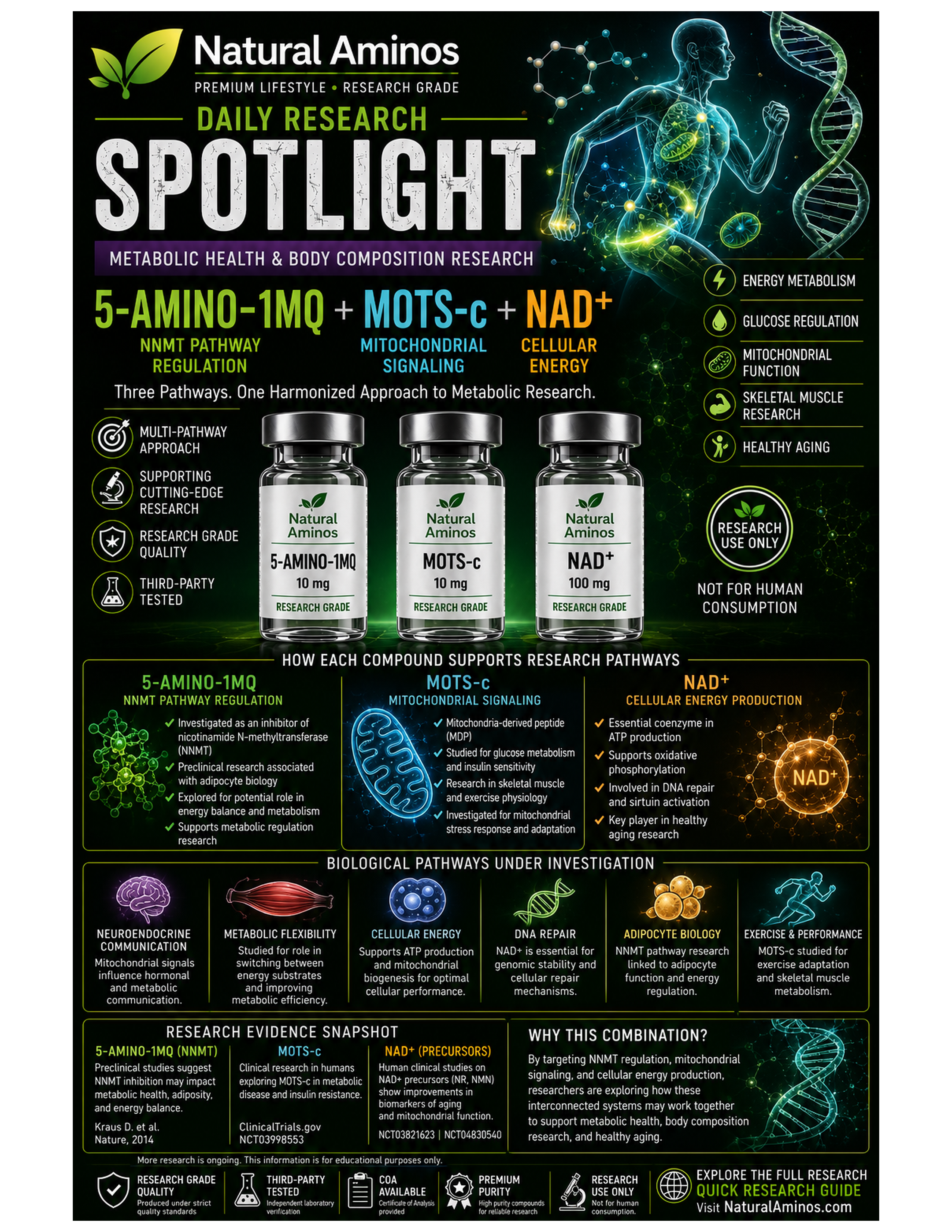
5-Amino-1MQ + MOTS-c + NAD+ Research Data
For laboratory research use only; not for human or veterinary use or consumption. This page provides research information, not personal-use instructions or medical advice.
Natural Aminos Research Stack or Formula of the Day
5-Amino-1MQ + MOTS-c + NAD+
Metabolic Signaling, Mitochondrial Energy & NAD+ Homeostasis Spotlight
Compound Classification & Research Context
This three-part stack combines three different classes of research compounds. 5-Amino-1MQ (5-amino-1-methylquinolinium; 5A1MQ) is a synthetic small-molecule inhibitor of nicotinamide N-methyltransferase (NNMT), not a peptide. MOTS-c is a 16-amino-acid mitochondrial-derived peptide encoded within the mitochondrial 12S rRNA region. NAD+ (nicotinamide adenine dinucleotide) is an endogenous cellular coenzyme required for redox reactions and used as a substrate by signaling enzymes such as sirtuins, PARPs and CD38. That distinction matters because the evidence base, pharmacology and translational stage are different for each member.
The common theme is metabolic homeostasis. 5-Amino-1MQ attempts to reduce diversion of nicotinamide and S-adenosylmethionine through NNMT; MOTS-c acts as a mitochondrial stress signal that can alter one-carbon/purine metabolism and activate AMPK; NAD+ is the redox and signaling currency that connects mitochondrial energy production with DNA repair, stress responses and metabolic regulation. No published study has established that administering all three together produces a beneficial or safe human outcome.
Benefits
5-Amino-1MQ
The proposed metabolic benefit of 5-Amino-1MQ comes from inhibiting NNMT, an enzyme that methylates nicotinamide to form 1-methylnicotinamide while consuming the methyl donor S-adenosylmethionine (SAM). In adipocyte experiments, 5-Amino-1MQ lowered 1-methylnicotinamide and altered intracellular nicotinamide/NAD+-salvage and methionine-cycle metabolites, including increases in NAD+ and SAM under the experimental conditions. The same research program reported suppressed lipogenesis in cultured adipocytes.
In diet-induced obese mice, 5-Amino-1MQ reduced or limited body-weight and fat-mass gain without requiring reduced food intake. The original 2018 work reported lower white-adipose mass, smaller adipocytes and lower plasma cholesterol. A 2024 mouse study extended those findings: once-daily treatment improved oral glucose tolerance and insulin sensitivity, reduced hyperinsulinemia, attenuated hepatic steatosis and macrophage infiltration, lowered liver triglyceride content, and improved several circulating liver/metabolic markers. These are meaningful preclinical findings, but there is still no published human efficacy trial demonstrating weight loss, improved insulin sensitivity or liver benefit from 5-Amino-1MQ.
MOTS-c
MOTS-c is a mitochondrial-derived signaling peptide first reported in 2015. Its best-established experimental pathway involves inhibition of the folate cycle and linked de novo purine synthesis, causing accumulation of AICAR, an endogenous AMP analog that activates AMPK. AMPK is a central cellular energy sensor that increases glucose uptake and fatty-acid oxidation while suppressing energy-intensive anabolic processes when cellular energy is low. MOTS-c also translocates to the nucleus during metabolic stress and influences stress-response gene expression.
In mice, exogenous MOTS-c improved skeletal-muscle insulin sensitivity, prevented high-fat-diet-induced obesity and insulin resistance, and improved age-related physical performance. Later work linked MOTS-c with exercise-responsive signaling, muscle homeostasis and mitochondrial bioenergetic efficiency. Human studies have so far been dominated by measurement of endogenous MOTS-c, exercise responses and mitochondrial genetic variants rather than administration of the peptide itself. As of September 2026, a Phase 2a randomized, double-blind, placebo-controlled trial is underway in adults with prediabetes and overweight/obesity, but no efficacy results have been posted.
NAD+
NAD+ is required for electron transfer in glycolysis, the tricarboxylic-acid cycle and oxidative phosphorylation, making it essential to ATP production. It is also consumed by sirtuins, PARPs and CD38, linking NAD+ availability to stress responses, protein deacetylation, DNA repair, calcium signaling and immune/metabolic regulation. NAD+ levels and NAD-related metabolites change with age and disease, which has driven a large research field attempting to raise NAD+ directly or by supplying precursors such as nicotinamide riboside (NR) and nicotinamide mononucleotide (NMN).
The strongest human finding across NAD+-boosting studies is biochemical target engagement: NR and NMN repeatedly increase blood or cellular NAD-related metabolites and are generally tolerated over short study periods. Clinical outcomes are much less consistent. Some trials report improvements in muscle insulin sensitivity, walking performance, fatigue, vascular or other endpoint-specific measures, while others show little or no functional benefit. A 2026 systematic review concluded that NAD+ augmentation clearly changes biology but that anti-aging and wellness effectiveness remains inconclusive. Direct intravenous NAD+ has far less outcome evidence than NR/NMN; a 2019 Australian pilot principally described NAD+ metabolism during infusion rather than demonstrating a therapeutic benefit.
What the Formulas Are Studied For
5-Amino-1MQ Research Areas
• NNMT inhibition as a strategy for obesity and metabolic-dysfunction research.
• Adipocyte lipogenesis, white-adipose remodeling and body-composition changes in diet-induced obesity models.
• Insulin sensitivity, hyperinsulinemia and glucose tolerance in animal models.
• Hepatic steatosis, liver triglyceride accumulation and obesity-associated liver pathology.
• Nicotinamide salvage, NAD+ homeostasis and SAM-dependent one-carbon metabolism.
MOTS-c Research Areas
• Mitochondrial-to-nuclear stress signaling and metabolic homeostasis.
• AMPK activation through folate/purine/AICAR pathway changes.
• Skeletal-muscle glucose uptake, insulin sensitivity and metabolic flexibility.
• Exercise signaling, physical performance, muscle quality and age-related functional decline.
• Obesity, prediabetes, type 2 diabetes risk, mitochondrial genetics and cardiometabolic disease.
• A current Phase 2a human trial testing insulin-sensitivity and cardiometabolic endpoints in prediabetes with overweight/obesity.
NAD+ Research Areas
• Cellular redox balance and mitochondrial ATP-generating metabolism.
• NAD+-dependent signaling through sirtuins, PARPs and CD38.
• Aging biology, mitochondrial stress and cellular repair.
• Insulin sensitivity, skeletal-muscle metabolism and cardiometabolic health.
• Vascular function, physical performance, fatigue, sleep and cognition in selected human trials.
• Direct NAD+ administration and, more extensively, NAD+-raising strategies using NR and NMN.
Published Research — Worldwide Evidence Review
5-Amino-1MQ & NNMT — United States and Europe
The foundational 2018 U.S. study by Neelakantan and colleagues characterized selective, membrane-permeable NNMT inhibitors and identified 5-Amino-1MQ as a lead compound. In adipocytes, the compound reduced the NNMT product 1-methylnicotinamide and altered NAD+-salvage and methionine-cycle metabolites. In diet-induced obese mice, short-term subcutaneous administration reduced body-weight gain, epididymal fat-pad weight and adipocyte size, and lowered plasma cholesterol without reducing food consumption. This paper remains the main mechanistic foundation for commercial claims around 5-Amino-1MQ.
A 2024 U.S. study in Diabetes, Obesity and Metabolism examined 5A1MQ for 28 days in diet-induced obese mice and added pharmacokinetic and tissue-distribution data. Treatment dose-dependently limited body-weight and fat-mass gain, improved glucose tolerance and insulin sensitivity, reduced hyperinsulinemia, and attenuated fatty-liver pathology. The compound reached adipose, muscle and liver after systemic administration. The same study also reported poor oral bioavailability in mice, an important limitation when extrapolating beyond the studied routes.
Human evidence supports NNMT as a metabolic target but not 5-Amino-1MQ as a human treatment. A German research group reported in 2015 that adipose NNMT expression was approximately twofold higher in people with type 2 diabetes and that NNMT expression and circulating 1-methylnicotinamide correlated with insulin resistance. Exercise and bariatric surgery, both of which improve insulin sensitivity, were associated with lower adipose NNMT expression. This is strong target biology, but it remains observational evidence about human NNMT, not evidence that blocking NNMT with 5-Amino-1MQ is safe or effective in people.
No published Phase 1, Phase 2 or Phase 3 human clinical trial of 5-Amino-1MQ was identified. Human pharmacokinetics, long-term effects on methyl-donor balance, drug interactions and a clinically validated safety window therefore remain unknown.
MOTS-c — United States, Asia, Europe and International Human Data
The 2015 U.S. discovery paper in Cell Metabolism showed that MOTS-c targets skeletal muscle and regulates metabolic homeostasis. In cells, MOTS-c altered the folate-methionine and purine pathways, increased AICAR and activated AMPK. In mice it improved insulin sensitivity and prevented high-fat-diet-induced obesity and insulin resistance. The paper also demonstrated that endogenous MOTS-c is detectable in human plasma, but it did not administer MOTS-c therapeutically to humans.
Human observational work has expanded internationally. A Chinese case-control study of children and adolescents found lower circulating MOTS-c in obese males and correlations with BMI, fasting insulin, HOMA-IR and HbA1c. Other cohorts have reported different directions of association in adults, underscoring that circulating MOTS-c may behave as a context-dependent stress signal rather than a simple 'higher is always better' biomarker. A large study involving East Asian cohorts (including Japanese and other Asian populations) linked an Asian-specific K14Q MOTS-c mitochondrial variant with higher type 2 diabetes prevalence in males, especially at lower physical-activity levels, and experimental work showed reduced insulin-sensitizing activity of the variant.
Exercise studies from Sweden and other European-linked groups show that endogenous mitochondrial-derived peptides can change with acute endurance exercise. A 2021 human study found endurance exercise increased circulating humanin and produced a trend toward higher MOTS-c, while resistance exercise did not produce the same signal. Separate human muscle work reported age-related differences in circulating and skeletal-muscle MOTS-c expression. These studies support physiological relevance but do not prove that administering MOTS-c recreates exercise benefits.
Recent mechanistic work continues to refine the picture. A 2026 study involving investigators in Denmark showed that MOTS-c improves skeletal-muscle mitochondrial bioenergetic efficiency in mouse models through PGC-1α- and AMPK-dependent mechanisms, while human exercise measurements did not support a simple model in which exercising muscle necessarily releases all circulating MOTS-c. A 2026 U.S./China collaborative study in human adipose-derived mesenchymal stromal cells found that MOTS-c activated metabolic signaling but also blunted some reparative functions, illustrating that the peptide's effects can be context-specific rather than uniformly beneficial.
Most importantly for translation, ClinicalTrials.gov now lists a Phase 2a randomized, double-blind, placebo-controlled MOTS-c study in adults with prediabetes and overweight/obesity. The trial began in February 2026, plans approximately 120 participants, and is designed to test insulin sensitivity, HbA1c, fasting glucose, lipids, body weight and waist circumference over 12 weeks. Its primary completion is expected in 2027, so the trial is evidence that MOTS-c has entered formal human testing, not evidence that it works.
NAD+ — Australia, United States, Japan, Hong Kong and Europe
Direct NAD+ administration has surprisingly little clinical-outcome evidence. An Australian-led 2019 pilot study tracked the plasma and urine NAD+ metabolome during a six-hour intravenous NAD+ infusion. It showed that infused NAD+ was rapidly metabolized and altered downstream metabolite handling, but the study was designed as a metabolic/pharmacokinetic investigation rather than a controlled efficacy trial. A 2026 PRISMA-guided systematic review found no eligible clinical-outcome trials of intravenous or intramuscular NAD+ itself for anti-aging or wellness and concluded that direct parenteral NAD+ evidence lags behind the precursor literature.
The human precursor literature is much broader. In a U.S. randomized trial published in Science in 2021, NMN improved skeletal-muscle insulin sensitivity in women with prediabetes, although other metabolic endpoints were not uniformly improved. Japanese randomized trials have reported that 12 weeks of NMN increased blood NAD-related metabolites and produced selected improvements in lower-limb function, walking time, fatigue or sleep-related measures, while another placebo-controlled study in older diabetic men found no significant benefit for grip strength or walking speed. These mixed results are representative of the field.
Systematic reviews from Hong Kong and other Asian research groups have concluded that NMN reliably increases NAD-related metabolites but has inconsistent effects on glucose and lipid outcomes. A 2025 Nature Metabolism review from Amsterdam and collaborating European centers similarly emphasized that NAD+ precursors show robust target engagement but that clinical benefits remain variable, population- and endpoint-specific, and generally smaller than the effects suggested by animal studies.
A newer 2026 randomized Phase 0/1b study of a modified oral NAD+ formulation in healthy adults aged 45-75 reported increases in whole-blood intracellular NAD and changes in NAD-related metabolic flux over five days. Because the formulation is proprietary, the study was short and clinical-health outcomes were not the main endpoint, it should be viewed as evidence that oral delivery technology can achieve target engagement rather than proof of anti-aging or metabolic efficacy.
The geographic search did not identify a completed Russian or Middle Eastern human intervention trial specifically administering 5-Amino-1MQ or MOTS-c that materially changes the evidence hierarchy above. Research from those regions contributes to the broader NAD+/metabolic literature, but the decisive compound-specific evidence remains concentrated in the United States, East Asia, Europe and Australia.
Direct Research on 5-Amino-1MQ + MOTS-c + NAD+ Together
No peer-reviewed animal or human study was identified that administered 5-Amino-1MQ, MOTS-c and NAD+ together as a three-part intervention. No controlled study was found for the pair 5-Amino-1MQ + MOTS-c, and no published clinical trial was found testing 5-Amino-1MQ with direct NAD+ administration. Publications and commercial pages may discuss these compounds together because their mechanisms converge on metabolic energy biology, but that is not the same as direct experimental evidence.
Therefore, the combined stack must be evaluated as a mechanistic hypothesis assembled from three separate research literatures. Any claim of synergy, superior fat loss, greater energy, improved longevity or enhanced insulin sensitivity from the complete stack would currently exceed the published evidence.
Theory of the Stack — How the Combination Could Work
1. Preserve Nicotinamide and Methyl-Donor Capacity — 5-Amino-1MQ
NNMT methylates nicotinamide using SAM. Inhibiting NNMT could theoretically leave more nicotinamide available for salvage back toward NAD+ while reducing one route of SAM consumption. In the original adipocyte experiments, 5-Amino-1MQ increased intracellular NAD+ and SAM under the tested conditions. The proposed first layer of the stack is therefore conservation: reduce a metabolic drain that may be upregulated in insulin-resistant adipose tissue.
2. Trigger Cellular Energy-Sensing and Metabolic Flexibility — MOTS-c
MOTS-c acts very differently. Its established experimental model disrupts folate-linked de novo purine synthesis enough to increase AICAR, which activates AMPK. AMPK then shifts the cell toward energy-producing processes such as glucose uptake and fatty-acid oxidation and away from energy-consuming synthesis. MOTS-c also influences nuclear stress-response programs and, in newer work, mitochondrial bioenergetic efficiency. This creates an 'energy demand/sensing' layer rather than simply adding another NAD+ source.
3. Expand or Support the NAD+ Redox Pool — NAD+
NAD+ provides the cofactor required to move reducing equivalents through central energy metabolism and also feeds NAD+-consuming signaling enzymes. In theory, raising NAD+ availability could support the redox and signaling work demanded by an AMPK-driven shift toward greater metabolic activity. Human precursor trials demonstrate that the NAD pool can be manipulated, although direct NAD+ delivery is less well characterized and does not guarantee that intact extracellular NAD+ enters target cells in a predictable fashion.
4. Where the Three Pathways Could Complement One Another
The most coherent theoretical sequence is: 5-Amino-1MQ reduces NNMT-mediated diversion of nicotinamide and SAM; NAD+ supplementation or NAD-raising strategies increase the available redox/signaling pool; MOTS-c activates AMPK and stress-adaptation programs that determine how cells use fuel. If all three effects occurred together as predicted, the stack could theoretically support greater metabolic flexibility, improved insulin-responsive glucose handling, reduced lipogenic pressure, improved fatty-acid oxidation and more efficient mitochondrial energy production. The pathways are different enough that the stack is not simply redundant.
5. The Important Overlap — One-Carbon Metabolism
The same biology that makes the combination interesting also creates its biggest uncertainty. 5-Amino-1MQ can preserve SAM by blocking an NNMT methylation reaction. MOTS-c, by contrast, alters the folate-methionine one-carbon network and de novo purine synthesis to raise AICAR. These are not independent pathways. They intersect around methyl-group availability, purine synthesis and cellular nutrient sensing. There is no published experiment showing what happens to SAM, SAH, homocysteine, folate intermediates, AICAR or global methylation when 5-Amino-1MQ and MOTS-c are used together.
6. NAD+ / AMPK / Sirtuin Crosstalk — Potentially Helpful, Not Automatically Additive
AMPK and NAD+-dependent sirtuin pathways frequently reinforce one another in exercise and fasting biology. AMPK can promote oxidative metabolism, while higher NAD+ availability can support sirtuin activity and mitochondrial stress adaptation. This provides a plausible reason for MOTS-c and NAD+ augmentation to be complementary. However, cellular energy networks are governed by feedback loops; activating the same adaptation network from several directions does not guarantee a larger beneficial effect. Once a pathway is saturated, additional stimulation can be neutral, and in some contexts metabolic stress signaling can impair proliferation or reparative function.
Possible Overall Benefit — Theoretical, Not Proven
The most defensible theory for the complete stack is a multi-layer metabolic strategy: 5-Amino-1MQ attempts to reduce an NNMT-related metabolic drain and lipogenic signal; MOTS-c attempts to shift cellular energy sensing toward AMPK-driven glucose use, fatty-acid oxidation and stress adaptation; NAD+ supplies or supports the redox/signaling pool required for mitochondrial metabolism and NAD+-dependent repair pathways. In theory, the combined result could be better metabolic flexibility rather than a single narrow effect.
For body-composition research, the theoretical advantage would be reduced adipocyte lipogenesis from NNMT inhibition combined with a greater tendency toward fuel oxidation from AMPK activation. For insulin-resistance research, the theoretical advantage would be improved skeletal-muscle glucose handling from MOTS-c alongside preservation or expansion of NAD-related metabolic capacity. For healthy-aging research, the theory adds mitochondrial stress signaling and NAD-dependent repair pathways to the same model.
The theory is reasonably strong at the pathway level but much weaker at the intervention level. The 5-Amino-1MQ effect has not been shown in humans; the MOTS-c human treatment trial has begun but has no results; and direct NAD+ outcome evidence is thin compared with NR/NMN. The complete stack therefore cannot be called clinically beneficial, safe, synergistic or superior to any single component on current evidence.
Why More Research Is Needed
• 5-Amino-1MQ has no published human safety, pharmacokinetic or efficacy trial. Its strongest evidence remains cell and mouse research.
• MOTS-c has entered formal Phase 2a human testing, but the trial is ongoing and no treatment results are available as of September 2026.
• Direct NAD+ administration has much less controlled outcome evidence than NAD+ precursor supplementation. Evidence from NR/NMN cannot be assumed to equal direct NAD+ injection or infusion.
• No published study has tested the complete 5-Amino-1MQ + MOTS-c + NAD+ stack, so synergy, antagonism, sequencing, exposure and interaction risk are unknown.
• 5-Amino-1MQ and MOTS-c both alter one-carbon metabolism from different directions. Their combined effect on SAM/SAH balance, homocysteine, folate intermediates, purine synthesis and methylation has not been mapped.
• MOTS-c biology is context-dependent. Human circulating levels vary by disease, age, sex and population, and newer cell work shows that metabolic activation can coexist with reduced reparative behavior in some human stromal-cell models.
• NAD+-boosting human trials show strong biochemical target engagement but inconsistent clinical outcomes; raising NAD+ does not automatically translate into better metabolic or functional performance.
• Long-term data are absent for the stack. Short-term changes in weight, glucose, NAD-related metabolites or mitochondrial signaling would not establish durable benefit, long-term safety or healthy-aging effects.
• Independent replication is uneven. 5-Amino-1MQ compound-specific research remains concentrated in a relatively small U.S. development network, while MOTS-c and NAD+ have broader international replication but still substantial unanswered translational questions.
Research Summary
5-Amino-1MQ + MOTS-c + NAD+ is one of the more mechanistically coherent metabolic stacks because the three components are not merely duplicates. 5-Amino-1MQ targets NNMT and the handling of nicotinamide/SAM; MOTS-c is a mitochondrial stress peptide that can increase AICAR and activate AMPK; NAD+ is the redox and signaling coenzyme that supports central metabolism and NAD-dependent stress-response pathways. That creates a plausible three-layer model of conserving metabolic resources, activating fuel-use signaling and supporting the cellular redox pool.
The evidence hierarchy is uneven. 5-Amino-1MQ has strong mechanistic mouse data but no human trials. MOTS-c has extensive preclinical and human observational biology and has now entered a Phase 2a human trial, but no treatment results are available. NAD+ augmentation has the largest human evidence base, yet most of it comes from NR and NMN rather than direct NAD+ administration, and clinical outcomes are mixed. The stack is therefore scientifically interesting and biologically plausible, but it remains a research hypothesis rather than an evidence-backed combined intervention.
Selected Sources
• Neelakantan H, et al. Selective and membrane-permeable small molecule inhibitors of nicotinamide N-methyltransferase reverse high fat diet-induced obesity in mice. Biochemical Pharmacology. 2018;147:141-152. PMID: 29155147. DOI: 10.1016/j.bcp.2017.11.007.
• Babula JJ, Bui D, Stevenson HL, Watowich SJ, Neelakantan H. Nicotinamide N-methyltransferase inhibition mitigates obesity-related metabolic dysfunction. Diabetes, Obesity and Metabolism. 2024;26(11):5272-5282. PMID: 39161060. DOI: 10.1111/dom.15879.
• Kannt A, et al. Association of nicotinamide-N-methyltransferase mRNA expression in human adipose tissue and plasma 1-methylnicotinamide with insulin resistance. Diabetologia. 2015;58(4):799-808. PMID: 25596852. DOI: 10.1007/s00125-014-3490-7.
• Lee C, et al. The mitochondrial-derived peptide MOTS-c promotes metabolic homeostasis and reduces obesity and insulin resistance. Cell Metabolism. 2015;21(3):443-454. PMID: 25738459. DOI: 10.1016/j.cmet.2015.02.009.
• Reynolds JC, et al. MOTS-c is an exercise-induced mitochondrial-encoded regulator of age-dependent physical decline and muscle homeostasis. Nature Communications. 2021;12:470. PMID: 33469015. DOI: 10.1038/s41467-020-20790-0.
• D'Souza RF, et al. Increased expression of the mitochondrial derived peptide MOTS-c in skeletal muscle of healthy aging men is associated with myofiber composition. Aging. 2020;12(6):5244-5258. PMID: 32182209. DOI: 10.18632/aging.102944.
• Acute endurance exercise stimulates circulating levels of mitochondrial-derived peptides in humans. American Journal of Physiology-Endocrinology and Metabolism. 2021. PMID: 34351816.
• Circulating MOTS-c levels are decreased in obese male children and adolescents and associated with insulin resistance. Pediatric Diabetes. 2018. PMID: 29691953. DOI: 10.1111/pedi.12685.
• Fuku N, et al./multi-cohort investigators. A pro-diabetogenic mtDNA polymorphism in the mitochondrial-derived peptide MOTS-c. Aging. 2021. PMID: 33468709.
• MOTS-c improves intrinsic muscle mitochondrial bioenergetic health and efficiency in a PGC-1alpha/AMPK-dependent manner. 2026. PMID: 41520850.
• Xing L, et al. Mitochondrial-derived peptide MOTS-c activates metabolic signaling but blunts reparative function in human mesenchymal stromal cells. Inflammation and Regeneration. 2026. PMID: 42324588. DOI: 10.1186/s41232-026-00431-7.
• ClinicalTrials.gov NCT07505745. Phase 2a randomized, double-blind, placebo-controlled study of MOTS-c for insulin sensitivity in adults with prediabetes and overweight/obesity. Study started February 2026; results not yet posted as of September 2026.
• Grant R, et al. A Pilot Study Investigating Changes in the Human Plasma and Urine NAD+ Metabolome During a 6 Hour Intravenous Infusion of NAD. Frontiers in Aging Neuroscience. 2019;11:257. PMID: 31572171. DOI: 10.3389/fnagi.2019.00257.
• Yoshino M, et al. Nicotinamide mononucleotide increases muscle insulin sensitivity in prediabetic women. Science. 2021;372(6547):1224-1229. PMID: 33888596. DOI: 10.1126/science.abe9985.
• Kim M, et al. Effect of 12-Week Intake of Nicotinamide Mononucleotide on Sleep Quality, Fatigue, and Physical Performance in Older Japanese Adults. Nutrients. 2022;14(4):755. PMID: 35215405. DOI: 10.3390/nu14040755.
• Effects of nicotinamide mononucleotide on older patients with diabetes and impaired physical performance: prospective placebo-controlled double-blind study. Geriatrics & Gerontology International. 2022. PMID: 36443648.
• Chen F, et al. Effects of Nicotinamide Mononucleotide on Glucose and Lipid Metabolism in Adults: Systematic Review and Meta-analysis of Randomised Controlled Trials. Current Diabetes Reports. 2024/2025. PMID: 39531138.
• Zhang J, Poon ETC, Wong SHS. Efficacy of oral nicotinamide mononucleotide supplementation on glucose and lipid metabolism for adults: systematic review with meta-analysis. Critical Reviews in Food Science and Nutrition. 2025. PMID: 39116016.
• Vinten KT, et al. NAD+ precursor supplementation in human ageing: clinical evidence and challenges. Nature Metabolism. 2025;7(10):1974-1990. PMID: 41083806. DOI: 10.1038/s42255-025-01387-7.
• Gallagher C, Emmanuel OO. NAD+ supplementation for anti-aging and wellness: A PRISMA-guided systematic review of preclinical and clinical evidence. Ageing Research Reviews. 2026. PMID: 41655607. DOI: 10.1016/j.arr.2026.103057.
• Kornilov SA, et al. Oral LNAD+ rapidly elevates whole blood intracellular NAD and metabolic flux without elevating plasma NAD: evidence from a randomized controlled trial. Geroscience. 2026. PMID: 42530810. DOI: 10.1007/s11357-026-02399-1.
Theory vs. Proof — Verdict
What is supported by evidence: NNMT is associated with human insulin resistance, and 5-Amino-1MQ produces metabolic and liver benefits in obese mice; MOTS-c has a well-characterized AMPK/AICAR mechanism, improves metabolic and physical outcomes in animal models, responds to exercise in humans and is now being formally tested in a Phase 2a trial; NAD+ augmentation reliably changes NAD-related biomarkers in humans and sometimes improves selected metabolic or functional endpoints.
What is not proven: that 5-Amino-1MQ is safe or effective in humans; that exogenous MOTS-c improves insulin sensitivity, body composition or exercise performance in humans; that direct NAD+ administration produces the same benefits reported in some NR/NMN studies; or that the three compounds together create an additive or synergistic effect.
Verdict — theory vs. proof: the mechanistic theory is moderately strong and largely complementary, but not cleanly independent. The strongest positive argument is that the stack addresses three connected layers of metabolism: NNMT/nicotinamide conservation, AMPK-driven fuel sensing, and NAD+-dependent redox/signaling capacity. The main caution is that 5-Amino-1MQ and MOTS-c both alter one-carbon metabolism, creating an untested biochemical interaction around SAM, folate, purine synthesis and methylation. Overall, this is a plausible and sophisticated metabolic research hypothesis, but the practical proof for the full stack is weak: one component is preclinical only, one is just entering human treatment trials, and the third has human evidence that is strongest for precursors rather than direct NAD+ itself. The stack should therefore be described as theoretically favorable but experimentally unvalidated, not as a proven metabolic or healthy-aging combination.
Research & Educational Use Only !!