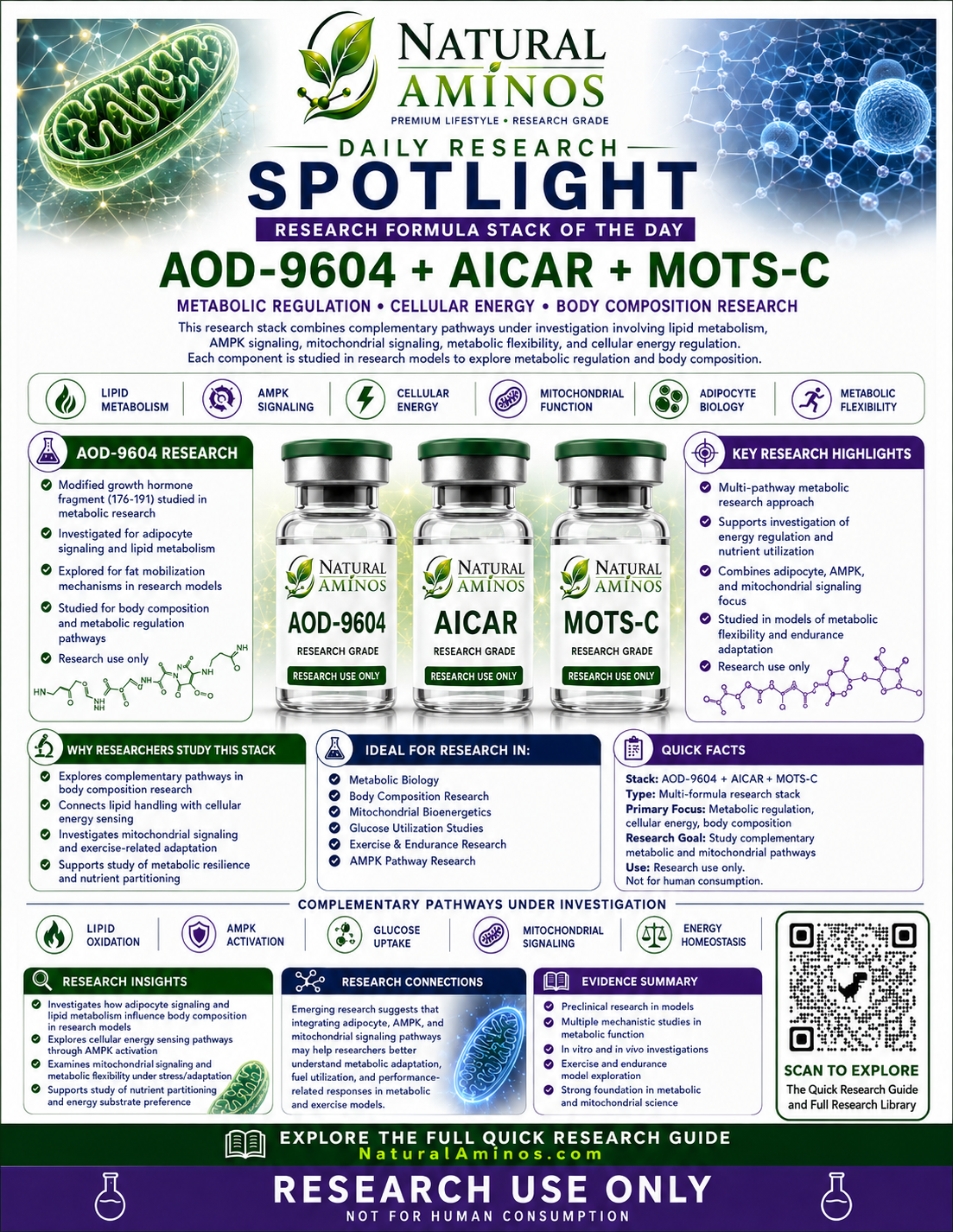
AOD-9604 + AICAR + MOTS-c Research Data
For laboratory research use only; not for human or veterinary use or consumption. This page provides research information, not personal-use instructions or medical advice.
Natural Aminos Research Stack or Formula of the Day
AOD-9604 + AICAR + MOTS-c
Lipolysis, AMPK Signaling & Mitochondrial Metabolic Research Spotlight
Compound Classification & Research Context
This stack combines three metabolically focused research compounds that operate at different biological levels. AOD-9604 is a synthetic C-terminal fragment of human growth hormone designed to preserve the lipolytic portion of the hormone without reproducing full growth-hormone receptor signaling. AICAR (also called acadesine or 5-aminoimidazole-4-carboxamide ribonucleoside) is a purine-pathway intermediate/prodrug that is converted intracellularly to ZMP, an AMP mimic widely used to probe AMP-activated protein kinase (AMPK) and related metabolic pathways. MOTS-c is a 16-amino-acid mitochondrial-derived peptide encoded within mitochondrial DNA that regulates metabolic stress signaling through the folate-purine pathway, AICAR accumulation and AMPK-related mechanisms.
The common theme is fuel mobilization and metabolic flexibility, but the evidence is not evenly distributed. AOD-9604 has older animal studies and a completed human obesity-development program whose larger trial did not meet its weight-loss endpoint. AICAR has direct human metabolic studies and a large multinational cardiovascular trial, although it is not an established chronic metabolic therapy. MOTS-c has extensive animal and human observational biology and, as of September 2026, an ongoing Phase 2a treatment trial in prediabetes and overweight/obesity with no results yet posted.
Benefits
AOD-9604
AOD-9604 was developed from the C-terminal lipolytic region of human growth hormone. In obese rodent models, the peptide increased lipolysis and fat oxidation, reduced lipogenesis and limited body-weight or fat gain. Unlike full-length growth hormone in the same experimental literature, AOD-9604 did not reproduce the same hyperglycemic or insulin-resistance effects and did not appear to act through the classical growth-hormone receptor. Animal work also linked part of its chronic lipolytic response to increased beta-3 adrenergic receptor expression and signaling in adipose tissue.
The human story is much less favorable for efficacy. AOD-9604 progressed through several randomized, placebo-controlled obesity studies in Australia, and a pooled safety publication described six controlled trials. However, FDA's 2024 review of the program concluded that most identified studies did not show a weight-reduction benefit over placebo. The larger 24-week OPTIONS study enrolled 536 adults with obesity and did not achieve a statistically significant weight-loss difference at the primary endpoint; commercial development for obesity was terminated. This makes AOD-9604 unusual among research peptides: it has meaningful human exposure data, but the principal intended efficacy signal did not hold up in the larger obesity program.
A separate South Korean rabbit osteoarthritis study reported improved cartilage morphology and shorter lameness with intra-articular AOD-9604, especially when combined with hyaluronic acid. That is a distinct preclinical research line and should not be interpreted as human joint-repair evidence.
AICAR
AICAR enters cells and is phosphorylated to ZMP, which mimics AMP and can activate AMPK while also exerting AMPK-independent effects. AMPK is a central energy sensor that favors ATP-generating pathways such as glucose uptake and fatty-acid oxidation and suppresses energy-consuming synthesis when cellular energy is low. In obesity and insulin-resistance models, AICAR improves glucose handling, reduces ectopic lipid accumulation and can increase skeletal-muscle glucose uptake.
Unlike many experimental metabolic compounds, AICAR has been administered directly to people. A 2007 United Kingdom study in healthy men found that AICAR acutely increased skeletal-muscle glucose uptake by about twofold and produced a small increase in whole-body glucose disposal. A later study in older men and men with type 2 diabetes also showed increased skeletal-muscle glucose uptake, although the response was blunted with age. These studies establish real human metabolic activity, but they were acute infusion experiments rather than long-term body-composition trials.
AICAR/acadesine also underwent much larger cardiovascular testing as an adenosine-regulating agent during coronary artery bypass grafting. The international RED-CABG randomized trial enrolled 3,080 participants at 300 sites in seven countries before being stopped for futility; acadesine did not reduce the composite of death, stroke or severe left-ventricular dysfunction. That negative trial does not erase AICAR's biochemical activity, but it demonstrates that pathway activation does not automatically translate into a successful clinical outcome.
MOTS-c
MOTS-c is a mitochondrial-derived signaling peptide first characterized in 2015. Its best-defined experimental mechanism is inhibition of the folate cycle and linked de novo purine synthesis, which increases intracellular AICAR and activates AMPK-related metabolic signaling. In mice, MOTS-c improved insulin sensitivity, protected against diet-induced obesity and insulin resistance, and later studies linked it to exercise adaptation, physical performance and skeletal-muscle mitochondrial efficiency.
Human research has primarily measured endogenous MOTS-c rather than administering it. Studies in China, Japan and other populations have linked circulating MOTS-c levels or MOTS-c genetic variation to obesity, insulin resistance, type 2 diabetes risk, vascular function and physical activity, although the direction of circulating associations is not consistent across all cohorts. A 2026 Denmark-led study strengthened the mechanistic case by showing improved skeletal-muscle mitochondrial bioenergetic efficiency in mouse models through PGC-1alpha- and AMPK-dependent mechanisms.
Most importantly for translation, MOTS-c has now entered a Phase 2a randomized, double-blind, placebo-controlled human study in adults with prediabetes and overweight/obesity. The trial began in February 2026, targets approximately 120 participants and evaluates insulin sensitivity and standard cardiometabolic markers over 12 weeks. No efficacy results are yet available.
What the Formulas Are Studied For
AOD-9604 Research Areas
• Adipose lipolysis, fatty-acid oxidation and suppression of lipogenesis in obesity models.
• Weight and body-fat outcomes in animal models and older human obesity trials.
• Separation of growth-hormone lipolytic effects from classical growth-hormone receptor/IGF-1 signaling.
• Beta-3 adrenergic receptor expression and adipose lipolytic sensitivity.
• Cartilage and osteoarthritis repair in a rabbit intra-articular model, with no established human cartilage efficacy.
AICAR Research Areas
• AMPK and cellular energy-sensing biology.
• Skeletal-muscle glucose uptake and metabolic flexibility.
• Insulin resistance, hepatic glucose output and ectopic lipid accumulation in animal models.
• Exercise-mimetic signaling and substrate oxidation research.
• Adenosine regulation and ischemia/reperfusion protection in cardiovascular clinical trials.
• Inflammatory signaling in adipose tissue and skeletal muscle.
MOTS-c Research Areas
• Mitochondrial-to-nuclear metabolic stress signaling.
• Folate/purine pathway regulation, endogenous AICAR generation and AMPK-related signaling.
• Skeletal-muscle insulin sensitivity and glucose utilization.
• Obesity, prediabetes, type 2 diabetes risk and metabolic homeostasis.
• Exercise adaptation, physical performance, aging-related muscle decline and mitochondrial efficiency.
• Current Phase 2a evaluation of insulin sensitivity and cardiometabolic outcomes in adults with prediabetes and overweight/obesity.
Published Research — Worldwide Evidence Review
AOD-9604 — Australia, United States Review & South Korea
AOD-9604's foundational metabolic work came from Monash University in Australia. A 2000 study in obese Zucker rats reported reduced body-weight gain and increased adipose lipolytic activity, while insulin sensitivity was not impaired as it was with intact growth hormone. A 2001 mouse study found reduced weight gain, increased fat oxidation and increased plasma glycerol, with no evidence that AOD-9604 acted through the classical growth-hormone receptor. Another 2001 study connected the chronic lipolytic effect with beta-3 adrenergic receptor expression.
Human development also occurred largely in Australia. A 2013 publication pooled safety observations from six randomized, double-blind, placebo-controlled AOD-9604 trials and reported no meaningful IGF-1 elevation, no consistent impairment of carbohydrate metabolism and no clear immunogenicity signal. However, the pooled paper was primarily a safety report and did not establish obesity efficacy.
FDA revisited the evidence in 2024 while evaluating AOD-9604 for compounding. FDA summarized several early obesity studies as failing to show statistically significant weight loss compared with placebo and highlighted the larger OPTIONS program: 536 adults were enrolled, 502 randomized, and oral AOD-9604 was compared with placebo alongside supervised diet and exercise for 24 weeks. The trial did not show a statistically significant difference in the primary weight-loss endpoint, and the developer ended the obesity program. FDA also noted that the available efficacy information was often limited to summaries, conference material and company disclosures rather than full peer-reviewed trial reports.
A distinct 2015 South Korean rabbit study examined intra-articular AOD-9604 in collagenase-induced knee osteoarthritis. Animals receiving AOD-9604, hyaluronic acid or both had better cartilage morphology than saline controls, with the combination arm performing best. This is credible animal evidence for a cartilage hypothesis, but FDA reported finding no human clinical study supporting osteoarthritis or osteoporosis use.
AICAR — United Kingdom, North America & Multinational Clinical Evidence
AICAR has one of the strongest direct-human evidence bases of the three compounds, although the evidence is not for long-term fat loss. In a 2007 study conducted in the United Kingdom, 29 healthy men received AICAR during controlled metabolic testing. Skeletal-muscle 2-deoxyglucose uptake increased roughly twofold, while whole-body glucose disposal rose modestly. Interestingly, the human effect was not accompanied by the expected measurable increase in muscle AMPK activity under the tested conditions, emphasizing that AICAR has biologic actions beyond a simple “AMPK switch.”
A follow-up study compared healthy young men, older men and older men with type 2 diabetes. AICAR increased skeletal-muscle glucose uptake in all groups, with a smaller response in older participants. Human cell work also shows that AICAR can reduce inflammatory cytokine production in adipose tissue and skeletal-muscle cells. These results support metabolic and anti-inflammatory pathway activity but do not establish chronic weight-loss, endurance or body-composition benefit.
The largest clinical experience came from cardiovascular medicine. Earlier CABG studies suggested possible reductions in selected ischemic outcomes, but the definitive RED-CABG trial tested acadesine in intermediate- to high-risk bypass patients at 300 sites in seven countries. The study was stopped after 3,080 participants because a prespecified futility analysis showed little likelihood of success. The primary composite endpoint occurred at essentially the same rate with acadesine and placebo. This is an important counterweight to mechanistic enthusiasm: AICAR/acadesine is unquestionably bioactive in humans, but large-scale clinical benefit has not been demonstrated for its best-tested cardiovascular indication.
Reviews also note practical and biologic limitations for chronic metabolic use, including poor oral bioavailability, a short half-life, requirement for intravenous administration in the major human studies, variable effectiveness, and reported risks such as bradycardia or hypoglycemia in clinical contexts. These factors help explain why AICAR became an important research tool rather than a routine metabolic drug.
MOTS-c — United States, China, Japan, Denmark & International Cohorts
The 2015 U.S. discovery paper established MOTS-c as a mitochondrial-derived peptide that regulates insulin sensitivity and metabolic homeostasis. In cells, MOTS-c inhibited folate-linked de novo purine synthesis, increased AICAR and activated AMPK-related signaling; in mice it prevented diet-induced obesity and age- or diet-associated insulin resistance. The work provided the key connection between MOTS-c and AICAR that is directly relevant to this stack.
Human observational evidence is geographically broad. A 2018 Chinese study found lower circulating MOTS-c in obese male children and adolescents and correlations with insulin resistance markers. Other adult studies have reported neutral or even higher circulating levels in obesity, including a 2026 cohort in which elevated MOTS-c tracked with BMI and insulin resistance. This inconsistency suggests that circulating MOTS-c may function partly as a compensatory stress signal rather than a simple deficiency marker.
A large East Asian genetic analysis across three cohorts totaling more than 27,000 participants found that an Asian-specific MOTS-c K14Q mitochondrial variant was associated with higher type 2 diabetes prevalence in men, especially at lower physical-activity levels. Experimental testing found that the variant had weaker insulin-sensitizing activity than reference MOTS-c. This provides a rare bridge between human genetics, population epidemiology and functional peptide biology.
Exercise and aging studies in North America, Europe and Australasia have linked endogenous MOTS-c with physical activity and muscle homeostasis. A 2026 Denmark-led mechanistic study showed that exogenous MOTS-c improved skeletal-muscle mitochondrial efficiency and reduced oxidative-stress measures in mice through PGC-1alpha- and AMPK-dependent mechanisms. The same paper found no clear arterio-venous evidence that exercising human skeletal muscle was the source of circulating MOTS-c, illustrating how much remains unresolved about human physiology.
The first major prospective treatment test is now underway in the United States: ClinicalTrials.gov lists a Phase 2a randomized, double-blind, placebo-controlled study of approximately 120 adults with prediabetes and overweight/obesity. The trial began in February 2026 and is designed to test insulin sensitivity, HbA1c, fasting glucose, lipids, body weight, waist circumference and safety. Primary completion is expected in 2027, so there are no efficacy results to interpret yet.
Direct Research on AOD-9604 + AICAR + MOTS-c Together
No peer-reviewed animal or human study was identified that administered AOD-9604, AICAR and MOTS-c together as a three-part intervention. No controlled study was identified for AOD-9604 plus AICAR, and no controlled study was identified for AOD-9604 plus exogenous MOTS-c. The direct mechanistic relationship between MOTS-c and AICAR is real—MOTS-c can raise endogenous AICAR as part of its folate/purine mechanism—but that does not constitute evidence that externally administering both is more effective than either alone.
Therefore, the stack must be interpreted as a theory assembled from separate literatures. Any claim that the three compounds are synergistic for fat loss, insulin sensitivity, exercise performance or longevity would currently go beyond the published evidence.
Theory of the Stack — How the Combination Could Work
1. Mobilize Stored Lipid — AOD-9604 Layer
The theoretical role of AOD-9604 is the adipose-mobilization layer. Rodent studies suggest increased lipolysis and fatty-acid oxidation with reduced lipogenesis and enhanced lipolytic sensitivity. If that biology translated meaningfully to the route and context being studied, AOD-9604 could increase the supply of fatty acids released from adipose tissue without relying on the anabolic growth-hormone/IGF-1 pathway.
2. Increase Cellular Fuel Demand and Glucose Uptake — AICAR Layer
AICAR provides the clearest direct energy-sensing signal in the stack. Once converted to ZMP, it mimics AMP and can drive AMPK-related metabolic responses while also acting through AMPK-independent pathways. Human infusion studies show that AICAR can acutely increase skeletal-muscle glucose uptake. In theory, this creates a downstream “use the fuel” signal that could complement an adipose “release the fuel” signal from AOD-9604.
3. Coordinate Mitochondrial Stress Adaptation — MOTS-c Layer
MOTS-c adds a broader mitochondrial stress-response program. Rather than acting only as an AMPK agonist, it changes folate/purine metabolism, promotes endogenous AICAR accumulation, influences nuclear stress-response programs and can improve mitochondrial bioenergetic efficiency in animal muscle. In theory, this could help coordinate how muscle handles glucose and fatty acids when substrate availability and cellular energy demand are changing.
4. Where AOD-9604 and the AMPK Arm Could Be Complementary
The strongest part of the stack theory is the separation between adipose mobilization and muscle/mitochondrial fuel use. AOD-9604 is proposed to increase fat mobilization from adipose stores, while AICAR/MOTS-c signaling is proposed to increase cellular energy sensing, glucose uptake and oxidative metabolism. That is a more coherent rationale than simply combining three compounds described as “fat burners.” It attempts to pair substrate release with substrate utilization.
5. Where AICAR and MOTS-c Are Partly Redundant
The biggest weakness in the theory is that AICAR and MOTS-c are not fully independent. The original MOTS-c mechanism specifically involves accumulation of endogenous AICAR and downstream AMPK activation. Adding external AICAR on top of MOTS-c could therefore duplicate part of the same pathway rather than provide a separate metabolic layer. If the AICAR/AMPK signal is already near saturation, extra stimulation may add little. If pathway intensity or timing matters, simultaneous stimulation could also produce effects that are different from the natural pulsatile stress response.
6. Why the Overlap Is Not Complete
The overlap does not make the combination automatically pointless. Human AICAR studies show metabolic effects even when measurable AMPK activation is not obvious, indicating meaningful AMPK-independent signaling. MOTS-c also has nuclear, mitochondrial and stress-adaptation effects that extend beyond simply creating AICAR. The plausible theory is therefore partial redundancy with some complementary biology—not two identical compounds, but also not two fully separate mechanisms.
7. Potential Interaction with AOD-9604 Fat Mobilization
If AOD-9604 increases circulating fatty-acid availability while AICAR/MOTS-c shifts muscle toward greater oxidative metabolism, the combined system could theoretically improve fat utilization rather than merely releasing fat from storage. However, mobilizing more fatty acid is beneficial only if tissues can oxidize or safely re-esterify it. In metabolic disease, excess circulating free fatty acids can worsen ectopic lipid deposition and insulin resistance. The stack theory therefore depends on the oxidative side of the system keeping pace with substrate release—something no combination study has measured.
Possible Overall Benefit — Theoretical, Not Proven
The most defensible theoretical benefit is improved metabolic flexibility through three linked steps: AOD-9604 may increase adipose lipolysis and decrease lipogenic pressure; AICAR may increase acute skeletal-muscle glucose uptake and energy-sensing pathways; MOTS-c may coordinate mitochondrial and cellular stress responses while promoting insulin-sensitive fuel use. If those effects translated together, the stack could theoretically favor greater movement of stored lipid into oxidation, better glucose handling and improved mitochondrial efficiency.
For body-composition research, the hypothesized advantage is that AOD-9604 addresses fat mobilization while AICAR/MOTS-c address fuel utilization. For insulin-resistance research, the hypothesized advantage is increased muscle glucose uptake plus improved mitochondrial metabolic signaling. For exercise or metabolic-aging research, MOTS-c contributes stress-adaptation biology that AOD-9604 does not provide.
The theoretical benefit is moderated by two major facts. First, AOD-9604 failed to produce convincing weight-loss efficacy in its larger human obesity program. Second, AICAR and MOTS-c share the AICAR/AMPK axis, making that part of the stack partly redundant and potentially subject to saturation or feedback. The combination is therefore mechanistically interesting, but the evidence does not justify assuming that three compounds will outperform one or two.
Why More Research Is Needed
• AOD-9604 has human exposure and safety data, but its larger obesity trial did not demonstrate a statistically significant primary weight-loss benefit. Modern route-specific efficacy studies are lacking.
• The AOD-9604 human obesity program largely used oral or intravenous administration, while many contemporary research discussions involve other routes. Evidence cannot automatically be transferred across routes.
• AICAR clearly alters human metabolism acutely, but chronic body-composition and metabolic-disease benefits have not been established, and the large RED-CABG cardiovascular trial was negative.
• AICAR is not a selective AMPK-only tool. Human and laboratory studies demonstrate AMPK-independent actions, so stack predictions based solely on “more AMPK” are incomplete.
• MOTS-c has strong animal and human observational biology, but controlled treatment data in humans are still pending from the ongoing Phase 2a trial.
• AICAR and MOTS-c overlap mechanistically because MOTS-c can promote endogenous AICAR accumulation. No study has established whether external AICAR adds to, saturates or interferes with MOTS-c signaling.
• No published study has tested the complete AOD-9604 + AICAR + MOTS-c stack, so synergy, antagonism, sequencing, exposure and interaction risk are unknown.
• No combination study has measured whether increased adipose fatty-acid release is matched by increased muscle oxidation, an important question because excess circulating fatty acids can be metabolically harmful when oxidation does not keep pace.
• Long-term safety is not established for the stack. Acute pathway activation and short-term metabolic markers cannot establish durable benefit, healthy-aging effects or chronic safety.
• Geographic evidence is broad but fragmented: AOD-9604 development was centered in Australia, AICAR human metabolic work included the United Kingdom and multinational cardiac trials, and MOTS-c research spans the United States, China, Japan, Denmark and other cohorts. No international program has tested the three together.
Research Summary
AOD-9604 + AICAR + MOTS-c is a metabolically coherent but evidence-uneven stack. AOD-9604 supplies a proposed adipose lipolysis/fat-oxidation component, AICAR supplies a direct cellular energy-sensing and glucose-uptake component, and MOTS-c supplies mitochondrial stress-signaling and metabolic-homeostasis biology. The most appealing theory is to connect fat mobilization with muscle fuel use and mitochondrial adaptation rather than relying on one pathway alone.
The evidence hierarchy, however, prevents a strong practical conclusion. AOD-9604 has actual human obesity-trial exposure but failed its larger weight-loss endpoint. AICAR has real human metabolic activity and extensive clinical exposure, yet its large cardiovascular trial was negative and it is not established as a chronic metabolic therapy. MOTS-c has strong preclinical and human observational evidence and is now in Phase 2a testing, but no treatment result is available. The stack is therefore best viewed as a mechanistic research hypothesis with one complementary adipose arm and a partly overlapping AICAR/MOTS-c energy-sensing arm.
Selected Sources
• Ng FM, et al. Metabolic studies of a synthetic lipolytic domain (AOD9604) of human growth hormone. Hormone Research. 2000;53(6):274-278. PMID: 11146367. DOI: 10.1159/000053183.
• Heffernan M, et al. Increase of fat oxidation and weight loss in obese mice caused by chronic treatment with human growth hormone or a modified C-terminal fragment. International Journal of Obesity. 2001;25(10):1442-1449. PMID: 11673763. DOI: 10.1038/sj.ijo.0801740.
• Heffernan M, et al. The effects of human GH and its lipolytic fragment (AOD9604) on lipid metabolism following chronic treatment in obese mice and beta3-AR knock-out mice. Endocrinology. 2001;142(12):5182-5189. PMID: 11713213. DOI: 10.1210/endo.142.12.8522.
• Stier H, Vos E, Kenley D. Safety and Tolerability of the Hexadecapeptide AOD9604 in Humans. Journal of Endocrinology and Metabolism. 2013;3(1-2):7-15. DOI: 10.4021/jem157w.
• U.S. Food and Drug Administration. Pharmacy Compounding Advisory Committee briefing materials: AOD-9604 free base and acetate evaluation. December 4, 2024. FDA review summarized the human obesity program and the negative primary endpoint in the 536-participant OPTIONS study.
• Kwon DR, Park GY. Effect of intra-articular injection of AOD9604 with or without hyaluronic acid in rabbit osteoarthritis model. Annals of Clinical and Laboratory Science. 2015;45(4):426-432. PMID: 26275694.
• Cuthbertson DJ, et al. 5-Aminoimidazole-4-carboxamide 1-beta-D-ribofuranoside acutely stimulates skeletal muscle 2-deoxyglucose uptake in healthy men. Diabetes. 2007;56(8):2078-2084. PMID: 17513706. DOI: 10.2337/db06-1716.
• Babraj JA, et al. Blunting of AICAR-induced human skeletal muscle glucose uptake in type 2 diabetes is dependent on age rather than diabetic status. American Journal of Physiology-Endocrinology and Metabolism. 2009;296(5):E1042-E1048. PMID: 19190259. DOI: 10.1152/ajpendo.90811.2008.
• Lihn AS, et al. The anti-diabetic AMPK activator AICAR reduces IL-6 and IL-8 in human adipose tissue and skeletal muscle cells. Molecular and Cellular Endocrinology. 2008. PMID: 18606210. DOI: 10.1016/j.mce.2008.06.004.
• Newman MF, et al. Effect of adenosine-regulating agent acadesine on morbidity and mortality associated with coronary artery bypass grafting: the RED-CABG randomized controlled trial. JAMA. 2012;308(2):157-164. PMID: 22782417. DOI: 10.1001/jama.2012.7633.
• AICAr, a Widely Used AMPK Activator with Important AMPK-Independent Effects: A Systematic Review. International Journal of Molecular Sciences. 2021;22. PMCID: PMC8147799.
• Lee C, et al. The mitochondrial-derived peptide MOTS-c promotes metabolic homeostasis and reduces obesity and insulin resistance. Cell Metabolism. 2015;21(3):443-454. PMID: 25738459. DOI: 10.1016/j.cmet.2015.02.009.
• Du C, et al. Circulating MOTS-c levels are decreased in obese male children and adolescents and associated with insulin resistance. Pediatric Diabetes. 2018. PMID: 29691953. DOI: 10.1111/pedi.12685.
• A pro-diabetogenic mtDNA polymorphism in the mitochondrial-derived peptide, MOTS-c. Aging. 2021. PMID: 33468709. Multi-cohort analysis included 27,527 participants.
• Reynolds JC, et al. MOTS-c is an exercise-induced mitochondrial-encoded regulator of age-dependent physical decline and muscle homeostasis. Nature Communications. 2021;12:470. DOI: 10.1038/s41467-020-20790-0.
• Gudiksen A, et al. MOTS-c improves intrinsic muscle mitochondrial bioenergetic health and efficiency in a PGC-1alpha/AMPK-dependent manner. Free Radical Biology and Medicine. 2026;246:682-696. PMID: 41520850. DOI: 10.1016/j.freeradbiomed.2026.01.002.
• ClinicalTrials.gov NCT07505745. MOTS-c for Improving Insulin Sensitivity in Adults With Prediabetes and Overweight/Obesity (MOTS-MET). Phase 2a randomized, double-blind, placebo-controlled study; recruiting in 2026; no results posted as of September 2026.
Theory vs. Proof — Verdict
What is supported by evidence: AOD-9604 increases lipolysis/fat oxidation and reduces adiposity in rodent models, and it has human safety exposure from an older obesity-development program; AICAR can acutely increase human skeletal-muscle glucose uptake and has been tested in thousands of cardiovascular patients; MOTS-c has a defined folate-purine-AICAR/AMPK mechanism, improves obesity and insulin-resistance outcomes in mice, has extensive human observational support and has entered Phase 2a treatment testing.
What is not supported by evidence: that AOD-9604 reliably produces clinically meaningful weight loss in humans; that chronic AICAR improves body composition, endurance or metabolic disease outcomes; that exogenous MOTS-c is effective in humans; or that the three compounds together are additive, synergistic or safe.
Verdict — theory vs. proof: the stack theory is mixed rather than uniformly strong. AOD-9604 is mechanistically complementary to the other two because it addresses adipose fat mobilization while AICAR/MOTS-c address cellular fuel sensing and muscle/mitochondrial metabolism. The AICAR + MOTS-c portion, however, is partly redundant because MOTS-c can increase endogenous AICAR as part of its own AMPK-related mechanism. That overlap could still provide distinct effects because both compounds have biology outside the shared pathway, but no study shows that external AICAR adds value to MOTS-c. Overall, the stack is theoretically plausible for linking fat mobilization with fuel utilization, but the practical proof is weak: AOD-9604 failed its larger human obesity efficacy test, AICAR has acute human metabolic activity but no established chronic metabolic indication, MOTS-c treatment data are still pending, and the complete combination has never been tested. The best description is a partly complementary, partly overlapping metabolic research hypothesis—not a proven body-composition or metabolic intervention.
Research & Educational Use Only !!