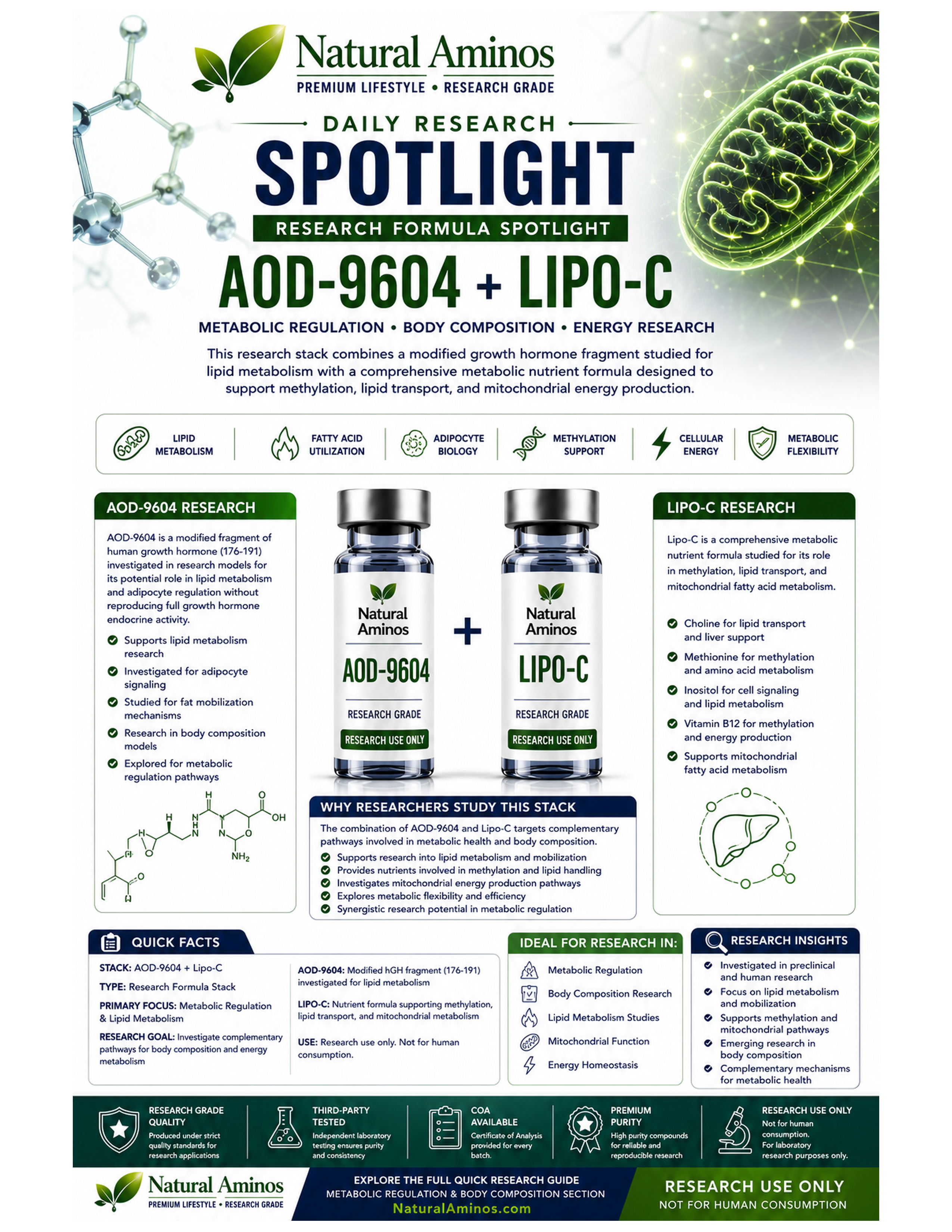
AOD-9604 + Lipo-C Research Data
For laboratory research use only; not for human or veterinary use or consumption. This page provides research information, not personal-use instructions or medical advice.
Natural Aminos Research Stack or Formula of the Day
AOD-9604 + Lipo-C
Lipolysis, Fatty-Acid Transport & Hepatic Lipid-Handling Research Spotlight
Important Formulation Note
AOD-9604 is a defined synthetic peptide, but “Lipo-C” is not one standardized molecule or one universally fixed formulation. Published and pharmacy formulations vary. Some use methionine, choline chloride, L-carnitine and dexpanthenol; others use the classic MIC base of methionine, inositol and choline with L-carnitine, and some add B vitamins, chromium, arginine or other ingredients. Because the exact Lipo-C vial composition was not specified, this report evaluates the common research core of methionine + inositol + choline + L-carnitine, while noting evidence for closely related formulations. Claims about one Lipo-C mixture cannot automatically be transferred to every product sold under the same name.
Benefits
AOD-9604
AOD-9604 is a synthetic 16-amino-acid peptide based on the C-terminal lipolytic region of human growth hormone. The research goal was to preserve part of growth hormone’s fat-mobilizing activity without reproducing its broader growth-promoting and diabetogenic effects. In obese rodent models, AOD-9604 increased lipolytic activity, altered beta-3-adrenergic receptor expression, increased fat oxidation and reduced body-weight or fat-mass gain. Earlier rat work also reported no deterioration in insulin sensitivity under conditions where intact human growth hormone produced insulin resistance.
The important limitation is human translation. AOD-9604 progressed into human obesity trials in Australia, so it has more clinical history than many research peptides. Small early studies generated signals suggesting changes in free fatty acids, waist measurements or short-term weight loss, but the largest 24-week randomized, double-blind, placebo-controlled obesity study did not show a significant weight-loss difference at the primary endpoint. Development for obesity was subsequently terminated. Therefore, the most defensible benefit statement is that AOD-9604 has a biologically coherent lipolysis/fat-oxidation mechanism with animal support, but its intended human weight-loss benefit was not confirmed in the pivotal development program.
Lipo-C
The proposed benefit of Lipo-C is broader metabolic support rather than direct appetite suppression. L-carnitine is required for transport of long-chain fatty acids into mitochondria for beta-oxidation. Choline supports phosphatidylcholine synthesis and export of triglyceride from the liver in very-low-density lipoproteins. Methionine participates in one-carbon metabolism and production of S-adenosylmethionine (SAM), a major cellular methyl donor. Inositol, when present, participates in insulin-signaling pathways and has human clinical literature suggesting modest improvements in glucose handling and insulin sensitivity in selected populations.
Human evidence is strongest for the individual ingredients, not for the compounded injectable mixture. A 2020 meta-analysis from Iran covering 37 randomized trials and 2,292 participants found that L-carnitine supplementation produced modest average reductions in body weight, BMI and fat mass, with no consistent improvement in waist circumference or body-fat percentage. A Spain/Portugal-led meta-analysis of 20 randomized inositol trials reported improvements in fasting glucose, fasting insulin and HOMA-IR. Choline has stronger evidence for hepatic lipid biology than for weight loss: a 2025 Egyptian randomized study found that oral phosphatidylcholine added to conventional management improved several fatty-liver and laboratory measures over 12 weeks.
These findings establish that major Lipo-C components are biologically active and have human evidence in specific settings. They do not establish that an injectable Lipo-C mixture produces meaningful fat loss, nor that injection is superior to oral administration. No controlled trial of the complete compounded Lipo-C blend was identified.
What the Formulas Are Studied For
AOD-9604 Research Areas
• Lipolysis and fat oxidation in adipose tissue.
• Body-weight and adipose-mass regulation in obesity models.
• Beta-adrenergic pathway involvement in adipose metabolism.
• Human obesity and body-composition research from the earlier Metabolic Pharmaceuticals clinical program.
• Cartilage and osteoarthritis research in animal models, separate from the metabolic indication.
• Analytical and anti-doping research because AOD-9604 is detectable as a prohibited peptide in sport.
Lipo-C / Component Research Areas
• L-carnitine: mitochondrial transport of long-chain fatty acids, beta-oxidation, exercise physiology and body-composition research.
• Choline: phosphatidylcholine synthesis, VLDL export, hepatic lipid handling and one-carbon metabolism.
• Methionine: SAM generation, methylation biology, transsulfuration and liver metabolic pathways.
• Inositol: insulin signaling, glucose homeostasis, PCOS/metabolic research and cardiometabolic markers.
• Optional B vitamins or other additives: cofactor biology varies by formulation and cannot be assumed unless the exact Lipo-C composition is known.
Published Research — Worldwide Evidence Review
AOD-9604 — Australia, United States and South Korea
Australian researchers at Monash University produced much of the foundational AOD-9604 work. In a 2000 study of obese Zucker rats, daily AOD-9604 reduced body-weight gain by more than half relative to controls and increased adipose lipolytic activity. Unlike intact human growth hormone, chronic AOD-9604 did not impair insulin sensitivity in the clamp experiments used in that study. A 2001 Australian mouse study then showed that chronic AOD-9604 reduced body weight and body fat in obese mice and increased beta-3-adrenergic receptor expression in adipose tissue. The effect was altered in beta-3-receptor knockout mice, supporting a relationship between AOD-9604 and adrenergic control of lipolysis, although the authors concluded that its action was not simply direct beta-3 receptor agonism.
Human development also occurred primarily in Australia. FDA’s 2024 review of the historical clinical program describes several early double-blind studies in people with obesity. Some small studies showed increases in non-esterified fatty acids or small differences in weight, but several did not show statistically significant weight loss versus placebo. A 12-week randomized study in approximately 300 participants produced a limited abstract-level signal, but FDA noted that the full study methods and results were not located in a standalone peer-reviewed publication.
The decisive study was the OPTIONS Phase 2B program. It enrolled 536 adults with obesity, randomized 502, and compared oral AOD-9604 with placebo alongside supervised diet and exercise for 24 weeks. The primary endpoint required significant weight loss after 12 weeks. The study did not demonstrate a statistically significant difference in the primary weight-loss endpoint, and the developer announced in 2007 that the result did not support commercial viability for obesity. This failed larger trial is the most important human efficacy result and prevents the earlier positive signals from being treated as established clinical benefit.
A pooled 2013 publication summarized safety and tolerability from six randomized, double-blind, placebo-controlled AOD-9604 studies. Historical trial authors generally described oral and intravenous exposure as tolerated, but the later FDA review emphasized important limitations: incomplete pharmacokinetic information, no identified human subcutaneous or transdermal exposure studies matching many modern compounded uses, limited long-term safety information and peptide-related concerns including impurities, aggregation and immunogenicity. FDA’s current compounding-safety page also lists AOD-9604 among substances for which the agency identifies limited safety information and potential concerns.
Outside metabolism, a 2015 South Korean rabbit study tested intra-articular AOD-9604 in collagenase-induced knee osteoarthritis. AOD-9604 improved cartilage-related morphological and histologic scores, and the combination with hyaluronic acid outperformed either alone in that animal model. This supports tissue-specific biological activity, but it does not validate systemic AOD-9604 for fat loss.
L-Carnitine — International Human Evidence
L-carnitine has the largest direct human evidence base among common Lipo-C components. A 2020 systematic review and dose-response meta-analysis by investigators in Iran included 37 randomized controlled trials with 2,292 participants. It found modest average reductions in body weight, BMI and fat mass, with the high-quality-trial analysis confirming the body-weight effect but not all body-composition outcomes. The magnitude was small, and the underlying studies varied in population, dose, duration and clinical condition.
The important route limitation is that these trials predominantly evaluated oral L-carnitine supplementation. They do not demonstrate that L-carnitine delivered as one ingredient in an injectable Lipo-C blend produces the same magnitude of effect, nor that it amplifies a second lipolytic intervention such as AOD-9604.
Inositol — Europe and Broader Clinical Evidence
A Spain/Portugal-led 2019 meta-analysis of 20 randomized controlled trials and 1,239 participants found that inositol-family supplementation reduced fasting glucose, two-hour glucose, fasting insulin and HOMA-IR. The authors interpreted the results as an improvement in insulin sensitivity that was not dependent on weight loss. That creates a plausible metabolic role for inositol in a Lipo-C formulation, but again the evidence comes from oral supplementation and specific clinical populations rather than the injectable multi-ingredient product.
Choline and Methionine — Europe, Middle East and Asia
Choline and methionine sit within one-carbon metabolism and are closely connected to hepatic lipid handling. Reviews from Spain, Poland, Brazil and China describe how choline availability, methionine metabolism, folate pathways and SAM influence phosphatidylcholine synthesis, methylation, VLDL export and fatty-liver biology. Deficiency of choline or methionine can strongly disturb hepatic lipid homeostasis, but deficiency biology does not prove that supraphysiologic supplementation in a replete person produces fat loss.
The Middle Eastern clinical literature adds a useful human signal. In 2025, investigators in Egypt randomized patients with non-alcoholic fatty liver disease to conventional management with or without oral phosphatidylcholine for 12 weeks. The choline group showed improvements in controlled attenuation parameter, liver enzymes, oxidative-stress measures and triglyceride-related outcomes. This supports choline-linked liver biology in humans, but it is not evidence for injectable Lipo-C or for weight reduction.
Direct Research on AOD-9604 + Lipo-C Together
No peer-reviewed animal or human study was identified that directly administered AOD-9604 together with a Lipo-C formulation. Searches pairing AOD-9604 with L-carnitine, methionine, inositol, choline and lipotropic-injection terms did not identify a controlled experiment containing both interventions. No study was found comparing AOD-9604 + Lipo-C against AOD-9604 alone, Lipo-C alone or placebo.
The nearest published connection is indirect: anti-obesity reviews discuss AOD-9604 as an investigational lipolytic peptide and separately discuss L-carnitine or nutritional approaches to fat oxidation. They do not establish synergy. Therefore, every claim about the combined stack must be classified as mechanistic theory.
Theory of the Stack — How the Combination Could Work
1. Mobilize Stored Fat — AOD-9604 Layer
The AOD-9604 theory begins at adipose tissue. Preclinical studies suggest increased lipolytic sensitivity, fat oxidation and changes in beta-adrenergic signaling. In a simplified model, that could increase release of fatty acids from stored triglyceride and reduce lipogenic pressure. This is the 'mobilization' side of the stack. The central weakness is that this mechanism did not translate into a statistically significant weight-loss benefit in the larger human obesity trial.
2. Transport Fatty Acids Into Mitochondria — L-Carnitine Layer
Once long-chain fatty acids are available for oxidation, they require the carnitine shuttle to enter the mitochondrial matrix. This creates the most obvious theoretical complement to AOD-9604: one compound may increase fatty-acid availability while L-carnitine supports the transport machinery needed to oxidize those fatty acids. Mechanistically this is coherent, but carnitine transport is not necessarily rate-limiting in people with adequate carnitine status, which helps explain why human L-carnitine weight-loss effects are modest.
3. Support Hepatic Lipid Export — Choline Layer
Lipolysis increases the movement of fatty acids through circulation and toward organs such as the liver. Choline is necessary for phosphatidylcholine synthesis and normal VLDL assembly, which helps the liver package and export triglyceride. In theory, choline could support hepatic handling of the additional lipid flux created by a fat-mobilizing strategy. This is a plausible metabolic-support function, not evidence that choline makes AOD-9604 more effective.
4. Support Insulin Signaling — Inositol Layer
When inositol is included in the Lipo-C formulation, it adds a glucose/insulin-signaling pathway rather than another direct lipolytic pathway. Improved insulin sensitivity could theoretically reduce hyperinsulinemic pressure that favors fat storage and could make fuel switching easier. This is complementary to AOD-9604 in theory, but no experiment has tested whether the combination changes insulin sensitivity or body composition.
5. Maintain One-Carbon and Methylation Biology — Methionine + Choline Layer
Methionine and choline participate in one-carbon metabolism and influence SAM-dependent methylation, phospholipid synthesis and transsulfuration. This pathway is relevant to liver health and nutrient handling. In a combined stack, the theoretical benefit would be metabolic support during increased lipid turnover rather than direct stimulation of lipolysis. The pathway is tightly regulated, however, and excessive or imbalanced methyl-donor exposure is not automatically beneficial.
6. The Key Requirement: Fat Mobilization Must Be Matched by Fat Oxidation
This is the most important systems-level point. Releasing fatty acids from adipose tissue is not equivalent to eliminating body fat. Mobilized fatty acids can be oxidized for energy, re-esterified back into triglyceride, or redistributed to other tissues. The stack theory only makes sense if energy demand and mitochondrial oxidation are sufficient to use the mobilized substrate. L-carnitine can support the transport step, but it cannot create an energy deficit by itself. This may help explain why a lipolytic mechanism can look convincing in laboratory models yet fail to produce large weight loss in humans.
Possible Overall Benefit — Theoretical, Not Proven
The strongest theoretical case for AOD-9604 + Lipo-C is a two-stage metabolic design: AOD-9604 attempts to increase adipose fat mobilization, while Lipo-C supplies nutrients involved in fatty-acid transport, hepatic lipid export, insulin signaling and one-carbon metabolism. If all of those mechanisms operated as intended, the combination could theoretically improve the movement of stored fat from adipose tissue toward oxidation while reducing the chance that increased lipid flux simply accumulates in the liver.
That theory is more biologically coherent than using two compounds that act on the same receptor, because the pathways are mostly complementary. However, the expected overall benefit should still be described as modest and uncertain. AOD-9604’s pivotal obesity program did not confirm meaningful human weight loss, and the complete Lipo-C injection has never been validated in a controlled weight-loss study. The combination could be mechanistically logical and still fail clinically if AOD-9604 does not mobilize enough fat in humans, if carnitine availability is not limiting, or if liberated fatty acids are re-esterified rather than oxidized.
Why More Research Is Needed
• AOD-9604 showed promising animal lipolysis biology, but the larger 24-week human obesity program did not demonstrate significant weight loss at the primary endpoint.
• AOD-9604 human pharmacokinetic and pharmacodynamic information remains incomplete, and FDA did not identify human data for modern subcutaneous or transdermal compounded use in its 2024 evaluation.
• Lipo-C is not standardized. Different products contain different ingredients and concentrations, so studies cannot be generalized to an unnamed formulation.
• No controlled trial has tested the complete injectable Lipo-C mixture for weight loss, body composition, hepatic fat mobilization or metabolic outcomes.
• Most positive human evidence for L-carnitine, inositol and choline comes from oral supplementation, not from the injected combination.
• No published experiment has tested AOD-9604 + Lipo-C together, so additive benefit, synergy, antagonism, pharmacokinetic interaction and long-term safety are unknown.
• The central mechanistic question remains whether increased adipose lipolysis would actually increase net fat oxidation in humans rather than simply increasing fatty-acid recycling or redistribution.
• Long-term safety needs better characterization, particularly for repeated exposure to AOD-9604 and for multi-ingredient compounded formulations whose impurity, stability and immunogenicity profiles can differ by preparation.
• International replication is uneven: AOD-9604’s clinical program was concentrated in Australia, while Lipo-C evidence is distributed across component-level studies from Iran, Europe, Egypt and other regions rather than research on the actual blend.
Research Summary
AOD-9604 + Lipo-C is a mechanistically understandable metabolic stack built around two different tasks. AOD-9604 is intended to influence adipose lipolysis and fat oxidation, while the common Lipo-C nutrients participate in mitochondrial fatty-acid transport, hepatic triglyceride export, insulin signaling and one-carbon metabolism. At the pathway level, this creates a plausible sequence of mobilizing fat and then supporting the systems that transport, oxidize and process that fat.
The evidence hierarchy is much less impressive than the theory. AOD-9604 has real human trial history, but the largest obesity trial failed its primary weight-loss endpoint and development for obesity stopped. Lipo-C has no standardized formula and no controlled trial of the complete injectable mixture; its strongest evidence belongs to individual nutrients and mostly oral administration. The stack is therefore best treated as a reasonable mechanistic hypothesis whose two components have very different evidence bases, not as a validated fat-loss combination.
Selected Sources
• Ng FM, et al. Metabolic studies of a synthetic lipolytic domain (AOD9604) of human growth hormone. Hormone Research. 2000. PMID: 11146367. DOI: 10.1159/000053183.
• Heffernan M, et al. The effects of human GH and its lipolytic fragment (AOD9604) on lipid metabolism following chronic treatment in obese mice and beta(3)-AR knock-out mice. Endocrinology. 2001;142(12):5182-5189. PMID: 11713213. DOI: 10.1210/endo.142.12.8522.
• Stier H, Vos E, Kenley D. Safety and tolerability of the hexadecapeptide AOD9604 in humans. Journal of Endocrinology and Metabolism. 2013;3:7-15. DOI: 10.4021/jem157w.
• U.S. Food and Drug Administration. FDA Briefing Document: Evaluation of AOD-9604-Related Bulk Drug Substances for Inclusion on the 503A Bulk Drug Substances List. Pharmacy Compounding Advisory Committee, December 4, 2024. Includes review of the Australian OPTIONS Phase 2B program and safety limitations.
• U.S. Food and Drug Administration. Certain Bulk Drug Substances for Use in Compounding that May Present Significant Safety Risks. Current FDA compounding-safety listing for AOD-9604.
• Kwon DR, Park GY. Effect of intra-articular injection of AOD9604 with or without hyaluronic acid in rabbit osteoarthritis model. Annals of Clinical and Laboratory Science. 2015;45(4):426-432. PMID: 26275694.
• Cox HD, et al. Detection and in vitro metabolism of AOD9604. Drug Testing and Analysis. 2015;7:31-38. PMID: 25208511. DOI: 10.1002/dta.1715.
• Talenezhad N, et al. Effects of L-carnitine supplementation on weight loss and body composition: systematic review and meta-analysis of 37 randomized controlled clinical trials. Clinical Nutrition ESPEN. 2020;37:9-23. PMID: 32359762. DOI: 10.1016/j.clnesp.2020.03.008.
• Miñambres I, et al. Effects of inositol on glucose homeostasis: systematic review and meta-analysis of randomized controlled trials. Clinical Nutrition. 2019;38(3):1146-1152. PMID: 29980312. DOI: 10.1016/j.clnu.2018.06.957.
• Sedhom SS, et al. The impact of choline supplementation on oxidative stress and clinical outcomes among patients with non-alcoholic fatty liver disease: a randomized controlled study. Therapeutic Advances in Chronic Disease. 2025;16. PMID: 40838115. DOI: 10.1177/20406223251358659.
• Mato JM, Martínez-Chantar ML, Lu SC. Methionine metabolism and liver disease. Annual Review of Nutrition. 2008;28:273-293. PMID: 18331185. DOI: 10.1146/annurev.nutr.28.061807.155438.
• One-Carbon Metabolism and Nonalcoholic Fatty Liver Disease: The Crosstalk between Nutrients, Microbiota, and Genetics. Nutrients. 2019. PMID: 31846961.
• Methionine metabolism in chronic liver diseases: an update on molecular mechanism and therapeutic implication. Signal Transduction and Targeted Therapy. 2020. PMID: 33273451. DOI: 10.1038/s41392-020-00349-7.
• Empower Pharmacy. Lipo-C Injection product information (methionine/choline chloride/L-carnitine/dexpanthenol). Used only to document formulation variability, not as efficacy evidence.
• MediVera Compounding Pharmacy. Lipo-C formulation overview (MIC plus L-carnitine). Used only to document that the commercial term Lipo-C does not refer to one standardized composition.
Theory vs. Proof — Verdict
What is supported by evidence: AOD-9604 can increase lipolytic activity and alter fat-metabolism pathways in obese rodents; it reached multiple human randomized studies and accumulated a historical safety dataset; L-carnitine has modest human body-weight evidence; inositol has human evidence for insulin-sensitivity effects; and choline/methionine biology is clearly relevant to hepatic lipid handling and one-carbon metabolism.
What is not proven: that AOD-9604 produces clinically meaningful weight loss in humans; that an injectable Lipo-C blend produces meaningful fat loss; that injection improves the effects seen in oral nutrient studies; or that combining AOD-9604 with Lipo-C creates a larger, safer or more durable effect than either approach alone.
Verdict — theory vs. proof: the mechanistic theory is reasonably strong and complementary. AOD-9604 is intended to mobilize stored fat, while Lipo-C supplies factors involved in fatty-acid transport, hepatic lipid export, insulin signaling and methyl-group metabolism. That sequence is biologically logical. The practical proof, however, is weak: the peptide failed to show significant weight loss in the largest human obesity study, the Lipo-C mixture itself has never been validated in a controlled clinical trial, and the two have never been studied together. This stack is best classified as a plausible fat-mobilization/oxidation hypothesis with limited clinical support, not a proven body-composition intervention.
Research & Educational Use Only !!