DSIP + Epithalon Research Data
For laboratory research use only; not for human or veterinary use or consumption. This page provides research information, not personal-use instructions or medical advice.
Natural Aminos Research Stack or Formula of the Day
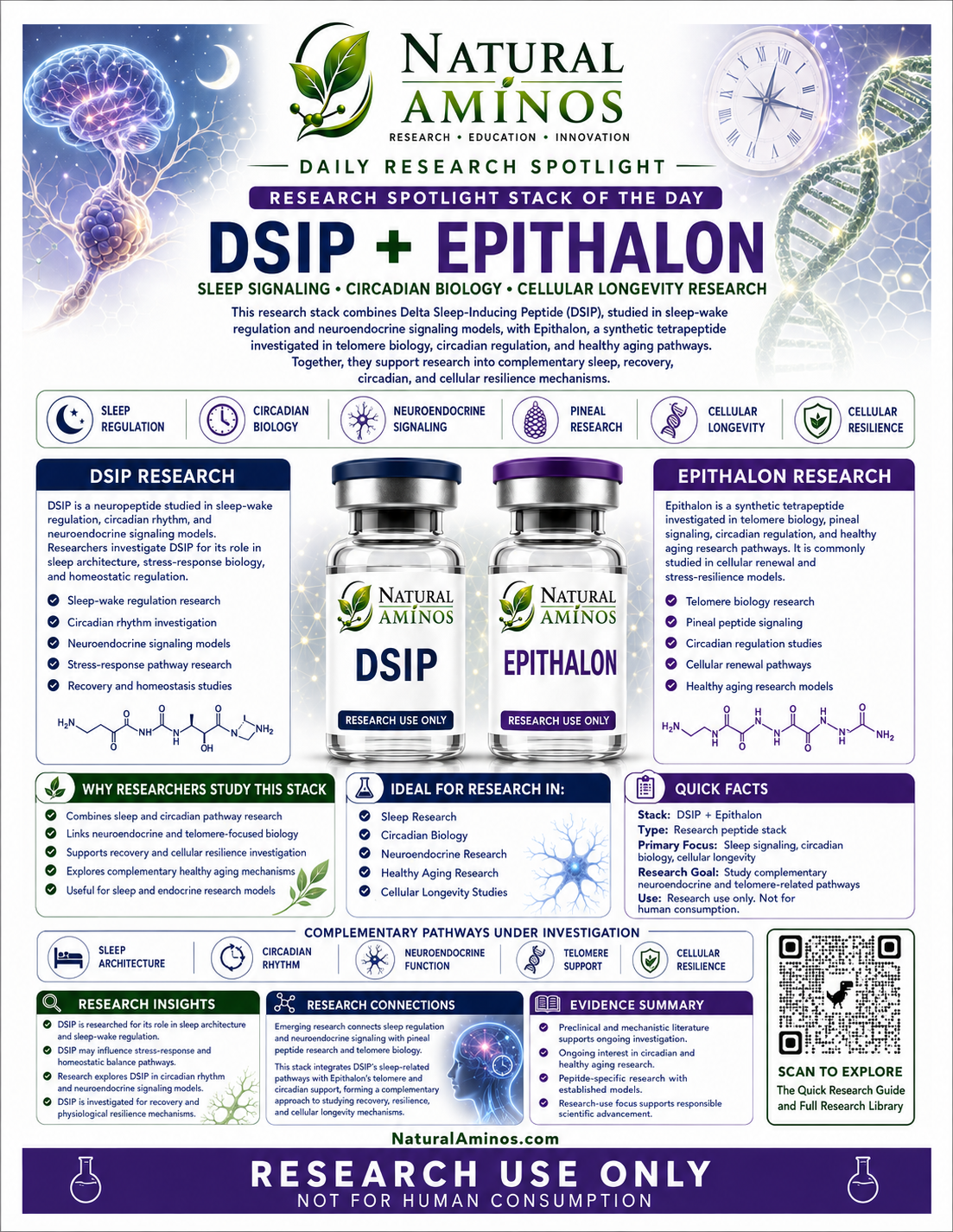
DSIP + Epithalon
Sleep Architecture, Circadian Rhythm & Healthy-Aging Research Spotlight
Compound Identity & Evidence Context
DSIP (delta sleep-inducing peptide; also called emideltide in recent U.S. regulatory review) is a nine-amino-acid peptide with the sequence Trp-Ala-Gly-Gly-Asp-Ala-Ser-Gly-Glu. It emerged from Swiss sleep research in the 1970s after a peptide fraction isolated during rabbit sleep experiments appeared to increase delta-wave activity. Despite the name, the modern evidence base does not establish DSIP as a reliable 'deep-sleep peptide.' Human studies from the 1980s and early 1990s produced mixed results, and a later review described DSIP's natural identity, precursor, receptor and physiological role as still unresolved.
Epithalon (Epitalon; AEDG) is a synthetic tetrapeptide with the sequence Ala-Glu-Asp-Gly. It was developed from the amino-acid composition of Epithalamin, a bovine pineal-gland peptide extract studied in Russia and Ukraine. This distinction matters: many long-term human gerontology studies that are routinely cited as 'Epithalon' evidence actually used Epithalamin, the extract, not the defined synthetic AEDG tetrapeptide. The strongest compound-specific Epithalon evidence concerns pineal/circadian biology, retinal research, cultured-cell telomerase/telomere effects and a smaller number of human studies.
The stack therefore combines two different research ideas: DSIP is an older neuropeptide studied for sleep-state regulation and stress-related neuroendocrine effects, while Epithalon is a pineal-derived tetrapeptide studied for circadian-melatonin regulation and broader aging biology. No peer-reviewed study was identified that directly tested DSIP and Epithalon together.
Benefits
DSIP
The proposed benefit of DSIP is normalization of sleep rather than classic pharmacologic sedation. Early human studies reported shorter sleep onset, higher sleep efficiency, increased total sleep time or improved daytime function after intravenous DSIP. A 1981 double-blind crossover study in six healthy volunteers reported increased sleep during the observation period and delayed improvement in subsequent nighttime sleep efficiency. Additional small studies in chronic insomnia reported improved sleep continuity and daytime alertness.
The important counterpoint is that these findings were not consistent. A 1987 double-blind crossover study in chronic insomnia found that some sleep parameters improved under DSIP, but the differences were of little clinical significance and were partly confounded by baseline imbalance. A 1992 double-blind study in 16 chronic insomniacs found somewhat higher sleep efficiency and shorter sleep latency versus placebo, but the authors concluded that the effects were weak and unlikely to represent a major therapeutic benefit. DSIP therefore has real human sleep research, but not a reproducible modern evidence base strong enough to establish reliable efficacy.
DSIP has also been studied outside sleep. A clinical report in alcohol and opioid withdrawal described rapid improvement of somatic withdrawal symptoms in many evaluable patients, although the design was not equivalent to a modern placebo-controlled trial. Neuroendocrine studies have produced inconsistent results: one randomized crossover study found reduced ACTH-like immunoreactivity after DSIP, whereas later work found no effect on CRH- or meal-stimulated ACTH/cortisol release. These conflicting findings reinforce the view that DSIP's mechanism is incompletely defined.
Epithalon
Epithalon's most defensible human benefit signal is circadian and pineal regulation rather than proven longevity extension. Russian and Ukrainian investigators reported that Epithalon and related pineal peptides could restore or increase nighttime melatonin output in older individuals with reduced pineal function. A later human study summarized in a 2025 review involved 75 women given Epithalon sublingually for 20 days; urinary 6-sulfatoxymelatonin increased relative to placebo, and several clock-gene expression measures changed in leukocytes or lymphocytes. This supports a possible effect on circadian signaling, but it did not establish an insomnia-treatment benefit.
Epithalon also has a human retinal literature. A St. Petersburg clinical study reported outcomes in 162 patients with retinitis pigmentosa after local parabulbar Epithalon exposure. Visual acuity, visual-field borders and some electrophysiologic measures improved in the treated group. The study is historically important, but it was conducted within the originating research network and has not been independently replicated in large modern randomized trials.
The best-known longevity claim involves telomerase. Earlier Russian cell-culture studies reported increased telomerase activity, telomere elongation and extension of replicative lifespan in human fibroblasts. In 2025, an independent United Kingdom group reported that Epithalon increased telomere length in normal human cell lines through hTERT/telomerase upregulation and also activated alternative telomere-lengthening mechanisms in breast-cancer cell lines. This is important independent replication of a cellular effect, but it remains an in-vitro result—not proof that Epithalon extends human lifespan or improves healthy-aging outcomes.
What the Formulas Are Studied For
DSIP Research Areas
• Sleep initiation, sleep continuity and sleep architecture in healthy volunteers and people with chronic insomnia.
• Slow-wave/delta-sleep regulation, although human findings have not consistently shown a selective increase in slow-wave sleep.
• Daytime alertness and performance after altered sleep.
• Stress-response and hypothalamic-pituitary-adrenal-axis modulation.
• Alcohol and opioid withdrawal symptoms in older clinical research.
• Neuroendocrine regulation and chronobiology.
• Sleep disorders including insomnia, narcolepsy and sleep-apnea biomarker research.
Epithalon Research Areas
• Pineal-gland function and circadian melatonin rhythm.
• Clock-gene expression and age-related circadian dysregulation.
• Telomerase activity, telomere length and cellular replicative aging.
• Retinal degeneration and retinitis pigmentosa.
• Antioxidant, antimutagenic and neuroendocrine pathways in cell and animal models.
• Age-related endocrine and metabolic regulation in animal models.
• Gerontology and longevity research, with the important caveat that much human long-term evidence belongs to Epithalamin rather than synthetic Epithalon.
Published Research — Worldwide Evidence Review
DSIP — Switzerland, Netherlands, Germany, Sweden, Uruguay and the United States
DSIP's human sleep literature is unusually old but genuinely clinical. Swiss investigators performed several of the early studies. In 1981, synthetic DSIP was given to six healthy volunteers in a double-blind crossover design; total sleep increased during the observation interval and later nighttime sleep showed shorter onset and better efficiency. Another 1981 study in six chronic insomniacs reported longer sleep duration, fewer interruptions and improved sleep quality after intravenous DSIP.
European follow-up studies were mixed. A 1984 Swiss clinical report described normalization of sleep in a small open series, and a 1987 placebo-controlled study in 14 severe chronic insomniacs reported improved nighttime sleep plus increased daytime alertness and performance. By contrast, a separate 1987 double-blind crossover trial concluded that DSIP-related sleep improvement was of little clinical importance. The strongest later test, a 1992 University of Amsterdam double-blind study in 16 chronic insomniacs, found modest objective improvement but concluded that short-term DSIP was unlikely to provide major therapeutic benefit.
Stress-axis research also yielded conflicting results. Swedish investigators reported reduced plasma ACTH-like immunoreactivity after a single intravenous DSIP dose in healthy men, without a corresponding cortisol change. German investigators later found that DSIP did not alter ACTH or cortisol responses to CRH or meals. This suggests that DSIP may interact with neuroendocrine regulation under some conditions but does not support a simple, reliably demonstrated cortisol-suppressing mechanism.
An older clinical report evaluated DSIP as sole treatment during alcohol and opioid withdrawal and described improvement in many evaluable patients. Although provocative, that study predates modern trial standards and had substantial attrition, so it should be interpreted as exploratory evidence rather than validated withdrawal therapy.
U.S. observational research measured DSIP-like immunoreactivity in people with sleep apnea and narcolepsy but did not find a clear disease-marker role. A 2006 review by Kovalzon and Strekalova concluded that the original hypothesis of DSIP as a natural sleep factor remained poorly documented, with unresolved questions about endogenous synthesis, precursor biology and the relationship between DSIP-like immunoreactivity and the synthetic nonapeptide used experimentally.
No modern large randomized insomnia trial, no established receptor-target program and no replicated Phase III development program were identified. In July 2026, FDA's Pharmacy Compounding Advisory Committee reviewed emideltide/DSIP for chronic insomnia, narcolepsy and opioid withdrawal. FDA's current safety page states that it lacks sufficient safety-related information for the proposed compounded routes and notes potential concerns about immunogenicity, peptide impurities and API characterization.
Epithalon — Russia, Ukraine, Poland, United Kingdom and Broader International Research
Epithalon research originated primarily in St. Petersburg and the broader Russian/Ukrainian gerontology network. The 2025 Polish review of Epithalon emphasizes that the compound was developed from Epithalamin but is chemically distinct. This matters because long-term human mortality and cardiovascular-aging studies from Ukraine frequently involved Epithalamin rather than Epithalon. Those studies support the broader pineal-peptide hypothesis but cannot be treated as direct proof for the synthetic tetrapeptide.
Compound-specific human evidence includes a retinitis-pigmentosa clinical study from St. Petersburg involving 162 patients. According to the published report and 2025 review, local Epithalon exposure was associated with improvements in visual acuity, visual-field borders and retinal electrophysiologic measures, with no reported side effects in that series. The evidence is notable but geographically concentrated and not independently reproduced in a modern multicenter randomized trial.
Circadian research provides the most relevant evidence for this stack. A Russian-language gerontology publication reported that Epithalon and Epithalamin could normalize nighttime melatonin release in older people with reduced pineal function. A separate study summarized in the 2025 review included 75 women and reported that 20 days of sublingual Epithalon increased urinary 6-sulfatoxymelatonin relative to placebo and altered Clock, Cry2 and Csnk1e expression. The study supports a biological circadian signal but did not demonstrate improved polysomnographic sleep outcomes or establish Epithalon as an insomnia treatment.
At the cellular level, Russian investigators previously reported increased telomerase activity and telomere elongation in human somatic cells, including fetal fibroblasts that continued dividing beyond the passage at which control cells stopped. In 2025, investigators at Brunel University London independently reported dose-dependent telomere extension in normal human fibroblast and epithelial cell lines with hTERT/telomerase upregulation. The same study found ALT activation in breast-cancer cell lines, a reminder that telomere manipulation is biologically complex and not automatically benign.
Animal research extends the biological picture. Old rhesus monkeys treated with Epithalon showed changes in nighttime melatonin and cortisol rhythms, and other rodent or cell models have reported antioxidant, antimutagenic, immune and gene-regulatory effects. These findings strengthen mechanistic plausibility but do not prove human longevity or generalized anti-aging benefit.
The current regulatory context also reflects the evidence gap. FDA's 2026 compounding review evaluated Epitalon for insomnia but states on its safety page that it has not identified adequate safety-related information for proposed compounded administration and notes potential immunogenicity and peptide-impurity concerns. FDA also reports that Epitalon is not recognized in the European or Japanese pharmacopoeias and that no approved Epitalon products were identified across a number of major Western countries. Advisory-committee consideration of compounding status does not constitute drug approval.
Direct Research on DSIP + Epithalon Together
No peer-reviewed human, animal or in-vitro study was identified that directly tested DSIP and Epithalon together. Searches across sleep, circadian rhythm, melatonin, pineal biology, aging and peptide-combination terminology found commercial and educational discussions of the pairing, but no controlled experiment establishing safety, pharmacokinetic compatibility or efficacy of the stack.
The combination must therefore be evaluated entirely by integrating the separate literatures. Any claim that the two compounds are synergistic, that Epithalon 'sets the clock' while DSIP 'deepens sleep,' or that the pair improves longevity through sleep should be labeled as a mechanistic theory rather than a demonstrated result.
Theory of the Stack — How the Combination Could Work
1. Circadian Timing Layer — Epithalon
The strongest stack rationale begins with circadian timing. Epithalon has human and primate evidence suggesting effects on nighttime melatonin output and clock-gene expression, particularly in older or circadian-disrupted systems. In theory, this could improve the timing signal that tells the brain and peripheral tissues when the biological night begins. This is different from directly inducing sleep.
2. Sleep-State Regulation Layer — DSIP
DSIP's theoretical contribution is closer to sleep architecture and sleep continuity. Some human trials reported shorter sleep latency, improved efficiency or more total sleep, while other controlled studies found effects too weak for major clinical importance. The stack theory therefore assumes a DSIP effect that is possible but inconsistent: a better transition into and maintenance of physiologic sleep rather than a sedative effect.
3. Why the Pair Could Be Complementary
Circadian alignment and sleep architecture are related but not identical biological problems. A person can have an appropriate circadian melatonin signal but fragmented sleep, or poor circadian timing with otherwise normal sleep-stage machinery. The theoretical benefit of the pair is therefore division of labor: Epithalon could influence when the system is prepared for sleep, while DSIP could influence how sleep is organized once it occurs.
4. Stress-Axis Modulation Could Add a Second Layer
Sleep disruption and circadian misalignment interact with the hypothalamic-pituitary-adrenal axis. DSIP has inconsistent but genuine human neuroendocrine data suggesting possible ACTH modulation, while Epithalon has primate data showing age-dependent changes in cortisol rhythm alongside melatonin normalization. In theory, the combination could reduce a mismatch between nighttime arousal signals and circadian sleep signals. Because the DSIP endocrine findings conflict across studies, this remains a weaker part of the stack rationale.
5. Recovery and Healthy-Aging Theory
The longevity argument is indirect. Good sleep and stable circadian rhythms are associated with normal endocrine, metabolic and immune function, while Epithalon has separate cell-based telomerase and telomere findings. A theoretical stack could therefore pair short-term sleep/circadian support with longer-term cellular-aging research. However, there is no evidence that adding DSIP amplifies Epithalon's telomerase effects, and there is no human trial showing that this combination slows aging, extends lifespan or improves validated biological-age measures.
6. The Main Weakness: Both Compounds Are Mechanistically Incomplete
The stack looks complementary because the marketing categories are different, but both compounds have unresolved basic biology. DSIP has no firmly established endogenous precursor/receptor system and inconsistent human sleep effects. Epithalon's proposed gene-regulatory and telomerase effects are broader than its clinically demonstrated outcomes, and much of its historical geroprotection narrative is borrowed from Epithalamin. Combining two incompletely characterized agents compounds uncertainty even when the high-level theory appears logical.
7. Circadian Normalization Does Not Guarantee Better Sleep
Melatonin rhythm is one component of sleep biology, not the whole system. A rise in nighttime melatonin or a change in clock-gene expression does not prove that sleep latency, slow-wave sleep, REM organization or next-day function will improve. Likewise, an acute DSIP sleep effect does not prove that circadian phase is corrected. A rigorous combination study would need both circadian markers and polysomnography rather than relying on subjective sleep reports alone.
Possible Overall Benefit — Theoretical, Not Proven
The most defensible theoretical benefit of DSIP + Epithalon is coordinated circadian and sleep-state support. Epithalon could, in theory, strengthen or normalize the nighttime pineal-melatonin signal and influence clock-gene expression. DSIP could, in theory, improve sleep initiation, continuity or sleep-state organization in people whose sleep system is responsive to the peptide. If both effects occurred in the same individual, the combined result could be a more synchronized biological night with more consolidated sleep.
A second possible benefit is improved recovery signaling. More stable sleep and circadian timing could theoretically support normal cortisol rhythm, growth-hormone timing, autonomic recovery and immune regulation. This is systems biology reasoning, not direct stack evidence. The human DSIP literature does not reliably show a large sleep effect, and Epithalon's human circadian studies did not prove clinically meaningful insomnia improvement.
For healthy-aging research, Epithalon contributes a separate cellular hypothesis involving telomerase, telomere biology and gene regulation. DSIP does not have evidence showing that it enhances those pathways. Any longevity benefit attributed to the stack would therefore be an indirect hypothesis based on better sleep plus Epithalon's independent cellular effects, not a demonstrated synergistic anti-aging mechanism.
Why More Research Is Needed
• No published study has tested DSIP and Epithalon together, so synergy, antagonism, pharmacokinetic compatibility and combined safety are unknown.
• DSIP sleep trials are small, mostly from the 1980s and early 1990s, and their results conflict; no modern large randomized insomnia trial has confirmed a clinically meaningful benefit.
• The endogenous identity and physiological receptor mechanism of DSIP remain unresolved, making target engagement difficult to define.
• DSIP neuroendocrine findings conflict: one human study reported ACTH suppression, while another found no effect on CRH- or meal-stimulated ACTH/cortisol secretion.
• Epithalon's human evidence is geographically concentrated, largely within the originating Russian/Ukrainian research network, with limited independent clinical replication.
• Many long-term geroprotective studies often attributed to Epithalon actually used Epithalamin, a bovine pineal peptide extract. These products should not be treated as equivalent evidence.
• The 2025 independent telomere study was performed in cultured human cells, not people. Telomere elongation in vitro does not establish longer lifespan or improved healthspan.
• The 2025 telomere study also observed alternative-lengthening activity in cancer cell lines, emphasizing that telomere biology is complex and requires dedicated long-term safety research.
• Epithalon's human circadian studies measured melatonin metabolites and clock-gene expression but did not establish improved polysomnographic sleep or durable insomnia remission.
• FDA's 2026 safety review states that sufficient safety-related information is lacking for proposed compounded routes of both emideltide/DSIP and Epitalon, with potential concerns involving immunogenicity and peptide-related impurities.
• A proper combination trial should measure circadian phase markers, melatonin, cortisol, full polysomnography, subjective sleep quality, daytime performance and next-day alertness, rather than relying on a single sleep endpoint.
• Long-term studies would also need to separate sleep benefit from anti-aging claims and specifically test whether any cellular Epithalon effect produces a meaningful human clinical outcome.
Research Summary
DSIP + Epithalon is a logically constructed sleep-and-circadian research stack, but the evidence is uneven. DSIP has direct human sleep studies, which is stronger than having only animal data, yet the results are old, small and inconsistent. Some trials reported better sleep efficiency, shorter latency or improved daytime function; other controlled studies concluded that the effect was weak or of little clinical importance. Epithalon has human evidence for circadian-melatonin regulation and retinal outcomes, plus a substantial cellular and animal literature. Its best-known telomerase effect has now been independently reproduced in human cell lines, but that remains laboratory evidence rather than proof of human longevity.
The theoretical pairing is reasonably coherent because circadian timing and sleep architecture are different layers of sleep biology. Epithalon could influence the nighttime pineal/clock signal, while DSIP could influence the organization or continuity of sleep. The major limitation is that neither mechanism is clinically established enough to make the combination predictable, and no direct study has tested the stack. The result should be viewed as a plausible circadian-plus-sleep hypothesis, not as a proven sleep, recovery or longevity intervention.
Selected Sources
• Schneider-Helmert D, et al. Acute and delayed effects of DSIP (delta sleep-inducing peptide) on human sleep behavior. Int J Clin Pharmacol Ther Toxicol. 1981;19(8):341-345. PMID: 6895513.
• Schneider-Helmert D, Schoenenberger GA. The influence of synthetic DSIP on disturbed human sleep. Experientia. 1981;37(9):913-917. PMID: 7028502. DOI: 10.1007/BF01971753.
• Schneider-Helmert D. Effects of delta-sleep-inducing peptide on 24-hour sleep-wake behaviour in severe chronic insomnia. European Neurology. 1987;27(2):120-129. PMID: 3622582. DOI: 10.1159/000116143.
• Monti JM, et al. Study of delta sleep-inducing peptide efficacy in improving sleep on short-term administration to chronic insomniacs. Int J Clin Pharmacol Res. 1987;7(2):105-110. PMID: 3583493.
• Bes F, Hofman W, Schuur J, van Boxtel C. Effects of delta sleep-inducing peptide on sleep of chronic insomniac patients: a double-blind study. Neuropsychobiology. 1992;26(4):193-197. PMID: 1299794. DOI: 10.1159/000118919.
• Graf MV, Kastin AJ. Delta-sleep-inducing peptide (DSIP): a review. Neuroscience and Biobehavioral Reviews. 1984;8(1):83-93. PMID: 6145137. DOI: 10.1016/0149-7634(84)90022-8.
• Kovalzon VM, Strekalova TV. Delta sleep-inducing peptide (DSIP): a still unresolved riddle. Peptides. 2006. PMID: 16539679.
• Reduction of immunoreactive ACTH in plasma following intravenous injection of delta sleep-inducing peptide in man. Psychoneuroendocrinology. 1989. PMID: 2554357.
• Späth-Schwalbe E, et al. Delta-sleep-inducing peptide does not affect CRH and meal-induced ACTH and cortisol secretion. Psychoneuroendocrinology. 1995;20(3):231-237. PMID: 7777652. DOI: 10.1016/0306-4530(94)00050-K.
• Successful treatment of withdrawal symptoms with delta sleep-inducing peptide. European Neurology. 1984. PMID: 6328354.
• Vgontzas AN, et al. Delta sleep-inducing peptide in normal humans and in patients with sleep apnea and narcolepsy. Peptides. 1995;16(6):1153-1156. PMID: 8532601.
• Araj SK, Brzezik J, Mądra-Gackowska K, Szeleszczuk Ł. Overview of Epitalon—Highly Bioactive Pineal Tetrapeptide with Promising Properties. International Journal of Molecular Sciences. 2025;26(6):2691. PMID: 40141333. PMCID: PMC11943447. DOI: 10.3390/ijms26062691.
• Khavinson VK, Razumovsky MI, Trofimova SV, Grigorian R, Razumovskaya A. Pineal-regulating tetrapeptide Epitalon improves eye retina condition in retinitis pigmentosa. Neuro Endocrinology Letters. 2002;23(4):365-368. PMID: 12195242.
• Korkushko OV, et al. Normalizing effect of the pineal gland peptides on the daily melatonin rhythm in old monkeys and elderly people. Advances in Gerontology. 2007;20(1):74-85. PMID: 17969590.
• Khavinson VK, Bondarev IE, Butyugov AA. Epithalon peptide induces telomerase activity and telomere elongation in human somatic cells. Bulletin of Experimental Biology and Medicine. 2003;135:590-592.
• Khavinson VK, Bondarev IE, Butyugov AA, Smirnova TD. Peptide promotes overcoming of the division limit in human somatic cell. Bulletin of Experimental Biology and Medicine. 2004;137(5):503-506. PMID: 15455129. DOI: 10.1023/B:BEBM.0000038164.49947.8c.
• Khavinson VK, et al. Peptide Epitalon activates chromatin at old age. Neuro Endocrinology Letters. 2003;24(5):329-333. PMID: 14647006.
• Al-Dulaimi S, Thomas R, Matta S, Roberts T. Epitalon increases telomere length in human cell lines through telomerase upregulation or ALT activity. Biogerontology. 2025;26(5):178. PMID: 40908429. PMCID: PMC12411320. DOI: 10.1007/s10522-025-10315-x.
• Korkushko OV, Khavinson VK, Shatilo VB, Antonyuk-Shcheglova IA. Geroprotective effect of epithalamine in elderly subjects with accelerated aging. Bulletin of Experimental Biology and Medicine. 2006;142(3):356-359. PMID: 17426848. DOI: 10.1007/s10517-006-0365-z. Included as related Epithalamin evidence, not direct Epithalon proof.
• U.S. Food and Drug Administration. July 23-24, 2026 Pharmacy Compounding Advisory Committee meeting materials for Emideltide/DSIP and Epitalon; uses reviewed included chronic insomnia, narcolepsy and opioid withdrawal for emideltide and insomnia for Epitalon.
• U.S. Food and Drug Administration. Certain Bulk Drug Substances for Use in Compounding that May Present Significant Safety Risks. 2026: FDA states that safety-related information is insufficient for compounded emideltide/DSIP and Epitalon and notes potential immunogenicity/peptide-impurity concerns.
Theory vs. Proof — Verdict
What is supported by evidence: DSIP has small human clinical sleep studies showing that it can alter some sleep measures in at least some participants, although results are inconsistent. Epithalon has human evidence for circadian-melatonin and retinal effects, older Russian cell studies supporting telomerase/telomere activity, and 2025 independent U.K. replication of telomere-length effects in cultured human cells.
What is not proven: that DSIP reliably increases deep sleep or meaningfully treats insomnia; that Epithalon improves clinical sleep outcomes, extends human lifespan or slows biological aging; that long-term Epithalamin geroprotection data are transferable to synthetic Epithalon; or that combining DSIP with Epithalon creates additive or synergistic benefit.
Verdict — theory vs. proof: the mechanistic theory is moderately strong at the systems level and weak at the direct clinical level. The combination is attractive because it addresses two different dimensions of sleep biology—circadian timing through the pineal/melatonin system and sleep-state regulation through DSIP's older neuropeptide literature. That division of labor is biologically plausible. However, DSIP's human sleep effects are inconsistent, Epithalon's sleep-specific human evidence is indirect, and no combination study exists. The stack is therefore best classified as a plausible circadian-plus-sleep research hypothesis with limited and uneven human evidence, not a proven sleep, recovery or longevity combination.
Research & Educational Use Only !!