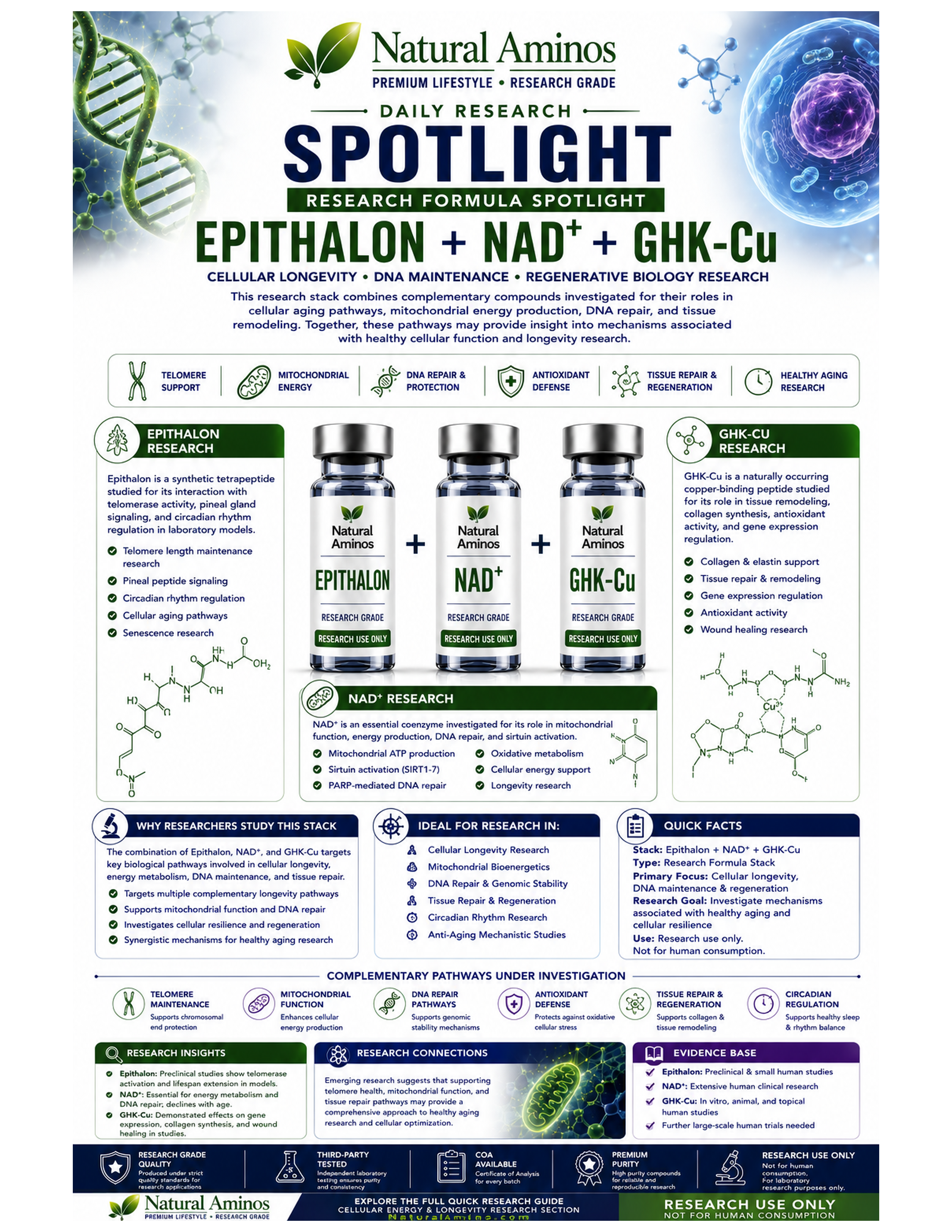
Epithalon + NAD+ + GHK-Cu Research Data
For laboratory research use only; not for human or veterinary use or consumption. This page provides research information, not personal-use instructions or medical advice.
Natural Aminos Research Stack or Formula of the Day
Epithalon + NAD+ + GHK-Cu
Circadian Biology, Cellular Energy & Regenerative-Matrix Research Spotlight
Compound Classification & Research Context
This stack combines three very different biological tools. Epithalon (also called Epitalon or AEDG) is a synthetic tetrapeptide, Ala-Glu-Asp-Gly, developed from the amino-acid composition of the pineal peptide preparation Epithalamin. Its research literature centers on pineal/circadian regulation, melatonin, retinal biology, gene regulation, telomerase and telomere length. NAD+ (nicotinamide adenine dinucleotide) is not a peptide; it is an essential endogenous redox coenzyme and signaling substrate required for energy metabolism, sirtuins, PARPs and other stress-response pathways. GHK-Cu is the copper complex of the naturally occurring tripeptide glycyl-L-histidyl-L-lysine, studied for extracellular-matrix remodeling, collagen and glycosaminoglycan synthesis, wound repair, angiogenesis, antioxidant effects and inflammatory modulation.
The theoretical attraction of the combination is that it addresses three different layers of age- and injury-related biology: Epithalon at the level of circadian and telomere-associated signaling, NAD+ at the level of cellular redox/energy and NAD-dependent repair enzymes, and GHK-Cu at the level of extracellular matrix and tissue regeneration. No peer-reviewed study was identified that tested all three together, and no controlled human study was identified for any Epithalon + NAD+, Epithalon + GHK-Cu, or NAD+ + GHK-Cu combination as a defined stack.
Benefits
Epithalon
Epithalon's most defensible human biological signal is pineal and circadian modulation. Russian and Ukrainian investigators reported that Epitalon or closely related pineal peptide preparations could increase or normalize nighttime melatonin output in older individuals whose pineal function was reduced. A 2007 report comparing pineal peptides in old monkeys and elderly people stated that Epitalon could restore nighttime melatonin release and normalize the circadian rhythm in people with reduced pineal function. This supports a circadian effect, but it is not the same as proving improved insomnia, sleep architecture or long-term health outcomes.
Epithalon also has a human retinal literature. A 2002 St. Petersburg clinical report in patients with retinitis pigmentosa described improvements in visual-function measures after Epitalon treatment. The study is important historically, but the work originated from the same research network that developed the peptide and has not been replicated in a large modern multicenter randomized trial.
The best-known healthy-aging claim involves telomerase and telomeres. Earlier Russian cell studies reported telomerase activation, telomere elongation and extension of replicative lifespan in human somatic cells. In 2025, investigators at Brunel University London independently reported dose-dependent telomere-length increases in normal human fibroblast and epithelial cell lines with increased hTERT/telomerase activity. The same paper also reported alternative lengthening of telomeres in breast-cancer cell lines. This is independent confirmation of a cellular effect, not evidence that Epithalon extends human lifespan.
NAD+
NAD+ is essential to cellular metabolism because it shuttles electrons through glycolysis, the tricarboxylic-acid cycle and oxidative phosphorylation. It is also consumed by sirtuins, PARPs and CD38, linking NAD+ availability to gene regulation, DNA repair, inflammation, calcium signaling and cellular stress responses. This makes NAD+ biologically central to mitochondrial function and tissue maintenance.
Human intervention evidence is strongest for the NAD+ precursors nicotinamide riboside (NR) and nicotinamide mononucleotide (NMN), not direct injected or infused NAD+. Randomized trials repeatedly show that NR or NMN can raise circulating or tissue NAD-related metabolites. A U.S. randomized trial in women with prediabetes found that NMN improved skeletal-muscle insulin sensitivity, while Japanese randomized studies reported selected benefits in walking speed, fatigue or sleep measures. However, large reviews conclude that functional and clinical outcomes remain inconsistent despite reliable biochemical target engagement.
Direct NAD+ administration has far less clinical evidence. An Australian-led 2019 pilot study showed that a six-hour intravenous NAD+ infusion was rapidly metabolized and altered downstream NAD metabolites, but it was primarily a pharmacokinetic/metabolomic study rather than an efficacy trial. In 2026, a randomized Phase 0/1b study of a modified oral NAD+ formulation reported a large increase in intracellular whole-blood NAD+ over five days, with favorable short-term tolerability, but no secondary clinical or wearable-derived health endpoint survived multiplicity correction. The strongest conclusion remains that NAD+ biology can be manipulated in humans, while durable healthy-aging benefit is not established.
GHK-Cu
GHK-Cu's strongest evidence concerns tissue repair and extracellular-matrix biology. Laboratory studies show increased collagen and glycosaminoglycan synthesis, changes in matrix metalloproteinases and their inhibitors, support for fibroblast function, angiogenesis and inflammatory modulation. These functions make GHK-Cu biologically relevant to wound healing, skin remodeling and age-related decline in tissue repair.
Human evidence is strongest with local/topical exposure. A multicenter randomized, evaluator-blinded, placebo-controlled study in diabetic neuropathic plantar ulcers found that topical GHK-Cu gel significantly increased ulcer closure and reduced infection incidence versus vehicle under standardized wound care. A randomized trial after CO2 laser resurfacing did not show objective superiority for erythema or wrinkles, although patient-reported skin-quality satisfaction favored the GHK-Cu regimen.
A 2026 systematic review from U.S. academic plastic-surgery groups evaluated GHK-Cu in aesthetic medicine and found 20 eligible studies, of which only two were randomized clinical trials and the remainder were preclinical. The review concluded that GHK-Cu has a reasonable regenerative biological basis but that clinical guidance remains limited by small study numbers, heterogeneous formulations and inconsistent delivery methods. This is especially important for systemic use: the strongest human evidence is local/topical, not injectable.
What the Formulas Are Studied For
Epithalon Research Areas
• Pineal-gland function, nighttime melatonin output and age-related circadian disruption.
• Clock-gene expression and neuroendocrine aging.
• Telomerase activity, hTERT expression and telomere length in cultured human cells.
• Retinal degeneration and retinitis pigmentosa.
• Antioxidant, antimutagenic and gene-regulatory effects in cellular and animal models.
• Gerontology and lifespan research in animals, with the important caveat that many long-term human gerontology studies used Epithalamin rather than synthetic Epithalon.
NAD+ Research Areas
• Cellular redox balance and mitochondrial ATP-generating metabolism.
• Sirtuin-, PARP- and CD38-dependent signaling.
• DNA-damage responses and cellular stress recovery.
• Metabolic health, skeletal-muscle insulin sensitivity and glucose handling.
• Exercise, physical function, fatigue, sleep and healthy-aging outcomes in precursor trials.
• Direct NAD+ infusion and newer delivery strategies intended to raise intracellular NAD+.
GHK-Cu Research Areas
• Wound healing and diabetic-ulcer repair.
• Collagen, elastin and glycosaminoglycan synthesis.
• Extracellular-matrix turnover and metalloproteinase regulation.
• Fibroblast activity, angiogenesis and tissue remodeling.
• Skin regeneration, post-procedure healing and aesthetic-photoaging research.
• Anti-inflammatory and antioxidant signaling.
• Experimental systemic regeneration in preclinical models, with limited human injectable evidence.
Published Research — Worldwide Evidence Review
Epithalon — Russia, Ukraine, Poland and United Kingdom
Epithalon research originated primarily from the St. Petersburg Institute of Bioregulation and Gerontology and related Russian/Ukrainian groups. A major interpretive issue is that Epithalon and Epithalamin are often blended together in secondary discussion even though they are chemically different. Epithalamin is a bovine pineal peptide extract; Epithalon is the defined AEDG tetrapeptide. Long-term human mortality, cardiovascular and geroprotection papers frequently used Epithalamin and therefore cannot be cited as direct proof of Epithalon.
Compound-specific Epithalon research includes the 2002 retinitis-pigmentosa clinical paper from St. Petersburg and a 2007 report on pineal peptides in old monkeys and elderly humans. The latter reported that Epitalon could increase nighttime melatonin in individuals with reduced pineal function and normalize the circadian rhythm. The evidence supports a pineal/circadian signal but remains geographically concentrated and methodologically older than contemporary drug-development standards.
The 2025 Polish review in the International Journal of Molecular Sciences catalogued approximately 25 years of Epitalon research across in-vitro, animal and human studies. It concluded that the peptide has promising neuroendocrine and geroprotective properties but that its mechanism is not fully resolved. The review also reinforces the need to distinguish AEDG-specific studies from older Epithalamin work.
Independent replication strengthened the cell-biology evidence in 2025. Brunel University London researchers treated normal human fibroblast and epithelial cells and reported dose-dependent telomere extension with increased hTERT expression and telomerase activity. In breast-cancer cell lines, telomere length also increased, but through alternative lengthening of telomeres. This is scientifically important because it confirms that Epithalon can influence telomere biology outside the original Russian research network while simultaneously showing why telomere activation requires careful safety study in proliferative disease.
Current U.S. regulatory review underscores the translational gap. FDA's 2026 compounding-safety page states that compounded Epitalon may pose immunogenicity risks for certain routes because of aggregation and peptide-related impurities, and that FDA has not identified sufficient safety-related information for the proposed route of administration. Epitalon was also reviewed by the Pharmacy Compounding Advisory Committee in July 2026 for the nominated use of insomnia. Advisory review is not drug approval and does not establish efficacy.
NAD+ — United States, Japan, Australia, Europe and International Reviews
The modern NAD+ clinical literature is international and methodologically stronger than the Epithalon literature, but the outcomes are more modest than the mechanistic claims. In 2021, Washington University investigators published a randomized controlled trial in women with prediabetes showing that NMN improved skeletal-muscle insulin sensitivity. The effect was tissue-specific; not all systemic metabolic outcomes improved, emphasizing that raising NAD+ can produce selective rather than global benefit.
Japanese randomized trials have explored physical function and sleep. A 2022 study of older adults reported time-of-day-dependent changes in fatigue and physical performance with NMN. A 2024 double-blind randomized trial found that NMN increased blood NAD+ and its metabolites and maintained or improved selected walking and sleep-related measures, although the primary stepping-test endpoint did not differ between groups. These trials demonstrate target engagement plus selected functional signals, not a universal anti-aging effect.
Australian investigators directly examined IV NAD+ metabolism in 2019. During a six-hour infusion, plasma NAD+ was rapidly removed and downstream metabolites changed, demonstrating active systemic metabolism. Because the study was not designed as a placebo-controlled clinical efficacy trial, it supports pharmacology rather than a therapeutic claim.
A 2025 Nature Metabolism review led by Amsterdam UMC concluded that NAD+ precursors are promising in preclinical aging models but have shown limited efficacy in human trials. The authors emphasized that evidence for a consistent age-related NAD+ decline in humans is less complete than often assumed and that tissue-specific NAD+ dynamics remain poorly mapped. A separate 2025 Nature Aging review likewise emphasized the need for better dose, route, frequency, long-term-safety and interindividual-response data.
A 2026 systematic review identified 33 human NAD-related intervention studies and concluded that NR/NMN reliably alter NAD-related biology but that functional outcomes remain heterogeneous. The review found far less evidence for parenteral NAD+ than for precursors. A 2026 randomized Phase 0/1b trial of a modified oral NAD+ formulation showed a 53% increase in intracellular whole-blood NAD+ versus placebo after five days, but no secondary clinical or wearable endpoint remained significant after correction for multiple comparisons. This is strong target-engagement evidence, not proof of healthy-aging efficacy.
GHK-Cu — United States, France and International Regenerative Research
GHK-Cu has a long mechanistic history in France and the United States. French fibroblast studies showed stimulation of collagen and sulfated glycosaminoglycan synthesis and modulation of extracellular-matrix enzymes. These observations established the peptide as a regulator of both matrix formation and remodeling rather than simply a collagen stimulant.
One of the strongest human studies is the multicenter randomized diabetic-ulcer trial. Under standardized debridement, pressure relief and diabetic care, topical GHK-Cu gel produced greater plantar-ulcer closure than vehicle, faster closure and a lower infection incidence. This is direct human evidence that local GHK-Cu can influence wound-healing outcomes in a defined clinical context.
Human aesthetic evidence is more mixed. The 2006 randomized CO2-laser study found no objective reduction in erythema or superior wrinkle improvement with a GHK-Cu-containing regimen, although patient satisfaction with skin quality was higher. Later multi-peptide formulations have reported improved healing or photoaging outcomes, but because they contain several active compounds they cannot be treated as isolated GHK-Cu evidence.
A 2026 systematic review of GHK-Cu in aesthetic medicine included 20 studies—18 preclinical and only two randomized clinical trials. The authors concluded that preclinical support for matrix synthesis, angiogenesis, cell proliferation and anti-inflammatory effects is consistent, but the clinical evidence is still too limited and heterogeneous to establish standardized treatment guidance. This review represents a useful current summary of the gap between strong mechanism and modest clinical validation.
For injectable use, the evidence gap is wider. FDA's 2026 compounding-safety page states that injectable GHK-Cu may pose immunogenicity risks because of aggregation and peptide-related impurities and that human safety data are limited. Therefore, human topical wound or cosmetic data cannot be automatically generalized to systemic injection.
Direct Research on Epithalon + NAD+ + GHK-Cu Together
No peer-reviewed human, animal or in-vitro study was identified that directly tested Epithalon, NAD+ and GHK-Cu as a three-part combination. No controlled study was identified for Epithalon + NAD+, Epithalon + GHK-Cu or direct NAD+ + GHK-Cu as defined paired interventions. Searches located commercial and educational pages proposing 'longevity stacks,' but those discussions assemble separate literatures rather than reporting combination experiments.
This means the full-stack analysis must be theoretical. Each component has a distinct research literature, but there is no published evidence establishing additive benefit, synergy, pharmacokinetic compatibility, optimal timing or long-term safety of the combination.
Theory of the Stack — How the Combination Could Work
1. Circadian and Telomere-Associated Signaling — Epithalon Layer
Epithalon's theoretical role is to influence age-sensitive signaling at two levels. First, it may help normalize pineal melatonin output and circadian timing in systems with reduced nighttime melatonin. Second, cell studies suggest that it can alter telomerase/telomere biology. In a multi-layer healthy-aging hypothesis, Epithalon would therefore address timing and chromosomal-replicative biology rather than energy production or tissue structure.
2. Redox, Energy and NAD-Dependent Repair — NAD+ Layer
NAD+ would provide the metabolic-support layer. Mitochondrial ATP production depends on NAD+/NADH cycling, while sirtuins and PARPs consume NAD+ during stress adaptation and DNA repair. If intracellular NAD+ availability is limiting in a particular tissue, raising the NAD pool could theoretically improve energy handling and support NAD-dependent repair programs. Human studies prove that the NAD metabolome can be altered; they do not prove that every tissue or age-related outcome improves.
3. Extracellular Matrix and Tissue Remodeling — GHK-Cu Layer
GHK-Cu supplies the structural-repair component. Collagen, glycosaminoglycans, fibroblast activity, matrix metalloproteinase balance and angiogenesis determine whether damaged or aged tissue can rebuild a functional extracellular environment. GHK-Cu's strongest direct human evidence—wound healing—fits this role. The stack theory therefore places GHK-Cu downstream of cellular energy and signaling: cells with adequate metabolic capacity still require a well-organized matrix to restore tissue function.
4. Why the Three Pathways Are More Complementary Than Redundant
The strongest theoretical argument is that the three compounds act at different biological levels. Epithalon is proposed to influence circadian/gene/telomere regulation; NAD+ supports metabolic redox and enzyme-driven repair; GHK-Cu influences the extracellular repair environment. Unlike a stack in which two compounds compete for the same receptor, these mechanisms are largely non-overlapping. That makes conceptual synergy possible, although it does not prove that one compound improves the pharmacology of another.
5. Circadian Timing Could Influence NAD+ Biology
Circadian clocks and NAD+ metabolism are biologically linked. NAD+ levels and sirtuin activity participate in clock-regulated metabolic cycles, while sleep/wake timing influences energy metabolism. If Epithalon truly normalizes circadian signaling in an older or disrupted system, it could theoretically improve the timing context in which NAD-dependent metabolic pathways operate. No Epithalon + NAD+ experiment has tested this proposition, so the interaction remains systems-level reasoning rather than demonstrated pharmacology.
6. NAD+ and GHK-Cu Could Support Different Parts of Tissue Repair
Tissue regeneration requires both intracellular energy and extracellular organization. NAD+ is required for ATP production, stress signaling and DNA repair; GHK-Cu is associated with collagen/glycosaminoglycan synthesis, fibroblast function and angiogenesis. The theoretical benefit is division of labor: NAD+ supports the cell's ability to carry out repair, while GHK-Cu helps shape the matrix and vascular environment into which that repair occurs.
This is biologically plausible but not necessarily additive. If cellular NAD+ is not limiting, raising it further may not increase matrix synthesis. If copper availability, fibroblast state or injury signaling is limiting, GHK-Cu may behave differently. No study has measured NAD metabolites, collagen remodeling and functional healing in the same GHK-Cu intervention.
7. Epithalon and GHK-Cu Could Converge on Gene-Regulated Regeneration
Both Epithalon and GHK-Cu are described in the literature as regulators of gene expression rather than simple receptor agonists. Epithalon has been linked with clock genes, hTERT and other transcriptional effects; GHK-Cu has been associated with broad gene-expression signatures related to matrix turnover, inflammation and repair. This creates a theoretical 'programming plus rebuilding' model in which Epithalon influences cellular regulatory state while GHK-Cu supports structural output.
The weakness is that broad gene-expression effects can be context-dependent. There is no evidence that combining these two regulatory signals produces a coordinated beneficial program rather than neutral or unpredictable effects.
8. The Telomerase/NAD+/Regeneration Question Requires Special Caution
The most scientifically important uncertainty is proliferative context. Telomerase activity can be beneficial for replicative lifespan in normal cells, but cancer cells also use telomerase or alternative telomere-lengthening mechanisms. NAD+ supports metabolism and DNA-repair enzymes, and GHK-Cu can promote angiogenesis and cellular proliferation during repair. None of these properties is inherently harmful, and there is no evidence that this stack causes cancer. However, combining telomere-lengthening, metabolic-support and regenerative pathways creates a clear need for dedicated long-term safety research in proliferative disease models before broad healthy-aging claims can be made.
Possible Overall Benefit — Theoretical, Not Proven
The most defensible theoretical benefit of Epithalon + NAD+ + GHK-Cu is broader coverage of age-related functional decline rather than one amplified pathway. Epithalon could theoretically strengthen circadian timing and influence telomere-related cellular programs. NAD+ could support mitochondrial energy, redox balance and NAD-dependent repair enzymes. GHK-Cu could support collagen-rich extracellular matrix, fibroblast activity, angiogenesis and tissue remodeling. If all three mechanisms translated at the same time, the overall effect could be improved coordination between cellular timing, intracellular energy and structural tissue repair.
For healthy-aging research, the attraction is that common aging phenotypes often span all three levels: circadian rhythms become less robust, cellular energy/stress responses change, and tissues lose regenerative capacity. A multi-layer intervention could theoretically address more of that biology than one compound alone. But the evidence strength does not rise simply because more pathways are included. The full combination has never been tested, and each component has a different translational limitation.
For skin or wound-regeneration research, the NAD+ + GHK-Cu portion may be the most immediately coherent: cellular energy/repair capacity plus extracellular-matrix remodeling. Epithalon could theoretically add circadian or gene-regulatory support, but there is no direct wound-healing study showing that it improves GHK-Cu or NAD-related outcomes. For longevity research, Epithalon's telomere findings and NAD's metabolic biology are conceptually complementary, but neither has demonstrated human lifespan extension.
Why More Research Is Needed
• No published study has tested Epithalon + NAD+ + GHK-Cu together, and no controlled pairwise combination study was identified for the three possible pairs.
• Epithalon's human evidence is small, methodologically older and geographically concentrated. Independent human randomized replication is lacking.
• Long-term human studies often cited in Epithalon discussions used Epithalamin, a bovine pineal peptide extract, not the synthetic AEDG tetrapeptide. These cannot be treated as equivalent evidence.
• The 2025 independent Epithalon telomere study was conducted in cell lines. Telomere extension in vitro does not prove slower human aging, and the observation of telomere-lengthening activity in cancer cell lines makes long-term proliferative safety an important research question.
• NAD+ human research is strongest for NR and NMN precursors. Results from precursor trials cannot be assumed to equal direct IV, injectable or other NAD+ administration.
• Direct NAD+ studies demonstrate metabolism and target engagement much more clearly than durable clinical benefit. Large, long-duration outcome trials are still needed.
• GHK-Cu's strongest human evidence is topical/local. Injectable systemic pharmacokinetics, tissue distribution, optimal exposure and long-term safety remain poorly characterized.
• FDA's 2026 safety page states that Epitalon and injectable GHK-Cu have peptide-related impurity/immunogenicity concerns and insufficient or limited human safety information for the proposed compounded routes.
• The stack theoretically activates or supports several repair-associated pathways—telomere maintenance, NAD-dependent metabolism, angiogenesis and cell proliferation. Long-term studies should specifically examine whether these pathways remain appropriately controlled in high-risk proliferative contexts.
• Circadian effects should be measured objectively with melatonin timing, actigraphy or polysomnography rather than inferred from subjective sleep or wellness claims.
• Healthy-aging studies need validated functional outcomes—strength, mobility, cognition, metabolic health, tissue healing and quality of life—rather than relying only on biomarkers such as NAD concentration, telomere length or collagen expression.
• International independent replication is needed. Epithalon evidence is heavily Russian/Ukrainian, NAD+ is broad and global, and GHK-Cu has stronger U.S./European wound and skin research; a combined program has never connected these research traditions.
Research Summary
Epithalon + NAD+ + GHK-Cu is one of the more conceptually broad healthy-aging stacks because the components act at three different biological levels. Epithalon has a smaller research base suggesting circadian-melatonin effects and telomere-related activity; NAD+ has an extensive human clinical literature showing reliable biochemical target engagement but inconsistent functional outcomes; GHK-Cu has a strong regenerative mechanism and genuine human local-wound evidence but limited systemic injectable data.
The theory is strongest as a systems-biology model: circadian and telomere-associated regulation, intracellular redox/energy support, and extracellular-matrix/tissue remodeling. The practical evidence is much weaker because no combination study exists and each component carries a different translation gap. Epithalon lacks modern large human trials, direct NAD+ has less outcome evidence than its precursors, and GHK-Cu's best human data are topical. The stack is therefore scientifically plausible but experimentally unvalidated.
Selected Sources
• Araj SK, Brzezik J, Mądra-Gackowska K, Szeleszczuk Ł. Overview of Epitalon—Highly Bioactive Pineal Tetrapeptide with Promising Properties. International Journal of Molecular Sciences. 2025;26(6):2691. PMID: 40141333. PMCID: PMC11943447. DOI: 10.3390/ijms26062691.
• Al-Dulaimi S, Thomas R, Matta S, Roberts T. Epitalon increases telomere length in human cell lines through telomerase upregulation or ALT activity. Biogerontology. 2025;26(5):178. PMID: 40908429. PMCID: PMC12411320. DOI: 10.1007/s10522-025-10315-x.
• Correction: Epitalon increases telomere length in human cell lines through telomerase upregulation or ALT activity. Biogerontology. 2025. PMID: 41240216. DOI: 10.1007/s10522-025-10326-8.
• Khavinson VK, Razumovsky MI, Trofimova SV, Grigorian R, Razumovskaya A. Pineal-regulating tetrapeptide Epitalon improves eye retina condition in retinitis pigmentosa. Neuro Endocrinology Letters. 2002;23(4):365-368. PMID: 12195242.
• Korkushko OV, et al. Normalizing effect of the pineal gland peptides on the daily melatonin rhythm in old monkeys and elderly people. Advances in Gerontology. 2007;20(1):74-85. PMID: 17969590.
• Khavinson VK, Bondarev IE, Butyugov AA. Epithalon peptide induces telomerase activity and telomere elongation in human somatic cells. Bulletin of Experimental Biology and Medicine. 2003;135:590-592.
• U.S. Food and Drug Administration. Certain Bulk Drug Substances for Use in Compounding that May Present Significant Safety Risks. Current 2026 entry for Epitalon and GHK-Cu injectable routes.
• U.S. Food and Drug Administration. July 23-24, 2026 Pharmacy Compounding Advisory Committee meeting materials: Epitalon-related bulk drug substances reviewed for insomnia.
• Vinten KT, et al. NAD+ precursor supplementation in human ageing: clinical evidence and challenges. Nature Metabolism. 2025;7(10):1974-1990. PMID: 41083806. DOI: 10.1038/s42255-025-01387-7.
• Zhang J, et al. Emerging strategies, applications and challenges of targeting NAD+ in the clinic. Nature Aging. 2025. PMID: 40926126.
• Gallagher C, Emmanuel OO. NAD+ supplementation for anti-aging and wellness: a PRISMA-guided systematic review of preclinical and clinical evidence. Ageing Research Reviews. 2026. PMID: 41655607. DOI: 10.1016/j.arr.2026.103057.
• Grant R, et al. A Pilot Study Investigating Changes in the Human Plasma and Urine NAD+ Metabolome During a 6 Hour Intravenous Infusion of NAD. Frontiers in Aging Neuroscience. 2019;11:257. PMID: 31572171. DOI: 10.3389/fnagi.2019.00257.
• Yoshino M, et al. Nicotinamide mononucleotide increases muscle insulin sensitivity in prediabetic women. Science. 2021;372(6547):1224-1229. PMID: 33888596. DOI: 10.1126/science.abe9985.
• Kim M, et al. Effect of 12-Week Intake of Nicotinamide Mononucleotide on Sleep Quality, Fatigue, and Physical Performance in Older Japanese Adults. Nutrients. 2022;14(4):755. PMID: 35215405. DOI: 10.3390/nu14040755.
• Morifuji M, et al. Ingestion of beta-nicotinamide mononucleotide increased blood NAD levels, maintained walking speed, and improved sleep quality in older adults in a double-blind randomized, placebo-controlled study. Geroscience. 2024;46(5):4671-4688. PMID: 38789831. DOI: 10.1007/s11357-024-01204-1.
• Kornilov SA, et al. Oral LNAD+ rapidly elevates whole blood intracellular NAD and metabolic flux without elevating plasma NAD: evidence from a randomized controlled trial. Geroscience. 2026. PMID: 42530810. DOI: 10.1007/s11357-026-02399-1.
• Mulder GD, et al. Enhanced healing of ulcers in patients with diabetes by topical treatment with glycyl-L-histidyl-L-lysine copper. Wound Repair and Regeneration. 1994;2(4):259-269. PMID: 17147644. DOI: 10.1046/j.1524-475X.1994.20406.x.
• Miller TR, et al. Effects of topical copper tripeptide complex on CO2 laser-resurfaced skin. Archives of Facial Plastic Surgery. 2006;8(4):252-259. PMID: 16847171. DOI: 10.1001/archfaci.8.4.252.
• Pickart L, Margolina A. Regenerative and Protective Actions of the GHK-Cu Peptide in the Light of the New Gene Data. International Journal of Molecular Sciences. 2018;19(7):1987. PMID: 29986520. PMCID: PMC6073405. DOI: 10.3390/ijms19071987.
• The Regenerative Potential of GHK-Cu in Aesthetic Medicine. Systematic review. 2026. PMID: 42619529.
• Topically applied GHK as an anti-wrinkle peptide: Advantages, problems and prospective. 2024/2025 review. PMID: 39963574.
Theory vs. Proof — Verdict
What is supported by evidence: Epithalon has published human circadian/melatonin and retinal research plus independent 2025 confirmation that it can alter telomere biology in cultured human cells; NAD+ precursor trials repeatedly show that the human NAD metabolome can be increased, with selected metabolic, sleep or physical-function benefits in some trials; and GHK-Cu has human local-wound evidence plus consistent preclinical extracellular-matrix and regenerative effects.
What is not proven: that Epithalon slows human aging or extends human lifespan; that direct NAD+ administration produces the same outcomes as NR/NMN; that systemic injectable GHK-Cu reproduces topical wound or skin effects; that any pair within this stack is synergistic; or that the three-part combination has an established safety, pharmacokinetic or efficacy profile.
Verdict — theory vs. proof: the mechanistic theory is strong at the systems level because the three components are largely complementary rather than redundant. Epithalon addresses circadian/telomere-associated regulation, NAD+ addresses intracellular redox, energy and NAD-dependent repair, and GHK-Cu addresses extracellular-matrix remodeling and tissue regeneration. That produces a coherent 'timing + cellular capacity + structural repair' hypothesis. The practical proof is weak for the complete stack because no combination study exists and all three components have meaningful translational gaps. The stack is best classified as a sophisticated, theoretically favorable healthy-aging and regenerative hypothesis with partial human evidence for each component separately, not a proven longevity or systemic-regeneration intervention.
Research & Educational Use Only !!