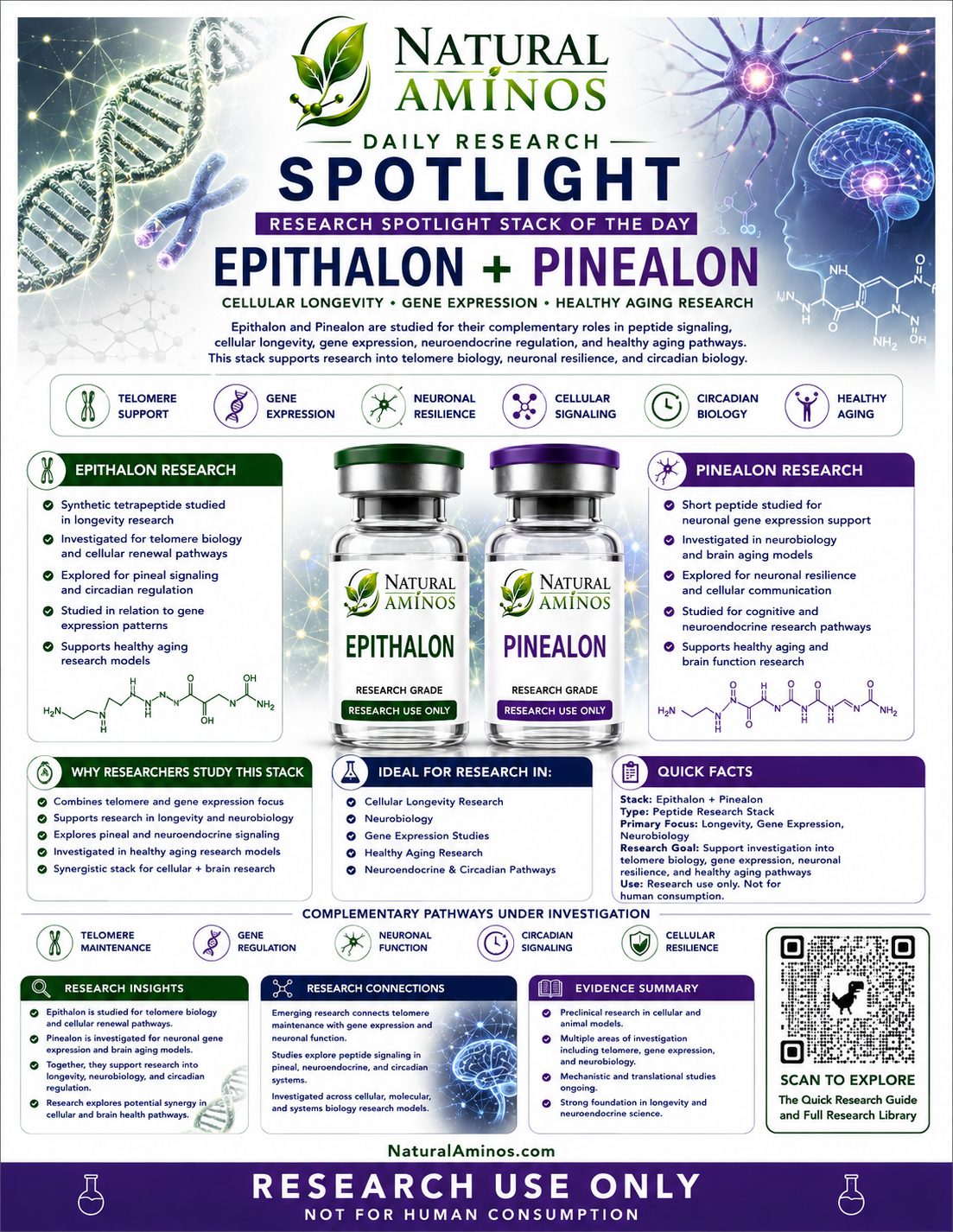
Epithalon + Pinealon Research Data
For laboratory research use only; not for human or veterinary use or consumption. This page provides research information, not personal-use instructions or medical advice.
Natural Aminos Research Stack or Formula of the Day
Epithalon + Pinealon
Circadian Regulation, Neuroprotection & Cognitive-Aging Research Spotlight
Compound Identity & Research Context
Epithalon (also spelled Epitalon or Epithalone) and Pinealon are distinct ultrashort synthetic peptides from the Russian short-peptide bioregulator research program associated with Vladimir Khavinson and colleagues in St. Petersburg. Epithalon is the tetrapeptide Ala-Glu-Asp-Gly (AEDG), developed from the amino-acid composition of the pineal peptide preparation Epithalamin. Pinealon is the tripeptide Glu-Asp-Arg (EDR), described in the literature as a neuroprotective sequence associated with cerebral-cortex polypeptide preparations such as Cortexin. Their names are sometimes grouped together commercially, but they are chemically and scientifically different compounds.
Epithalon is studied primarily for pineal/circadian regulation, melatonin, retinal biology, cellular aging, telomerase and telomere biology. Pinealon is studied primarily for neuronal stress resistance, oxidative injury, dendritic-spine preservation, neuroplasticity and cognitive aging. The two peptides share a proposed short-peptide gene-regulatory model involving nuclear penetration and interactions with DNA or histone proteins, but their functional research profiles differ.
An important strength of this pair is that the compounds have been tested side-by-side in several laboratory studies. Those experiments permit a direct biological comparison, but they are not combination studies: the peptides were generally applied in separate experimental arms. No peer-reviewed human trial, animal trial or cell experiment was identified in which Epithalon and Pinealon were administered together as one defined stack.
Benefits
Epithalon
Epithalon's most defensible biological benefit signal is regulation of age-sensitive pineal and circadian function. Russian research in old rhesus monkeys found that Epithalon increased nighttime melatonin concentrations that had fallen with age, while younger animals did not show the same effect. Human gerontology reports likewise describe increased nighttime melatonin output in older individuals with reduced pineal function. This suggests a normalization model rather than simple stimulation: the peptide appears most active in systems showing age- or stress-related dysregulation.
Epithalon also has a cellular-aging research line centered on telomerase and telomeres. Earlier St. Petersburg studies reported that the peptide activated telomerase, lengthened telomeres and extended the replicative life of human fibroblasts in culture. In 2025, a research group at Brunel University London independently reported telomere-length increases in normal human cell lines through hTERT/telomerase upregulation. The same study also found telomere-lengthening effects in breast-cancer cell lines through an alternative pathway, emphasizing that telomere biology is mechanistically interesting but not automatically equivalent to a safe or clinically useful longevity effect.
Additional Epithalon work supports neuroendocrine and neuronal effects. Human retinal research reported improvements in selected visual outcomes in retinitis pigmentosa, while stem-cell experiments found increased expression of neuronal differentiation markers including Nestin, GAP43, beta-tubulin III and Doublecortin. In a 2024 model of induced cortical neurons derived from elderly human fibroblasts, AEDG increased dendritic arborization, supporting a possible neuroprotective role in addition to its better-known pineal and telomere research.
Pinealon
Pinealon's strongest research signal is neuroprotection under oxidative, hypoxic and degenerative stress. In cerebellar granule cells, PC12 cells and neutrophils, Pinealon reduced reactive-oxygen-species accumulation and necrotic cell death under stress conditions, while altering ERK1/2 signaling and cell-cycle behavior. In hypobaric-hypoxia research comparing several short peptides, Pinealon produced the most pronounced antihypoxic effect and appeared to improve neuronal resistance through endogenous antioxidant systems and reduced excitotoxic stress rather than through direct radical scavenging.
Pinealon also has a consistent neuroplasticity signal in Alzheimer-related models. In cultured mouse hippocampal neurons exposed to amyloid-beta synaptotoxicity, EDR restored the number of mature mushroom-shaped dendritic spines toward normal. In 5xFAD Alzheimer's mice, EDR and another tripeptide reduced dendritic-spine loss. The proposed mechanism involves regulation of genes associated with apoptosis, antioxidant defense, lipid signaling and neuroplasticity, including CASP3, SOD2, PPARA, PPARG and GAP43.
Human evidence is much weaker. Russian clinical and occupational reports describe improved memory, attention, performance or biological-age indices after Pinealon-containing interventions. A 2020 review reports that oral Pinealon added to standard therapy in 72 patients with post-traumatic cerebrasthenia was associated with better memory, fewer or less intense headaches, emotional stabilization and improved performance. However, the accessible indexed source is a review rather than a fully retrievable primary randomized trial, so this should be treated as low-certainty clinical observation.
A separate 2015 Russian report followed 32 adults aged 41-83 with polymorbidity and organic brain syndrome in remission who received Pinealon and Vesugen. The investigators reported improved central-nervous-system activity and biological-age indicators, but the study did not isolate Pinealon cleanly and also reported prooxidant chemiluminescence findings and a decrease in circulating CD34-positive hematopoietic cells. Those findings argue against presenting Pinealon as a simple, uniformly antioxidant human intervention.
What the Formulas Are Studied For
Epithalon Research Areas
• Pineal-gland function and age-related reduction in nighttime melatonin.
• Circadian rhythm regulation and clock-related neuroendocrine biology.
• Telomerase activation, hTERT expression and telomere length in cultured cells.
• Retinal degeneration and retinitis pigmentosa.
• Neuronal differentiation and dendritic development in human-derived cell models.
• Chromatin, histone and gene-expression regulation.
• Animal gerontology and lifespan research, while recognizing that many human long-term gerontology studies used Epithalamin rather than synthetic Epithalon.
Pinealon Research Areas
• Neuroprotection during oxidative stress and hypoxic injury.
• Dendritic-spine preservation and neuroplasticity in Alzheimer-related models.
• Cognitive aging, memory, attention and perceptual-motor performance.
• Post-traumatic cerebral dysfunction and cerebrasthenia in older Russian clinical observations.
• MAPK/ERK signaling, apoptosis, antioxidant-enzyme expression and neuronal stress responses.
• Serotonin synthesis and brain-cortex gene regulation.
• Gene/histone interaction and proposed epigenetic regulation by short peptides.
Published Research — Worldwide Evidence Review
Epithalon — Russia, Ukraine, Poland and United Kingdom
The majority of Epithalon's historical research comes from the St. Petersburg Institute of Bioregulation and Gerontology and related Russian/Ukrainian groups. A major evidence issue is the frequent mixing of Epithalon with Epithalamin. Epithalamin is a bovine pineal polypeptide extract; Epithalon is the defined AEDG tetrapeptide. Long-term mortality and geroprotection studies involving Epithalamin are important to the broader pineal-peptide hypothesis but are not direct clinical proof for Epithalon.
Compound-specific Epithalon research includes old-monkey studies demonstrating increased nighttime melatonin after treatment and a human retinitis-pigmentosa clinical report describing improved visual measures. In cultured lymphocytes from older adults, Epithalon was also reported to activate ribosomal genes and modify age-associated heterochromatin. These studies support biological activity but were produced mainly within the originating research network.
A 2020 Russian/Italian collaborative cellular study found that AEDG increased expression and synthesis of several neuronal differentiation markers in human gingival mesenchymal stem cells. Molecular modeling suggested interaction with H1 histones at DNA-associated sites, providing one proposed epigenetic mechanism. A 2025 Polish review summarized more than two decades of Epithalon work and concluded that geroprotective, neuroendocrine and antioxidant effects are promising but that the full mechanism and modern clinical validation remain incomplete.
Independent evidence improved in 2025 when Brunel University London investigators reported Epithalon-associated telomere lengthening in normal human cell lines with increased telomerase activity. The study is valuable because it comes from outside the original St. Petersburg program, but it remains an in-vitro experiment and cannot establish human lifespan extension.
Pinealon — Russia and Limited Human Observational Evidence
Pinealon's published evidence remains heavily concentrated in Russian institutions. The 2011 Rejuvenation Research paper from the St. Petersburg group demonstrated reduced ROS accumulation and necrotic cell death under stress in neuronal and related cell systems, with altered ERK1/2 activation. A 2008 hypobaric-hypoxia study tested Vilon, Epithalon, Vesugen and Pinealon and reported the strongest antihypoxic effect for Pinealon.
The Alzheimer-related evidence is also preclinical. A 2017 hippocampal-neuron study found that EDR increased mature dendritic spines by 71% under amyloid-beta synaptotoxicity, restoring the measure toward normal. A 2021 5xFAD mouse study reported that EDR and KED prevented dendritic-spine loss and proposed gene-regulatory mechanisms involving promoters relevant to apoptosis, antioxidant defense, lipid metabolism and neuronal plasticity.
Pinealon has additional cell research linking it with serotonin synthesis in aging brain-cortex cultures. A 2014 study reported increased serotonin expression and proposed regulation of the tryptophan-hydroxylase gene. These studies create a plausible neurochemical and cognitive research rationale, but they remain cell or animal evidence.
The strongest indexed human Pinealon report available as a primary abstract is a 2015 Russian gerontology study of 32 adults aged 41-83 with chronic polymorbidity and organic brain syndrome in remission. Pinealon and Vesugen were associated with improved CNS activity and biological-age indicators; Vesugen was described as producing the stronger geroprotective effect. The same report also described prooxidant activity and a reduction in circulating CD34-positive cells. Because two peptides were evaluated and the design details available in the abstract are limited, the study cannot establish Pinealon-specific efficacy.
A 2012 Russian occupational report in locomotive crews described improved biological-age and adaptive-response measures after a short Pinealon course. Again, the study was not a modern randomized, blinded, placebo-controlled efficacy trial. A 2020 Molecules review also summarizes the 72-patient post-traumatic cerebrasthenia experience, but the primary trial report is not readily accessible in indexed English-language form. No registered U.S. or EU randomized clinical development program for Pinealon was identified.
Direct Epithalon vs. Pinealon Research
Although no study was identified that administered the two peptides together as one intervention, several experiments have tested both AEDG and EDR in the same design. This is valuable because it lets the compounds be compared directly instead of relying only on separate literatures.
In the 2008 hypobaric-hypoxia model, Epithalon and Pinealon were both active, but Pinealon produced the most pronounced antihypoxic effect among the four short peptides studied. A companion in-vitro study found that the peptides did not act as direct antioxidants; all increased baseline intracellular ROS, while all except Epithalon reduced the fraction of dead neurons. These findings suggest that the peptides influence stress-response and cell-death pathways rather than functioning as simple free-radical scavengers.
Biophysical work in 2011 showed that fluorescently labeled Epithalon and Pinealon could enter the cytoplasm, nucleus and nucleolus of HeLa cells and interact in vitro with specific DNA oligonucleotide sequences. A 2013 study found that both AEDG and EDR could bind histones in a site-dependent manner. These experiments support a shared nuclear/epigenetic hypothesis, but they do not prove that an administered peptide reaches target-cell nuclei intact in a living human.
The most relevant modern comparison was published in 2024 using induced cortical neurons transdifferentiated from dermal fibroblasts of elderly human donors. Epithalon (AEDG), Pinealon (EDR) and KED all increased dendritic arborization, including the number of primary neuronal processes and total dendrite length. Pinealon produced the clearest reduction in oxidative DNA damage; Epithalon also increased dendritic complexity but did not significantly reduce the oxidative-DNA marker in that model. Neither peptide improved mitochondrial or lysosomal activity. This direct human-derived-cell comparison suggests related neuroprotective potential with different endpoint strengths.
A 2025 study of neuronal transdifferentiation and senescence again included AEDG and EDR among the peptides tested. AEDG and KED were associated with reductions in selected senescence markers, whereas EDR did not lead that endpoint. The pattern reinforces the idea that Epithalon and Pinealon are not interchangeable: both can affect neuronal biology, but their strongest effects differ by model and outcome.
Direct Research on Epithalon + Pinealon as a Stack
No peer-reviewed human, animal or cell study was identified that intentionally combined Epithalon and Pinealon in the same treatment arm and compared the pair with either peptide alone. The existing head-to-head studies tested the compounds separately. Therefore, the biological interaction of concurrent AEDG + EDR exposure—including synergy, redundancy, antagonism, pharmacokinetics and safety—remains untested.
This is an important distinction. The pair has more comparative evidence than many peptide stacks, because researchers have applied both peptides within the same experimental systems, but comparative evidence is not combination evidence. A theory of the stack can be informed by the observed differences between AEDG and EDR, yet the combined outcome still cannot be predicted with confidence.
Theory of the Stack — How the Combination Could Work
1. Circadian and Pineal Regulation — Epithalon Layer
Epithalon would provide the circadian/neuroendocrine layer of the stack. Aging is associated with reduced nighttime melatonin output and less robust circadian organization. Epithalon's primate and human literature suggests that it may normalize nighttime pineal output primarily when that system is already impaired. In theory, a more stable circadian signal could improve the timing environment in which neuronal repair, sleep-dependent memory processing and metabolic recovery occur.
2. Direct Neuronal Stress Resistance — Pinealon Layer
Pinealon would provide the more direct neuroprotective layer. Its strongest preclinical effects involve oxidative stress, hypoxia, dendritic-spine preservation and reduced neuronal death. If these effects translated to humans, Pinealon could theoretically increase resilience of neurons exposed to metabolic, inflammatory or age-related stress and help preserve synaptic structure.
3. Neuroplasticity Could Be a Shared but Differentiated Target
The 2024 induced-neuron experiment is particularly useful for stack theory because both AEDG and EDR increased dendritic arborization. That means the peptides may converge on neuronal structural plasticity. However, EDR was stronger on oxidative-DNA damage, while other studies give AEDG stronger effects on neurogenic differentiation or senescence-associated endpoints. The theoretical benefit of combining them is therefore not simple duplication: one might strengthen the cellular environment for differentiation and aging resistance while the other strengthens stress resistance and dendritic preservation.
4. Shared Nuclear Mechanisms Could Be Complementary—or Redundant
Both peptides have been reported to enter cell nuclei in vitro and interact with histones or DNA sequences. In theory, this could allow each short peptide to regulate a different set of genes because their amino-acid sequences and binding preferences differ. A combination might therefore broaden gene-regulatory coverage. The counterargument is redundancy: if both peptides converge on the same chromatin or transcriptional machinery, co-exposure might produce little additional effect once the relevant regulatory pathway is already engaged.
5. Memory and Circadian Biology Are Mechanistically Connected
Sleep/circadian disruption can impair memory consolidation, attention and neuronal plasticity. Epithalon's pineal/melatonin research and Pinealon's cognition/neuroprotection research therefore fit together at a systems level. The theoretical stack benefit would be to support both the timing architecture that helps organize sleep-dependent neural function and the neuronal resilience required to maintain memory circuits.
This remains an indirect hypothesis. No study has shown that Epithalon improves Pinealon's cognitive effects, that Pinealon improves Epithalon's circadian effects, or that either peptide changes clinically meaningful sleep or cognition when the other is present.
6. Oxidative Stress and Cellular Aging Could Be Addressed at Different Points
Pinealon appears strongest in models of oxidative DNA damage, hypoxia and neuronal stress. Epithalon's aging literature emphasizes chromatin, telomerase, telomeres, melatonin and cellular differentiation. A theoretical combined benefit would be simultaneous support for stress resistance and age-associated regulatory decline. The 2024 induced-neuron study gives some support to this division: both peptides improved neuronal morphology, but EDR showed the stronger oxidative-DNA effect.
7. Telomere Biology Adds a Distinct Epithalon Component
Pinealon does not have a comparably developed telomerase/telomere literature. Epithalon therefore contributes a distinct cellular-aging hypothesis that the EDR peptide does not simply duplicate. If Epithalon's telomere findings eventually translate to human tissue, combining it with a neuroprotective peptide could theoretically address both replicative/cellular aging and neuronal functional aging.
The limitation is substantial: telomere lengthening in cultured cells is not proof of healthy-aging benefit in people, and telomere-maintenance pathways are active in cancer biology. A stack that combines gene-regulatory and proliferative-aging mechanisms requires long-term safety study rather than assuming that broader biological activity is automatically favorable.
8. The Main Risk to the Theory Is Single-Network Evidence
Most research on both peptides still traces to the same St. Petersburg research tradition or close collaborators. Shared methods and hypotheses can make two compounds look mutually supportive even when independent laboratories have not replicated the findings. Epithalon now has some independent in-vitro replication, but Pinealon remains much more dependent on the originating network. Theoretical complementarity should therefore be discounted for limited independent replication.
Possible Overall Benefit — Theoretical, Not Proven
The most defensible theoretical benefit of Epithalon + Pinealon is coordinated support for age-related brain function at two levels. Epithalon could influence circadian/pineal timing, neuronal differentiation and broader cellular-aging pathways; Pinealon could support neuronal resistance to oxidative and hypoxic stress, preserve dendritic structure and influence neuroplasticity-related gene expression. If both effects translated in the same biological system, the combination could theoretically support cognitive resilience more broadly than either peptide alone.
For cognitive-aging research, the possible overall benefit would be preservation of neuronal structure plus improvement of the neuroendocrine environment in which cognition operates. Pinealon could theoretically help protect synapses and neurons from stress, while Epithalon could help stabilize circadian signals that influence sleep-dependent memory and recovery. Both peptides also appear capable of increasing dendritic complexity in human-derived induced neurons, which provides a direct cellular point of convergence.
For healthy-aging research, Epithalon adds a separate telomere/chromatin hypothesis while Pinealon adds direct neuronal stress-resistance biology. That makes the stack more complementary than two peptides targeting the same receptor. However, no experiment has shown that the combination is additive or synergistic, and human evidence for Pinealon remains especially weak. The overall benefit should therefore be described as plausible neurogeroprotective coverage, not a demonstrated cognitive or longevity effect.
Why More Research Is Needed
• No published study has administered Epithalon and Pinealon together in one treatment arm, so synergy, redundancy, antagonism and combined safety are unknown.
• The strongest direct pair evidence is comparative rather than combinational: both peptides have been studied side-by-side in hypoxia, nuclear-interaction and induced-neuron experiments, but not as a stack.
• Pinealon lacks a modern randomized, blinded, placebo-controlled human efficacy trial, human pharmacokinetics and independently replicated clinical safety data.
• The often-cited 72-patient Pinealon post-traumatic-brain-injury observation is summarized in later reviews, but the primary report is not readily accessible as a modern indexed randomized trial and should remain low-certainty evidence.
• The 2015 Pinealon/Vesugen human study did not isolate Pinealon and included potentially concerning findings such as prooxidant activity and reduced circulating CD34-positive cells.
• Most Pinealon research comes from one Russian research network, leaving independent replication as a major gap.
• Epithalon's human evidence is also geographically concentrated and methodologically older. Many long-term human geroprotection studies used Epithalamin rather than synthetic Epithalon.
• The 2025 independent Epithalon telomere study was conducted in cultured cells. Telomere extension is not proof of slower human aging or better cognition.
• Both peptides are proposed to act through nuclear DNA/histone interactions, but no study has demonstrated intact-peptide target engagement in living human brain tissue.
• The 2024 induced-neuron study used cells derived from only three elderly donors. It is a useful human-cell model but cannot establish clinical efficacy or brain penetration.
• A rigorous combination study should measure circadian markers, objective cognitive testing, EEG/sleep measures, oxidative-DNA damage, neurofilament or synaptic biomarkers, and long-term safety rather than relying on one endpoint.
• Long-duration work should specifically examine whether broad gene-regulatory and telomere-related effects remain controlled in proliferative tissues and whether repeated exposure changes hematologic, immune or metabolic function.
Research Summary
Epithalon + Pinealon is a scientifically coherent neurogeroprotection stack because the two peptides have different primary research profiles despite sharing a short-peptide gene-regulation framework. Epithalon is strongest in pineal/circadian, telomere and neuronal-differentiation research; Pinealon is strongest in oxidative-stress, hypoxia, dendritic-spine and neuroplasticity research. The pair also has unusually useful head-to-head laboratory evidence: both have been tested in the same experimental systems, and a 2024 human-derived induced-neuron study found that both increased dendritic arborization while Pinealon produced the clearer reduction in oxidative DNA damage.
The practical evidence remains weak for a true stack. No study has administered both together and shown an additive outcome. Epithalon has limited human biological data and some newer independent cell-line replication; Pinealon has small Russian human observations but no modern randomized efficacy program and little independent replication. The correct interpretation is therefore a plausible circadian-plus-neuroprotection hypothesis with shared and differentiated cellular effects, not a proven cognitive, neurodegenerative or longevity intervention.
Selected Sources
• Araj SK, Brzezik J, Madra-Gackowska K, Szeleszczuk L. Overview of Epitalon—Highly Bioactive Pineal Tetrapeptide with Promising Properties. International Journal of Molecular Sciences. 2025;26(6):2691. PMID: 40141333. PMCID: PMC11943447. DOI: 10.3390/ijms26062691.
• Al-Dulaimi S, Thomas R, Matta S, Roberts T. Epitalon increases telomere length in human cell lines through telomerase upregulation or ALT activity. Biogerontology. 2025;26(5):178. PMID: 40908429. PMCID: PMC12411320. DOI: 10.1007/s10522-025-10315-x.
• Khavinson VK, Bondarev IE, Butyugov AA, Smirnova TD. Peptide promotes overcoming of the division limit in human somatic cell. Bulletin of Experimental Biology and Medicine. 2004;137(5):503-506. PMID: 15455129. DOI: 10.1023/B:BEBM.0000038164.49947.8c.
• Khavinson VK, et al. Peptide Epitalon activates chromatin at the old age. Neuro Endocrinology Letters. 2003;24(5):329-333. PMID: 14647006.
• Korkushko OV, et al. Normalizing effect of the pineal gland peptides on the daily melatonin rhythm in old monkeys and elderly people. Advances in Gerontology. 2007;20(1):74-85. PMID: 17969590.
• Peptide correction of age-related pineal disturbances in monkeys. Advances in Gerontology. PMID: 14743609.
• Khavinson VK, Razumovsky MI, Trofimova SV, Grigorian R, Razumovskaya A. Pineal-regulating tetrapeptide Epitalon improves eye retina condition in retinitis pigmentosa. Neuro Endocrinology Letters. 2002;23(4):365-368. PMID: 12195242.
• Khavinson VK, Linkova NS, Kozhevnikova EO, Trofimova SV. EDR Peptide: Possible Mechanism of Gene Expression and Protein Synthesis Regulation Involved in the Pathogenesis of Alzheimer's Disease. Molecules. 2020;26(1):159. PMID: 33396470. PMCID: PMC7795577. DOI: 10.3390/molecules26010159.
• Khavinson V, Ribakova Y, Kulebiakin K, et al. Pinealon increases cell viability by suppression of free radical levels and activating proliferative processes. Rejuvenation Research. 2011;14(5):535-541. PMID: 21978084. DOI: 10.1089/rej.2011.1172.
• Kozina LS. Investigation of antihypoxic properties of short peptides. Advances in Gerontology. 2008;21(1):61-67. PMID: 18546825.
• Kozina LS, Arutiunian AV, Stvolinskii SL, Khavinson VK. Biological activity of regulatory peptides in model experiments in vitro. Advances in Gerontology. 2008;21(1):68-73. PMID: 18546826.
• Kraskovskaya N, et al. Tripeptides Restore the Number of Neuronal Spines under Conditions of In Vitro Modeled Alzheimer's Disease. Bulletin of Experimental Biology and Medicine. 2017;163(4):550-553. PMID: 28853087.
• Khavinson V, et al. Neuroprotective Effects of Tripeptides—Epigenetic Regulators in Mouse Model of Alzheimer's Disease. Pharmaceuticals. 2021;14(6):515. PMID: 34071923. PMCID: PMC8227791. DOI: 10.3390/ph14060515.
• Short peptides stimulate serotonin expression in cells of brain cortex. Bulletin of Experimental Biology and Medicine. 2014;157(1):77-80. PMID: 24909721. DOI: 10.1007/s10517-014-2496-y.
• Meshchaninov VN, et al. Effect of synthetic peptides on aging of patients with chronic polymorbidity and organic brain syndrome of the central nervous system in remission. Advances in Gerontology. 2015;28(1):62-67. PMID: 26390612.
• Nazimko VA, et al. Analysis of some parameters of biological age and adaptation possibilities of workers of locomotive brigades. Advances in Gerontology. 2012;25(1):57-62. PMID: 22708445.
• Umnov RS, Linkova NS, Khavinson VK. Neuroprotective effects of peptide bioregulators in people of various age. Advances in Gerontology. 2013;26(4):671-678. PMID: 24738258.
• Fedoreyeva LI, Kireev II, Khavinson VK, Vanyushin BF. Penetration of short fluorescence-labeled peptides into the nucleus in HeLa cells and in vitro specific interaction of the peptides with deoxyribooligonucleotides and DNA. Biochemistry (Moscow). 2011;76(11):1210-1219. PMID: 22117547.
• Fedoreyeva LI, Smirnova TA, Kolomijtseva GYa, Khavinson VK, Vanyushin BF. Interaction of short peptides with FITC-labeled wheat histones and their complexes with deoxyribooligonucleotides. Biochemistry (Moscow). 2013;78(2):166-175. PMID: 23581987. DOI: 10.1134/S0006297913020053.
• Khavinson V, et al. AEDG Peptide (Epitalon) Stimulates Gene Expression and Protein Synthesis during Neurogenesis: Possible Epigenetic Mechanism. Molecules. 2020;25(3):609. PMID: 32019204. PMCID: PMC7037223.
• Kraskovskaya N, Linkova N, Sakhenberg E, et al. Short Peptides Protect Fibroblast-Derived Induced Neurons from Age-Related Changes. International Journal of Molecular Sciences. 2024;25(21):11363. PMID: 39518916. PMCID: PMC11546785. DOI: 10.3390/ijms252111363.
• The Influence of Short Peptides on Cell Senescence and Neuronal Differentiation. 2025. PMID: 41020860.
Theory vs. Proof — Verdict
What is supported by evidence: Epithalon has human and primate evidence for pineal/circadian effects, human retinal research, a substantial cell literature on telomerase/chromatin/neurogenesis, and 2025 independent confirmation of telomere effects in cultured human cells. Pinealon has repeated preclinical evidence for neuroprotection, hypoxia resistance, reduced oxidative injury and dendritic-spine preservation, plus small low-certainty Russian human observations. Both peptides have been tested directly in the same laboratory models, including a 2024 human-derived induced-neuron system in which both increased dendritic complexity.
What is not proven: that Pinealon improves cognition or prevents neurodegenerative disease in a modern randomized human trial; that Epithalon slows human aging or extends lifespan; that the two peptides reach neuronal nuclei intact after human administration; or that simultaneous Epithalon + Pinealon exposure is additive, synergistic or safe over the long term.
Verdict — theory vs. proof: the mechanistic theory is moderately strong and genuinely complementary, but the clinical proof is weak. Epithalon contributes a pineal/circadian, neurogenic and telomere-associated regulatory layer, while Pinealon contributes a stronger neuronal stress-resistance and dendritic-preservation layer. Shared nuclear and dendritic effects create some overlap, so synergy cannot be assumed. The strongest modern head-to-head evidence suggests differentiated strengths rather than one peptide simply duplicating the other: both promoted dendritic growth, while Pinealon showed the clearer oxidative-DNA protection in aged induced neurons. Overall, Epithalon + Pinealon is best classified as a coherent neurogeroprotective research hypothesis with meaningful preclinical comparison data, limited human evidence, and no direct proof for the combined stack.
Research & Educational Use Only !!