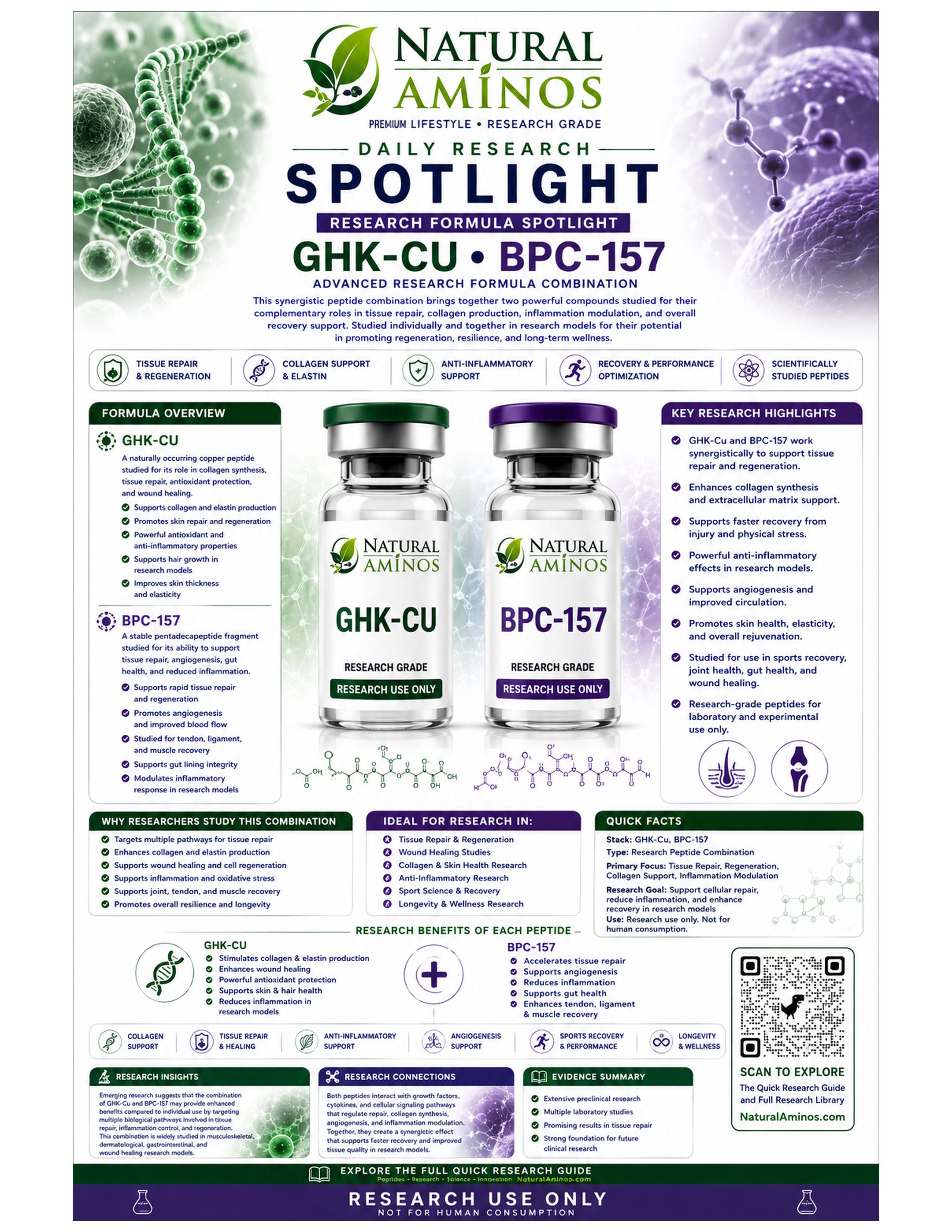
GHK-Cu + BPC-157 Research Data
For laboratory research use only; not for human or veterinary use or consumption. This page provides research information, not personal-use instructions or medical advice.
Natural Aminos Research Stack or Formula of the Day
GHK-Cu + BPC-157
Extracellular-Matrix Remodeling, Angiogenesis & Tissue-Repair Research Spotlight
Compound Identity & Research Context
GHK-Cu and BPC-157 are both discussed in regenerative research, but they represent different biological systems and very different levels of clinical evidence. GHK-Cu is the copper(II) complex of the naturally occurring human tripeptide glycyl-L-histidyl-L-lysine (GHK). It is found in plasma and other biological fluids and has been studied for wound repair, collagen and glycosaminoglycan synthesis, extracellular-matrix remodeling, angiogenesis, fibroblast function, inflammatory modulation and skin regeneration. BPC-157 is a synthetic 15-amino-acid peptide (GEPPPGKPADDAGLV) developed from a gastric protein fragment and studied primarily in Croatian animal models of tendon, ligament, muscle, nerve, gastrointestinal and vascular injury.
The strongest GHK-Cu human evidence is local/topical. A randomized multicenter diabetic-ulcer trial reported substantially greater wound closure with topical GHK-Cu gel than vehicle. The strongest BPC-157 evidence remains preclinical: repeated rat studies show improved tendon, ligament and muscle healing, while human evidence consists of very small uncontrolled studies and a two-person intravenous pilot. No peer-reviewed cell, animal or human study was identified that administered GHK-Cu and BPC-157 together as one defined combination.
Benefits
GHK-Cu
GHK-Cu's best-supported benefit is regulation of tissue remodeling. French fibroblast studies showed that GHK-Cu stimulates collagen synthesis and increases sulfated glycosaminoglycan production at low concentrations. Later work showed that it also increases matrix metalloproteinase-2 and tissue inhibitors of metalloproteinases, indicating that the peptide does not simply build matrix; it can participate in controlled matrix turnover and reorganization.
This matrix biology is accompanied by a broader regenerative profile. Reviews of the experimental literature describe increased fibroblast and keratinocyte activity, vascular growth, nerve outgrowth, collagen/elastin-related synthesis, antioxidant effects and suppression of selected inflammatory pathways. GHK-Cu therefore fits best as a remodeling signal that can influence both the cells performing repair and the extracellular environment they rebuild.
Human evidence is meaningful but route-specific. In a multicenter randomized, evaluator-blinded, placebo-controlled study of diabetic neuropathic ulcers, topical GHK-Cu gel produced a median 98.5% reduction in plantar-ulcer area versus 60.8% with vehicle, accelerated closure and reduced ulcer infections when treatment began after debridement. A randomized post-laser-resurfacing trial did not find objective superiority for erythema or wrinkle improvement, though patient satisfaction with skin quality was higher. A 2026 systematic review in aesthetic medicine found only two randomized clinical trials among 20 eligible studies, emphasizing that the human evidence remains much thinner than the preclinical literature.
Injectable use is a separate evidence problem. FDA's current compounding-safety page states that injectable GHK-Cu may present immunogenicity risks because of aggregation and peptide-related impurities and that human safety data for injectable routes are limited. Therefore, topical wound-healing data cannot be automatically converted into proof for systemic injection.
BPC-157
BPC-157's proposed regenerative benefit comes from a wide preclinical pattern rather than a single receptor mechanism. Rat studies have reported improved healing after Achilles tendon transection, medial collateral ligament transection, muscle crush, myotendinous-junction injury, muscle-to-bone detachment and peripheral-nerve injury. Across these models, treated animals often showed improved biomechanics, collagen organization, walking function, reduced inflammatory infiltration and better restoration of tissue continuity.
Angiogenesis appears to be one important part of the repair response. Croatian investigators reported that BPC-157 did not directly stimulate angiogenesis in isolated cell cultures but increased VEGF-associated vascular responses in injured muscle and tendon. This suggests context-dependent angiomodulation rather than simple constitutive vessel growth. BPC-157 has also been linked experimentally with nitric-oxide/eNOS signaling, growth-factor pathways, fibroblast/tendocyte activity and inflammatory modulation.
Human evidence remains very limited. A 2021 retrospective knee-pain series contacted 16 patients after intra-articular BPC-157 or BPC-157 plus thymosin-beta-4 and reported subjective pain improvement in most patients, but there was no control group, no standardized functional instrument, no imaging-based tissue endpoint and no blinding. A 2025 IRB-approved IV pilot exposed only two healthy adults and found no short-term laboratory or vital-sign abnormalities after brief infusion. These studies show human exposure, not established efficacy or long-term safety.
In July 2026, FDA reviewed BPC-157-related bulk drug substances through the Pharmacy Compounding Advisory Committee process. FDA continues to state that compounded BPC-157 may pose immunogenicity and peptide-characterization risks and that available safety-related information is limited for the proposed routes of administration. BPC-157 therefore remains investigational.
What the Formulas Are Studied For
GHK-Cu Research Areas
• Wound healing and diabetic-ulcer closure.
• Collagen, elastin and glycosaminoglycan synthesis.
• Extracellular-matrix turnover through MMP/TIMP regulation.
• Fibroblast, keratinocyte and endothelial-cell activity.
• Angiogenesis and microvascular repair.
• Skin remodeling, photoaging and post-procedure recovery.
• Anti-inflammatory, antioxidant and gene-expression effects.
• Experimental nerve outgrowth and broader tissue-regeneration models.
BPC-157 Research Areas
• Achilles tendon repair, tendon-to-bone healing and myotendinous-junction recovery in rats.
• Ligament healing and biomechanical restoration.
• Muscle transection, crush injury and muscle-to-bone reattachment.
• VEGF-associated angiogenesis/angiomodulation during tissue repair.
• Nitric-oxide/eNOS signaling and inflammatory control.
• Peripheral-nerve repair in traumatic animal models.
• Gastrointestinal mucosal injury and inflammatory-bowel-disease-related research.
• Limited exploratory human work in knee pain, interstitial cystitis and intravenous safety/pharmacokinetics.
Published Research — Worldwide Evidence Review
GHK-Cu — France, United States, China and Current International Reviews
The foundational extracellular-matrix studies came from Reims, France. In 1988, Maquart and colleagues reported that GHK-Cu stimulated collagen synthesis in cultured fibroblasts without simply increasing cell number. In 1992, the same research tradition showed a dose-dependent increase in sulfated glycosaminoglycan synthesis, particularly dermatan sulfate and heparan sulfate. Later French work demonstrated increased MMP-2 expression together with TIMP-1 and TIMP-2, supporting a coordinated matrix-remodeling rather than one-directional collagen-production model.
U.S. human data include the multicenter diabetic-ulcer trial, which remains one of the strongest direct treatment studies for GHK-Cu. Topical GHK-Cu significantly accelerated plantar-ulcer closure compared with vehicle within standardized wound care and reduced infection incidence. A 2006 randomized post-CO2-laser study did not find objective superiority for erythema, wrinkles or skin-quality scoring, showing that GHK-Cu's clinical effect is not uniform across all tissue-repair settings.
More recent Asian research has focused on delivery systems rather than systemic peptide administration. Chinese groups have developed GHK-Cu- or Cu-GHK-containing nanofibers and hydrogels that improved fibroblast migration, collagen remodeling, angiogenesis and wound closure in preclinical models. A 2024 China-based study used GHK/GHK-Cu-modified silver nanoparticles to combine antibacterial and wound-healing activity, and newer Chinese hydrogel research continues to use GHK-Cu in diabetic and infected wound systems. These studies strengthen the local-regeneration literature but remain preclinical material-science research.
A 2026 U.S. systematic review of GHK-Cu in aesthetic medicine included 20 studies but only two randomized clinical trials. The review found consistent preclinical support for extracellular-matrix synthesis, angiogenesis, proliferation and anti-inflammatory effects, while concluding that clinical guidance is limited by few controlled trials, variable formulations and delivery methods. This current review confirms a strong mechanism but a large translational gap.
BPC-157 — Croatia, United States and Current Reviews
BPC-157's musculoskeletal literature is dominated by Croatian investigators. A 2003 rat Achilles-tendon study found improved load to failure, functional Achilles index, fibroblast/collagen organization and restoration of tendon integrity. A 2010 medial-collateral-ligament study reported consistent functional, biomechanical, macroscopic and histological improvements over 90 days across intraperitoneal, topical and oral administration routes.
Croatian angiogenesis work showed that BPC-157 was associated with increased VEGF expression and organized vascular repair in injured muscle and tendon, while isolated cell cultures did not show simple direct angiogenesis. Other rat work demonstrated improved early tendon-to-bone recovery with reduced inflammatory cell influx and increased vascular index, and later studies reported restoration of myotendinous-junction and muscle-to-bone injuries that normally heal poorly.
BPC-157 has also shown activity outside connective tissue, including rat sciatic-nerve injury and multiple gastrointestinal injury models. These diverse animal effects support a broad injury-response hypothesis but also create a translational challenge: a peptide that appears active across many unrelated organ systems requires strong human target-engagement and pharmacology studies before the same breadth of benefit can be assumed clinically.
The U.S. human literature is very small. The 2021 retrospective knee-pain report included 16 contacted patients; most reported subjective improvement after BPC-157 alone or BPC-157 plus thymosin-beta-4, but the design was uncontrolled and did not establish tissue regeneration. In 2025, an IV pilot in two previously exposed healthy adults reported no short-term adverse effects after one-hour infusions. A 2025 systematic review and a 2026 orthopaedic primer both concluded that BPC-157's musculoskeletal evidence remains overwhelmingly preclinical and requires rigorous human trials.
No completed Russian, Middle Eastern or large East-Asian BPC-157 clinical program was identified that materially changes this evidence hierarchy. The central BPC-157 evidence remains Croatian preclinical work plus limited U.S. exploratory human exposure.
Direct Research on GHK-Cu + BPC-157 Together
No peer-reviewed cell, animal or human study was identified that directly administered GHK-Cu and BPC-157 together as a defined combination. Current 2026 reviews compare the two compounds because both are discussed in regenerative medicine, but those reviews synthesize separate literatures rather than reporting a combination experiment.
No study was found comparing BPC-157 + GHK-Cu against BPC-157 alone, GHK-Cu alone or placebo. No published pharmacokinetic study was identified that measured systemic exposure or tissue distribution when the two were administered concurrently, and no controlled compatibility study was identified for combining separate preparations.
The stack therefore has no direct proof. Its proposed benefit must be judged by whether the mechanisms are sufficiently different to be complementary without assuming that overlapping repair pathways automatically create synergy.
Theory of the Stack — How the Combination Could Work
1. Early Injury-Response and Vascular Signaling — BPC-157 Layer
BPC-157's most plausible contribution is the early injury environment. Animal studies associate it with reduced inflammatory infiltration, improved vascular response, VEGF-related angiogenesis, nitric-oxide signaling and earlier restoration of mechanical and functional integrity. In a theoretical stack, BPC-157 would help move injured tissue from an unstable inflammatory state toward organized repair.
2. Matrix Construction and Remodeling — GHK-Cu Layer
GHK-Cu would provide the structural-remodeling layer. Fibroblasts exposed to GHK-Cu increase collagen and selected glycosaminoglycans, while MMP/TIMP changes suggest active matrix turnover rather than indiscriminate deposition. In theory, this could support maturation of the connective-tissue scaffold once early inflammatory and vascular conditions become favorable.
3. Angiogenesis Is a Point of Complementarity and Overlap
Both compounds are associated with vascular repair. BPC-157's animal studies link it with injury-dependent VEGF expression and new vessel formation; GHK-Cu research also supports endothelial migration and angiogenesis. This overlap could be helpful if each acts through different regulatory signals, but it also creates uncertainty. There is no combination study showing that concurrent exposure produces better perfusion than either compound alone, and excessive or poorly timed angiogenic signaling would not necessarily improve repair.
4. Fibroblast and Collagen Biology Could Form a Sequential Repair Model
The strongest stack theory is sequential rather than simply additive. BPC-157 may improve the injury environment and support migration/vascularization; GHK-Cu may then support matrix production and remodeling by fibroblasts. Tendon, ligament, muscle and skin repair all require transition from inflammation to proliferation and then matrix maturation. A combination could theoretically cover more than one phase of that process.
The weakness is that BPC-157 itself already improves fibroblast, collagen and matrix outcomes in animal models, so GHK-Cu may partly duplicate an effect BPC-157 already produces. No experiment has established whether the overlap adds benefit or simply reaches the same biological ceiling.
5. Anti-Inflammatory Signaling Could Reduce Excessive Scar-Forming Pressure
Both peptides have anti-inflammatory research signals. If inflammation is appropriately reduced without blocking the necessary early wound response, the theoretical result could be less prolonged tissue damage and better-quality remodeling. GHK-Cu is described as suppressing several inflammatory pathways and oxidative processes; BPC-157 reduces inflammatory infiltration in multiple animal injury models. Their combined effect on human wound inflammation is completely unknown.
6. Nerve and Microvascular Repair May Add a Broader Regenerative Layer
GHK-Cu reviews describe nerve outgrowth activity, while BPC-157 has a rat sciatic-nerve injury literature. Both are also linked to vascular repair. In tissue injuries where sensory nerves, microvasculature and connective tissue are damaged together, the stack could theoretically provide broader recovery coverage than a matrix-only approach. This is mechanistic extrapolation; no GHK-Cu + BPC-157 nerve-repair study exists.
7. Route of Administration Is the Largest Translational Problem
The two compounds have different evidence-supported routes. GHK-Cu's strongest human evidence is topical/local, while BPC-157's main efficacy evidence is in animals using intraperitoneal, oral or local routes. Modern systemic subcutaneous stacking assumes pharmacokinetics and target-tissue exposure that have not been characterized in controlled human studies. The theory may be sound at the tissue level while the actual systemic exposures fail to reproduce the conditions under which the individual evidence was generated.
8. Copper Biology Makes GHK-Cu More Than 'Another Healing Peptide'
GHK-Cu carries copper, and copper is a catalytic cofactor involved in matrix enzymes, antioxidant defense and vascular biology. That makes GHK-Cu mechanistically distinct from BPC-157. The potential advantage is access to copper-dependent repair pathways that BPC-157 does not directly supply. The uncertainty is that systemic copper handling is tightly regulated; a locally active GHK-Cu wound mechanism does not prove that repeated systemic exposure produces the same controlled copper delivery.
Possible Overall Benefit — Theoretical, Not Proven
The most defensible theoretical benefit of GHK-Cu + BPC-157 is a two-stage regenerative strategy: BPC-157 could improve early injury-response signaling, vascularization and inflammatory control, while GHK-Cu could support later extracellular-matrix synthesis, collagen/glycosaminoglycan organization and tissue remodeling. If these effects occur sequentially and at useful tissue concentrations, the combination could theoretically improve both the speed and quality of repair.
For tendon, ligament or muscle research, the possible benefit would be earlier restoration of blood supply and cellular activity followed by stronger or better-organized matrix maturation. For skin or wound research, GHK-Cu already has direct human local evidence, while BPC-157 could theoretically add an early vascular/injury-response component. For injuries involving nerve and connective tissue, both compounds also have separate preclinical nerve-related evidence.
The theory is reasonably strong because the compounds are not pharmacologic duplicates, but it is less independent than it first appears. Both influence angiogenesis, fibroblast behavior, inflammation and collagen-related repair. That means synergy cannot be assumed. A stack could outperform either compound alone, equal the best single agent, or provide no additional benefit if the shared repair pathways are already maximally engaged.
Why More Research Is Needed
• No published study has tested GHK-Cu + BPC-157 together in cells, animals or humans, so additive benefit, synergy, antagonism and optimal timing are unknown.
• BPC-157's strongest evidence is preclinical and concentrated in Croatian research groups. Human musculoskeletal evidence remains small, uncontrolled and methodologically weak.
• The 2025 BPC-157 IV pilot included only two previously exposed healthy adults and cannot establish population-level safety or long-term risk.
• GHK-Cu has real human local/topical evidence, but systemic injectable pharmacokinetics, tissue distribution, copper handling and long-term safety are poorly defined.
• FDA currently identifies both BPC-157 and injectable GHK-Cu as having limited safety information and potential concerns related to aggregation, peptide impurities, API characterization and immunogenicity.
• Both compounds influence angiogenesis. Combination studies should determine whether the vascular overlap is complementary, redundant or excessive in different tissues and injury stages.
• Both compounds can influence fibroblast and matrix biology. A controlled head-to-head and combination design is needed to determine whether GHK-Cu adds anything beyond BPC-157's existing preclinical collagen/fibroblast effects.
• Route translation is unresolved. Topical GHK-Cu, intra-articular BPC-157, IV BPC-157, oral animal BPC-157 and systemic subcutaneous research use cannot be assumed pharmacologically equivalent.
• Copper-dependent signaling requires dedicated monitoring. Repeated systemic GHK-Cu studies should evaluate copper distribution, ceruloplasmin, hepatic handling and oxidative balance rather than assuming local wound pharmacology applies systemically.
• Future work should separate early inflammatory/vascular effects from later matrix-remodeling effects and test whether sequential timing is superior to simultaneous administration.
• Independent replication across Europe, Asia and North America is needed, particularly for BPC-157's musculoskeletal findings and for systemic GHK-Cu exposure.
• Human trials should use objective endpoints such as MRI/ultrasound tissue structure, validated functional scores, tensile or biomechanical surrogates where possible, wound-closure rates, vascular imaging and safety biomarkers rather than subjective improvement alone.
Research Summary
GHK-Cu + BPC-157 is a mechanistically coherent tissue-repair stack built from two different regenerative traditions. BPC-157 has a large animal literature showing tendon, ligament, muscle, nerve and vascular repair effects, but very limited human evidence. GHK-Cu has deep extracellular-matrix research and stronger direct human local wound evidence, particularly in diabetic plantar ulcers, but its systemic injectable evidence is sparse.
The theoretical pairing is strongest as a staged repair model: BPC-157 for early injury-response, vascular and inflammatory regulation; GHK-Cu for fibroblast-driven collagen, glycosaminoglycan and matrix remodeling. The limitation is that the two pathways overlap in angiogenesis, inflammation and fibroblast biology, so the combination may be complementary without necessarily being synergistic. No direct combination study exists, making the stack a plausible regenerative hypothesis rather than an experimentally validated treatment strategy.
Selected Sources
• Maquart FX, et al. Stimulation of collagen synthesis in fibroblast cultures by the tripeptide-copper complex glycyl-L-histidyl-L-lysine-Cu2+. FEBS Letters. 1988;238(2):343-346. PMID: 3169264. DOI: 10.1016/0014-5793(88)80509-X.
• Maquart FX, et al. Stimulation of sulfated glycosaminoglycan synthesis by the tripeptide-copper complex glycyl-L-histidyl-L-lysine-Cu2+. Life Sciences. 1992. PMID: 1522753. DOI: 10.1016/0024-3205(92)90504-I.
• Siméon A, et al. The tripeptide-copper complex GHK-Cu stimulates matrix metalloproteinase-2 expression by fibroblast cultures. Life Sciences. 2000. PMID: 11045606.
• Mulder GD, et al. Enhanced healing of ulcers in patients with diabetes by topical treatment with glycyl-L-histidyl-L-lysine copper. Wound Repair and Regeneration. 1994;2(4):259-269. PMID: 17147644. DOI: 10.1046/j.1524-475X.1994.20406.x.
• Miller TR, et al. Effects of topical copper tripeptide complex on CO2 laser-resurfaced skin. Archives of Facial Plastic Surgery. 2006;8(4):252-259. PMID: 16847171. DOI: 10.1001/archfaci.8.4.252.
• Pickart L. The human tri-peptide GHK and tissue remodeling. Journal of Biomaterials Science, Polymer Edition. 2008;19:969-988. PMID: 18644225.
• Pickart L, Margolina A. Regenerative and Protective Actions of the GHK-Cu Peptide in the Light of the New Gene Data. International Journal of Molecular Sciences. 2018;19(7):1987. PMID: 29986520. PMCID: PMC6073405. DOI: 10.3390/ijms19071987.
• The Regenerative Potential of GHK-Cu in Aesthetic Medicine. Systematic review. 2026. PMID: 42619529.
• Tripeptides GHK and GHK-Cu-modified silver nanoparticles for enhanced antibacterial and wound healing activities. 2024. PMID: 38387323.
• In situ photo-crosslinkable hyaluronic acid-based hydrogel embedded with GHK peptide nanofibers for bioactive wound healing. 2023. PMID: 37832839.
• Staresinic M, et al. Gastric pentadecapeptide BPC 157 accelerates healing of transected rat Achilles tendon and in vitro stimulates tendocytes growth. Journal of Orthopaedic Research. 2003;21(6):976-983. PMID: 14554208. DOI: 10.1016/S0736-0266(03)00110-4.
• Cerovecki T, et al. Pentadecapeptide BPC 157 (PL 14736) improves ligament healing in the rat. Journal of Orthopaedic Research. 2010;28(9):1155-1161. PMID: 20225319. DOI: 10.1002/jor.21107.
• Pevec D, et al. Modulatory effect of gastric pentadecapeptide BPC 157 on angiogenesis in muscle and tendon healing. Journal of Physiology and Pharmacology. 2010. PMID: 20388964.
• Krivic A, et al. Modulation of early functional recovery of Achilles tendon to bone unit after transection by BPC 157 and methylprednisolone. Inflammation Research. 2008. PMID: 18594781.
• Gjurasin M, et al. Peptide therapy with pentadecapeptide BPC 157 in traumatic nerve injury. Regulatory Peptides. 2010;160:33-41. PMID: 19903499. DOI: 10.1016/j.regpep.2009.11.005.
• Stable Gastric Pentadecapeptide BPC 157 as a Therapy for the Disable Myotendinous Junctions in Rats. 2021. PMID: 34829776.
• Stable Gastric Pentadecapeptide BPC 157 as Therapy After Surgical Detachment of the Quadriceps Muscle from Its Attachments for Muscle-to-Bone Reattachment in Rats. 2025. PMID: 39861766.
• Lee E, Padgett B. Intra-Articular Injection of BPC 157 for Multiple Types of Knee Pain. Alternative Therapies in Health and Medicine. 2021;27(4):8-13. PMID: 34324435.
• Lee E, Burgess K. Safety of Intravenous Infusion of BPC157 in Humans: A Pilot Study. Alternative Therapies in Health and Medicine. 2025;31(5):20-24. PMID: 40131143.
• Vasireddi N, et al. Emerging Use of BPC-157 in Orthopaedic Sports Medicine: A Systematic Review. HSS Journal. 2025. PMID: 40756949.
• Regeneration or Risk? A Narrative Review of BPC-157 for Musculoskeletal Healing. 2025. PMID: 40789979.
• BPC-157 and GHK-Cu in Wound Healing and Tissue Repair: A Review of Clinical Efficacy and Safety. Quality in Sport. 2026. DOI: 10.12775/QS.2026.54.70818.
• U.S. Food and Drug Administration. July 23-24, 2026 Pharmacy Compounding Advisory Committee briefing materials for BPC-157-related bulk drug substances.
• U.S. Food and Drug Administration. Certain Bulk Drug Substances for Use in Compounding that May Present Significant Safety Risks. Current 2026 entries for BPC-157 and injectable GHK-Cu.
Theory vs. Proof — Verdict
What is supported by evidence: GHK-Cu has direct human local/topical wound-healing evidence and extensive fibroblast/extracellular-matrix research showing effects on collagen, glycosaminoglycans and matrix remodeling. BPC-157 has repeated animal evidence for tendon, ligament, muscle, vascular and nerve repair, with only limited exploratory human exposure and pain data.
What is not proven: that systemic injectable GHK-Cu reproduces topical wound benefits; that BPC-157 reliably accelerates human tissue regeneration; that concurrent BPC-157 + GHK-Cu exposure is additive or synergistic; or that the combination has a defined human pharmacokinetic, safety or efficacy profile.
Verdict — theory vs. proof: the mechanistic theory is moderately strong and largely complementary, but direct proof is absent. BPC-157 plausibly contributes early injury-response, inflammatory and vascular signaling, while GHK-Cu contributes a well-developed extracellular-matrix remodeling and copper-dependent repair layer. The main uncertainty is substantial pathway overlap: both influence angiogenesis, fibroblast activity, inflammation and collagen-related repair, so two biologically active repair signals may not automatically outperform one. Overall, GHK-Cu + BPC-157 is best classified as a coherent multi-phase tissue-repair hypothesis with meaningful individual evidence—stronger human local evidence for GHK-Cu and stronger animal musculoskeletal evidence for BPC-157—but no direct evidence validating the combined stack.
Research & Educational Use Only !!