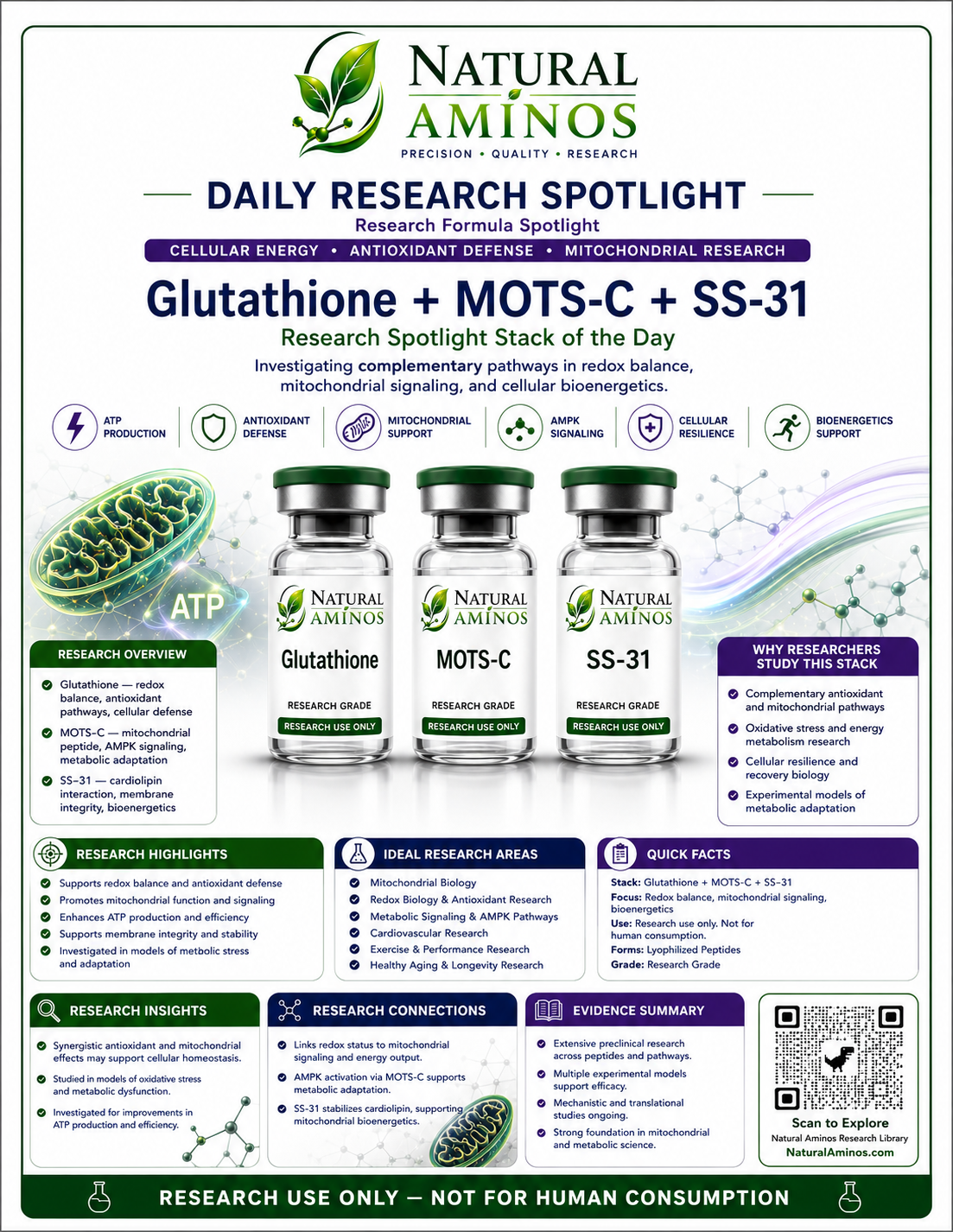
Glutathione + MOTS-c + SS-31 Research Data
For laboratory research use only; not for human or veterinary use or consumption. This page provides research information, not personal-use instructions or medical advice.
Natural Aminos Research Stack or Formula of the Day
Glutathione + MOTS-c + SS-31
Redox Defense, Metabolic Signaling & Mitochondrial-Membrane Research Spotlight
Compound Identity & Research Context
This stack combines three different approaches to mitochondrial and cellular stress biology. Glutathione (GSH) is an endogenous tripeptide—glutamate, cysteine and glycine—and one of the cell's principal thiol-redox buffers. It participates in peroxide detoxification, protein thiol regulation, xenobiotic conjugation and maintenance of the reduced intracellular environment. MOTS-c is a 16-amino-acid mitochondrial-derived peptide encoded within the mitochondrial 12S rRNA region; its best-characterized research actions involve folate/purine metabolism, AICAR accumulation, AMPK activation and metabolic adaptation. SS-31 is the research name for elamipretide, a mitochondria-targeting tetrapeptide that associates with cardiolipin and inner-mitochondrial-membrane protein complexes.
The regulatory status of SS-31 changed materially in 2025. Elamipretide received U.S. FDA accelerated approval under the brand name Forzinity to improve muscle strength in adult and pediatric patients with Barth syndrome weighing at least 30 kg. The approval is narrow, based on an intermediate muscle-strength endpoint, and requires a confirmatory trial. It does not establish elamipretide as a general anti-aging, athletic, metabolic or mitochondrial-performance drug.
The theoretical stack is attractive because the three components act at different levels: glutathione buffers intracellular oxidation, MOTS-c activates adaptive energy-sensing and mitochondrial stress-response programs, and SS-31 directly targets the inner mitochondrial membrane and cardiolipin-dependent bioenergetic organization. No peer-reviewed animal or human study was identified that tested all three together.
Benefits
Glutathione
Glutathione's clearest biological benefit is redox control. Reduced glutathione donates electrons to detoxify peroxides through glutathione peroxidases and is regenerated from oxidized glutathione by glutathione reductase using NADPH. It also participates in protein S-glutathionylation, a reversible redox modification that can protect reactive cysteine residues and regulate enzyme activity. Because mitochondria continuously generate reactive oxygen species during respiration, glutathione is an important component of mitochondrial redox homeostasis even though mitochondrial GSH must be supplied from the cytosolic pool.
Human supplementation studies demonstrate that glutathione exposure can alter measurable body stores, but clinical effects depend heavily on formulation, route and indication. A six-month randomized, double-blind trial in 54 healthy adults found dose- and time-dependent increases in glutathione in blood, erythrocytes, plasma, lymphocytes and buccal cells. A smaller liposomal-glutathione study also reported increased blood and cellular GSH together with lower oxidative-stress markers. A 2026 randomized crossover pharmacokinetic trial in Canada found that a micellar oral formulation increased blood GSH exposure more than comparator formulations after a single dose.
Clinical outcome evidence is much less uniform. Intravenous glutathione in a small randomized Parkinson's disease pilot was tolerated but did not significantly improve the primary motor outcome. Inhaled glutathione has been tested in European cystic-fibrosis trials: one six-month German multicenter trial did not improve the primary FEV1 endpoint, while a longer Italian study found only modest subgroup and functional signals. A 2026 review concluded that glutathione's molecular importance is much stronger than the evidence for broad systemic therapeutic benefit and warned that excessive reducing pressure can theoretically create reductive stress.
MOTS-c
MOTS-c is a mitochondrial-derived signaling peptide rather than a structural mitochondrial component. The foundational 2015 U.S. study showed that MOTS-c inhibits part of the folate cycle and de novo purine pathway, leading to accumulation of the endogenous AMP analog AICAR and activation of AMPK. In mice, MOTS-c improved insulin sensitivity and prevented high-fat-diet-induced obesity and insulin resistance, with skeletal muscle identified as a major target tissue.
MOTS-c research has since expanded toward exercise, aging and mitochondrial efficiency. A 2026 Copenhagen-led study reported that MOTS-c improved intrinsic skeletal-muscle mitochondrial bioenergetic performance through PGC-1alpha- and AMPK-dependent mechanisms, while lowering mitochondrial reactive-oxygen-species emission and oxidative protein damage in mice. This is particularly relevant to the present stack because it suggests that MOTS-c can improve mitochondrial performance while simultaneously lowering excessive ROS rather than simply stimulating metabolism at the expense of oxidation.
Human evidence remains transitional. Observational studies link endogenous MOTS-c and mitochondrial MOTS-c variants with insulin resistance, exercise and type 2 diabetes risk. An Asian-specific K14Q mitochondrial variant has been associated with higher type 2 diabetes prevalence in men and reduced insulin-sensitizing activity. Most importantly, a Phase 2a randomized, double-blind, placebo-controlled trial began in 2026 to test 12 weeks of exogenous MOTS-c in adults with prediabetes and overweight/obesity. The trial is recruiting and has no efficacy results yet.
SS-31 / Elamipretide
SS-31, now clinically known as elamipretide, is a mitochondria-targeting tetrapeptide that concentrates at the inner mitochondrial membrane and interacts with cardiolipin. Cardiolipin is a specialized phospholipid required for the organization and function of oxidative-phosphorylation complexes, cristae architecture and multiple mitochondrial proteins. Contemporary mechanistic work suggests that elamipretide is not simply a free-radical scavenger; it can alter cardiolipin-associated membrane electrostatics, protein organization and bioenergetic function.
The human clinical program is extensive and mixed. In a 30-person randomized crossover trial in primary mitochondrial myopathy, four weeks of elamipretide did not significantly meet the six-minute-walk primary endpoint, although fatigue-related patient-reported outcomes favored treatment. The subsequent 218-person Phase III MMPOWER-3 trial failed both primary endpoints—six-minute walk distance and total fatigue—providing Class I evidence that elamipretide did not improve those outcomes in that broad primary-mitochondrial-myopathy population.
Barth syndrome produced a different result. A small randomized crossover trial initially failed its primary endpoints at 12 weeks, but open-label extension data and later analyses supported longer-term functional improvement. In September 2025, FDA granted accelerated approval to Forzinity (elamipretide) for Barth syndrome in patients weighing at least 30 kg, based on improved knee-extensor muscle strength considered reasonably likely to predict clinical benefit. A post-approval randomized confirmatory trial is required.
Elamipretide has also been studied in heart failure. A single-infusion trial showed acute favorable changes in ventricular volumes at the highest dose, but a later 28-day Phase II trial did not improve left-ventricular end-systolic volume or ejection fraction versus placebo. This history shows that a strong mitochondrial mechanism can produce disease-specific benefit without yielding broad success across every mitochondrial or cardiovascular indication.
What the Formulas Are Studied For
Glutathione Research Areas
• Cellular and mitochondrial redox homeostasis.
• Peroxide detoxification through glutathione peroxidase systems.
• Protein S-glutathionylation and redox-sensitive enzyme regulation.
• Oxidative-stress conditions including neurodegenerative and pulmonary disease research.
• Immune function and inflammatory-redox signaling.
• Oral, liposomal, micellar, inhaled, topical and intravenous delivery research.
• Bioavailability and the relationship between measurable GSH elevation and actual clinical outcomes.
MOTS-c Research Areas
• Insulin sensitivity, glucose uptake and metabolic homeostasis.
• AMPK activation through folate/purine/AICAR pathway changes.
• Skeletal-muscle mitochondrial bioenergetics and metabolic flexibility.
• Exercise signaling, physical performance and age-related functional decline.
• Mitochondrial oxidative stress and ROS handling.
• Prediabetes and overweight/obesity in an ongoing Phase 2a human treatment trial.
• Mitochondrial genetics, including the Asian-specific K14Q variant and diabetes risk.
SS-31 / Elamipretide Research Areas
• Cardiolipin binding and inner-mitochondrial-membrane organization.
• Oxidative phosphorylation, ATP-generating efficiency and cristae function.
• Barth syndrome, for which elamipretide now has U.S. accelerated approval in patients weighing at least 30 kg.
• Primary mitochondrial myopathy, where a Phase III trial failed its major endpoints.
• Heart failure and cardiac energetics.
• Kidney, ischemia-reperfusion, aging-heart and other mitochondrial-injury models.
• Mitochondrial ROS production, protein-thiol oxidation and redox remodeling.
Published Research — Worldwide Evidence Review
Glutathione — United States, Canada, Australia, Europe, Asia and Middle East
The human glutathione literature is global and route-dependent. In the United States, a six-month randomized double-blind trial in healthy adults found that oral glutathione increased GSH stores in multiple blood and cellular compartments and reduced the oxidized-to-reduced glutathione ratio. A later U.S. pilot of liposomal glutathione showed increased GSH in blood and peripheral immune cells and reduced oxidative-stress markers, although the sample was small.
In 2026, Canadian investigators with Australian collaborators published a randomized crossover pharmacokinetic study comparing oral micellar, standard and liposomal glutathione in healthy adults. The work supports formulation-dependent differences in systemic glutathione exposure and short-term safety, reinforcing that 'glutathione' is not one pharmacokinetic intervention across all oral products.
European disease trials show why biochemical plausibility must be separated from clinical efficacy. A German multicenter double-blind study of inhaled glutathione in cystic fibrosis did not improve the primary FEV1 endpoint over six months. An Italian randomized study over 12 months also failed its prespecified major lung-function target, although selected subgroups and walking performance showed modest signals. These trials demonstrate that raising airway antioxidant capacity does not automatically translate into a major clinical outcome.
In U.S. Parkinson's disease research, a randomized IV-glutathione pilot was well tolerated but did not significantly improve Unified Parkinson's Disease Rating Scale outcomes compared with placebo. In Asia, oral glutathione has been tested in dermatology, including randomized trials in Thailand and Indonesia, with modest or inconsistent changes in pigmentation or inflammatory markers. Iranian investigators published a 2026 review concluding that oral glutathione has plausible benefits and measurable bioavailability but faces major translational limitations from degradation, formulation variability and inconsistent clinical endpoints.
No Russian or Middle Eastern controlled trial of glutathione combined specifically with MOTS-c or elamipretide was identified. Research from those regions contributes to general redox biology, but it does not alter the combination-evidence gap.
MOTS-c — United States, East Asia and Europe
The 2015 discovery study from the University of Southern California, UCLA and the U.S. National Institute on Aging established MOTS-c as a mitochondrial-derived metabolic signal. Cellular work linked it to the folate cycle, de novo purine synthesis, AICAR accumulation and AMPK activation, while mouse studies showed prevention of high-fat-diet-induced obesity and insulin resistance.
Human genetics provides an important East-Asian data set. A multi-cohort analysis involving more than 27,000 participants found that the Asian-specific mitochondrial MOTS-c K14Q variant was associated with greater type 2 diabetes prevalence in men, particularly at lower physical-activity levels. Experimental K14Q-MOTS-c also lost much of the insulin-sensitizing activity of the canonical peptide, supporting biological relevance of the endogenous pathway.
European-led physiology has expanded the mechanism. The 2026 Copenhagen/Ghent study showed that exogenous MOTS-c improved intrinsic muscle mitochondrial efficiency in mice through PGC-1alpha and AMPK and lowered mitochondrial ROS emission and protein oxidative damage. Human exercise measurements in the same work did not support a simple model in which contracting skeletal muscle is necessarily the source of circulating MOTS-c.
As of September 2026, the most important translational development is the MOTS-MET Phase 2a trial (NCT07505745). It is recruiting adults with prediabetes and overweight/obesity and is designed to test insulin sensitivity, glycemic measures, lipids, body weight, waist circumference and safety after 12 weeks. There are no posted results yet, so exogenous MOTS-c remains investigational.
SS-31 / Elamipretide — United States, Europe and International Mitochondrial Trials
Mechanistic research from U.S. and international laboratories shows that elamipretide binds within cardiolipin-rich inner mitochondrial membranes and interacts with cardiolipin-associated proteins involved in oxidative phosphorylation and 2-oxoglutarate metabolism. Current reviews emphasize restoration of membrane organization and bioenergetics rather than a simplistic 'antioxidant peptide' description.
Clinical results vary by disease. MMPOWER-2 enrolled 30 adults with genetically confirmed primary mitochondrial myopathy. Four weeks of 40 mg/day subcutaneous elamipretide produced a numerically greater six-minute walk distance than placebo but did not reach statistical significance for the primary endpoint; several fatigue-related patient-reported outcomes improved. MMPOWER-3 then enrolled 218 participants for 24 weeks and failed both primary endpoints, with no improvement in six-minute walk distance or total fatigue.
Barth syndrome showed a more disease-specific response. The randomized crossover TAZPOWER trial in 12 participants did not meet its primary endpoints during the initial blinded periods, but the open-label extension reported improved six-minute walk performance and symptom scores at later time points. FDA ultimately granted accelerated approval in September 2025 for patients weighing at least 30 kg based on improvement in knee-extensor muscle strength, while requiring a confirmatory randomized trial.
Cardiac trials provide additional mixed evidence. A single-infusion heart-failure study involving U.S. and Bulgarian sites showed short-term favorable changes in ventricular volumes at the highest dose. A later 71-person Phase II study of 28 days of daily subcutaneous treatment failed to improve left-ventricular end-systolic volume or ejection fraction versus placebo. These results emphasize that mitochondrial target engagement is not equivalent to universal functional benefit.
Preclinical aging-heart work gives the strongest direct link between elamipretide and the glutathione redox system. In old mice, SS-31 reduced mitochondrial ROS, shifted cardiac protein thiols toward a more reduced state and reversed age-associated protein S-glutathionylation patterns. This does not prove that added exogenous glutathione will enhance elamipretide, but it shows that elamipretide's biological effects intersect directly with glutathione-dependent redox chemistry.
Direct Research on Glutathione + MOTS-c + SS-31 Together
No peer-reviewed human, animal or cell study was identified that administered glutathione, MOTS-c and SS-31/elamipretide together as one three-part intervention. No controlled pairwise combination study was identified for glutathione + MOTS-c, glutathione + elamipretide, or MOTS-c + elamipretide as a defined therapeutic combination.
There are important mechanistic intersections. MOTS-c can lower mitochondrial ROS while improving bioenergetic efficiency; elamipretide can reduce mitochondrial ROS and protein-thiol oxidation while reorganizing cardiolipin-dependent mitochondrial function; and glutathione is a primary intracellular redox buffer and substrate for reversible protein S-glutathionylation. These overlaps make the stack biologically coherent, but they also create the possibility of redundancy or excessive redox suppression.
Theory of the Stack — How the Combination Could Work
1. Baseline Redox Buffering — Glutathione Layer
Glutathione would provide the broadest redox-defense layer. When mitochondrial respiration produces hydrogen peroxide or other oxidants, the glutathione system helps convert those species into less reactive products and returns oxidized protein thiols toward a reduced state. In theory, adequate glutathione availability could reduce oxidative damage to proteins, lipids and mitochondrial enzymes while preserving redox-sensitive signaling.
2. Adaptive Metabolic Signaling — MOTS-c Layer
MOTS-c would provide the metabolic-adaptation layer. By increasing AICAR and activating AMPK, MOTS-c shifts cells toward fuel utilization, glucose uptake and energy-producing processes. Newer research suggests that it can also improve intrinsic mitochondrial efficiency and lower ROS emission. This is important because the theoretical role of MOTS-c is not simply to add another antioxidant; it attempts to change how the metabolic system operates.
3. Inner-Membrane Structural Support — SS-31 Layer
SS-31/elamipretide would provide the most mitochondria-specific structural layer. Cardiolipin helps organize electron-transport-chain proteins and cristae architecture. Elamipretide's cardiolipin interactions can improve membrane organization, electron-transfer efficiency and bioenergetic function while reducing electron leak and oxidative stress. In theory, this addresses the source of mitochondrial ROS rather than only buffering ROS after it has formed.
4. Why the Three Could Be Complementary
The strongest stack theory is a sequence of source control, adaptation and buffering. SS-31 could improve inner-membrane organization and reduce inefficient electron leak; MOTS-c could activate AMPK/PGC-1alpha-linked adaptive metabolism and improve fuel handling; glutathione could buffer residual oxidants and protect thiol-sensitive proteins. If all three effects occurred without excessive suppression of physiological signaling, the combination could theoretically improve mitochondrial efficiency and cellular resilience more broadly than any single layer alone.
5. SS-31 and Glutathione Share a Direct Redox Intersection
The elamipretide aging-heart literature makes the SS-31/glutathione relationship especially interesting. Aging increased cardiac protein S-glutathionylation, reflecting altered thiol-redox state, and SS-31 treatment largely reversed those changes. This suggests that SS-31 can normalize a redox environment in which the glutathione system is already actively engaged. One theoretical interpretation is that adequate glutathione provides the chemical buffering system while SS-31 reduces the mitochondrial conditions driving abnormal glutathione-dependent protein oxidation.
The alternative interpretation is redundancy: if SS-31 already lowers mitochondrial ROS enough to normalize glutathione redox balance, additional glutathione may produce little extra benefit. No combination study has tested which interpretation is correct.
6. MOTS-c and SS-31 Target Different Parts of Mitochondrial Dysfunction
MOTS-c is best understood as a signaling peptide that tells the cell how to adapt to energy stress, whereas SS-31 directly targets mitochondrial membrane structure and cardiolipin-associated function. That difference makes them more complementary than redundant. A cell with better inner-membrane efficiency may still need AMPK-driven metabolic reprogramming, and AMPK activation does not itself rebuild cardiolipin organization.
However, both compounds reduce mitochondrial ROS in preclinical systems. Their combined redox effect could plateau once oxidative stress is normalized, even if their metabolic and structural effects remain complementary.
7. The Hormesis Question — Could Too Much Antioxidant Pressure Blunt Adaptation?
Reactive oxygen species are not only damaging byproducts; low-level ROS also act as signals during exercise, mitochondrial adaptation and stress responses. MOTS-c is itself part of a stress-adaptation system. A strong external antioxidant intervention could theoretically blunt some redox-sensitive adaptive signaling if it reduces ROS below the level needed for normal signaling. This concern is well established conceptually in redox biology but has not been tested specifically with glutathione + MOTS-c + SS-31.
This means the theoretical goal should be redox normalization rather than maximal ROS elimination. The three-compound stack could be helpful in a high-oxidative-stress state yet redundant or counterproductive in a system where redox signaling is already balanced.
8. Metabolic Disease Theory
For insulin-resistance or metabolic-stress research, MOTS-c provides the clearest metabolic signal through AMPK and skeletal-muscle glucose handling. SS-31 could theoretically improve mitochondrial efficiency and reduce oxidative damage that accompanies insulin resistance, while glutathione could support systemic redox buffering. The combination could therefore address signaling, organelle function and oxidative burden at the same time.
The limitation is that only one member currently has an ongoing human metabolic-treatment trial—MOTS-c—and it has no results yet. Elamipretide's human successes are disease-specific, and glutathione clinical outcomes are inconsistent despite measurable changes in GSH stores.
9. Healthy-Aging Theory
Aging is associated with mitochondrial dysfunction, altered redox state, reduced metabolic flexibility and impaired stress responses. All three compounds map onto those themes: glutathione to redox buffering, MOTS-c to mitochondrial stress signaling and metabolic adaptation, and SS-31 to cardiolipin-dependent mitochondrial structure. The stack therefore has a coherent healthy-aging theory.
The practical evidence is much weaker. Elamipretide has not been approved for aging and failed Phase III endpoints in primary mitochondrial myopathy; MOTS-c has not yet produced human treatment results; and glutathione supplementation has not demonstrated broad anti-aging clinical outcomes. The healthy-aging application remains hypothesis-level.
Possible Overall Benefit — Theoretical, Not Proven
The most defensible theoretical benefit of Glutathione + MOTS-c + SS-31 is coordinated mitochondrial support at three levels. SS-31 could improve inner-membrane organization and reduce electron leak; MOTS-c could improve AMPK/PGC-1alpha-linked metabolic adaptation and mitochondrial efficiency; glutathione could maintain redox buffering and protect proteins from excessive oxidation. This creates a coherent 'membrane + signaling + redox' model.
For metabolic research, the possible benefit would be improved glucose and fuel handling together with lower mitochondrial oxidative stress. For muscle-fatigue research, the theoretical benefit would be more efficient mitochondrial ATP production plus improved cellular stress adaptation. For recovery or aging research, the possible benefit would be reduced cumulative oxidative injury while preserving mitochondrial responsiveness.
The strongest caution is that this stack may contain more overlap than its three different names imply. MOTS-c and SS-31 both lower mitochondrial ROS in preclinical models, and SS-31 directly changes glutathione-sensitive protein redox states. The combination could be complementary when oxidative stress is high, but may show diminishing returns once redox balance is restored. There is no evidence that adding exogenous glutathione improves either MOTS-c or elamipretide efficacy.
Why More Research Is Needed
• No published study has tested Glutathione + MOTS-c + SS-31 together, and no controlled pairwise combination trial was identified.
• Glutathione changes measurable redox biomarkers more consistently than it changes major clinical outcomes; formulation and route strongly influence exposure.
• Glutathione research must distinguish correction of oxidative stress from excessive reductive pressure. Reductive stress is biologically possible and should be measured in combination studies.
• MOTS-c remains investigational. The ongoing Phase 2a MOTS-MET trial has no posted efficacy results as of September 2026.
• MOTS-c's strongest benefits remain animal and mechanistic. Human observational genetics and exercise biology support the pathway but do not prove therapeutic efficacy of exogenous MOTS-c.
• Elamipretide's evidence is disease-specific. It is FDA-approved under accelerated approval for Barth syndrome, but Phase III primary mitochondrial myopathy endpoints were negative and heart-failure trials were mixed.
• The post-approval Forzinity confirmatory trial is still required to verify that improved knee-extensor strength translates into meaningful patient benefit.
• Both MOTS-c and elamipretide reduce mitochondrial ROS in preclinical models. Combination studies are needed to determine whether this is complementary or simply redundant.
• Glutathione and SS-31 intersect through protein-thiol redox and S-glutathionylation. The ideal redox state, dose-response and timing of a combined intervention are unknown.
• Physiological ROS participate in exercise and mitochondrial hormesis. Studies should test whether aggressive antioxidant buffering blunts AMPK/PGC-1alpha adaptation or other beneficial redox signals.
• Direct systemic glutathione, oral glutathione, liposomal/micellar glutathione and precursor strategies are not pharmacologically equivalent and should not be pooled as one intervention.
• Future studies should measure mitochondrial respiration, ATP production, cardiolipin remodeling, glutathione redox ratio, protein S-glutathionylation, AMPK/PGC-1alpha signaling, insulin sensitivity and validated functional outcomes in the same experimental design.
Research Summary
Glutathione + MOTS-c + SS-31 is a mechanistically sophisticated mitochondrial stack because the components address different but connected parts of mitochondrial stress biology. Glutathione is the broad intracellular redox buffer; MOTS-c is a mitochondrial-derived metabolic signal that activates AMPK and can improve mitochondrial efficiency; SS-31/elamipretide is a cardiolipin-targeting inner-membrane peptide with the strongest human drug-development history of the three and a current FDA-approved Barth-syndrome indication.
The strongest argument for the stack is the division of labor between redox buffering, adaptive metabolic signaling and mitochondrial-membrane organization. The strongest argument against assuming synergy is mechanistic overlap: both MOTS-c and elamipretide lower mitochondrial ROS, and elamipretide already normalizes glutathione-sensitive protein-thiol redox states in preclinical aging models. No combination experiment has established whether added glutathione improves outcomes or simply adds redundant antioxidant pressure. The stack is therefore biologically coherent but experimentally unvalidated.
Selected Sources
• Richie JP Jr, et al. Randomized controlled trial of oral glutathione supplementation on body stores of glutathione. European Journal of Nutrition. 2015;54(2):251-263. PMID: 24791752. ClinicalTrials.gov NCT01044277.
• Sinha R, et al. Oral supplementation with liposomal glutathione elevates body stores of glutathione and markers of immune function. European Journal of Clinical Nutrition. 2018;72(1):105-111. PMID: 28853742. DOI: 10.1038/ejcn.2017.132.
• Solnier J, et al. A Targeted Metabolomic Assessment of Oral Glutathione Bioavailability and Safety in Humans: A Randomized Crossover Clinical Trial. Antioxidants. 2026;15(3):354. PMID: 41897500. DOI: 10.3390/antiox15030354.
• Hauser RA, et al. Randomized, double-blind, pilot evaluation of intravenous glutathione in Parkinson's disease. Movement Disorders. 2009;24(7):979-983. PMID: 19230029. DOI: 10.1002/mds.22401.
• Griese M, et al. Inhalation treatment with glutathione in patients with cystic fibrosis. A randomized clinical trial. American Journal of Respiratory and Critical Care Medicine. 2013. PMID: 23631796. DOI: 10.1164/rccm.201303-0427OC.
• Randomized, single blind, controlled trial of inhaled glutathione vs placebo in patients with cystic fibrosis. Journal of Cystic Fibrosis. 2015. PMID: 25458463. DOI: 10.1016/j.jcf.2014.09.014.
• Fathizadeh H, et al. A review of the potential benefits and limitations of oral glutathione supplementation. Inflammation Research. 2026. PMID: 42446814. DOI: 10.1007/s10787-026-02336-w.
• Glutathione in redox homeostasis: Bridging molecular mechanisms, bioavailability constraints, and translational challenges in systemic therapeutics. 2026. PMID: 42585816.
• Lee C, et al. The mitochondrial-derived peptide MOTS-c promotes metabolic homeostasis and reduces obesity and insulin resistance. Cell Metabolism. 2015;21(3):443-454. PMID: 25738459. PMCID: PMC4350682. DOI: 10.1016/j.cmet.2015.02.009.
• Fuku N, et al. A pro-diabetogenic mtDNA polymorphism in the mitochondrial-derived peptide, MOTS-c. Aging. 2021. PMID: 33468709.
• Gudiksen A, et al. MOTS-c improves intrinsic muscle mitochondrial bioenergetic health and efficiency in a PGC-1alpha/AMPK-dependent manner. Free Radical Biology and Medicine. 2026;246:682-696. PMID: 41520850. DOI: 10.1016/j.freeradbiomed.2026.01.002.
• ClinicalTrials.gov NCT07505745. MOTS-c for Improving Insulin Sensitivity in Adults With Prediabetes and Overweight/Obesity (MOTS-MET). Phase 2a; recruiting; no results posted as of September 2026.
• Karaa A, et al. A randomized crossover trial of elamipretide in adults with primary mitochondrial myopathy. Journal of Cachexia, Sarcopenia and Muscle. 2020;11(4):909-918. PMID: 32096613. DOI: 10.1002/jcsm.12559.
• Karaa A, et al. Efficacy and Safety of Elamipretide in Individuals With Primary Mitochondrial Myopathy: The MMPOWER-3 Randomized Clinical Trial. Neurology. 2023;101(3):e238-e252. PMID: 37268435. DOI: 10.1212/WNL.0000000000207402.
• A phase 2/3 randomized clinical trial followed by an open-label extension to evaluate elamipretide in Barth syndrome. Genetics in Medicine. 2021. PMID: 33077895.
• U.S. Food and Drug Administration. FDA Grants Accelerated Approval to First Treatment for Barth Syndrome. September 19, 2025. Forzinity (elamipretide) for patients weighing at least 30 kg.
• U.S. Food and Drug Administration. Forzinity (elamipretide) Prescribing Information. Initial U.S. Approval 2025. NDA 215244.
• Daubert MA, et al. Novel Mitochondria-Targeting Peptide in Heart Failure Treatment: A Randomized, Placebo-Controlled Trial of Elamipretide. Circulation: Heart Failure. 2017. PMID: 29217757. DOI: 10.1161/CIRCHEARTFAILURE.117.004389.
• Effects of Elamipretide on Left Ventricular Function in Patients With Heart Failure With Reduced Ejection Fraction: The PROGRESS-HF Phase 2 Trial. Journal of Cardiac Failure. 2020. PMID: 32068002. DOI: 10.1016/j.cardfail.2020.02.001.
• Mitochondrial protein interaction landscape of SS-31. Proceedings of the National Academy of Sciences / related mitochondrial-proteomics research. 2020. PMID: 32554501.
• Elamipretide: A Review of Its Structure, Mechanism of Action, and Therapeutic Potential. 2025. PMID: 39940712.
• Contemporary insights into elamipretide's mitochondrial mechanism of action and therapeutic effects. 2025. PMID: 40294492.
• Chiao YA, et al. Late-life restoration of mitochondrial function reverses cardiac dysfunction in old mice. eLife. 2020. PMID: 32648542.
• Elamipretide (SS-31) treatment attenuates age-associated post-translational modifications of heart proteins. Geroscience. 2021. PMID: 34480713.
Theory vs. Proof — Verdict
What is supported by evidence: oral and specialized glutathione formulations can increase measurable human glutathione stores, although disease-level outcomes are inconsistent; MOTS-c has strong metabolic and mitochondrial preclinical evidence and has entered Phase 2a human treatment testing; elamipretide has extensive randomized human data and is now FDA-approved under accelerated approval for a specific Barth-syndrome population.
What is not proven: that glutathione improves MOTS-c or elamipretide efficacy; that exogenous MOTS-c produces clinically meaningful metabolic benefit in humans; that elamipretide's Barth-syndrome benefit generalizes to healthy-aging, athletic or metabolic populations; or that the three compounds together are additive, synergistic or safe as a combined regimen.
Verdict — theory vs. proof: the mechanistic theory is strong at the systems level but unvalidated as a stack. Glutathione provides cellular redox buffering, MOTS-c provides AMPK/PGC-1alpha-linked metabolic adaptation, and SS-31/elamipretide provides cardiolipin-centered inner-mitochondrial-membrane support. The three mechanisms are sufficiently distinct to be complementary, yet the redox effects overlap substantially. MOTS-c and SS-31 both lower mitochondrial ROS, and SS-31 already normalizes glutathione-sensitive thiol chemistry in preclinical models. The most accurate conclusion is that Glutathione + MOTS-c + SS-31 is a scientifically coherent 'redox + metabolic signaling + membrane bioenergetics' hypothesis with strong individual mechanistic evidence, one component with a narrow FDA-approved indication, but no direct proof that the complete combination improves mitochondrial function, metabolism, recovery or healthy-aging outcomes.
Research & Educational Use Only !!