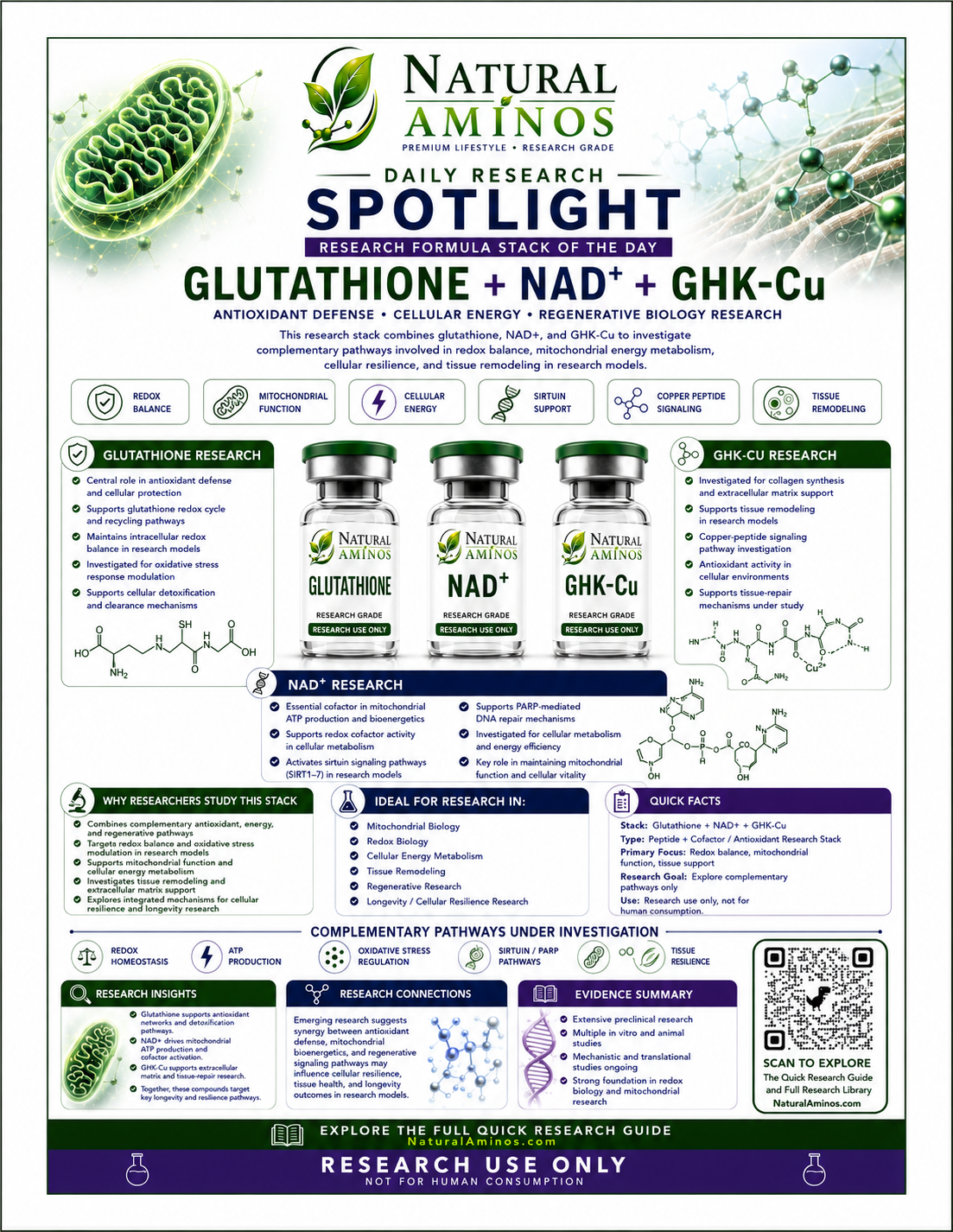
Glutathione + NAD+ + GHK-Cu Research Data
For laboratory research use only; not for human or veterinary use or consumption. This page provides research information, not personal-use instructions or medical advice.
Natural Aminos Research Stack or Formula of the Day
Glutathione + NAD+ + GHK-Cu
Redox Defense, Cellular Energy & Regenerative-Matrix Research Spotlight
Compound Identity & Research Context
This stack combines three biologically distinct systems. Glutathione (GSH) is an endogenous tripeptide made from glutamate, cysteine and glycine and is one of the cell's principal thiol-redox buffers. NAD+ (nicotinamide adenine dinucleotide) is an essential intracellular coenzyme used in redox metabolism and as a substrate by sirtuins, PARPs, CD38 and other signaling enzymes. GHK-Cu is the copper(II) complex of the naturally occurring tripeptide glycyl-L-histidyl-L-lysine, studied for collagen and glycosaminoglycan synthesis, extracellular-matrix remodeling, angiogenesis, fibroblast activity and wound repair.
The key scientific point is that these are connected but not interchangeable redox systems. Glutathione reductase regenerates reduced glutathione from oxidized glutathione using NADPH, not NAD+ directly. NAD+/NADH and NADP+/NADPH are related pyridine-nucleotide pools but serve different metabolic roles. NAD+ can influence mitochondrial energy, sirtuin/PARP activity and the metabolic pathways that help generate NADPH, while NADPH is the direct reducing currency that supports glutathione recycling. A stack theory therefore has to respect that distinction rather than claiming that added NAD+ simply "recharges" glutathione.
The theoretical combination is nevertheless coherent at three levels: glutathione provides intracellular redox buffering, NAD+ supports energy metabolism and NAD-dependent repair signaling, and GHK-Cu provides an extracellular-matrix and tissue-remodeling layer. No peer-reviewed human, animal or cell study was identified that intentionally tested all three together as one intervention.
Benefits
Glutathione
Glutathione's best-established benefit is maintenance of cellular redox homeostasis. Reduced GSH acts directly and through glutathione-dependent enzymes to detoxify peroxides, electrophiles and oxidized cellular components. Mitochondrial glutathione is especially important because mitochondria generate reactive oxygen species during oxidative phosphorylation yet cannot synthesize GSH de novo; the organelle depends on transport of glutathione from the cytosol. Depletion of mitochondrial GSH increases susceptibility to oxidative injury and cell-death pathways.
Human supplementation studies show that glutathione exposure can raise measurable body GSH stores. A six-month randomized, double-blind U.S. trial in 54 healthy adults found dose- and time-dependent increases in blood, erythrocyte, plasma, lymphocyte and buccal-cell glutathione, together with a lower oxidized-to-reduced glutathione ratio. That is strong evidence for biochemical target engagement, but it does not establish a broad disease-treatment or healthy-aging effect.
Clinical outcome trials are inconsistent and route-specific. Intravenous glutathione has been studied in small neurological trials, inhaled glutathione in cystic fibrosis, oral or liposomal glutathione in healthy adults and dermatologic settings, and newer formulations have been studied for bioavailability. The overall pattern is that glutathione can alter redox biomarkers more reliably than it changes major clinical endpoints. This is important for a stack: biochemical plausibility is strong, but the magnitude of added clinical benefit depends on whether oxidative stress is actually a limiting factor in the tissue being studied.
NAD+
NAD+ is required for glycolysis, the tricarboxylic-acid cycle and mitochondrial oxidative metabolism because it accepts and donates electrons through the NAD+/NADH pair. It is also consumed by sirtuins, PARPs and CD38, connecting NAD availability with gene regulation, DNA-damage responses, calcium signaling, inflammation and stress adaptation. These roles make NAD+ central to energy production and cellular repair biology.
The strongest human clinical evidence comes from NAD+-raising precursors such as nicotinamide riboside (NR) and nicotinamide mononucleotide (NMN), rather than direct NAD+ infusion. A 2021 randomized U.S. trial found that NMN improved skeletal-muscle insulin sensitivity in women with prediabetes. Other trials from Japan and elsewhere show reliable increases in NAD-related metabolites with selected improvements in physical, sleep or metabolic endpoints, but the effects are not consistent across all studies.
A 2025 Nature Metabolism review concluded that human NAD+ precursor trials show limited and tissue-specific efficacy despite strong preclinical biology. Direct NAD+ administration is even less established: a 2019 Australian-led pilot showed rapid metabolism during a six-hour intravenous infusion but was designed mainly to characterize pharmacokinetics and metabolite handling rather than to prove clinical benefit. The defensible benefit statement is therefore that NAD+ biology is essential and modifiable in humans, while broad anti-aging or regenerative efficacy remains unproven.
GHK-Cu
GHK-Cu's strongest benefit is regulation of tissue remodeling. French fibroblast research showed that the copper tripeptide stimulates collagen synthesis, and later work demonstrated increased sulfated glycosaminoglycans and changes in matrix metalloproteinases and their inhibitors. This supports a model in which GHK-Cu participates in both building and reorganizing extracellular matrix rather than simply increasing collagen deposition.
Human evidence is strongest with local/topical administration. A multicenter randomized, evaluator-blinded, placebo-controlled diabetic-ulcer study found markedly greater plantar-ulcer closure with topical GHK-Cu gel than vehicle, faster closure and fewer infections within standardized wound care. Other topical and aesthetic studies are more heterogeneous, and a 2026 systematic review found only two randomized clinical trials among 20 eligible GHK-Cu studies, with most evidence still preclinical.
Systemic injectable use has a much weaker evidence base. FDA currently states that compounded injectable GHK-Cu may carry immunogenicity risk from aggregation or peptide-related impurities and that human safety data are limited. Therefore, topical wound-healing data should not be presented as proof that injected GHK-Cu produces systemic collagen, nerve, skin or whole-body regenerative effects.
What the Formulas Are Studied For
Glutathione Research Areas
• Cellular and mitochondrial redox homeostasis.
• Peroxide detoxification through glutathione peroxidase systems.
• Protein S-glutathionylation and redox-sensitive signaling.
• Detoxification and electrophile conjugation through glutathione transferases.
• Oxidative-stress and inflammatory conditions in neurological, pulmonary, hepatic and metabolic research.
• Oral, liposomal, micellar, inhaled, topical and intravenous delivery strategies.
• Bioavailability and the relationship between measurable GSH elevation and functional outcomes.
NAD+ Research Areas
• Cellular redox metabolism and mitochondrial ATP production.
• Sirtuin-, PARP- and CD38-dependent signaling.
• DNA-damage responses and cellular stress recovery.
• Insulin sensitivity, skeletal-muscle metabolism and glucose handling.
• Aging biology, physical function, sleep, fatigue and vascular outcomes in precursor trials.
• Direct NAD+ infusion and newer delivery strategies aimed at raising intracellular NAD+.
• Tissue-specific NAD dynamics and the question of whether human NAD+ truly declines consistently with age.
GHK-Cu Research Areas
• Diabetic-ulcer and wound healing.
• Collagen, elastin and glycosaminoglycan synthesis.
• Extracellular-matrix turnover through MMP/TIMP regulation.
• Fibroblast, keratinocyte and endothelial-cell activity.
• Angiogenesis and local microvascular repair.
• Skin regeneration, photoaging and post-procedure recovery.
• Anti-inflammatory, antioxidant and gene-expression effects.
• Experimental nerve outgrowth and broader tissue-regeneration models, with limited systemic human evidence.
Published Research — Worldwide Evidence Review
Glutathione — United States, Europe, Australia, Canada, Asia and Current U.S. Safety Data
The U.S. six-month randomized trial by Richie and colleagues remains one of the clearest demonstrations that oral glutathione can increase human body GSH stores. Both 250 mg/day and 1,000 mg/day increased glutathione in several blood and cellular compartments, with the high-dose group showing approximately 30-35% increases in several compartments at six months and a large increase in buccal cells. The study supports bioavailability and redox target engagement, not a specific disease outcome.
European and U.S. disease trials are more mixed. Inhaled glutathione did not consistently improve the major lung-function endpoints in cystic-fibrosis trials, and a small randomized IV-glutathione study in Parkinson's disease did not significantly improve the main motor outcome. These findings are useful because they show that correcting or increasing a redox biomarker is not automatically sufficient to change clinical function.
Australian and Canadian work has focused on pharmacokinetics and formulation, while Asian studies have explored oral glutathione in dermatology and metabolic settings. The broader international literature confirms that route and formulation strongly affect exposure. Oral, liposomal, micellar, inhaled and intravenous glutathione should not be treated as one equivalent intervention.
A major current U.S. safety issue must also be separated from the molecule's biology. On August 27, 2026, FDA warned compounders not to use dietary-supplement-grade glutathione for injectable products after reports of at least 30 adverse events associated with compounded IV glutathione made from a specific dietary-supplement-grade lot; some products had elevated endotoxin and several patients were hospitalized with fever, chills, hypotension or sepsis-like reactions. This alert concerns injectable product quality and sourcing, not evidence that pharmaceutical-quality glutathione itself inherently causes endotoxin reactions.
NAD+ — United States, Japan, Australia and Europe
NAD+ human research is geographically broad. In the United States, the 2021 Washington University randomized trial showed that NMN increased muscle NAD-related metabolites and improved skeletal-muscle insulin sensitivity in women with prediabetes. The effect was selective: the trial did not demonstrate universal improvement across all systemic metabolic endpoints.
Japanese randomized studies of NMN have reported reliable increases in NAD-related metabolites and selected effects on walking performance, fatigue, drowsiness or sleep quality in older adults, while other trials have found minimal functional differences. These mixed outcomes are representative of the field: biochemical target engagement is reproducible, while clinically meaningful benefit depends on population and endpoint.
Australian investigators directly studied intravenous NAD+ metabolism in 2019. During a six-hour infusion, infused NAD+ was rapidly removed from plasma and converted into downstream metabolites. The experiment was valuable pharmacokinetic evidence but was not a controlled efficacy trial for aging, energy or recovery. Direct NAD+ should therefore not inherit efficacy claims from NR or NMN without direct evidence.
The 2025 Amsterdam-led Nature Metabolism review concluded that preclinical NAD+ biology is compelling but human evidence for age-related NAD+ decline is less uniform than often presented and human precursor trials show limited efficacy. The review emphasized tissue-specific metabolism, dose, baseline NAD status and disease context as major unresolved variables. This is the best current framework for interpreting NAD+ claims in a stack.
GHK-Cu — France, United States, China and Current Systematic Review
The foundational GHK-Cu matrix research came from Reims, France. Maquart and colleagues showed stimulation of collagen synthesis in cultured fibroblasts and later demonstrated increased sulfated glycosaminoglycan production. Subsequent work showed regulation of matrix metalloproteinases and tissue inhibitors, supporting a coordinated remodeling function rather than simple matrix accumulation.
The strongest direct human treatment evidence comes from the United States. The multicenter diabetic-neuropathic-ulcer trial found that topical GHK-Cu significantly increased plantar-ulcer closure compared with vehicle, accelerated healing and reduced infections under standardized care. This is genuine human regenerative evidence for local GHK-Cu exposure.
More recent Chinese work has focused on GHK-Cu-containing hydrogels, nanofibers and other wound-delivery systems that improve fibroblast migration, angiogenesis, antibacterial activity or wound closure in preclinical models. These studies strengthen the local wound-repair mechanism but do not establish systemic injectable benefit.
A 2026 U.S. systematic review from academic plastic-surgery groups identified 20 GHK-Cu studies relevant to aesthetic medicine but only two randomized clinical trials. The authors described a convincing preclinical regenerative profile alongside limited and heterogeneous human evidence. FDA currently lists injectable GHK-Cu as a route with limited human safety data and possible immunogenicity concerns from aggregation and peptide-related impurities.
Direct Research on Glutathione + NAD+ + GHK-Cu Together
No peer-reviewed human, animal or cell study was identified that intentionally tested glutathione, NAD+ and GHK-Cu together as a defined three-part intervention. No controlled pairwise combination study was identified for glutathione + direct NAD+, glutathione + GHK-Cu, or direct NAD+ + GHK-Cu as a therapeutic combination.
The literatures do intersect mechanistically. NAD+/NADH participates in energy metabolism; NADP+/NADPH supplies the reducing power used by glutathione reductase; glutathione controls the intracellular thiol-redox environment; and GHK-Cu regulates extracellular-matrix and wound-repair biology. These connections make a stack hypothesis possible, but they are not evidence of synergy.
Theory of the Stack — How the Combination Could Work
1. Intracellular Redox Buffering — Glutathione Layer
Glutathione would provide the immediate intracellular redox-defense layer. During energy production, inflammation and tissue repair, cells generate reactive oxygen species. GSH and glutathione-dependent enzymes help keep that oxidation within a signaling range rather than allowing it to damage proteins, lipids and mitochondrial membranes. In theory, adequate GSH could protect metabolically active or repairing cells from excessive oxidative burden.
2. Energy and NAD-Dependent Repair — NAD+ Layer
NAD+ would provide the intracellular energy-and-repair layer. A cell rebuilding tissue must generate ATP, maintain redox flux, repair DNA and regulate stress-responsive gene expression. NAD+ supports all of those functions through central metabolism, PARPs and sirtuins. If NAD availability is limiting in a stressed tissue, improving the NAD pool could theoretically increase the cellular capacity to execute repair.
This must not be confused with direct glutathione recycling. Glutathione reductase uses NADPH rather than NAD+. NAD+ can influence metabolic pathways that ultimately affect NADPH production, but a NAD+ intervention cannot be described as directly converting oxidized glutathione back to GSH.
3. Extracellular Matrix Reconstruction — GHK-Cu Layer
GHK-Cu would provide the extracellular structural layer. Repair requires fibroblast migration, collagen and glycosaminoglycan synthesis, matrix turnover, angiogenesis and reorganization of damaged tissue. The diabetic-ulcer trial demonstrates that local GHK-Cu can influence this process in humans. In a stack model, GHK-Cu would therefore act outside the core metabolic/redox machinery to shape the tissue scaffold that recovering cells must rebuild.
4. Why the Three Pathways Are Complementary
The strongest argument for the stack is division of labor. Glutathione protects the redox environment, NAD+ supports the energy and enzyme systems that allow cells to function and repair, and GHK-Cu influences the extracellular-matrix and microvascular environment. These mechanisms operate at different levels and are therefore more complementary than a stack containing three agents aimed at the same receptor.
5. NAD+ and Glutathione Are Connected Through Metabolism, Not Directly
The NAD and glutathione systems communicate through cellular metabolism. NADH is mainly linked to ATP-generating redox reactions, while NADPH is the dominant reductant used by glutathione reductase and other antioxidant systems. Cells can generate NADPH through the pentose-phosphate pathway and mitochondrial enzymes, and the balance among NAD+, NADH, NADP+ and NADPH changes with nutrient use and stress. A theoretical NAD+ intervention could indirectly affect redox capacity if it changes these metabolic networks, but the direction and magnitude would be tissue-specific.
6. GHK-Cu Adds Copper-Dependent Biology That the Other Two Do Not
GHK-Cu is not merely a third antioxidant. Copper is required by enzymes involved in connective-tissue cross-linking, antioxidant defense and vascular biology. GHK binds copper with high affinity and is proposed to help regulate its local biological availability. This creates a distinct regenerative component that NAD+ and glutathione do not directly provide.
The same feature creates uncertainty. Free or poorly controlled transition metals can participate in oxidative chemistry, while peptide-bound copper behaves differently. There is no human combination study showing how systemic GHK-Cu exposure interacts with glutathione redox status or NAD metabolism. The theoretical benefit depends on controlled copper delivery, not simply on increasing copper exposure.
7. Wound and Tissue-Repair Theory
For wound or connective-tissue research, the theory is especially coherent. GHK-Cu could drive fibroblast and matrix remodeling; NAD+ could support the ATP and NAD-dependent repair processes required by proliferating and migrating cells; glutathione could limit excessive oxidative injury during inflammation and revascularization. The three components could theoretically support the structural, energetic and redox requirements of repair at the same time.
The weakness is that local wound repair already requires controlled oxidative signaling. Reactive oxygen species help coordinate immune defense, angiogenesis and cell migration at physiologic levels. Excessive antioxidant pressure could theoretically blunt some of those signals. No study has established the optimal redox range when GHK-Cu-driven matrix remodeling is combined with glutathione supplementation.
8. Healthy-Aging Theory
Aging biology provides another systems-level rationale. NAD-related metabolism changes with age and disease, glutathione redox capacity can decline in some tissues, and extracellular-matrix remodeling becomes less efficient. A three-layer intervention could theoretically address intracellular energy, oxidative balance and declining tissue structure simultaneously.
The practical evidence is much weaker than this theory. NAD+ precursors have limited and inconsistent human functional benefits, glutathione clinical outcomes vary by indication, and GHK-Cu systemic use lacks controlled human evidence. No human study has shown that combining these pathways slows biological aging or extends healthspan.
9. Potential Redundancy and the Risk of Overcorrecting Redox Signaling
Glutathione is necessary for antioxidant defense, but redox signaling is not inherently harmful. Cells use controlled ROS to regulate proliferation, immune responses, angiogenesis and adaptation. NAD-dependent signaling also responds to cellular stress. If a system is already redox-balanced, aggressively increasing antioxidant capacity could theoretically reduce useful signaling without improving repair. This is one reason a stack should be judged by measurable redox dysfunction rather than by assuming that more antioxidant capacity is always better.
10. Proliferative and Angiogenic Context Requires Long-Term Study
GHK-Cu supports fibroblast activity and angiogenesis during repair; NAD+ supports cellular metabolism and DNA-repair systems; glutathione can protect proliferating cells from oxidative damage. Those are desirable properties in wound healing, but any long-term regenerative strategy should also be studied in contexts where uncontrolled proliferation is a concern. There is no evidence that this stack causes cancer, but broad support of repair, metabolism and vascular growth warrants dedicated long-term safety research rather than assuming that every proliferative effect is beneficial.
Possible Overall Benefit — Theoretical, Not Proven
The most defensible theoretical benefit of Glutathione + NAD+ + GHK-Cu is coordinated support for cellular repair across three levels: glutathione maintains a protective thiol-redox environment, NAD+ supports mitochondrial energy and NAD-dependent stress/repair signaling, and GHK-Cu supports extracellular-matrix construction, remodeling and angiogenesis. If all three layers are limiting in damaged or aged tissue, the combination could theoretically improve the efficiency and quality of repair more broadly than one mechanism alone.
For skin or wound research, the possible benefit would be metabolically capable cells operating in a controlled redox environment while GHK-Cu organizes collagen, glycosaminoglycans and local vascular repair. For metabolic or healthy-aging research, NAD+ and glutathione could theoretically support mitochondrial function and redox resilience while GHK-Cu addresses the structural decline of connective tissue.
The strongest caution is that the complete stack has never been tested and the evidence levels are uneven. GHK-Cu has real human local wound evidence but weak systemic evidence; NAD+ research is strongest for NR/NMN rather than direct NAD+; and glutathione reliably changes redox biomarkers more often than it changes major clinical outcomes. The overall benefit is biologically plausible but not clinically demonstrated.
Why More Research Is Needed
• No published study has tested Glutathione + NAD+ + GHK-Cu together, and no controlled pairwise combination study was identified for the three possible pairs.
• The NAD+/NADH and NADP+/NADPH systems are related but distinct. Combination studies should directly measure NAD+, NADH, NADP+, NADPH, GSH and GSSG rather than assuming one redox pool represents the others.
• Glutathione supplementation changes redox biomarkers more consistently than major clinical outcomes; the therapeutic value depends on route, formulation, tissue and baseline oxidative stress.
• FDA issued an August 27, 2026 alert concerning adverse events from compounded injectable glutathione made from dietary-supplement-grade material and endotoxin-contaminated products. Injectable quality, sourcing and sterility are separate but important safety variables.
• Human NAD+ outcome research is strongest for NR and NMN. Direct NAD+ infusion has pharmacokinetic evidence but much less controlled efficacy data, so precursor findings should not be transferred automatically to direct NAD+ administration.
• The 2025 Nature Metabolism review concluded that human NAD+ precursor efficacy is limited and tissue-specific, and even the degree of age-related NAD+ decline in humans is incompletely characterized.
• GHK-Cu human evidence is strongest for topical/local use. Systemic injectable pharmacokinetics, tissue distribution, copper handling and long-term safety remain poorly defined.
• FDA currently identifies injectable GHK-Cu as having limited human safety data and potential immunogenicity risk from peptide aggregation or impurities.
• GHK-Cu-driven wound healing depends on fibroblast activity, angiogenesis and matrix remodeling, all of which use physiological redox signals. Research is needed to determine whether high glutathione availability helps or blunts those signals.
• Copper chemistry should be monitored directly in combination research, including free copper, ceruloplasmin, liver handling and oxidative markers, rather than assuming that all copper remains safely peptide-bound.
• Healthy-aging studies need validated functional outcomes—wound closure, strength, mobility, skin mechanical properties, metabolic measures and quality of life—rather than relying only on NAD concentration, GSH/GSSG ratio or collagen expression.
• Long-term studies should examine whether broad support of redox defense, cellular metabolism and angiogenic/matrix repair remains appropriately regulated in proliferative disease contexts.
Research Summary
Glutathione + NAD+ + GHK-Cu is a coherent three-layer repair and healthy-aging hypothesis. Glutathione supplies intracellular redox buffering, NAD+ supports central energy metabolism and NAD-dependent repair signaling, and GHK-Cu contributes extracellular-matrix remodeling, collagen/glycosaminoglycan synthesis and local wound biology. The three mechanisms are more complementary than redundant because they operate at different biological levels.
The evidence hierarchy is uneven. Glutathione has human target-engagement data and mixed clinical outcomes; NAD+ biology has the deepest human trial infrastructure through NR/NMN but direct NAD+ efficacy remains sparsely tested; GHK-Cu has genuine human local wound-healing evidence but little controlled systemic injectable evidence. No combination experiment exists. The stack should therefore be described as a plausible redox + energy + matrix-repair strategy, not as a proven regenerative or longevity intervention.
Selected Sources
• Richie JP Jr, et al. Randomized controlled trial of oral glutathione supplementation on body stores of glutathione. European Journal of Nutrition. 2015;54(2):251-263. PMID: 24791752. DOI: 10.1007/s00394-014-0706-z.
• Marí M, et al. Glutathione and mitochondria. Frontiers in Pharmacology / related review literature. PMID: 25024695.
• Mitochondrial Glutathione: Regulation and Functions. Antioxidants & Redox Signaling. PMID: 28558477.
• Marí M, et al. Mitochondrial glutathione: features, regulation and role in disease. Biochimica et Biophysica Acta. 2013. PMID: 23123815. PMCID: PMC3578987.
• Couto N, et al. The role of glutathione reductase and related enzymes on cellular redox homeostasis network. Free Radical Biology and Medicine. 2016. PMID: 26923386.
• Protein S-glutathionylation links energy metabolism to redox signaling in mitochondria. PMID: 26773874.
• U.S. Food and Drug Administration. FDA reminds compounders not to use dietary supplement grade glutathione for injectables. August 27, 2026.
• U.S. Food and Drug Administration. Optimal Balance Pharmacy recall of compounded glutathione injection due to elevated endotoxin levels. 2026.
• Yoshino M, et al. Nicotinamide mononucleotide increases muscle insulin sensitivity in prediabetic women. Science. 2021;372(6547):1224-1229. PMID: 33888596. DOI: 10.1126/science.abe9985.
• Grant R, et al. A Pilot Study Investigating Changes in the Human Plasma and Urine NAD+ Metabolome During a 6 Hour Intravenous Infusion of NAD. Frontiers in Aging Neuroscience. 2019;11:257. PMID: 31572171. PMCID: PMC6751327. DOI: 10.3389/fnagi.2019.00257.
• Vinten KT, et al. NAD+ precursor supplementation in human ageing: clinical evidence and challenges. Nature Metabolism. 2025;7(10):1974-1990. PMID: 41083806. DOI: 10.1038/s42255-025-01387-7.
• Maquart FX, et al. Stimulation of collagen synthesis in fibroblast cultures by the tripeptide-copper complex glycyl-L-histidyl-L-lysine-Cu2+. FEBS Letters. 1988;238(2):343-346. PMID: 3169264. DOI: 10.1016/0014-5793(88)80509-X.
• Maquart FX, et al. Stimulation of sulfated glycosaminoglycan synthesis by the tripeptide-copper complex glycyl-L-histidyl-L-lysine-Cu2+. Life Sciences. 1992. PMID: 1522753.
• Mulder GD, et al. Enhanced healing of ulcers in patients with diabetes by topical treatment with glycyl-L-histidyl-L-lysine copper. Wound Repair and Regeneration. 1994;2(4):259-269. PMID: 17147644. DOI: 10.1046/j.1524-475X.1994.20406.x.
• Pickart L, Margolina A. Regenerative and Protective Actions of the GHK-Cu Peptide in the Light of the New Gene Data. International Journal of Molecular Sciences. 2018;19(7):1987. PMID: 29986520. PMCID: PMC6073405.
• The Regenerative Potential of GHK-Cu in Aesthetic Medicine. Systematic review. 2026. PMID: 42619529.
• U.S. Food and Drug Administration. Certain Bulk Drug Substances for Use in Compounding that May Present Significant Safety Risks. Current 2026 entry for injectable GHK-Cu.
• U.S. Food and Drug Administration. Bulk Drug Substances Nominated for Use in Compounding Under Section 503A. Updated 2026 entry distinguishing GHK-Cu non-injectable from injectable routes.
Theory vs. Proof — Verdict
What is supported by evidence: glutathione is a central cellular and mitochondrial redox buffer and oral supplementation can raise measurable human GSH stores; NAD+ is essential to energy and repair signaling, and NR/NMN trials reliably increase NAD-related metabolites with selected clinical effects in some populations; GHK-Cu has strong extracellular-matrix biology and direct human evidence for local diabetic-wound healing.
What is not proven: that direct NAD+ administration reproduces the outcomes seen with NR/NMN; that systemic injectable GHK-Cu reproduces topical wound effects; that increasing glutathione improves NAD-dependent repair or GHK-Cu-mediated regeneration; or that the three compounds together are additive, synergistic or safe as a combined intervention.
Verdict — theory vs. proof: the mechanistic theory is moderately strong and genuinely complementary. Glutathione covers intracellular redox defense, NAD+ covers metabolic energy and NAD-dependent stress/repair signaling, and GHK-Cu covers extracellular-matrix and local vascular remodeling. The strongest scientific caution is that the redox relationship is often oversimplified: glutathione recycling depends directly on NADPH, not NAD+, and wound healing requires controlled oxidative signaling rather than maximal antioxidant suppression. Overall, Glutathione + NAD+ + GHK-Cu is best classified as a plausible redox + cellular-energy + matrix-repair hypothesis with meaningful individual human evidence but no direct proof for the complete stack, especially not for systemic injectable use.
Research & Educational Use Only !!