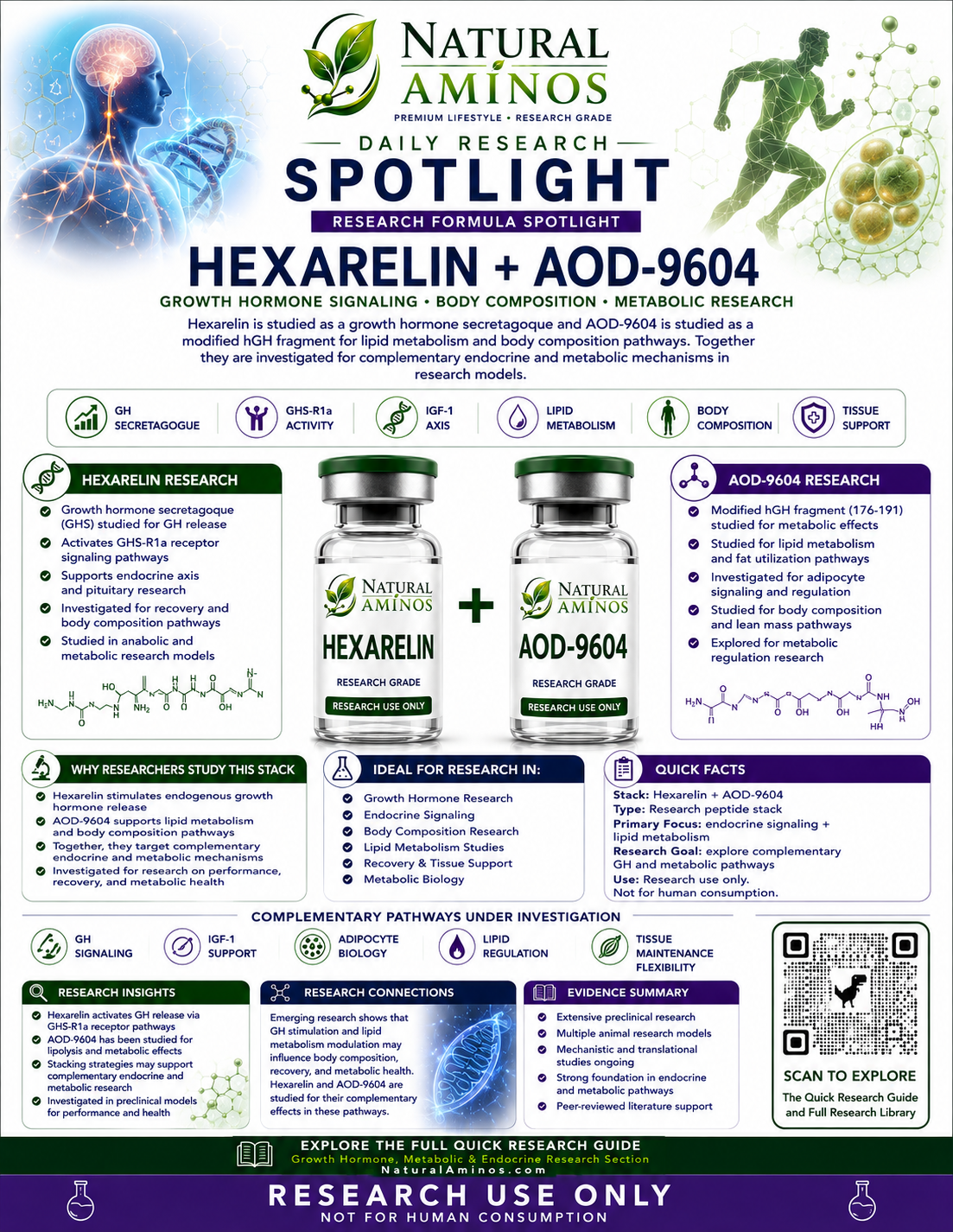
Hexarelin + AOD-9604 Research Data
For laboratory research use only; not for human or veterinary use or consumption. This page provides research information, not personal-use instructions or medical advice.
Natural Aminos Research Stack or Formula of the Day
Hexarelin + AOD-9604
Growth-Hormone Signaling, Lipid Metabolism & Body-Composition Research Spotlight
Compound Identity & Research Context
Hexarelin and AOD-9604 are both related to growth-hormone biology, but they were designed to do very different things. Hexarelin is a synthetic six-amino-acid growth-hormone-releasing peptide (GHRP) that activates the growth-hormone secretagogue receptor and can produce a strong pulse of endogenous growth hormone (GH). It also has GH-independent peripheral biology, including binding to the scavenger receptor CD36 and acute cardiovascular effects reported in human and animal studies. AOD-9604 is a synthetic 16-amino-acid peptide derived from the C-terminal lipolytic region of human GH. It was engineered as an anti-obesity candidate intended to retain part of GH's fat-metabolism activity without reproducing the classical GH-receptor/IGF-1 growth effects.
The pairing is therefore unusual: Hexarelin deliberately re-engages the endogenous GH axis, while AOD-9604 was developed to separate lipid-related GH biology from the broader growth-hormone system. That creates a potentially complementary body-composition theory, but it also creates a conceptual tension. If AOD-9604's value is avoiding the endocrine effects of full GH signaling, adding a potent GH secretagogue partly removes that separation.
No peer-reviewed human, animal or cell study was identified that directly tested Hexarelin and AOD-9604 together. A 2026 Polish review of GH/IGF-1-axis research peptides discusses both compounds in the same evidence framework, but not as a clinically studied combination.
Benefits
Hexarelin
Hexarelin's best-established human effect is acute stimulation of GH secretion. In double-blind human studies from Italy and the United Kingdom, intravenous Hexarelin produced a rapid, dose-dependent GH rise, with peak concentrations generally occurring around 30 minutes. In one 12-subject study, the GH response to intravenous Hexarelin was greater than the response to growth-hormone-releasing hormone (GHRH), and subcutaneous Hexarelin also produced a strong dose-dependent response. This provides real human pharmacodynamic evidence, but it does not by itself demonstrate improved body composition, muscle gain, fat loss or physical performance.
Repeated exposure changes the picture. In healthy elderly subjects, short courses of intranasal or oral Hexarelin maintained GH responsiveness and produced small changes in IGF-I or IGF-binding protein-3 in some protocols. However, a separate 16-week study of twice-daily subcutaneous Hexarelin showed partial attenuation of the GH response by weeks 4 and 16, with recovery after discontinuation. Thus, repeated GH stimulation can desensitize partially even when the effect remains reversible.
Hexarelin can also affect other pituitary axes. Acute dose-response studies reported increases in prolactin and cortisol at higher intravenous doses, although one-day intermittent subcutaneous schedules increased 24-hour GH secretion without materially changing average prolactin, ACTH or cortisol. The endocrine spillover is therefore dose-, route- and schedule-dependent rather than absent.
Human metabolic data are more reassuring than would be predicted from ghrelin itself. In a direct comparison in 11 healthy volunteers, ghrelin increased blood glucose and suppressed insulin, while Hexarelin strongly increased GH without changing glucose or insulin acutely. This shows that Hexarelin does not reproduce every metabolic effect of ghrelin even though both act through the growth-hormone secretagogue receptor system.
Preclinical metabolic research suggests additional GH-independent possibilities. In insulin-resistant MKR mice, 12 days of Hexarelin improved glucose and insulin tolerance, reduced plasma and liver triglycerides, reduced fat mass and increased lean mass despite increasing food intake. The investigators linked these effects to improved lipid handling and adipocyte differentiation, including CD36-related pathways. These are animal findings and cannot be treated as proof of adult human body-composition benefit.
Hexarelin also has a small human cardiovascular literature. Acute administration increased left-ventricular ejection fraction in healthy men and in people with GH deficiency, and improved cardiac performance during coronary bypass surgery. These effects appeared at least partly GH-independent and have been linked experimentally to cardiac growth-hormone-secretagogue receptors and CD36. This is mechanistically important but separate from a body-composition indication.
AOD-9604
AOD-9604 was developed specifically to isolate the lipid-metabolism portion of human GH. In obese rodents, chronic treatment reduced body-weight gain and fat mass, increased lipolysis, increased fat oxidation and increased beta-3-adrenergic-receptor expression in adipose tissue. Unlike full-length GH, AOD-9604 did not bind the classical GH receptor, did not induce GH-receptor-mediated cell proliferation and did not produce the same hyperglycemic or insulin-suppressing effects in the animal models.
That design concept translated partially into human safety observations but not into successful obesity efficacy. Across six older randomized, placebo-controlled human studies summarized in 2013, AOD-9604 did not significantly raise IGF-1 or worsen oral-glucose-tolerance measures. FDA's 2024 review similarly noted that anti-AOD-9604 antibodies were not detected in tested subsets and that adverse-event distributions were generally similar to placebo in the large oral programs, while emphasizing incomplete details and the absence of human data for modern subcutaneous or transdermal compounded routes.
The major limitation is the failed pivotal obesity program. The Australian OPTIONS Phase 2B study enrolled 536 adults with obesity and randomized 502 to oral AOD-9604 or placebo plus supervised diet and exercise for 24 weeks. The primary endpoint was significant weight loss after 12 weeks. FDA's review reports that the study did not find a significant difference in the primary weight-loss endpoint, and the developer terminated obesity development because the result did not support commercial viability. This larger negative study outweighs the smaller early signals when judging likely human fat-loss efficacy.
AOD-9604 also has a separate cartilage-repair research line. A South Korean rabbit osteoarthritis study found improved gross and histologic cartilage scores after intra-articular AOD-9604, with the AOD-9604 plus hyaluronic-acid group performing better than either alone. This is useful evidence of biological activity outside fat metabolism, but it is an animal joint model and does not validate systemic AOD-9604 for obesity or recovery.
What the Formulas Are Studied For
Hexarelin Research Areas
• Growth-hormone secretagogue activity and stimulation of pulsatile GH release.
• Age-related decline in GH secretion and responsiveness of the GH/IGF-1 axis.
• Pituitary effects on prolactin, ACTH and cortisol.
• Cardiac contractility and GH-independent cardiovascular signaling.
• CD36-associated lipid handling and vascular biology.
• Body composition, triglyceride handling and insulin resistance in animal models.
• Potential orexigenic effects in selected animal models.
• Use as a research probe for growth-hormone-secretagogue receptor physiology.
AOD-9604 Research Areas
• Lipolysis and fat oxidation in adipose tissue.
• Body-weight and adipose-mass regulation in obesity models.
• Beta-adrenergic pathway involvement in adipose metabolism.
• Human obesity drug development in the former Australian Metabolic Pharmaceuticals program.
• Separation of GH-related lipid effects from GH-receptor/IGF-1 growth signaling.
• Glucose and insulin-sensitivity comparisons with full-length GH.
• Cartilage and osteoarthritis repair in animal models.
Published Research — Worldwide Evidence Review
Hexarelin — Italy, United Kingdom, Australia and United States
Italy produced the largest body of human Hexarelin pharmacology. University of Turin investigators showed in the 1990s that Hexarelin was a potent and reproducible GH secretagogue after intravenous, subcutaneous, intranasal and oral administration. The subcutaneous route had substantially greater biological availability than intranasal or oral exposure, and the GH response was consistently stronger than GHRH alone in young adults.
The same Italian program demonstrated important physiologic modifiers. Food intake partially blunted Hexarelin-induced GH release but less strongly than it blunted the response to GHRH. Aging reduced the GH response, and higher fat mass was associated with weaker GH release in elderly subjects. This means the biological response is not fixed; age and adiposity materially alter the endocrine effect.
United Kingdom studies confirmed potent GH stimulation and also clarified desensitization. In healthy elderly subjects receiving twice-daily subcutaneous Hexarelin for 16 weeks, GH area under the curve fell significantly by weeks 4 and 16 compared with baseline and returned after a washout period. Another U.K. dose-response study showed that higher acute Hexarelin exposure increased prolactin and cortisol as well as GH, while low-dose Hexarelin combined with GHRH generated very large GH release with less cortisol effect.
The cardiovascular literature is again centered in Italy. In healthy men, acute Hexarelin raised left-ventricular ejection fraction for roughly one hour even when recombinant GH itself did not. Similar acute inotropic effects were reported in GH-deficient adults and in patients undergoing coronary-artery bypass surgery. Animal and receptor work later identified CD36 as a Hexarelin-binding protein in cardiac tissue, providing a plausible GH-independent mechanism.
Australia and the United States contribute important metabolic animal data. University of Queensland and U.S. NIH investigators treated insulin-resistant MKR mice for 12 days and reported improved glucose and insulin tolerance, lower plasma and liver triglycerides, reduced fat mass and increased lean mass. Food intake increased in the insulin-resistant mice, showing that Hexarelin can have orexigenic activity even when body weight does not increase. No comparable randomized adult-human body-composition trial was identified.
A 2026 review from Poznan University of Medical Sciences in Poland placed Hexarelin in an evidence tier where human endocrine pharmacology is real but performance/body-composition outcomes remain largely unproven. The review also highlighted the uncertainty created by off-label stacking practices and the potential for endocrine effects involving prolactin, cortisol, appetite and glucose regulation.
AOD-9604 — Australia, Germany and South Korea
AOD-9604 originated from Monash University in Australia. Obese-rat and obese-mouse studies reported reduced weight gain, increased adipose lipolytic activity, increased fat oxidation and increased beta-3-adrenergic-receptor expression. Importantly, AOD-9604 did not bind the classical GH receptor or reproduce the same glucose/insulin effects as full-length GH in those models.
Between 2001 and 2006, the Australian development program conducted six randomized, double-blind, placebo-controlled human studies involving approximately 900 participants according to the 2013 safety publication. The studies included intravenous and oral exposure. Safety analyses found no consistent rise in IGF-1, no major deterioration in glucose handling and no anti-AOD-9604 antibodies in tested subsets. The authors reported good overall tolerability, but this publication was primarily a pooled safety review rather than proof of efficacy.
The decisive efficacy evidence came from the OPTIONS study. FDA's 2024 review describes 536 enrolled and 502 randomized adults with obesity receiving oral AOD-9604 or placebo alongside diet and exercise for 24 weeks. There was no significant difference in the 12-week primary weight-loss endpoint, and company development for obesity was terminated in 2007. FDA concluded that available evidence did not support effectiveness for obesity and noted that it did not find human subcutaneous or transdermal exposure studies matching commonly proposed compounded routes.
South Korean researchers later studied intra-articular AOD-9604 in a rabbit collagenase-induced osteoarthritis model. AOD-9604 and hyaluronic acid each improved cartilage-related measures compared with saline, and the combination produced the strongest result. That study supports tissue-level activity but is unrelated to Hexarelin and does not establish a body-composition benefit in humans.
No controlled human Hexarelin or AOD-9604 program from Russia or the Middle East was identified that materially changes the evidence hierarchy. The strongest Hexarelin human endocrine data remain European, while the strongest AOD-9604 obesity-development data remain Australian.
Direct Research on Hexarelin + AOD-9604 Together
No peer-reviewed human, animal or in-vitro study was identified that directly administered Hexarelin and AOD-9604 together as one intervention. Searches using both compound names, growth-hormone-secretagogue terminology, body-composition terms, obesity terms and GH-fragment terminology did not identify a controlled combination experiment.
Commercial and clinic-oriented pages describe the pair as a possible 'stack,' but those pages do not provide direct combination data and are not evidence of efficacy. The 2026 peer-reviewed review of GH/IGF-1-axis performance peptides discusses Hexarelin and AOD-9604 as separate research compounds and explicitly emphasizes the lack of controlled evidence for many stacking practices.
Therefore, any conclusion about the pair must be built from mechanism, not direct observation. There is no published evidence defining whether the combination is additive, redundant, antagonistic, safer or less safe than either compound alone.
Theory of the Stack — How the Combination Could Work
1. Endogenous GH Pulse Amplification — Hexarelin Layer
Hexarelin would provide the endocrine layer. By activating the growth-hormone-secretagogue receptor, it can produce a large endogenous GH pulse. GH has known effects on lipolysis, protein metabolism and tissue growth through direct GH signaling and downstream IGF-1 biology. In theory, this could support lean-tissue maintenance or anabolic signaling while also contributing to mobilization of stored fat.
2. GH-Fragment Lipolytic Signaling — AOD-9604 Layer
AOD-9604 would provide a second lipid-oriented signal derived from the C-terminal region of GH. Animal work suggests increased lipolytic sensitivity, fat oxidation and beta-3-adrenergic-receptor expression without classical GH-receptor activation. The theoretical logic is that Hexarelin stimulates the whole endogenous GH system while AOD-9604 supplies a more targeted fragment-associated lipid signal.
3. The Proposed Complement: Lean-Mass Support Plus Fat-Metabolism Support
The strongest high-level theory is body-composition partitioning rather than simple weight loss. Hexarelin's GH pulse could theoretically favor protein retention, recovery or lean-tissue signaling, while AOD-9604 could theoretically favor adipose lipolysis and fat oxidation. The Australian Hexarelin mouse study—reduced fat mass and increased lean mass—and the AOD-9604 obese-mouse studies make this concept biologically plausible at a preclinical level.
The weakness is that neither component has established adult-human body-composition efficacy in the population for which this stack is commonly proposed. Hexarelin has no modern adult recomposition trial, and AOD-9604 failed its pivotal obesity endpoint.
4. The Stack Partly Reverses AOD-9604's Original Design Advantage
AOD-9604 was deliberately designed to separate GH's lipid effects from the endocrine consequences of full GH signaling. Its development rationale emphasized the absence of GH-receptor binding, IGF-1 elevation and diabetogenic effects seen with full GH. Hexarelin does the opposite: it deliberately raises endogenous GH and can increase IGF-I or IGF-binding proteins with repeated exposure in some studies.
This means the pair is not simply two complementary fat-metabolism agents. Adding Hexarelin reintroduces the very GH/IGF-axis biology that AOD-9604 was designed to avoid. That does not make the combination inherently contradictory, but it changes the safety and mechanism profile and weakens any claim that AOD-9604 provides a 'GH-like fat effect without GH-system exposure' once a GH secretagogue is added.
5. Glucose and Insulin Effects Are More Nuanced Than Full-Length GH
A theoretical concern is that stronger GH exposure can worsen insulin sensitivity, while a body-composition stack is often intended to improve metabolic health. The available Hexarelin human data are somewhat reassuring: one acute study found no change in glucose or insulin despite a large GH response. AOD-9604's human trials also did not show the same glucose or IGF-1 disturbances associated with full GH.
However, acute studies do not establish long-term metabolic neutrality. Hexarelin produces repeated GH pulses, may alter appetite in some models and shows partial receptor-level desensitization over time. No study has measured long-term glucose tolerance, insulin sensitivity and body composition under concurrent Hexarelin + AOD-9604 exposure.
6. Appetite Could Work Against a Fat-Loss Goal
Growth-hormone secretagogue receptor biology is closely connected with appetite. Hexarelin is not identical to ghrelin, and acute human Hexarelin did not reproduce ghrelin's glucose/insulin effects, but animal work shows that Hexarelin can increase food intake in specific metabolic states. In the MKR mouse study, food intake rose even though body weight did not.
For a weight-loss hypothesis, increased energy intake could offset part of any lipolytic advantage. This is another reason the theoretically stronger endpoint is body composition rather than guaranteed net weight reduction.
7. CD36 and Lipid Handling Add a GH-Independent Hexarelin Pathway
Hexarelin's CD36 binding creates a second possible metabolic layer independent of pituitary GH release. In animal work, Hexarelin improved triglyceride handling and adipocyte differentiation, and CD36 is involved in fatty-acid transport and lipid signaling. AOD-9604, meanwhile, affects adipose lipolysis and fat oxidation through pathways that include altered beta-adrenergic sensitivity.
Theoretically, the pair could therefore influence both mobilization of stored lipid and downstream lipid handling. No direct experiment has measured whether these mechanisms reinforce one another or simply alter different compartments without producing greater net fat loss.
8. Desensitization Makes Chronic Stack Behavior Hard to Predict
AOD-9604 did not show the same endocrine-feedback loop as a GH secretagogue, but Hexarelin does. The 16-week human study showed a partial and reversible decline in GH responsiveness. If the Hexarelin component loses effect over time, the relative contribution of each compound in a chronic stack would shift even if the same exposures were maintained.
This means an acute 'two-pathway' theory cannot be assumed to remain stable during prolonged research. Longitudinal studies would need repeated GH, IGF-1, glucose, insulin, appetite, body-composition and lipid measurements.
Possible Overall Benefit — Theoretical, Not Proven
The most defensible theoretical benefit of Hexarelin + AOD-9604 is body-composition support through two different GH-related mechanisms. Hexarelin could provide pulsatile endogenous GH signaling with possible lean-tissue and recovery effects, while AOD-9604 could provide a GH-fragment-associated lipolytic signal that does not itself require classical GH-receptor activation. A CD36-related lipid-handling pathway may add a further Hexarelin-specific component.
If those mechanisms translated successfully to humans, the combination could theoretically favor greater fat mobilization while preserving or supporting lean tissue. It could also theoretically produce a broader metabolic effect than AOD-9604 alone because Hexarelin affects endocrine, cardiac and lipid-handling pathways that the fragment does not.
The human evidence does not currently support calling the pair an effective fat-loss or recomposition intervention. AOD-9604's pivotal obesity study was negative, and Hexarelin's adult human literature demonstrates GH release far more clearly than it demonstrates improved body composition. The combination could therefore be mechanistically logical yet clinically ineffective, particularly if increased appetite, endocrine spillover or Hexarelin desensitization offset the intended benefit.
Why More Research Is Needed
• No published human, animal or cell study has tested Hexarelin + AOD-9604 together, so synergy, antagonism, pharmacokinetic compatibility and combined safety are unknown.
• AOD-9604 failed the primary weight-loss endpoint in its largest human obesity program, and development for obesity was terminated.
• FDA's 2024 review found insufficient evidence to support AOD-9604 effectiveness for obesity and did not identify human subcutaneous or transdermal exposure data matching commonly proposed compounded routes.
• Hexarelin has strong human pharmacodynamic evidence for GH release but very limited controlled adult-human evidence for fat loss, muscle gain, recovery or body-composition change.
• Hexarelin can stimulate prolactin and cortisol under some acute conditions, so endocrine monitoring would be necessary in any controlled combination study.
• Long-term Hexarelin exposure can partially desensitize the GH response, meaning the pharmacodynamic effect of a chronic stack may change over time.
• Hexarelin can increase food intake in some animal models. Appetite and caloric intake would need to be measured because they could oppose a weight-loss endpoint.
• The original rationale for AOD-9604 was to avoid full GH/IGF-1 signaling. Adding a GH secretagogue partly removes that mechanistic separation and requires a new safety analysis rather than assuming AOD-9604's safety profile remains unchanged.
• AOD-9604 human efficacy research used oral and intravenous exposure; Hexarelin has been studied by IV, subcutaneous, intranasal and oral routes. Route-specific pharmacology makes untested extrapolation especially uncertain.
• Future trials should compare Hexarelin alone, AOD-9604 alone, the combination and placebo while measuring DEXA body composition, appetite/food intake, fasting glucose and insulin, oral-glucose tolerance, IGF-1, prolactin, cortisol, lipids and validated functional outcomes.
• Independent international replication is limited. Hexarelin human work is concentrated in Italian and U.K. endocrine research, while AOD-9604 human development was concentrated in Australia.
• Long-term studies are needed to determine whether any theoretical body-composition benefit outweighs endocrine, metabolic and product-quality uncertainties associated with unapproved peptide combinations.
Research Summary
Hexarelin + AOD-9604 is a mechanistically interesting but untested GH-axis/body-composition stack. Hexarelin has genuine human evidence as a potent growth-hormone secretagogue and also has GH-independent CD36/cardiovascular biology. AOD-9604 has strong preclinical lipid-metabolism rationale and an extensive historical human safety database, but its pivotal obesity program did not demonstrate significant weight loss.
The theoretical pairing is strongest when framed as lean-tissue/endocrine support plus adipose-lipid signaling rather than as guaranteed weight loss. The central contradiction is equally important: AOD-9604 was designed to isolate GH-related fat metabolism without activating the classical GH/IGF-1 system, while Hexarelin intentionally activates that system. The combination could therefore broaden the biological response, but it also removes part of AOD-9604's original design advantage. No direct combination evidence exists.
Selected Sources
• Imbimbo BP, et al. Growth hormone-releasing activity of hexarelin in humans. A dose-response study. European Journal of Clinical Pharmacology. 1994;46(5):421-425. PMID: 7957536. DOI: 10.1007/BF00191904.
• Ghigo E, et al. Growth hormone-releasing activity of hexarelin, a new synthetic hexapeptide, after intravenous, subcutaneous, intranasal, and oral administration in man. Journal of Clinical Endocrinology & Metabolism. 1994;78(3):693-698. PMID: 8126144. DOI: 10.1210/jcem.78.3.8126144.
• Massoud AF, Hindmarsh PC, Brook CG. Hexarelin-induced growth hormone, cortisol, and prolactin release: a dose-response study. Journal of Clinical Endocrinology & Metabolism. 1996;81(12). PMID: 8954038. DOI: 10.1210/jcem.81.12.8954038.
• Ghigo E, et al. Short-term administration of intranasal or oral Hexarelin, a synthetic hexapeptide, does not desensitize the growth hormone responsiveness in human aging. European Journal of Endocrinology. 1996;135(4):407-412. PMID: 8921821. DOI: 10.1530/eje.0.1350407.
• Rahim A, Shalet SM. Does desensitization to hexarelin occur? Growth Hormone & IGF Research. 1998;8 Suppl B:141-143. PMID: 10990150. DOI: 10.1016/S1096-6374(98)80039-7.
• Maccario M, et al. Impact of two or three daily subcutaneous injections of hexarelin on 24-h GH, prolactin, ACTH and cortisol secretion in humans. European Journal of Endocrinology. 2002;146(3):310-318. PMID: 11888836. DOI: 10.1530/eje.0.1460310.
• Broglio F, et al. Ghrelin, a natural GH secretagogue produced by the stomach, induces hyperglycemia and reduces insulin secretion in humans. Journal of Clinical Endocrinology & Metabolism. 2001;86(10):5083-5086. PMID: 11600590. DOI: 10.1210/jcem.86.10.8098. Includes direct comparison showing acute Hexarelin did not change glucose or insulin.
• Bisi G, et al. Acute cardiovascular and hormonal effects of GH and hexarelin, a synthetic GH-releasing peptide, in humans. Journal of Endocrinological Investigation. 1999;22(4):266-272. PMID: 10342360. DOI: 10.1007/BF03343555.
• Broglio F, et al. Growth hormone-independent cardiotropic activities of growth hormone-releasing peptides in normal subjects, GH deficiency, and dilated cardiomyopathy. Endocrine. 2001;14(1):105-108. PMID: 11322491. DOI: 10.1385/ENDO:14:1:105.
• Effects of acute hexarelin administration on cardiac performance in patients with coronary artery disease during bypass surgery. PMID: 12144941.
• Bodart V, et al. Identification of the growth hormone-releasing peptide binding site in CD36: a photoaffinity cross-linking study. Biochemical Journal. 2004. PMID: 15176951.
• Bodart V, et al. CD36 mediates the cardiovascular action of growth hormone-releasing peptides in the heart. Circulation Research. 2002. PMID: 11988484.
• Mosa R, et al. Hexarelin, a Growth Hormone Secretagogue, Improves Lipid Metabolic Aberrations in Nonobese Insulin-Resistant Male MKR Mice. Endocrinology. 2017;158(10):3174-3187. PMID: 28977588. PMCID: PMC5659698. DOI: 10.1210/en.2017-00168.
• Dominikowski A, et al. The emerging landscape of performance-enhancing peptides modulating GH-IGF1 axis: bridging the gap between clinical evidence and patient self-administration. Frontiers in Endocrinology. 2026;17:1822475. PMID: 42395176. PMCID: PMC13322892. DOI: 10.3389/fendo.2026.1822475.
• Ng FM, et al. Metabolic studies of a synthetic lipolytic domain (AOD9604) of human growth hormone. Hormone Research. 2000. PMID: 11146367. DOI: 10.1159/000053183.
• Heffernan M, et al. The effects of human GH and its lipolytic fragment (AOD9604) on lipid metabolism following chronic treatment in obese mice and beta(3)-AR knockout mice. Endocrinology. 2001;142(12):5182-5189. PMID: 11713213. DOI: 10.1210/endo.142.12.8522.
• Heffernan M, et al. Increase of fat oxidation and weight loss in obese mice caused by chronic treatment with human growth hormone or a modified C-terminal fragment. International Journal of Obesity. 2001. PMID: 11673763. DOI: 10.1038/sj.ijo.0801740.
• Stier H, Vos E, Kenley D. Safety and Tolerability of the Hexadecapeptide AOD9604 in Humans. Journal of Endocrinology and Metabolism. 2013;3(1-2):7-15. DOI: 10.4021/jem157w.
• U.S. Food and Drug Administration. FDA Briefing Document: Evaluation of AOD-9604-Related Bulk Drug Substances for Inclusion on the 503A Bulk Drug Substances List. Pharmacy Compounding Advisory Committee, December 4, 2024. The review describes the 536-enrollee OPTIONS study, its negative primary weight-loss endpoint, and the absence of identified human subcutaneous/transdermal exposure data.
• Kwon DR, Park GY. Effect of intra-articular injection of AOD9604 with or without hyaluronic acid in rabbit osteoarthritis model. Annals of Clinical and Laboratory Science. 2015;45(4):426-432. PMID: 26275694.
Theory vs. Proof — Verdict
What is supported by evidence: Hexarelin reliably stimulates GH secretion in humans and can produce additional endocrine and acute cardiovascular effects; preclinical Hexarelin research shows potentially favorable lipid/body-composition effects in insulin-resistant mice. AOD-9604 increases lipolysis and fat oxidation in obese-animal models and has human trial data showing relatively little IGF-1 or glucose disruption compared with full GH.
What is not proven: that Hexarelin improves adult human body composition, that AOD-9604 produces clinically meaningful human fat loss, that the two compounds are additive or synergistic, or that AOD-9604's apparent endocrine separation is preserved once a potent GH secretagogue is introduced.
Verdict — theory vs. proof: the mechanistic theory is moderately strong but internally conflicted. The potential complement is understandable—Hexarelin supplies endogenous GH/lean-tissue signaling and CD36-linked lipid biology, while AOD-9604 supplies a GH-fragment-associated lipolytic signal without directly activating the classical GH receptor. The conflict is that AOD-9604 was specifically designed to obtain lipid effects while avoiding broad GH/IGF-axis activation, and Hexarelin deliberately restores that axis. AOD-9604 also failed the pivotal human obesity endpoint, while Hexarelin's body-composition benefit remains largely preclinical. Overall, Hexarelin + AOD-9604 is best classified as a biologically plausible body-composition hypothesis with genuine human endocrine data for Hexarelin, substantial historical human exposure for AOD-9604, but no direct combination evidence and weak proof of meaningful human fat-loss or recomposition benefit.
Research & Educational Use Only !!