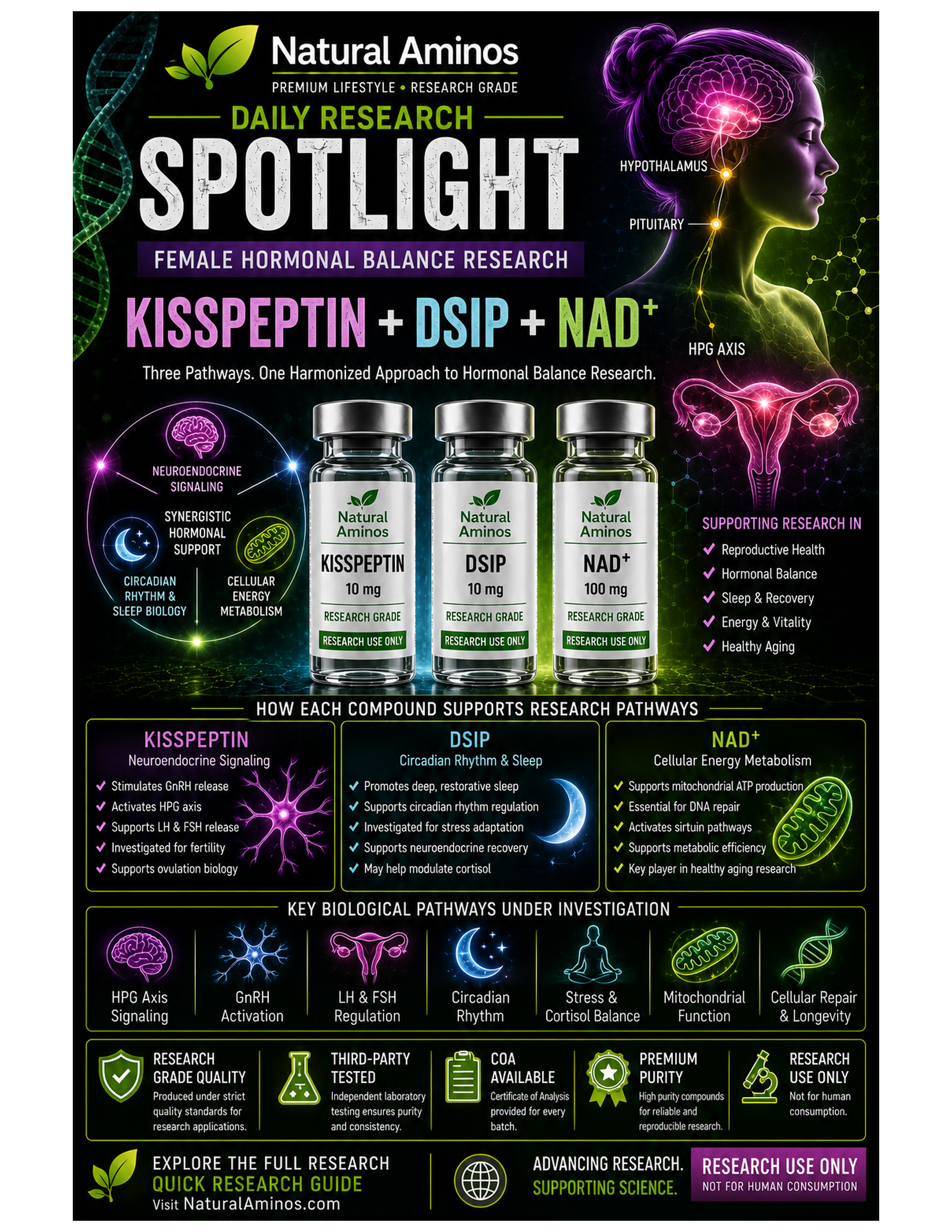
Kisspeptin + DSIP + NAD+ Research Data
For laboratory research use only; not for human or veterinary use or consumption. This page provides research information, not personal-use instructions or medical advice.
Natural Aminos Research Stack or Formula of the Day
Kisspeptin + DSIP + NAD+
Reproductive-Axis Signaling, Sleep Regulation & Cellular-Energy Research Spotlight
Compound Identity & Research Context
This stack combines three biologically distinct systems. Kisspeptin is an endogenous reproductive neuropeptide that activates KISS1R/GPR54 and stimulates hypothalamic GnRH, thereby increasing pituitary LH and FSH and downstream gonadal hormone output. DSIP (delta sleep-inducing peptide; also referred to as emideltide in current U.S. regulatory review) is a synthetic nonapeptide with the sequence Trp-Ala-Gly-Gly-Asp-Ala-Ser-Gly-Glu that emerged from sleep research in the 1970s. NAD+ (nicotinamide adenine dinucleotide) is an endogenous redox coenzyme and signaling substrate required for cellular energy metabolism and NAD+-consuming enzymes including sirtuins, PARPs and CD38.
The three components therefore address different levels of physiology: Kisspeptin targets the reproductive neuroendocrine axis, DSIP was studied primarily for sleep and neuroendocrine modulation, and NAD+ supports cellular redox, mitochondrial metabolism and circadian-linked signaling. No peer-reviewed human, animal or cell study was identified that intentionally tested Kisspeptin, DSIP and NAD+ together as one defined intervention.
A second evidence issue is route and compound identity. Human Kisspeptin studies include Kisspeptin-54 and Kisspeptin-10, which differ in length and pharmacokinetics. DSIP human trials largely used intravenous synthetic peptide decades ago. Modern NAD+ research is dominated by oral precursors such as nicotinamide riboside (NR) and nicotinamide mononucleotide (NMN), while direct intravenous NAD+ has much less controlled outcomes evidence. These evidence streams should not be treated as interchangeable.
Benefits
Kisspeptin
Kisspeptin has the strongest direct human endocrine evidence in this stack. A double-blind crossover study in healthy men showed that Kisspeptin-54 significantly increased LH, FSH and testosterone compared with saline. This established that pharmacologic Kisspeptin can activate the human hypothalamic-pituitary-gonadal axis upstream of GnRH rather than simply supplying gonadal steroids or gonadotropins.
Human reproductive-medicine studies provide additional proof of biological activity. In women undergoing IVF, a single subcutaneous Kisspeptin-54 injection successfully triggered oocyte maturation, fertilization and subsequent pregnancies. Later work extended this approach to women at high risk for ovarian hyperstimulation syndrome. These findings establish Kisspeptin as a real human reproductive-axis signal, although they do not establish general hormone-optimization, body-composition or anti-aging benefits.
Kisspeptin has also been studied in sexual-behavior research. Randomized controlled studies in men and women with hypoactive sexual desire disorder found that Kisspeptin-54 altered sexual and attraction-related brain processing. In men, Kisspeptin increased penile tumescence during sexual visual stimuli and improved several measures related to sexual desire and arousal.
The most important 2026 update concerns chronic exposure. In August 2026, Imperial College London investigators reported that intermittent daily subcutaneous Kisspeptin-10 exposure for 12 days sustained gonadotropin and testosterone stimulation in healthy men, whereas continuous exposure produced greater attenuation. This shows that the pattern of Kisspeptin exposure strongly influences tachyphylaxis and is central to any chronic endocrine research design.
DSIP
DSIP has genuine human sleep research, but the results are old and inconsistent. In an early double-blind crossover experiment in six healthy volunteers, intravenous DSIP increased short-term sleep and was followed by shorter sleep onset and improved sleep efficiency during the subsequent night. Additional early clinical reports in chronic insomnia described improved continuity, total sleep time or daytime alertness.
The strongest later controlled study was less encouraging. A 1992 double-blind trial in 16 chronic-insomnia patients found higher objective sleep efficiency and shorter sleep latency with DSIP than placebo, but the investigators concluded that the statistically significant effects were weak, partly susceptible to baseline variation, and unlikely to provide major therapeutic benefit. A 2006 Russian review described the original DSIP-as-sleep-factor hypothesis as poorly documented and emphasized that a DSIP gene, natural precursor and specific receptor had never been clearly established.
DSIP also has a neuroendocrine literature. One Swedish randomized crossover study found reduced plasma ACTH-like immunoreactivity after intravenous DSIP without a cortisol change. A later German study found no effect on CRH- or meal-stimulated ACTH/cortisol release. These conflicting human findings argue against a simple, reproducible HPA-axis mechanism.
Older withdrawal studies reported rapid improvement in somatic alcohol- and opioid-withdrawal symptoms after IV DSIP, but the designs predated contemporary randomized-trial standards and had substantial attrition. In July 2026, FDA reviewed emideltide/DSIP for chronic insomnia, opioid withdrawal and narcolepsy through the Pharmacy Compounding Advisory Committee process. FDA currently states that safety information for proposed compounded routes is insufficient and highlights potential immunogenicity, peptide-impurity and API-characterization concerns.
NAD+
NAD+ is fundamental to cellular energy metabolism. It accepts and donates electrons through glycolysis, the tricarboxylic-acid cycle and oxidative phosphorylation, and is also consumed by enzymes involved in DNA repair, stress adaptation, inflammatory signaling and epigenetic regulation. NAD+ levels and NAD+-dependent sirtuins are also tightly linked to circadian-clock biology, creating a plausible connection between metabolic state and sleep-wake timing.
Human intervention evidence is strongest for NR and NMN rather than direct NAD+ administration. A 2026 PRISMA-guided systematic review identified 33 human NAD-related intervention studies and found that oral NR/NMN/NAM reliably increased NAD-related biomarkers, but functional, metabolic, vascular and other healthspan outcomes were heterogeneous and often null or endpoint-specific. No eligible controlled outcomes trials evaluated IV or IM NAD+ itself for anti-aging or wellness.
Some individual human trials provide selected signals. A U.S. randomized trial found that NMN improved skeletal-muscle insulin sensitivity in women with prediabetes. A Japanese randomized 12-week study in older adults found increased blood NAD-related metabolites and shorter four-meter walking time; sleep-quality improvements were secondary rather than primary outcomes. These findings support biological target engagement, not a universal sleep, fertility or healthy-aging benefit.
Direct NAD+ infusion has been studied mainly pharmacokinetically. An Australian-led 2019 pilot tracked plasma and urine NAD+ metabolites during a six-hour IV infusion and showed active metabolism of infused NAD+, but it was not a controlled clinical efficacy trial. Therefore, claims for direct NAD+ administration should remain separate from the larger NR/NMN evidence base.
What the Formulas Are Studied For
Kisspeptin Research Areas
• Activation of GnRH, LH and FSH secretion and the human HPG axis.
• Acute and intermittent stimulation of endogenous testosterone in healthy men.
• Hypothalamic amenorrhea and reproductive-axis restoration research.
• Oocyte maturation and ovulation triggering during IVF.
• Sexual-desire and sexual-brain-processing research in men and women.
• Exposure-pattern-dependent tachyphylaxis and preservation of Kisspeptin receptor responsiveness.
• Metabolic regulation of fertility and communication between energy status and reproductive function.
DSIP Research Areas
• Sleep initiation, sleep continuity and objective sleep efficiency in older human trials.
• Slow-wave/delta-sleep regulation, although selective slow-wave enhancement was not consistently reproduced.
• Daytime alertness and performance after disturbed sleep.
• HPA-axis and neuroendocrine modulation.
• Alcohol- and opioid-withdrawal symptoms in historical clinical reports.
• Circadian, locomotor and neurotransmitter effects in older animal and human research.
• Chronic insomnia, narcolepsy and opioid withdrawal in FDA's 2026 compounding review.
NAD+ Research Areas
• Cellular redox balance and mitochondrial energy metabolism.
• Sirtuin-, PARP- and CD38-dependent signaling.
• Circadian-clock coupling through NAD+/SIRT1 and NAMPT feedback.
• Metabolic health, insulin sensitivity and glucose handling.
• Physical function, fatigue and sleep-related outcomes in precursor trials.
• Direct NAD+ infusion pharmacokinetics and metabolism.
• Healthy-aging research, with human clinical benefit still inconsistent.
Published Research — Worldwide Evidence Review
Kisspeptin — United Kingdom and International Reproductive Endocrinology
The modern human Kisspeptin program is dominated by Imperial College London and collaborating U.K. reproductive-endocrinology groups. In 2005, a double-blind placebo-controlled crossover study in healthy men demonstrated that intravenous Kisspeptin-54 significantly increased LH, FSH and testosterone. This remains one of the cleanest demonstrations of pharmacologic HPG-axis activation in healthy human males.
Women with hypothalamic amenorrhea were subsequently studied because Kisspeptin signaling sits upstream of GnRH. Acute dosing produced marked gonadotropin release, but frequent repeated exposure could produce tachyphylaxis. Intermittent schedules preserved responsiveness better than continuous stimulation, foreshadowing the newer 2026 male data.
Clinical translation is strongest in assisted reproduction. A 2014 proof-of-concept JCI trial in 53 women undergoing IVF found that Kisspeptin-54 could trigger oocyte maturation, fertilization and successful pregnancy. Additional studies investigated women at high risk for ovarian hyperstimulation syndrome, providing evidence that Kisspeptin can serve as a physiologic ovulation-trigger signal in a carefully controlled clinical setting.
Randomized crossover studies in 2022 and 2023 extended Kisspeptin research into sexual behavior. Women and men with hypoactive sexual desire disorder showed changes in sexual-brain processing, and men demonstrated increased penile tumescence during erotic visual stimuli. These central nervous system effects appear to extend beyond gonadotropin release, although they are not evidence for routine endocrine enhancement.
The August 2026 European Journal of Endocrinology study is the most relevant update for chronic research. Daily intermittent subcutaneous Kisspeptin-10 administration for 12 days sustained increases in gonadotropins and testosterone in healthy men and preserved receptor responsiveness to a Kisspeptin bolus. Continuous infusion produced more attenuation. The result strengthens the biological case for intermittent rather than continuous HPG-axis stimulation.
FDA reviewed Kisspeptin-10 during the October 2024 Pharmacy Compounding Advisory Committee process. FDA recognized substantial human reproductive pharmacology but raised concerns about incomplete nonclinical toxicity data, possible immunogenicity with compounded parenteral preparations and peptide-related impurity/API-characterization issues. These manufacturing and safety questions are distinct from the established endocrine mechanism.
DSIP — Switzerland, Netherlands, Sweden, Germany and Russia
DSIP originated from Swiss sleep research. The peptide was isolated and chemically characterized in the 1970s from experiments involving rabbit sleep-related EEG activity. Early Swiss human studies then reported acute sleep pressure and delayed improvement in sleep efficiency after IV DSIP, creating the basis for its name and subsequent insomnia research.
European follow-up was inconsistent. The 1992 University of Amsterdam double-blind study in 16 chronic insomniacs found somewhat higher sleep efficiency and shorter latency but concluded that the overall effect was weak and unlikely to be a major therapeutic benefit. Earlier controlled and open studies showed a mixture of positive and marginal outcomes.
HPA-axis research also conflicted. Swedish investigators reported lower ACTH-like immunoreactivity after DSIP without lower cortisol, while German investigators later found no effect on CRH- or meal-induced ACTH/cortisol release. The discrepancy reinforces uncertainty about the peptide's target and mechanism.
Russian investigators later revisited the basic biology and concluded in a 2006 Journal of Neurochemistry review that the DSIP sleep-factor hypothesis remained weakly documented. They emphasized the absence of an identified gene, precursor or receptor and noted that several animal and human studies failed to reproduce strong slow-wave-sleep effects.
The July 2026 FDA review evaluated emideltide/DSIP for chronic insomnia, opioid withdrawal and narcolepsy. FDA's current safety page states that it has not identified adequate safety-related information for the proposed compounded route and notes risks involving immunogenicity, peptide-related impurities and API characterization. The advisory review does not establish an approved DSIP indication.
NAD+ — United States, Japan, Australia, Europe and International Reviews
The NAD+ clinical literature is broader geographically and methodologically than the DSIP literature, but most interventions use precursors. U.S. and Japanese randomized trials show that NMN and NR can raise blood or cellular NAD-related metabolites. Some trials report tissue-specific metabolic, mobility, fatigue or sleep-related signals, whereas others show little functional difference from placebo.
A 2026 international systematic review synthesized 113 intervention studies, including 33 human studies. It concluded that oral NR/NMN/NAM consistently demonstrate biochemical target engagement but that functional and metabolic outcomes are heterogeneous. The review did not identify eligible controlled outcomes trials of IV/IM NAD+ itself for anti-aging or wellness, making direct NAD+ clinical claims substantially weaker than precursor target-engagement claims.
Circadian research gives the strongest mechanistic link to DSIP-related sleep theory. Work from U.S. circadian-metabolism laboratories shows that NAD+ levels and NAD+-dependent SIRT1 participate in clock transcription through CLOCK/BMAL1 and NAMPT-linked feedback loops. This establishes a biologic connection between cellular metabolism and circadian regulation, but it does not show that NAD+ administration improves insomnia or amplifies DSIP.
Reproductive metabolism gives the strongest mechanistic link to Kisspeptin. Kisspeptin neurons are sensitive to energy status and serve as a major relay between metabolic state and reproductive function. However, no human intervention study was identified in which NAD+ augmentation was used to enhance the gonadotropin or testosterone response to Kisspeptin.
Direct Research on Kisspeptin + DSIP + NAD+ Together
No peer-reviewed human, animal or in-vitro study was identified that directly administered Kisspeptin, DSIP and NAD+ together as one intervention. No controlled pairwise study was identified for Kisspeptin + DSIP, Kisspeptin + direct NAD+, or DSIP + direct NAD+ as defined combinations.
The stack must therefore be evaluated through separate literatures and systems-level physiology. Any claim that NAD+ increases Kisspeptin responsiveness, that DSIP enhances Kisspeptin-driven testosterone, or that NAD+ makes DSIP a stronger sleep agent would be theoretical and not directly supported by published combination data.
Theory of the Stack — How the Combination Could Work
1. Reproductive-Axis Activation — Kisspeptin Layer
Kisspeptin would provide the most direct endocrine signal in the stack. By activating KISS1R on GnRH neurons, it can increase LH and FSH and, in men with an intact gonadal axis, increase endogenous testosterone. In women, Kisspeptin can trigger the LH surge and oocyte maturation under controlled fertility protocols. This layer is the strongest clinically demonstrated part of the combination.
2. Sleep-State and Stress-Regulation Layer — DSIP
DSIP would theoretically provide a sleep/restoration layer. Some early human trials reported shorter sleep latency, improved sleep efficiency or increased sleep time, while later controlled studies found the effect weak. The most defensible theory is therefore not guaranteed deep sleep, but possible modulation of sleep continuity or neuroendocrine arousal in a subset of responsive subjects.
3. Cellular Energy and Circadian-Metabolic Layer — NAD+
NAD+ would provide the intracellular metabolic layer. Reproductive hormone synthesis, neuronal signaling and sleep-wake regulation all require cellular energy and redox balance. NAD+-dependent sirtuins also interact with core circadian-clock machinery. A theoretical benefit would be support for the cellular energetic and timing environment in which the Kisspeptin and DSIP systems operate.
This should not be overstated. Raising blood NAD-related metabolites does not prove that hypothalamic Kisspeptin neurons, GnRH neurons or sleep-regulatory circuits receive a clinically meaningful increase in usable NAD+. Direct tissue-specific human evidence is limited.
4. Metabolism and Reproduction Are Biologically Linked
The strongest systems-level rationale for Kisspeptin + NAD+ is the known dependence of reproductive function on energy availability. Kisspeptin neurons integrate nutritional, hormonal and metabolic signals and help determine whether the reproductive axis is appropriately active. NAD+ sits inside metabolic pathways that reflect cellular energy state. In theory, improved metabolic homeostasis could provide a more favorable background for reproductive signaling.
However, this is not evidence that NAD+ administration directly increases Kisspeptin efficacy. The metabolic regulation of Kisspeptin involves many signals—leptin, insulin, nutrient state, sex steroids and neuronal circuits—not a single NAD+ concentration.
5. Sleep and Reproductive Hormones Are Also Connected
Sleep disruption can alter reproductive hormones, and reproductive hormones can alter sleep architecture. A theoretical stack might therefore pair direct HPG-axis stimulation from Kisspeptin with a sleep-focused signal from DSIP. Better sleep could hypothetically support normal endocrine timing, while improved reproductive-axis function could influence mood, sexual function or energy.
The weak point is DSIP. Because the human sleep effect is inconsistent, the stack cannot assume that DSIP reliably improves the sleep environment in which the reproductive axis operates.
6. NAD+ Could Support Circadian Timing Without Being a Sedative
NAD+ and SIRT1 participate in circadian feedback loops, so NAD-related metabolism may influence the timing of cellular functions. This is conceptually complementary to DSIP because circadian timing and sleep induction are different problems. NAD+ would not be expected to act as an acute hypnotic; its theoretical role is metabolic/circadian support rather than sedation.
7. Endocrine Timing Matters More Than Simply Raising Hormones
The 2026 Kisspeptin study shows that intermittent exposure preserves gonadotropin/testosterone responsiveness better than continuous stimulation. Sleep and circadian systems are also strongly time-dependent. This makes timing a central theoretical feature of the stack: a combination affecting reproduction, sleep and metabolism could behave very differently depending on when each signal occurs.
No published study has defined an optimal temporal relationship among Kisspeptin, DSIP and NAD+ exposure. Any timing strategy would therefore be a research hypothesis rather than an evidence-based protocol.
8. The Stack Has Low Pharmacologic Redundancy but High Biological Complexity
The three components do not compete for the same receptor or clearly duplicate one another. This lowers the likelihood of simple receptor redundancy. At the same time, reproductive endocrinology, sleep physiology and cellular metabolism are highly interconnected feedback systems. Broadening the number of systems affected may increase theoretical coverage while also making the net outcome harder to predict.
Possible Overall Benefit — Theoretical, Not Proven
The most defensible theoretical benefit of Kisspeptin + DSIP + NAD+ is coordinated endocrine, sleep and metabolic support. Kisspeptin could activate the HPG axis and increase reproductive hormones in responsive subjects. DSIP could theoretically improve sleep initiation or continuity in some individuals. NAD+ augmentation could support intracellular redox, mitochondrial energy and circadian-linked signaling.
For male reproductive research, the theoretical outcome would be sustained endogenous gonadotropin/testosterone signaling occurring in a more favorable sleep and metabolic environment. For female reproductive research, Kisspeptin has direct fertility applications, while DSIP/NAD+ would remain adjunctive theories rather than proven fertility enhancers. For general recovery or healthy-aging research, the stack would combine neuroendocrine timing, sleep and cellular metabolism without relying on one shared pathway.
The evidence hierarchy prevents a strong efficacy claim. Kisspeptin has convincing human endocrine target engagement. NAD+ precursors have convincing biochemical target engagement but mixed functional outcomes. DSIP has the weakest and oldest evidence, with inconsistent controlled sleep results and unresolved basic pharmacology. The full combination therefore remains a systems-level hypothesis, not a demonstrated endocrine, sleep or longevity intervention.
Why More Research Is Needed
• No published study has tested Kisspeptin + DSIP + NAD+ together, and no controlled pairwise combination study was identified.
• Kisspeptin responses depend strongly on sex, reproductive state, dose and exposure pattern. Continuous exposure can attenuate gonadotropin signaling, while intermittent exposure can preserve it.
• The August 2026 Kisspeptin-10 study involved a small number of healthy men and lasted 12 days; longer-term reproductive, fertility and safety outcomes remain unknown.
• DSIP sleep trials are small, old and inconsistent, and a specific endogenous DSIP receptor/precursor system has not been firmly established.
• FDA currently states that adequate safety-related information is lacking for compounded emideltide/DSIP via proposed routes and highlights immunogenicity and peptide-characterization concerns.
• NAD+ human evidence is strongest for NR and NMN precursors. Direct IV/IM NAD+ has far less controlled clinical-outcome evidence.
• NAD+ target engagement in blood does not prove clinically meaningful changes in hypothalamic reproductive neurons or sleep-regulatory brain circuits.
• Kisspeptin neurons are metabolically regulated by multiple signals. It is unknown whether NAD+ augmentation changes Kisspeptin sensitivity, GnRH pulse generation or gonadal hormone output.
• Sleep and reproductive endocrine systems are both circadian. Any combination trial should incorporate time-of-day and exposure timing rather than treating administration time as irrelevant.
• The stack could produce different effects in healthy men, hypogonadal men, premenopausal women, postmenopausal women, hypothalamic amenorrhea and infertility populations.
• Future studies should measure polysomnography or validated sleep endpoints together with LH, FSH, testosterone/estradiol, GnRH-related pulse surrogates, NAD metabolites, glucose/insulin and validated functional outcomes.
• Long-term safety studies would be required before any conclusion about chronic multi-system endocrine, sleep and metabolic manipulation could be justified.
Research Summary
Kisspeptin + DSIP + NAD+ is a broad neuroendocrine-metabolic research stack rather than a same-pathway combination. Kisspeptin has the strongest human evidence, with randomized studies demonstrating HPG-axis activation, IVF oocyte triggering, sexual-brain effects and, most recently, sustained gonadotropin/testosterone stimulation during intermittent 12-day Kisspeptin-10 exposure. NAD+ has strong fundamental metabolic and circadian biology, while precursor trials reliably demonstrate biochemical target engagement but inconsistent functional benefit. DSIP has actual human sleep studies, but the evidence is old, small and contradictory.
The theoretical pairing is coherent because reproductive signaling, sleep and metabolism interact physiologically. Kisspeptin could supply a direct reproductive-axis signal, DSIP a possible sleep-modulatory signal and NAD+ a cellular-energy/circadian-metabolic support layer. The practical proof is weak for the combination because no direct study exists and the least certain component—DSIP—has unresolved basic biology and limited modern safety data. The stack is therefore best classified as a plausible endocrine-sleep-metabolic hypothesis with strong component-level evidence for Kisspeptin, moderate target-engagement evidence for NAD+ augmentation and weak/inconsistent clinical evidence for DSIP.
Selected Sources
• Dhillo WS, et al. Kisspeptin-54 stimulates the hypothalamic-pituitary gonadal axis in human males. Journal of Clinical Endocrinology & Metabolism. 2005. PMID: 16174713. DOI: 10.1210/jc.2005-1468.
• Jayasena CN, et al. Kisspeptin-54 triggers egg maturation in women undergoing in vitro fertilization. Journal of Clinical Investigation. 2014;124(8):3667-3677. PMID: 25036713. PMCID: PMC4109525. DOI: 10.1172/JCI75730.
• Thurston L, et al. Effects of Kisspeptin Administration in Women With Hypoactive Sexual Desire Disorder: A Randomized Clinical Trial. JAMA Network Open. 2022;5(10):e2236131. PMID: 36287566. PMCID: PMC9606846.
• Mills EG, et al. Effects of Kisspeptin on Sexual Brain Processing and Penile Tumescence in Men With Hypoactive Sexual Desire Disorder: A Randomized Clinical Trial. JAMA Network Open. 2023;6(2):e2254313. PMID: 36735255. PMCID: PMC9898824.
• Chronic subcutaneous kisspeptin-10 stimulates gonadotropin secretion for 12 days in healthy men. European Journal of Endocrinology. 2026;195(2):206-216. PMID: 42549827. DOI: 10.1093/ejendo/lvag134.
• Navarro VM. Metabolic regulation of kisspeptin—the link between energy balance and reproduction. Nature Reviews Endocrinology. 2020;16:407-420. PMID: 32427949.
• U.S. Food and Drug Administration. October 29, 2024 Pharmacy Compounding Advisory Committee materials for Kisspeptin-10.
• Schneider-Helmert D, et al. Acute and delayed effects of DSIP (delta sleep-inducing peptide) on human sleep behavior. International Journal of Clinical Pharmacology, Therapy and Toxicology. 1981;19(8):341-345. PMID: 6895513.
• Bes F, Hofman W, Schuur J, Van Boxtel C. Effects of delta sleep-inducing peptide on sleep of chronic insomniac patients: a double-blind study. Neuropsychobiology. 1992;26(4):193-197. PMID: 1299794. DOI: 10.1159/000118919.
• Kovalzon VM, Strekalova TV. Delta sleep-inducing peptide (DSIP): a still unresolved riddle. Journal of Neurochemistry. 2006;97(2):303-309. PMID: 16539679. DOI: 10.1111/j.1471-4159.2006.03693.x.
• Reduction of immunoreactive ACTH in plasma following intravenous injection of delta sleep-inducing peptide in man. Psychoneuroendocrinology. 1989. PMID: 2554357. DOI: 10.1016/0306-4530(89)90004-8.
• Späth-Schwalbe E, et al. Delta-sleep-inducing peptide does not affect CRH and meal-induced ACTH and cortisol secretion. Psychoneuroendocrinology. 1995;20(3):231-237. PMID: 7777652. DOI: 10.1016/0306-4530(94)00050-K.
• Successful treatment of withdrawal symptoms with delta sleep-inducing peptide. European Neurology. 1984. PMID: 6328354.
• DSIP in the treatment of withdrawal syndromes from alcohol and opiates. European Neurology. 1984. PMID: 6548969.
• U.S. Food and Drug Administration. July 23-24, 2026 Pharmacy Compounding Advisory Committee materials for Emideltide/DSIP-related bulk drug substances; reviewed uses included chronic insomnia, opioid withdrawal and narcolepsy.
• U.S. Food and Drug Administration. Certain Bulk Drug Substances for Use in Compounding that May Present Significant Safety Risks. Current 2026 entry for Emideltide/DSIP.
• Gallagher C, Emmanuel OO. NAD+ supplementation for anti-aging and wellness: a PRISMA-guided systematic review of preclinical and clinical evidence. Ageing Research Reviews. 2026;116:103057. PMID: 41655607. DOI: 10.1016/j.arr.2026.103057.
• Grant R, et al. A Pilot Study Investigating Changes in the Human Plasma and Urine NAD+ Metabolome During a 6 Hour Intravenous Infusion of NAD. Frontiers in Aging Neuroscience. 2019;11:257. PMID: 31572171. DOI: 10.3389/fnagi.2019.00257.
• Yoshino M, et al. Nicotinamide mononucleotide increases muscle insulin sensitivity in prediabetic women. Science. 2021;372(6547):1224-1229. PMID: 33888596. DOI: 10.1126/science.abe9985.
• Morifuji M, et al. Ingestion of beta-nicotinamide mononucleotide increased blood NAD levels, maintained walking speed, and improved sleep quality in older adults. Geroscience. 2024. PMID: 38789831. DOI: 10.1007/s11357-024-01204-1.
• Bellet MM, et al. The time of metabolism: NAD+, SIRT1, and the circadian clock. Cold Spring Harbor Symposia on Quantitative Biology. 2011;76:31-38. PMID: 22179986. DOI: 10.1101/sqb.2011.76.010520.
• Minireview: NAD+, a circadian metabolite with an epigenetic twist. Endocrinology. 2012. PMID: 22186411.
Theory vs. Proof — Verdict
What is supported by evidence: Kisspeptin reliably activates the human reproductive axis and can increase LH, FSH and testosterone in men; intermittent Kisspeptin-10 can sustain gonadotropin stimulation over 12 days in a small 2026 controlled study. DSIP has human sleep trials showing modest effects on sleep latency or efficiency in some experiments, but later controlled work found weak clinical benefit. NAD+ precursor interventions reliably increase NAD-related biomarkers in humans, and NAD+/SIRT1 biology is tightly linked to cellular metabolism and circadian regulation.
What is not proven: that DSIP reliably improves deep sleep or chronic insomnia; that direct NAD+ administration improves sleep, reproductive hormones or Kisspeptin responsiveness; that NAD+ augments DSIP; or that the three-compound combination has any established efficacy, pharmacokinetic interaction or long-term safety profile.
Verdict — theory vs. proof: the mechanistic theory is moderately strong at the systems level because the three components are largely nonredundant. Kisspeptin supplies a direct HPG-axis signal, DSIP supplies a possible sleep/neuroendocrine signal and NAD+ supplies a cellular-energy/circadian-metabolic layer. The combination is biologically coherent, especially because sleep, metabolic state and reproductive function influence one another. The practical proof is weak for the stack itself: no direct combination study exists, direct NAD+ outcome evidence is sparse and DSIP remains the least validated component. Overall, Kisspeptin + DSIP + NAD+ is best classified as a plausible reproductive-sleep-metabolic research hypothesis with strong human endocrine evidence for Kisspeptin, strong biochemical but mixed clinical evidence for NAD+ augmentation, and weak/inconsistent human therapeutic evidence for DSIP.
Research & Educational Use Only !!