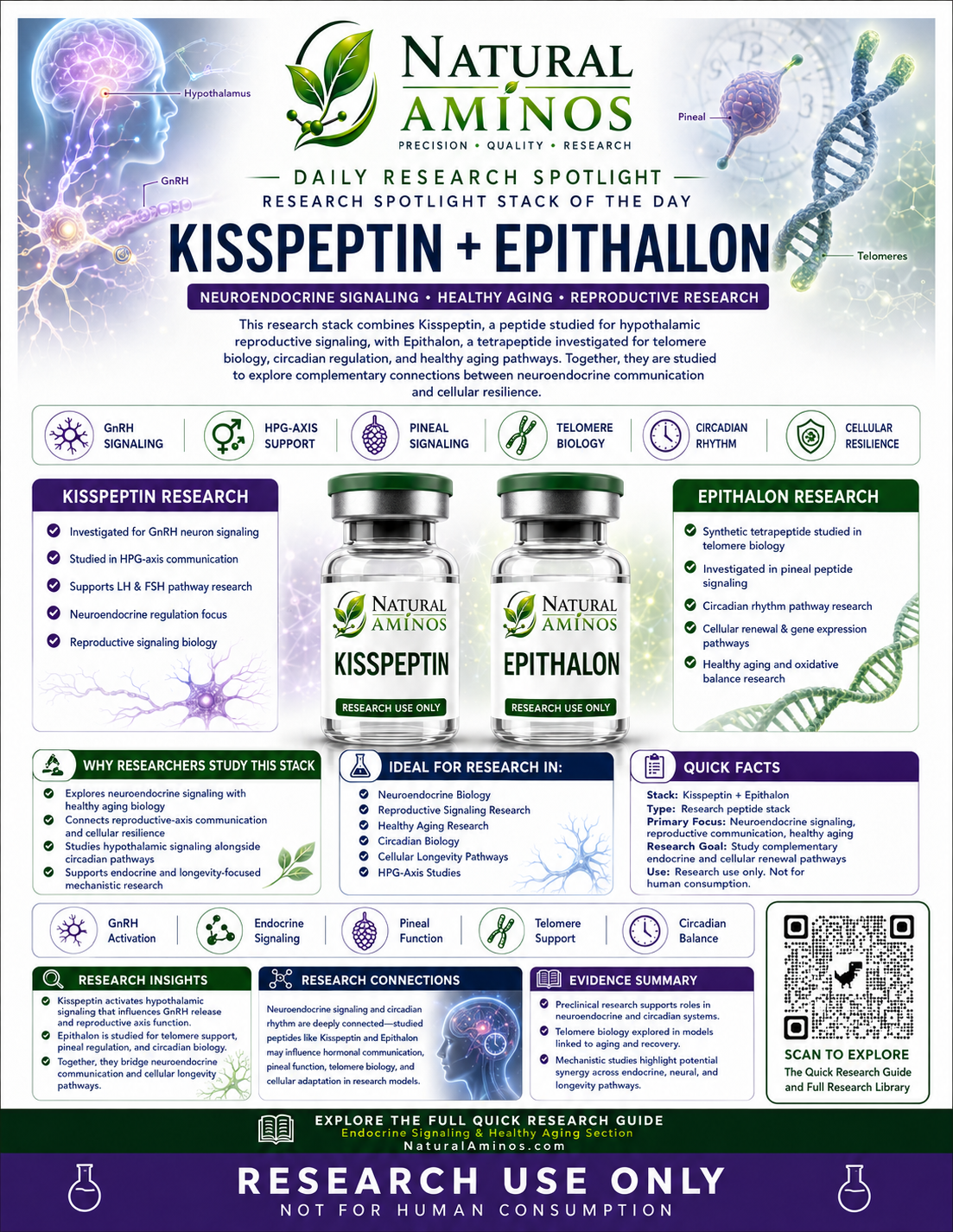
Kisspeptin + Epithalon Research Data
For laboratory research use only; not for human or veterinary use or consumption. This page provides research information, not personal-use instructions or medical advice.
Natural Aminos Research Stack or Formula of the Day
Kisspeptin + Epithalon
Reproductive-Axis Timing, Circadian-Pineal Signaling & Healthy-Aging Research Spotlight
Compound Identity & Research Context
Kisspeptin and Epithalon act in very different research domains. Kisspeptin is an endogenous neuropeptide system encoded by KISS1 and acting through KISS1R/GPR54. It is a central upstream regulator of gonadotropin-releasing hormone (GnRH), luteinizing hormone (LH), follicle-stimulating hormone (FSH) and downstream gonadal function. Human studies have directly demonstrated reproductive-hormone activation, oocyte-maturation triggering in IVF, sexual-brain effects and, most recently, sustained gonadotropin/testosterone stimulation with intermittent kisspeptin-10 in healthy men.
Epithalon (Epitalon; AEDG) is a synthetic tetrapeptide, Ala-Glu-Asp-Gly, developed from the amino-acid composition of the pineal peptide preparation Epithalamin. Its literature centers on pineal function, melatonin and circadian rhythms, retinal biology, chromatin/gene regulation, telomerase and telomere length. The strongest human biological signals are older Russian studies involving melatonin/circadian regulation and retinal disease, while the strongest modern independent replication is a 2025 U.K. cell-line study showing effects on telomere length and telomerase-related pathways.
The combination has no direct clinical evidence. Its theoretical rationale comes from the fact that reproductive physiology is strongly time-dependent: kisspeptin neurons help integrate circadian signals into GnRH/LH output, while Epithalon has been studied for normalization of pineal melatonin rhythms. That creates a plausible “circadian timing + reproductive signaling” hypothesis. However, no peer-reviewed study was identified that administered Kisspeptin and Epithalon together, and no human study has shown that Epithalon improves kisspeptin responsiveness, fertility, testosterone, ovulation or reproductive outcomes.
Benefits
Kisspeptin
Kisspeptin has one of the strongest human endocrine evidence bases among research peptides because its primary target can be measured directly. In healthy men, intravenous kisspeptin-54 increased LH, FSH and testosterone. In women undergoing IVF, a single kisspeptin-54 injection successfully induced oocyte maturation; subsequent fertilization, embryo transfer and clinical pregnancies were documented. A later Phase II study in women at high risk of ovarian hyperstimulation syndrome also showed that kisspeptin-54 could trigger oocyte maturation in that specialized fertility setting.
Kisspeptin also has a human psychosexual research line. Randomized studies in men and women with hypoactive sexual desire disorder found altered sexual and attraction-related brain processing. In men, kisspeptin increased penile tumescence during sexual visual stimulation and improved selected measures of desire and arousal. These studies support central neuroendocrine actions beyond LH/FSH release, but they do not establish kisspeptin as a general sexual-performance or testosterone-replacement therapy.
The newest chronic human data are especially relevant. In August 2026, Imperial College London investigators reported that daily intermittent subcutaneous kisspeptin-10 exposure for 12 days sustained increases in gonadotropins in healthy men and maintained testosterone stimulation. Continuous exposure produced more attenuation, whereas the intermittent schedule preserved receptor responsiveness. This demonstrates that dosing pattern materially changes endocrine behavior and that kisspeptin physiology is not well represented by a simple “more exposure is better” model.
The main limitation is tachyphylaxis. Earlier studies in women with hypothalamic amenorrhea showed marked loss of response with frequent chronic exposure. Kisspeptin therefore has genuine human endocrine efficacy, but sustained benefit depends on sex, reproductive state, baseline hypothalamic function and exposure pattern.
Epithalon
Epithalon's most defensible human benefit signal is modulation of pineal and circadian biology. A 2007 Russian gerontology report comparing older monkeys and elderly people described age-associated reductions in nighttime melatonin and circadian amplitude and reported that Epithalon or the related pineal extract Epithalamin could restore nighttime melatonin release in individuals with reduced pineal function. This supports a normalization model rather than proof of a sedative or insomnia effect.
Epithalon also has a small human retinal literature. A St. Petersburg study in retinitis pigmentosa reported a high proportion of positive clinical responses in patients, alongside supportive animal retinal data. This is direct human exposure evidence but is methodologically older, geographically concentrated and not independently reproduced in a modern multicenter randomized program.
The best-known healthy-aging mechanism is telomere biology. Earlier Russian cell studies reported telomerase activation, telomere elongation and extended replicative capacity in normal human fibroblasts. In 2025, Brunel University London investigators independently reported dose-dependent telomere-length extension in normal human cell lines with hTERT/telomerase upregulation. The same study also observed alternative telomere-lengthening activity in breast-cancer cell lines. These findings strengthen the evidence that Epithalon can affect telomere biology in vitro while simultaneously underscoring that telomere manipulation is biologically complex and is not equivalent to proven human longevity.
Current U.S. regulatory review highlights the translation gap. FDA states that compounded Epitalon may pose immunogenicity risks because of aggregation and peptide-related impurities and that it has not identified sufficient safety information for proposed administration routes. Epitalon was discussed at the July 24, 2026 Pharmacy Compounding Advisory Committee meeting for the nominated use of insomnia; committee discussion does not constitute drug approval.
What the Formulas Are Studied For
Kisspeptin Research Areas
• GnRH activation and control of the hypothalamic-pituitary-gonadal axis.
• LH, FSH and testosterone responses in healthy men.
• Hypothalamic amenorrhea and restoration of gonadotropin signaling.
• Ovulation and oocyte-maturation triggering during IVF.
• Reproductive disorders associated with KISS1/KISS1R dysfunction.
• Sexual desire, attraction-related brain processing and reproductive behavior.
• Circadian timing of reproduction and integration of suprachiasmatic-clock signals with GnRH output.
• Exposure-pattern-dependent tachyphylaxis and maintenance of receptor responsiveness.
Epithalon Research Areas
• Pineal function, nighttime melatonin and age-related circadian dysregulation.
• Retinal degeneration and retinitis pigmentosa.
• Telomerase activity, hTERT expression and telomere length in cultured human cells.
• Chromatin decondensation and age-associated gene-expression regulation.
• Neuroendocrine aging and pineal-gland signaling.
• Antioxidant, neuroprotective and antimutagenic effects in preclinical models.
• Gerontology and healthy-aging research, with the critical distinction that many long-term human studies used Epithalamin rather than synthetic Epithalon.
Published Research — Worldwide Evidence Review
Kisspeptin — United Kingdom, Europe, Asia and Human Reproductive Endocrinology
The strongest human kisspeptin program comes from Imperial College London and collaborating U.K. reproductive-endocrinology groups. A landmark 2005 study demonstrated that kisspeptin-54 robustly stimulates LH, FSH and testosterone in healthy men. Subsequent work showed that kisspeptin-54 can trigger oocyte maturation during IVF and that reproductive responses vary with sex, reproductive state and hormonal context.
Human chronic-exposure studies established tachyphylaxis as a real biological constraint. In women with hypothalamic amenorrhea, repeated frequent kisspeptin administration produced declining gonadotropin responses, while less frequent schedules preserved more activity. These findings helped establish the modern concept that the reproductive axis responds best to appropriately patterned upstream stimulation.
The 2026 European Journal of Endocrinology study moved this question forward in men. Acute subcutaneous kisspeptin-10 increased LH, FSH and testosterone in a dose-dependent fashion. Five days of continuous exposure attenuated gonadotropin responses, but daily 8-hour intermittent infusions for 12 days maintained significant LH stimulation and preserved receptor responsiveness to a subsequent kisspeptin bolus. The study provides direct human evidence that intermittent kisspeptin can sustain HPG-axis stimulation for nearly two weeks.
Delivery research has also progressed. A 2025 human study reported that intranasal kisspeptin-54 rapidly stimulated gonadotropin release in healthy men, healthy women and women with hypothalamic amenorrhea without reported adverse events in that study. This expands route-of-delivery research but does not establish long-term safety or superiority to established fertility treatments.
Kisspeptin is also embedded in circadian reproductive biology. Reviews from U.S. and French/European neuroendocrine groups describe kisspeptin neurons as an interface between the suprachiasmatic circadian system, ovarian steroid feedback and GnRH neurons, especially in timing the preovulatory LH surge. Much of the detailed mechanistic evidence comes from animal models, so this should be treated as strong physiology rather than proof that a circadian-modifying peptide will improve human kisspeptin treatment.
Current FDA compounding guidance states that compounded Kisspeptin-10 may pose immunogenicity and peptide-impurity/API-characterization risks for certain administration routes and that FDA has no or limited safety information for the proposed compounded routes. This is distinct from the controlled kisspeptin clinical literature, which generally uses well-characterized research material under protocol conditions.
Epithalon — Russia, Ukraine, Poland and United Kingdom
Epithalon research originated in the St. Petersburg Institute of Bioregulation and Gerontology and related Russian/Ukrainian groups. The most important evidence-quality issue is the repeated mixing of Epithalon with Epithalamin. Epithalamin is a bovine pineal peptide extract; Epithalon is the defined synthetic AEDG tetrapeptide. Long-term human mortality or geroprotection findings generated with Epithalamin should not be presented as direct clinical proof for Epithalon.
The 2007 pineal study reported that aging reduced nighttime melatonin levels and circadian amplitude in monkeys and humans and that Epithalon could restore nighttime endogenous melatonin in people with reduced pineal function. This finding is highly relevant to the present stack because circadian timing is also important to reproductive neuroendocrinology. However, the study did not test fertility, testosterone, ovulation, kisspeptin signaling or reproductive outcomes.
Cellular aging research began with Russian studies showing activation of the telomerase catalytic subunit, telomerase enzyme activity and telomere elongation in normal human fibroblasts. Epithalon-treated cells underwent additional population doublings beyond untreated controls. Separate lymphocyte work in elderly subjects reported decondensation of age-associated heterochromatin and activation of ribosomal genes. These results support gene-regulatory activity in vitro but do not establish organism-level rejuvenation.
Independent replication improved in 2025 when Brunel University London researchers reported that Epithalon increased telomere length in normal human fibroblast and epithelial cell lines through hTERT/telomerase upregulation. In breast-cancer cell lines, telomeres also lengthened through alternative-lengthening mechanisms. This is important external confirmation of telomere-pathway activity, but it also illustrates why long-term safety questions cannot be reduced to the idea that longer telomeres are automatically beneficial.
A 2025 review from the Medical University of Warsaw summarized approximately 25 years of Epithalon research and concluded that geroprotective and neuroendocrine findings are promising but mechanistically incomplete. The review also confirms the limited modern clinical-development infrastructure compared with established pharmaceutical programs.
Direct Research on Kisspeptin + Epithalon Together
No peer-reviewed human, animal or in-vitro study was identified that administered Kisspeptin and Epithalon together as a defined intervention. No controlled study was found comparing the combination with Kisspeptin alone, Epithalon alone or placebo, and no pharmacokinetic or safety interaction study was identified.
The two literatures intersect conceptually through circadian reproductive timing. Kisspeptin neurons help transmit circadian information to GnRH/LH reproductive output, while Epithalon has been reported to normalize melatonin rhythms in older organisms with reduced pineal function. This is a biologically plausible bridge, but it remains an inference assembled from separate literatures rather than direct combination evidence.
Theory of the Stack — How the Combination Could Work
1. Upstream Reproductive Signaling — Kisspeptin Layer
Kisspeptin would provide the active reproductive-endocrine layer. By activating KISS1R on or upstream of GnRH neurons, it can increase LH and FSH and thereby stimulate gonadal steroid production when the downstream axis is capable of responding. In men, controlled studies show acute and intermittent increases in testosterone; in women, the same upstream pathway can trigger the LH surge needed for oocyte maturation.
2. Circadian-Pineal Timing — Epithalon Layer
Epithalon would provide the proposed circadian layer. Its most relevant human/primates evidence concerns restoration of nighttime melatonin patterns in aging or pineal insufficiency. If a reproductive system is being influenced by disrupted circadian timing, a theoretical normalization of pineal timing could provide a more physiologically appropriate temporal environment for kisspeptin-GnRH signaling.
3. Why Circadian Timing Matters to Reproduction
Reproductive physiology is not constant across the day. In female mammals, the circadian system helps determine when the preovulatory LH surge occurs, and kisspeptin neurons are a major interface between clock signals and GnRH neurons. In humans, shift work, sleep disruption and circadian misalignment are associated with reproductive disturbances, although many confounding factors are involved. The theoretical attraction of Epithalon is therefore not that it directly stimulates fertility, but that a more organized circadian signal could theoretically improve the timing context in which kisspeptin operates.
4. The Melatonin-Kisspeptin Link Is Indirect
The theory should not be simplified into “Epithalon raises melatonin and therefore increases Kisspeptin.” In seasonal animals, melatonin can regulate reproductive timing through networks that ultimately influence kisspeptin neurons, but kisspeptin cells do not necessarily express melatonin receptors directly, and the pathways vary across species. In humans, there is no controlled evidence showing that Epithalon-induced melatonin changes increase kisspeptin tone or improve kisspeptin pharmacodynamics.
5. Intermittent Kisspeptin May Be More Important Than Adding Epithalon
The 2026 human study makes an important practical point for the theory: the pattern of kisspeptin exposure itself has a large effect on sustained gonadotropin output. Intermittent daily exposure preserved signaling for 12 days better than continuous exposure. That direct human finding is much stronger evidence than any proposed Epithalon interaction. A combination study would therefore need to control Kisspeptin schedule carefully before attributing any difference to Epithalon.
6. Epithalon Adds a Healthy-Aging Hypothesis, Not Proven Reproductive Synergy
Epithalon also contributes a separate telomere/chromatin hypothesis that Kisspeptin does not share. In theory, healthier cellular aging or improved neuroendocrine resilience could support reproductive function indirectly. However, no study has shown that telomerase activation improves Kisspeptin responsiveness, preserves fertility, increases testosterone or restores ovarian reserve. This part of the stack is therefore parallel healthy-aging biology rather than demonstrated reproductive synergy.
7. Sex and Baseline Endocrine State Could Change the Entire Outcome
Kisspeptin responses differ markedly by sex, menstrual phase, fertility status and baseline hypothalamic function. Epithalon's pineal effects also appear strongest where age-related melatonin output is already reduced. A combination could therefore behave very differently in a healthy young man, an older man with low nighttime melatonin, a cycling premenopausal woman, a woman with hypothalamic amenorrhea or a postmenopausal woman. A single generalized “hormone balance” claim would not be scientifically justified.
8. Feedback and Desensitization Remain Central
The HPG axis is governed by strong negative feedback. Kisspeptin can raise gonadotropins and gonadal steroids, but chronic continuous exposure can attenuate the response. Epithalon does not remove this feedback architecture. Even if circadian timing improved, the endocrine system could still down-regulate under inappropriate kisspeptin exposure. The combination should therefore be viewed as timing plus stimulation, not as a way to bypass physiologic feedback.
9. Telomere Biology Requires Long-Term Caution
Epithalon's telomere findings are scientifically interesting but add uncertainty as well as theoretical benefit. Telomerase can extend replicative capacity in normal cells, yet telomere-maintenance pathways are also used by cancers. The 2025 study found telomere-lengthening activity in breast-cancer cell lines through alternative mechanisms. There is no evidence that Kisspeptin plus Epithalon promotes malignancy, but long-term combination studies should not assume that broader endocrine stimulation plus telomere manipulation is automatically beneficial.
Possible Overall Benefit — Theoretical, Not Proven
The most defensible theoretical benefit of Kisspeptin + Epithalon is improved coordination between reproductive-axis signaling and circadian timing. Kisspeptin could directly stimulate the GnRH/LH/FSH system, while Epithalon could theoretically strengthen or normalize pineal melatonin rhythms in a person with circadian/pineal dysregulation. If both effects occurred in the same individual, the reproductive signal might be delivered in a more physiologically organized temporal environment.
For men, the theoretical result could be sustained endogenous gonadotropin/testosterone signaling when Kisspeptin is used intermittently, with Epithalon contributing circadian support rather than direct androgen stimulation. For women, the theoretical concept would be more complex because ovulation depends on precisely timed estrogen feedback and LH-surge physiology. No evidence currently shows that Epithalon improves oocyte maturation, ovulation, ovarian reserve or pregnancy rates.
For healthy-aging research, Epithalon contributes telomere, chromatin and pineal hypotheses that are largely separate from Kisspeptin. The combination could therefore be described as a reproductive-endocrine plus circadian/gerontology research concept. It should not be described as a proven fertility, testosterone, anti-aging or longevity stack.
Why More Research Is Needed
• No published study has tested Kisspeptin + Epithalon together, so synergy, antagonism, pharmacokinetic compatibility and combined safety are unknown.
• Kisspeptin has strong human endocrine target-engagement evidence, but clinical outcomes depend on sex, reproductive diagnosis, exposure schedule and baseline gonadal function.
• Continuous or overly frequent kisspeptin exposure can cause tachyphylaxis; intermittent exposure appears more sustainable in human studies.
• Epithalon human evidence is small, methodologically older and geographically concentrated, with limited independent clinical replication.
• Many long-term human gerontology claims attributed to Epithalon actually derive from Epithalamin, a bovine pineal peptide extract, and should not be treated as equivalent evidence.
• The 2025 independent Epithalon telomere study was performed in cultured cells, not in humans, and therefore does not prove human longevity or reproductive benefit.
• The melatonin-kisspeptin relationship is well supported as a circadian-reproductive concept, especially in animal models, but no human Epithalon study has shown improved Kisspeptin signaling.
• FDA states that compounded Kisspeptin-10 and Epitalon raise unresolved immunogenicity, peptide-impurity/API-characterization or route-specific safety questions.
• A rigorous combination study would need objective circadian markers such as dim-light melatonin onset or overnight melatonin profiles together with LH pulse analysis, FSH, sex steroids and reproductive outcomes.
• Female studies would need menstrual-cycle-phase control, ovulation tracking and careful interpretation of estrogen feedback; male studies would need serial LH, FSH, testosterone, estradiol and gonadal-function measures.
• Long-term studies should distinguish immediate endocrine target engagement from sustained clinical outcomes such as fertility, sexual function, menstrual regularity or validated hypogonadism endpoints.
• Long-term safety studies should also examine proliferative risk, because Epithalon alters telomere-maintenance pathways in cultured cells and the combination would simultaneously manipulate endocrine signaling.
Research Summary
Kisspeptin + Epithalon is a biologically coherent but untested neuroendocrine stack. Kisspeptin has substantial direct human evidence for reproductive-axis activation, including LH/FSH/testosterone stimulation, IVF oocyte triggering, sexual-brain effects and 2026 evidence that intermittent subcutaneous Kisspeptin-10 can sustain gonadotropin stimulation over 12 days. Epithalon has a smaller, older human literature supporting pineal/melatonin and retinal effects plus a substantial cellular aging literature, with 2025 independent confirmation that it can alter telomere biology in human cell lines.
The most scientifically defensible connection between the compounds is circadian timing. Kisspeptin is a key interface between circadian signaling and GnRH/LH reproductive output, while Epithalon has been reported to normalize nighttime melatonin rhythms in older organisms with pineal dysfunction. That makes the pairing plausible as “circadian context + reproductive signal.” The combination remains entirely unvalidated, and there is no evidence that Epithalon improves Kisspeptin responsiveness, fertility, testosterone or ovulation.
Selected Sources
• Dhillo WS, et al. Kisspeptin-54 stimulates the hypothalamic-pituitary gonadal axis in human males. Journal of Clinical Endocrinology & Metabolism. 2005. PMID: 16174713. DOI: 10.1210/jc.2005-1468.
• Jayasena CN, et al. Kisspeptin-54 triggers egg maturation in women undergoing in vitro fertilization. Journal of Clinical Investigation. 2014;124(8):3667-3677. PMID: 25036713. PMCID: PMC4109525. DOI: 10.1172/JCI75730.
• Abbara A, et al. Efficacy of Kisspeptin-54 to Trigger Oocyte Maturation in Women at High Risk of Ovarian Hyperstimulation Syndrome During IVF Therapy. Journal of Clinical Endocrinology & Metabolism. 2015;100(9):3322-3331. PMID: 26192876.
• Jayasena CN, et al. Subcutaneous kisspeptin-54 acutely stimulates gonadotropin secretion in women with hypothalamic amenorrhea, but chronic administration causes tachyphylaxis. Journal of Clinical Endocrinology & Metabolism. 2009. PMID: 19820030.
• Jayasena CN, et al. Twice-weekly administration of kisspeptin-54 for 8 weeks stimulates release of reproductive hormones in women with hypothalamic amenorrhea. Clinical Pharmacology & Therapeutics. 2010;88(6):840-847. PMID: 20980998.
• Mills EG, et al. Effects of Kisspeptin on Sexual Brain Processing and Penile Tumescence in Men With Hypoactive Sexual Desire Disorder: A Randomized Clinical Trial. JAMA Network Open. 2023;6(2):e2254313. PMID: 36735255. PMCID: PMC9898824.
• Mills EG, et al. Kisspeptin Administration Stimulates Reproductive Hormones but Does Not Affect Anxiety in Humans. Journal of Clinical Endocrinology & Metabolism. 2025;110(11):3133-3141. PMID: 40036336. PMCID: PMC12527446. DOI: 10.1210/clinem/dgaf128.
• Intranasal kisspeptin administration rapidly stimulates gonadotropin release in humans. 2025. PMID: 40215751.
• Yeung AC, et al. Chronic subcutaneous kisspeptin-10 stimulates gonadotropin secretion for 12 days in healthy men. European Journal of Endocrinology. 2026;195(2):206-216. PMID: 42549827. DOI: 10.1093/ejendo/lvag134.
• Beymer M, et al. The role of kisspeptin and RFRP in the circadian control of female reproduction. Molecular and Cellular Endocrinology. 2016. PMID: 27364888. DOI: 10.1016/j.mce.2016.06.026.
• Kriegsfeld LJ. Circadian regulation of kisspeptin in female reproductive functioning. Advances in Experimental Medicine and Biology. 2013. PMID: 23550016. PMCID: PMC4385794.
• Xie Q, et al. The Role of Kisspeptin in the Control of the Hypothalamic-Pituitary-Gonadal Axis and Reproduction. Frontiers in Endocrinology. 2022. PMID: 35837314.
• Korkushko OV, et al. Normalizing effect of the pineal gland peptides on the daily melatonin rhythm in old monkeys and elderly people. Advances in Gerontology. 2007;20(1):74-85. PMID: 17969590.
• Khavinson VK, et al. Pineal-regulating tetrapeptide Epitalon improves eye retina condition in retinitis pigmentosa. Neuro Endocrinology Letters. 2002;23(4):365-368. PMID: 12195242.
• Khavinson VK, Bondarev IE, Butyugov AA. Epithalon peptide induces telomerase activity and telomere elongation in human somatic cells. Bulletin of Experimental Biology and Medicine. 2003;135(6):590-592. PMID: 12937682. DOI: 10.1023/A:1025493705728.
• Khavinson VK, Bondarev IE, Butyugov AA, Smirnova TD. Peptide promotes overcoming of the division limit in human somatic cell. Bulletin of Experimental Biology and Medicine. 2004;137(5):503-506. PMID: 15455129. DOI: 10.1023/B:BEBM.0000038164.49947.8c.
• Khavinson VK, et al. Peptide Epitalon activates chromatin at the old age. Neuro Endocrinology Letters. 2003;24(5):329-333. PMID: 14647006.
• Araj SK, Brzezik J, Madra-Gackowska K, Szeleszczuk L. Overview of Epitalon—Highly Bioactive Pineal Tetrapeptide with Promising Properties. International Journal of Molecular Sciences. 2025;26(6):2691. PMID: 40141333. PMCID: PMC11943447. DOI: 10.3390/ijms26062691.
• Al-Dulaimi S, Thomas R, Matta S, Roberts T. Epitalon increases telomere length in human cell lines through telomerase upregulation or ALT activity. Biogerontology. 2025;26(5):178. PMID: 40908429. PMCID: PMC12411320. DOI: 10.1007/s10522-025-10315-x.
• U.S. Food and Drug Administration. Certain Bulk Drug Substances for Use in Compounding that May Present Significant Safety Risks. Current entries for Kisspeptin-10 and Epitalon.
• U.S. Food and Drug Administration. July 23-24, 2026 Pharmacy Compounding Advisory Committee meeting materials. Epitalon-related bulk drug substances were reviewed for the nominated use of insomnia.
Theory vs. Proof — Verdict
What is supported by evidence: Kisspeptin can directly activate the human HPG axis and has controlled human evidence for LH/FSH/testosterone stimulation and IVF oocyte maturation. Intermittent Kisspeptin-10 can maintain gonadotropin stimulation for 12 days in healthy men. Epithalon has human evidence consistent with pineal/melatonin modulation and retinal effects, plus reproducible cell evidence that it can alter telomerase/telomere biology.
What is not proven: that Epithalon improves Kisspeptin signaling, testosterone, fertility, ovulation or sexual function; that altered melatonin caused by Epithalon improves reproductive outcomes; that telomere effects provide reproductive or longevity benefit in humans; or that simultaneous Kisspeptin + Epithalon exposure has an established efficacy, pharmacokinetic or safety profile.
Verdict — theory vs. proof: the mechanistic theory is moderately coherent but the direct proof is absent. Kisspeptin supplies a strong, directly demonstrated reproductive signal, while Epithalon supplies a much less validated pineal/circadian and cellular-aging signal. Their most plausible point of complementarity is timing: kisspeptin is a major interface between circadian information and the reproductive axis, and Epithalon has been reported to normalize age-disrupted melatonin rhythms. That does not establish synergy. The 2026 Kisspeptin data indicate that exposure pattern alone strongly determines sustained endocrine responsiveness, and that evidence is more direct than any proposed Epithalon interaction. Overall, Kisspeptin + Epithalon is best classified as a plausible circadian-reproductive research hypothesis with strong human endocrine evidence for Kisspeptin, limited human circadian evidence for Epithalon, and no direct combination evidence.
Research & Educational Use Only !!