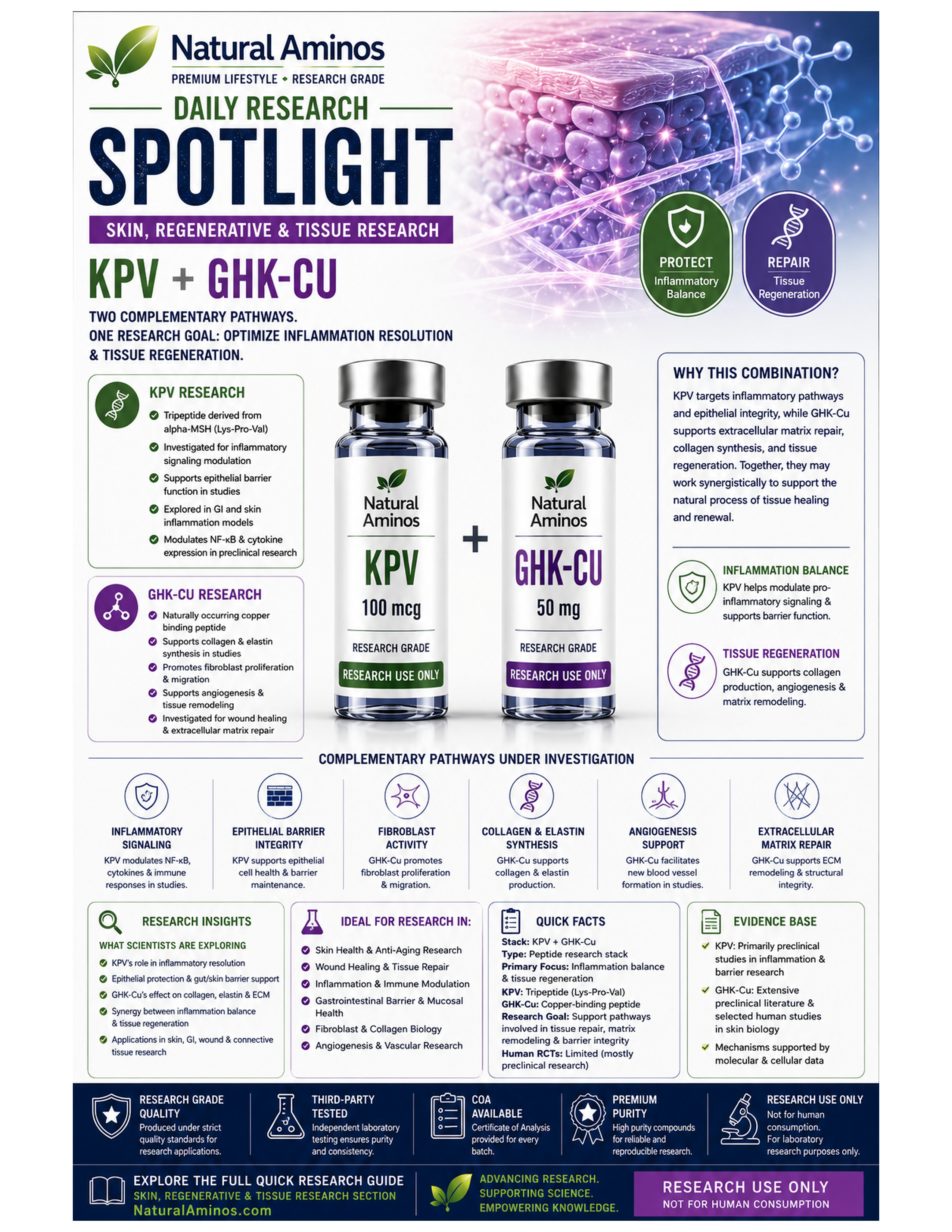
KPV + GHK-Cu Research Data
For laboratory research use only; not for human or veterinary use or consumption. This page provides research information, not personal-use instructions or medical advice.
Natural Aminos Research Stack or Formula of the Day
KPV + GHK-Cu
Inflammatory Signaling, Extracellular-Matrix Remodeling & Wound-Repair Research Spotlight
Compound Identity & Evidence Context
KPV is the tripeptide Lys-Pro-Val, corresponding to residues 11-13 of alpha-melanocyte-stimulating hormone (alpha-MSH). It has been studied primarily as a compact anti-inflammatory peptide capable of suppressing NF-kappaB, MAPK, IL-1beta and related inflammatory signaling in epithelial and immune systems. Its published evidence is predominantly preclinical: human intestinal, airway and skin cells plus mouse inflammatory models. FDA states that it has not identified human exposure data from drug products containing KPV administered by any route and lacks important human safety information.
GHK-Cu is the copper(II) complex of the naturally occurring tripeptide glycyl-L-histidyl-L-lysine. GHK was originally identified in human plasma and is studied for wound healing, collagen and glycosaminoglycan synthesis, extracellular-matrix turnover, fibroblast activity, angiogenesis and inflammatory modulation. Its human evidence is stronger than KPV's but is concentrated in local/topical applications, including a randomized multicenter diabetic-ulcer study. A 2026 systematic review identified 20 eligible GHK-Cu studies, of which 18 were preclinical and only two were randomized clinical trials.
No peer-reviewed human, animal or cell study was identified that directly administered KPV and GHK-Cu together as one defined combination. The stack therefore has no direct proof of synergy, additive benefit, pharmacokinetic compatibility or combined safety.
Benefits
KPV
KPV's strongest experimental benefit is suppression of inflammatory signaling. In human intestinal epithelial cells and T cells, nanomolar KPV inhibited NF-kappaB and MAP-kinase activation and reduced pro-inflammatory cytokine secretion. Uptake studies showed that KPV can use the PepT1 di-/tripeptide transporter, which is induced in inflamed colonic tissue and inflammatory cell systems.
In mouse colitis models, oral KPV reduced inflammatory cytokine expression, inflammatory-cell infiltration and tissue injury. A separate German study reported earlier recovery, improved weight regain, lower myeloperoxidase activity and reduced histologic inflammation. Activity persisted in mice with nonfunctional melanocortin-1 receptors, supporting at least partly receptor-independent anti-inflammatory biology.
KPV also acts outside the intestine. Human bronchial epithelial-cell research showed reduced IL-8/eotaxin secretion, lower MMP-9 activity and interference with nuclear import of NF-kappaB p65. A 2025 South Korean study reported reduced particulate-matter-induced oxidative stress, apoptosis and IL-1beta-related inflammation in human keratinocytes and a 3D skin model. In 2026, KPV was also reported to alter adipocyte and hepatic lipid signaling in preclinical systems, but these newer metabolic findings do not establish human benefit.
The central limitation remains human translation. FDA's July 2026 briefing stated that neither the nomination nor FDA's literature search identified clinical studies or human exposure data for KPV via any route. FDA therefore described potential human safety risks as unknown.
GHK-Cu
GHK-Cu's best-supported biological role is coordinated extracellular-matrix production and remodeling. Classic French fibroblast studies showed that very low concentrations of GHK-Cu stimulate collagen synthesis without simply increasing cell number. Additional work demonstrated increased sulfated glycosaminoglycan synthesis, particularly dermatan sulfate and heparan sulfate, both relevant to connective-tissue organization.
GHK-Cu does not merely increase matrix deposition. It also increases matrix metalloproteinase-2 expression and secretion of TIMP-1/TIMP-2, supporting a remodeling model in which damaged extracellular matrix is turned over while new matrix is produced. In rat wound chambers, GHK-Cu increased collagen, glycosaminoglycans, DNA and total tissue content and increased type I/III collagen mRNA, providing in-vivo proof that the matrix effects can translate beyond cultured fibroblasts.
Human wound evidence is meaningful but route-specific. A multicenter randomized, evaluator-blinded, placebo-controlled study of diabetic neuropathic plantar ulcers found that topical GHK-Cu gel significantly increased median ulcer-area closure, accelerated healing and reduced infection incidence versus vehicle under standardized wound care. This is direct human clinical evidence for local wound repair.
The current 2026 systematic review in aesthetic medicine found a consistent preclinical signal for extracellular-matrix synthesis, angiogenesis, cellular proliferation and anti-inflammatory effects, but only two randomized clinical trials among 20 included studies. The review concluded that the biological rationale is credible while clinical guidance remains limited by study heterogeneity, few well-designed trials and inconsistent formulations/delivery systems.
Injectable use should be separated from topical/local evidence. FDA currently states that compounded injectable GHK-Cu may pose immunogenicity risk because of aggregation and peptide-related impurities and that human data are limited for safety-related considerations. FDA separately returned non-injectable GHK-Cu to Category 1 under evaluation in May 2026 and plans further PCAC consideration before the end of February 2027.
What the Formulas Are Studied For
KPV Research Areas
• Inflammatory bowel disease and experimental colitis.
• NF-kappaB and MAPK inflammatory signaling.
• IL-1beta-related inflammatory pathways.
• PepT1-mediated uptake in inflamed epithelium and immune cells.
• Airway epithelial inflammation, chemokine release and MMP-9 regulation.
• Skin oxidative stress and inflammatory injury.
• Emerging adipocyte and hepatic lipid-signaling research in 2026 preclinical models.
• Wound-healing and inflammatory-condition use reviewed by FDA in 2026, without identified human exposure data.
GHK-Cu Research Areas
• Collagen synthesis and extracellular-matrix reconstruction.
• Dermatan sulfate, heparan sulfate and broader glycosaminoglycan synthesis.
• MMP/TIMP regulation and matrix remodeling.
• Fibroblast, keratinocyte and endothelial-cell activity.
• Angiogenesis and microvascular wound repair.
• Diabetic-ulcer healing and local wound closure.
• Skin regeneration, post-procedure recovery and aesthetic/photoaging research.
• Anti-inflammatory and antioxidant signaling.
Published Research - Worldwide Evidence Review
KPV - United States, Germany, United Kingdom and South Korea
The foundational KPV gastrointestinal work came from Emory University in the United States and the University of Muenster in Germany. The 2008 Gastroenterology study demonstrated PepT1-mediated uptake in human intestinal epithelial cells and T cells, suppression of NF-kappaB/MAPK signaling and reduced DSS/TNBS colitis in mice. The independent German study likewise found anti-inflammatory activity in DSS and T-cell-transfer colitis.
United Kingdom airway research provided a distinct mechanistic layer by showing that KPV interferes with nuclear translocation of NF-kappaB p65 in human bronchial epithelial cells, with reductions in pro-inflammatory chemokines and MMP-9 activity. This supports the idea that KPV can function as a direct intracellular inflammatory modulator rather than only through classical melanocortin signaling.
South Korean studies have expanded KPV into skin and metabolic models. The 2025 keratinocyte study reported reduced ROS and inflammatory-cell-death signaling after particulate exposure. In 2026, KPV was reported to suppress adipocyte differentiation and lipid accumulation and to alter ROS-linked AKT/mTORC1/PPAR-gamma signaling. These are potentially useful mechanistic extensions but remain preclinical.
FDA's July 2026 PCAC materials reviewed KPV free base and KPV acetate for wound healing and inflammatory conditions. FDA reported no identified clinical studies, no identified human exposure data and unknown potential safety risks. Advisory-committee discussion of compounding status is not evidence of drug approval or clinical efficacy.
GHK-Cu - France, United States, Middle East/U.S. Review Network and Asia
France produced much of the foundational extracellular-matrix evidence. Reims investigators showed stimulation of collagen synthesis in fibroblasts, followed by dose-dependent increases in sulfated glycosaminoglycans and later coordinated MMP-2/TIMP regulation. These studies established GHK-Cu as a regulator of matrix turnover rather than a simple collagen stimulant.
U.S. human wound research provides one of the strongest clinical anchors. In the randomized diabetic-ulcer trial, topical GHK-Cu gel produced markedly greater plantar-ulcer closure than vehicle and reduced infections when started after debridement. A separate U.S. post-laser-resurfacing trial produced more mixed objective cosmetic findings, illustrating that clinical benefit is not uniform across all applications.
The 2026 systematic review involved investigators affiliated with institutions in the United Arab Emirates, Egypt and major U.S. plastic-surgery centers. It reviewed 20 studies through March 2026 and found 18 preclinical studies but only two randomized clinical trials. The authors concluded that GHK-Cu has a reasonable regenerative basis but that larger standardized human trials are necessary.
Asian work increasingly focuses on delivery systems and complex wound environments. Chinese groups have studied GHK-Cu in hydrogels, nanofibers and catalytic wound platforms. A 2026 diabetic-wound hydrogel study combined GHK-Cu with glucose oxidase to reduce local glucose, reverse hypoxia, stimulate angiogenesis and promote repair in preclinical models. These advanced delivery studies strengthen local wound-mechanism evidence but do not establish systemic injectable efficacy.
Direct Research on KPV + GHK-Cu Together
No peer-reviewed human, animal or cell study was identified that directly tested KPV + GHK-Cu as one intervention. No controlled study was found comparing the combination against KPV alone, GHK-Cu alone or placebo, and no combination pharmacokinetic or compatibility study was identified.
This means the stack theory must be constructed from separate literatures. KPV has the stronger anti-inflammatory signaling argument; GHK-Cu has the stronger matrix-remodeling and human local-wound evidence. Whether those effects reinforce each other, overlap, or interfere with normal wound-phase sequencing has not been tested.
Theory of the Stack - How the Combination Could Work
1. Upstream Inflammatory Control - KPV Layer
KPV would theoretically act early by lowering excessive NF-kappaB, MAPK, IL-1beta and chemokine signaling. Persistent inflammation can prolong tissue damage, impair epithelial function and disrupt normal wound progression. Reducing that inflammatory pressure could create a more favorable environment for fibroblast-driven rebuilding.
2. Extracellular-Matrix Construction - GHK-Cu Layer
GHK-Cu would theoretically provide the structural-repair layer. Its strongest mechanistic evidence concerns collagen, glycosaminoglycans, fibroblast behavior and matrix remodeling. Once inflammation is controlled, this could support reconstruction of the connective-tissue scaffold.
3. The Stack Looks Sequential Rather Than Receptor-Synergistic
The most coherent model is not direct receptor synergy but phase-of-repair complementarity: KPV reduces excessive inflammatory signaling, and GHK-Cu supports matrix production/remodeling. That is conceptually attractive because inflammation control and structural rebuilding are different biological tasks.
4. Both Compounds Also Have Anti-Inflammatory Activity
The complementarity is not complete. GHK-Cu itself has anti-inflammatory and antioxidant actions, and KPV can affect MMP-related inflammatory biology. Therefore, part of the stack may be redundant. If GHK-Cu already sufficiently modifies the inflammatory wound environment, KPV may add little. Conversely, KPV could suppress pathways that GHK-Cu does not strongly affect. No direct experiment distinguishes these possibilities.
5. Inflammation Is Necessary During Early Repair
A central caution is that wound inflammation is not purely harmful. Early inflammatory signaling helps clear damaged tissue and coordinate recruitment of repair cells. Excessive or poorly timed suppression of NF-kappaB/IL-1beta signaling could theoretically impair normal repair sequencing. The stack therefore cannot be assumed to benefit from maximal anti-inflammatory activity.
6. Fibroblast and MMP Biology Could Intersect
KPV reduces MMP-9 activity in airway epithelial research, while GHK-Cu increases MMP-2 along with TIMP-1/TIMP-2 in fibroblasts. These are different metalloproteinase systems, but the contrast highlights why matrix remodeling is a controlled balance rather than a simple “more collagen” process. A combination study would need to examine whether KPV changes the remodeling pattern induced by GHK-Cu.
7. Angiogenesis Adds a GHK-Cu-Specific Repair Component
GHK-Cu has a stronger angiogenesis and endothelial-repair literature than KPV. Improved microvascular support could help sustain fibroblast activity, collagen synthesis and epithelial recovery. KPV does not currently have comparable evidence for direct human vascular repair, so this is one area where GHK-Cu adds genuinely distinct biology.
8. Copper-Dependent Repair Is Mechanistically Distinct
GHK-Cu is not simply another short peptide; it carries copper, a catalytic cofactor involved in matrix enzymes, antioxidant defense and vascular biology. This creates repair mechanisms that KPV does not duplicate. It also creates route-specific questions because local copper handling may differ from systemic exposure.
9. Wound-Healing Research Is the Strongest Theoretical Context
Among potential applications, wound repair provides the strongest rationale because GHK-Cu already has human local-wound evidence and KPV is being evaluated preclinically and by FDA in the context of wound healing and inflammatory conditions. KPV could theoretically reduce excessive inflammation while GHK-Cu supports extracellular-matrix restoration. The absence of a direct combination study remains the decisive limitation.
Possible Overall Benefit - Theoretical, Not Proven
The most defensible theoretical benefit of KPV + GHK-Cu is coordinated transition from inflammatory control to tissue rebuilding. KPV could reduce persistent NF-kappaB/MAPK/IL-1beta signaling, while GHK-Cu could support collagen, glycosaminoglycan, fibroblast and microvascular components of wound repair. If timed appropriately, the combination could theoretically improve the quality of the repair environment rather than simply suppressing symptoms.
For skin or wound research, the possible overall benefit would be less prolonged inflammatory damage followed by more organized matrix reconstruction. For inflamed connective tissue, GHK-Cu could provide a structural-remodeling component that KPV lacks. The pair is therefore more complementary than two compounds targeting the same receptor.
The evidence remains highly asymmetric. GHK-Cu has genuine human local/topical clinical data, whereas KPV remains preclinical with no identified human drug-exposure data. The full combination therefore cannot be described as a human-validated wound-healing or regenerative intervention.
Why More Research Is Needed
• No published study has tested KPV + GHK-Cu together, so synergy, redundancy, antagonism, timing and combined safety are unknown.
• KPV has no identified clinical study or human drug-exposure data according to FDA, leaving human pharmacokinetics and safety undefined.
• KPV's strongest evidence comes from cell and animal inflammatory models rather than human wound outcomes.
• GHK-Cu has direct human wound evidence, but its clinical literature remains small; the 2026 systematic review found only two randomized clinical trials among 20 included studies.
• GHK-Cu evidence is highly route-specific. Topical/local wound data cannot be assumed to prove systemic injectable effectiveness.
• FDA identifies injectable GHK-Cu as having potential immunogenicity risk from aggregation and peptide-related impurities, with limited human safety data.
• FDA is separately evaluating non-injectable GHK-Cu under the 503A process, underscoring that route and formulation materially affect the regulatory evidence base.
• Both compounds have anti-inflammatory effects, so a head-to-head and combination design is needed to determine whether KPV adds anything beyond GHK-Cu alone.
• Early inflammation is part of normal wound healing; future studies should determine whether KPV timing alters debridement, immune-cell recruitment or later remodeling.
• GHK-Cu affects MMP/TIMP balance, while KPV can alter inflammatory protease signaling. Combination studies should measure matrix-degradation as well as matrix-production endpoints.
• Copper handling should be characterized in any systemic GHK-Cu research, including tissue distribution and biomarkers of copper homeostasis.
• Human trials should use objective endpoints such as wound-closure rate, infection rate, validated scar scales, collagen organization, vascular imaging, inflammatory biomarkers and long-term safety rather than subjective appearance alone.
Research Summary
KPV + GHK-Cu is a biologically coherent inflammation-plus-matrix-repair stack with sharply unequal evidence maturity. KPV has repeated preclinical anti-inflammatory evidence involving NF-kappaB, MAPK, IL-1beta, epithelial inflammation and oxidative stress but no identified human drug-exposure data. GHK-Cu has a deeper extracellular-matrix literature and genuine human local wound-healing evidence, including a randomized diabetic-ulcer trial, while the current 2026 systematic review confirms that human controlled evidence is still limited.
The theoretical pairing is strongest as a staged repair model: KPV to reduce excessive inflammatory signaling and GHK-Cu to support collagen, glycosaminoglycans, fibroblasts, angiogenesis and matrix remodeling. The main uncertainty is overlap, because GHK-Cu itself has anti-inflammatory effects. No direct experiment shows that adding KPV improves GHK-Cu outcomes or that concurrent exposure is better than properly timed single-agent activity.
Selected Sources
• Dalmasso G, et al. PepT1-mediated tripeptide KPV uptake reduces intestinal inflammation. Gastroenterology. 2008;134(1):166-178. PMID: 18061177. PMCID: PMC2431115. DOI: 10.1053/j.gastro.2007.10.026.
• Kannengiesser K, et al. Melanocortin-derived tripeptide KPV has anti-inflammatory potential in murine models of inflammatory bowel disease. Inflammatory Bowel Diseases. 2008;14(3):324-331. PMID: 18092346. DOI: 10.1002/ibd.20334.
• Inhibition of cellular and systemic inflammation cues in human bronchial epithelial cells by melanocortin-related peptides: mechanism of KPV action and a role for MC3R agonists. PMID: 22837805.
• An SH, Park JY, Lee SJ. Lysine-Proline-Valine peptide mitigates fine dust-induced keratinocyte apoptosis and inflammation by regulating oxidative stress and modulating the MAPK/NF-kappaB pathway. 2025. PMID: 40073467.
• An SH, Park JY, Lee SJ. KPV attenuates adipogenesis and lipid metabolism through modulation of ROS-mediated AKT/mTORC1/PPAR-gamma signaling. Tissue and Cell. 2026;104(Pt 1):103837. PMID: 42585803. DOI: 10.1016/j.tice.2026.103837.
• U.S. Food and Drug Administration. July 23-24, 2026 Pharmacy Compounding Advisory Committee briefing materials for KPV-related bulk drug substances. FDA reported no identified clinical studies or human exposure data for KPV.
• U.S. Food and Drug Administration. Certain Bulk Drug Substances for Use in Compounding that May Present Significant Safety Risks. Current 2026 entries for KPV and injectable GHK-Cu.
• Maquart FX, et al. Stimulation of collagen synthesis in fibroblast cultures by the tripeptide-copper complex glycyl-L-histidyl-L-lysine-Cu2+. FEBS Letters. 1988;238(2):343-346. PMID: 3169264. DOI: 10.1016/0014-5793(88)80509-X.
• Maquart FX, et al. Stimulation of sulfated glycosaminoglycan synthesis by the tripeptide-copper complex glycyl-L-histidyl-L-lysine-Cu2+. Life Sciences. 1992. PMID: 1522753. DOI: 10.1016/0024-3205(92)90504-I.
• In vivo stimulation of connective tissue accumulation by the tripeptide-copper complex GHK-Cu in rat experimental wounds. Journal of Clinical Investigation. 1993. PMID: 8227353. PMCID: PMC288419. DOI: 10.1172/JCI116842.
• The tripeptide-copper complex GHK-Cu stimulates matrix metalloproteinase-2 expression by fibroblast cultures. 2000. PMID: 11045606.
• Mulder GD, et al. Enhanced healing of ulcers in patients with diabetes by topical treatment with glycyl-L-histidyl-L-lysine copper. Wound Repair and Regeneration. 1994;2(4):259-269. PMID: 17147644. DOI: 10.1046/j.1524-475X.1994.20406.x.
• Pollard JD, et al. Effects of copper tripeptide on the growth and expression of growth factors by normal and irradiated fibroblasts. Archives of Facial Plastic Surgery. 2005;7(1):27-31. PMID: 15655171.
• Pickart L, Margolina A. Regenerative and Protective Actions of the GHK-Cu Peptide in the Light of the New Gene Data. International Journal of Molecular Sciences. 2018;19(7):1987. PMID: 29986520. PMCID: PMC6073405. DOI: 10.3390/ijms19071987.
• Mokhtar J, et al. The Regenerative Potential of GHK-Cu in Aesthetic Medicine. Aesthetic Surgery Journal. 2026 Aug 20. PMID: 42619529. DOI: 10.1093/asj/sjag169.
• Jiang F, et al. Synergy of GHK-Cu and hyaluronic acid on collagen IV upregulation via fibroblast and ex-vivo skin tests. Journal of Cosmetic Dermatology. 2023;22(9):2598-2604. PMID: 37062921. DOI: 10.1111/jocd.15763.
• Huang ZJ, et al. Copper peptide activated cascade catalysis for glucose regulation and hypoxia reversing in infected diabetic wound healing. Materials Today Bio. 2026;39:103396. PMID: 42404628. PMCID: PMC13330688. DOI: 10.1016/j.mtbio.2026.103396.
• U.S. Food and Drug Administration. Bulk Drug Substances Nominated for Use in Compounding Under Section 503A. Updated May 14, 2026: GHK-Cu except injectable routes returned to Category 1 under evaluation, with further PCAC review planned before the end of February 2027.
Theory vs. Proof - Verdict
What is supported by evidence: KPV repeatedly suppresses inflammatory signaling in human cell systems and animal inflammatory models. GHK-Cu has a well-developed extracellular-matrix literature showing collagen, glycosaminoglycan and MMP/TIMP effects, plus direct human local wound-healing evidence from a randomized diabetic-ulcer study.
What is not proven: that KPV is safe or effective as a human drug; that KPV improves human wound healing; that systemic injectable GHK-Cu reproduces topical wound benefits; or that KPV + GHK-Cu together are additive, synergistic or safer than either component alone.
Verdict - theory vs. proof: the mechanistic theory is moderately strong and reasonably complementary, but direct proof is absent. KPV plausibly supplies an upstream inflammatory-control layer, while GHK-Cu supplies a stronger extracellular-matrix, fibroblast, angiogenesis and copper-dependent repair layer. The main weakness is partial overlap because GHK-Cu itself has anti-inflammatory activity and both compounds can influence protease/remodeling biology. Overall, KPV + GHK-Cu is best classified as a plausible inflammation-to-repair hypothesis with meaningful human local evidence for GHK-Cu, preclinical-only evidence for KPV, and no direct evidence validating the combination.
Research & Educational Use Only !!