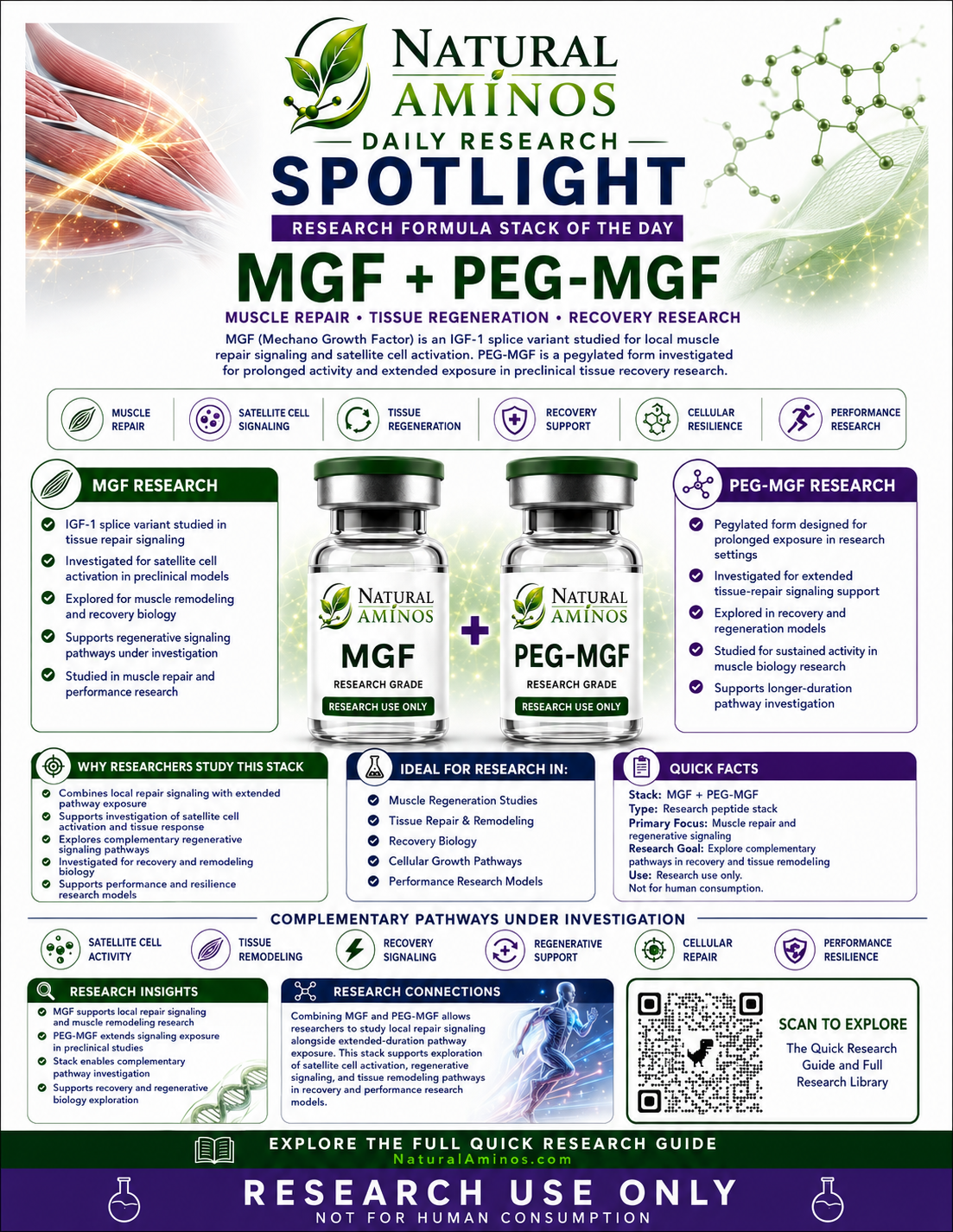
MGF + PEG-MGF Research Data
For laboratory research use only; not for human or veterinary use or consumption. This page provides research information, not personal-use instructions or medical advice.
Natural Aminos Research Stack or Formula of the Day
MGF + PEG-MGF
Muscle Repair, Satellite-Cell Biology & IGF-1 Splice-Variant Research Spotlight
Important Identity & Evidence Note
MGF and PEG-MGF require unusually careful terminology. “Mechano Growth Factor” originally referred to the mechanically responsive IGF-1 splice variant expressed in muscle after loading or injury. In humans this transcript is commonly called IGF-1Ec. The term MGF is also used for a synthetic 24-amino-acid peptide corresponding to the unique C-terminal E-domain of that splice variant. Those are not the same experimental object: one is an endogenous IGF-1 transcript/propeptide system, while the other is an isolated synthetic peptide fragment.
PEG-MGF is generally marketed as a PEGylated version of the synthetic MGF E-domain peptide. PEGylation is intended to prolong exposure by increasing molecular size and reducing clearance or proteolysis. However, peer-reviewed pharmacokinetic and efficacy data for PEG-MGF itself are extremely sparse. FDA states that it has not identified human exposure data from drug products containing PEG-MGF administered by any route.
A major scientific controversy also exists around the synthetic MGF E-peptide. A 2010 minireview emphasized that no analogous free MGF peptide product had been identified or isolated from cultured cells, conditioned media, animal tissues or biological fluids. In 2014, investigators from Novartis were unable to reproduce several reported effects of synthetic MGF peptides on human and mouse muscle cells. Therefore, evidence for endogenous IGF-1Ec/MGF expression after exercise cannot automatically be treated as evidence that injected synthetic MGF or PEG-MGF produces the same physiology.
Benefits
MGF / IGF-1Ec Biology
The strongest evidence for MGF is endogenous biology rather than drug administration. Human muscle-biopsy studies show that IGF-1Ec/MGF expression changes after resistance exercise and muscle damage. In a 2003 human study comparing young and elderly adults, high-resistance exercise increased MGF mRNA in young muscle, while the older group showed a weaker response. This supported the idea that impaired local IGF-1 splice-variant signaling may contribute to age-related loss of muscle adaptation.
Additional human work has shown changes in MGF/IGF-1Ec transcript expression after exercise-induced muscle damage and during strength-training programs. These studies support the concept that the IGF-1 gene is locally regulated in working muscle and that the MGF transcript is part of the early adaptation and repair response. They do not show that administration of an isolated MGF peptide improves muscle growth or recovery in people.
Early cell studies from the United Kingdom reported that a synthetic MGF E-domain peptide increased myoblast proliferation and delayed terminal differentiation. French investigators later reported that the MGF E-peptide increased proliferative lifespan and fusion potential in primary human muscle progenitor cells from younger donors, with weaker effects in cells from older adults. These findings support a possible satellite-cell role, but they remain cell-culture evidence.
Animal and gene-delivery studies have produced additional regenerative and neuroprotective signals. MGF expression is rapidly increased after muscle injury in rodents, and MGF gene delivery improved motoneuron survival and muscle function in an ALS mouse model. In muscle-contusion models, MGF manipulation has altered inflammatory cytokines, macrophage behavior and fibrosis. These findings demonstrate biological activity within experimental systems but do not establish clinical efficacy of an injected synthetic peptide.
Synthetic MGF E-Peptide - Conflicting Evidence
The synthetic 24-amino-acid MGF E-peptide has a much less certain evidence base than the endogenous transcript. The 2002 Yang and Goldspink study reported increased myoblast proliferation and delayed differentiation. A 2011 French study using primary human muscle progenitor cells also reported increased proliferative lifespan and fusion potential in several age groups.
However, a 2014 study from the Novartis Institutes for Biomedical Research attempted to reproduce these findings using C2C12 cells, primary human skeletal-muscle myoblasts, primary mouse muscle stem cells and cardiac myocytes. Native and stabilized MGF peptides failed to increase proliferation, failed to inhibit differentiation and failed to activate the reported ERK signaling response. Mature IGF-1 and full-length IGF-1Eb remained biologically active in the same systems. The authors concluded that the findings called into question a physiological role for the isolated MGF peptide.
A 2016 receptor-activation study added another layer of uncertainty. Full-length MGF could activate the human IGF-1 receptor at sufficiently high concentrations, although less potently than IGF-1. In contrast, the short human MGF peptide and a stabilized Goldspink-MGF analog did not activate IGF-1R in that assay. This supports the view that full-length IGF-1 splice products and isolated E-domain peptides should not be treated as pharmacologically equivalent.
PEG-MGF
PEG-MGF is intended to solve a pharmacokinetic problem rather than introduce a new biological mechanism. The premise is that attaching polyethylene glycol to an MGF-derived peptide will extend systemic exposure compared with the unmodified peptide. In principle, PEGylation can reduce renal clearance and proteolytic degradation for many peptide or protein drugs. However, the effect depends on PEG size, attachment site, product homogeneity and retention of biological activity.
For PEG-MGF specifically, no published human pharmacokinetic study, dose-response trial or clinical efficacy study was identified. FDA states that it has not identified any human exposure data on drug products containing PEG-MGF by any route and lacks important information about whether the substance could cause harm in humans. FDA also identifies potential immunogenicity risk and complexity related to peptide impurities and active-pharmaceutical-ingredient characterization.
Current 2026 regulatory documents add an important status update. The nomination for PEG-MGF was withdrawn from FDA’s interim Category 2 process, but FDA announced that it still intends to consult the Pharmacy Compounding Advisory Committee before the end of February 2027 regarding possible inclusion of PEG-MGF-related bulk drug substances on the 503A bulks list. That planned consultation is not approval and does not establish safety or efficacy.
What the Formulas Are Studied For
MGF / IGF-1Ec Research Areas
• Mechanical loading and exercise-induced IGF-1 gene splicing in skeletal muscle.
• Satellite-cell activation and myoblast proliferation.
• Muscle injury, regeneration and fibrosis.
• Age-related decline in muscle adaptation and sarcopenia biology.
• Exercise-induced muscle damage and resistance-training adaptation.
• Neuroprotection and motoneuron survival in animal models.
• Macrophage behavior and inflammatory signaling during muscle injury.
• Distinction between full-length IGF-1 splice products and synthetic E-domain peptides.
PEG-MGF Research Areas
• Experimental extension of exposure to an MGF-derived peptide through PEGylation.
• Hypothesized muscle-repair and satellite-cell applications inferred from non-PEG MGF research.
• Performance-enhancing-peptide literature within the GH/IGF-1 axis.
• Compounding-safety and immunogenicity review.
• Product identity, PEG size, attachment site and peptide-impurity characterization.
• No identified human clinical efficacy, pharmacokinetic or safety trial.
Published Research - Worldwide Evidence Review
United Kingdom - Discovery, Exercise Biology and Early MGF Peptide Work
Much of the MGF field originated at University College London and related U.K. groups led by Geoffrey Goldspink. Early work characterized a mechanically responsive IGF-1 splice variant whose expression increased after overload or muscle damage. Rodent studies linked early MGF transcription with satellite-cell activation, while human studies showed exercise- and age-related changes in IGF-1Ec/MGF mRNA.
The 2003 Journal of Physiology study in young and elderly adults showed that resistance exercise altered MGF and IGF-1Ea transcript expression differently by age. A later clinical trial in elderly men examined recombinant GH and resistance exercise effects on MGF/IGF-1Ea mRNA. These are genuine human studies, but they measured endogenous gene expression rather than administering MGF peptide.
The early synthetic-peptide hypothesis also came from this research tradition. A 2002 FEBS Letters study reported that the MGF E-domain peptide increased myoblast proliferation while delaying differentiation. Subsequent reviews proposed roles in local muscle repair, satellite-cell activation and age-related muscle maintenance.
France - Primary Human Muscle Progenitor Cells
In 2011, investigators at the Institut de Myologie in Paris tested the MGF E-peptide in primary human muscle-cell cultures obtained from donors of different ages. The peptide increased the proliferative lifespan of satellite-cell-derived cultures from neonatal and young-adult muscle and increased fusion potential. Cells from older adults showed less proliferative benefit. This study is one of the strongest human-derived-cell experiments supporting an MGF E-peptide effect, but it was not administration to human participants.
Switzerland and International Pharmaceutical Research - Failure to Reproduce
In 2014, Novartis researchers conducted a broad replication effort using several cell systems. They did not observe increased proliferation or delayed differentiation after native or stabilized MGF peptide exposure, and did not reproduce the previously reported ERK-signaling effect. Full-length IGF-1 and IGF-1Eb remained active controls. This negative study is highly important because it challenges a central assumption behind injectable MGF products.
United States and Human Exercise Research
U.S. exercise-science groups have measured endogenous IGF-1 splice variants before and after resistance exercise. Studies from the University of Oklahoma and other institutions found changes in IGF-1Ea and IGF-1Ec/MGF expression across repeated exercise bouts and training programs. These studies strengthen the physiological relevance of local IGF-1 gene regulation but again do not evaluate synthetic MGF or PEG-MGF treatment.
Animal Injury, Inflammation and Neuroprotection
Rodent muscle-injury studies show that MGF transcription rises rapidly after local damage and then declines as other IGF-1 isoforms increase. Overexpression studies suggest that excessive MGF can delay macrophage resolution and maintain inflammatory-cell populations, showing that more MGF is not automatically better. In another contusion model with macrophage depletion, MGF injection reduced fibrosis and several inflammatory mediators but did not restore muscle-fiber regeneration.
In a SOD1(G93A) mouse model of amyotrophic lateral sclerosis, MGF gene delivery to hindlimb muscle improved muscle strength and motoneuron survival, with more surviving motoneurons than in the IGF-1 gene-delivery group. This supports neuroprotective potential in a specific animal model but does not validate systemic synthetic MGF or PEG-MGF in humans.
2026 Review and Regulatory Evidence
A 2026 European review of performance-enhancing peptides placed PEG-MGF among unregulated IGF-1-axis analogues encountered in self-administration settings. The review emphasized the gap between preclinical or mechanistic rationale and controlled clinical evidence, as well as product-quality and safety uncertainty.
FDA’s current compounding-safety page is more specific for PEG-MGF: no human exposure data were identified, and FDA cites potential immunogenicity risk plus complexities involving peptide-related impurities and API characterization. FDA’s April 22, 2026 503A bulk-substance update states that the PEG-MGF nomination was withdrawn but that the agency intends to consult PCAC before the end of February 2027.
Direct Research on MGF + PEG-MGF Together
No peer-reviewed human, animal or cell study was identified that intentionally compared unmodified synthetic MGF with PEG-MGF as a combination treatment. No study was identified in which both were administered together and compared with either form alone.
This lack of combination evidence is especially important because PEG-MGF is not designed to activate a different pathway. It is intended to modify the exposure profile of an MGF-derived peptide. Therefore, MGF + PEG-MGF is fundamentally a same-core-molecule stack rather than a complementary multi-pathway combination.
Theory of the Stack - How the Combination Could Work
1. Native or Unmodified MGF - Short Local Signal
The theoretical role of unmodified MGF is a short, local repair signal after mechanical stress or injury. Endogenous IGF-1Ec/MGF transcription rises early after damage, and the synthetic E-domain peptide has been proposed to stimulate satellite-cell proliferation before later differentiation and tissue remodeling occur.
2. PEG-MGF - Prolonged Exposure to the Same Core Signal
PEG-MGF is intended to prolong exposure to an MGF-derived sequence. The theoretical benefit is not a new mechanism but a longer pharmacokinetic window. If the unmodified peptide were biologically active but degraded rapidly, PEGylation could in principle extend the period during which target tissues encounter the peptide.
3. Why the Pair Is Highly Redundant
Because both components are based on the same MGF-derived sequence, mechanistic complementarity is low. A stack containing unmodified MGF plus PEG-MGF would mainly create two exposure profiles of the same putative signal - one shorter and one theoretically longer. Unlike combining a repair peptide with a mitochondrial or anti-inflammatory agent, there is no clear second biological pathway.
4. Timing Is the Only Strong Theoretical Rationale
The most plausible rationale is temporal: a short initial exposure from unmodified MGF followed by a longer PEGylated exposure. In muscle repair, early satellite-cell activation and later differentiation occur in sequence, so timing matters. However, prolonged activation of a proliferative signal is not automatically desirable, particularly if differentiation requires the early proliferative signal to decline.
5. PEGylation Could Alter Biology, Not Just Half-Life
PEGylation changes molecular size, steric accessibility, tissue penetration, receptor interaction and immune recognition. Therefore, even if the unmodified MGF peptide were active, PEG-MGF cannot be assumed to have identical potency or tissue distribution. Without a defined PEG molecular weight, conjugation site and head-to-head pharmacology, the term PEG-MGF does not represent a single rigorously characterized drug product.
6. Endogenous MGF Biology Does Not Prove Synthetic Peptide Activity
The strongest biological evidence in this field concerns endogenous IGF-1Ec/MGF transcript regulation after exercise and injury. That observation does not establish that the free 24-amino-acid E-domain peptide is released as a natural circulating or paracrine molecule. The 2010 minireview explicitly noted failure to identify an analogous free peptide product in biological tissues or fluids.
7. Replication Failure Weakens the Entire Stack Theory
The 2014 Novartis replication study found no effect of native or stabilized MGF peptides on proliferation, differentiation or ERK activation in several muscle-cell systems. If the synthetic peptide itself lacks the claimed biological activity under robust assay conditions, extending its half-life through PEGylation would not solve the core problem. Longer exposure to an inactive or weakly active molecule would not create a meaningful therapeutic effect.
8. Prolonged Proliferative Signaling Could Have Tradeoffs
Early muscle repair requires satellite-cell proliferation, but later phases require differentiation and fusion. Some early MGF peptide experiments suggested delayed differentiation. A longer-acting PEGylated version could theoretically sustain the proliferative phase longer than intended. No study has established whether that would improve repair, delay maturation or have no effect.
9. Inflammation and Macrophage Resolution Add Another Timing Concern
MGF overexpression in injured muscle has been associated with delayed macrophage resolution and prolonged pro-inflammatory macrophage persistence. This suggests that prolonged MGF signaling may have different effects from a short endogenous pulse. PEGylation could theoretically alter the balance between early repair signaling and later inflammatory resolution, but this has not been tested directly.
Possible Overall Benefit - Theoretical, Not Proven
The most defensible theoretical benefit of MGF + PEG-MGF is temporal extension of a muscle-repair signal rather than pathway synergy. Unmodified MGF could theoretically provide an early local proliferative cue, while PEG-MGF could extend exposure after the initial signal declines.
For muscle injury or age-related muscle-repair research, this could theoretically support satellite-cell activation over a wider time window. For neuroprotection, the rationale would be similar: prolonging exposure to a peptide concept that has shown protective effects in selected preclinical systems.
The theory is weak because the two compounds are highly redundant and the biological identity of the synthetic MGF peptide remains unsettled. The strongest human evidence concerns endogenous gene expression, not administered peptide. PEG-MGF has no identified human exposure data, and no peer-reviewed study has shown that PEGylation preserves or improves MGF biological activity.
Why More Research Is Needed
• No published human treatment trial has administered synthetic MGF or PEG-MGF for muscle growth, injury repair, sarcopenia or neuroprotection.
• FDA states that it has not identified human exposure data from drug products containing PEG-MGF by any route.
• The endogenous IGF-1Ec/MGF transcript and the synthetic 24-amino-acid E-domain peptide are not interchangeable experimental entities.
• A major review noted that a naturally occurring free peptide corresponding to the synthetic MGF E-domain had not been identified in tissues, fluids or conditioned media.
• A 2014 Novartis replication study failed to reproduce reported proliferation, differentiation or ERK-signaling effects of native or stabilized MGF peptides.
• PEG-MGF lacks published human pharmacokinetics, dose-response data, receptor pharmacology and controlled efficacy studies.
• PEG size, conjugation site and product homogeneity can materially change pharmacology; PEG-MGF is not sufficiently defined without those specifications.
• No direct study has compared unmodified MGF versus PEG-MGF in the same biological system using a defined PEG conjugate.
• Prolonged MGF signaling could theoretically interfere with the transition from satellite-cell proliferation to differentiation and fusion.
• MGF overexpression has been associated with delayed macrophage resolution in injured muscle, raising questions about prolonged exposure.
• Full-length MGF can activate IGF-1R under some in-vitro conditions, while short MGF peptides did not activate IGF-1R in the same assay.
• FDA identifies potential immunogenicity and peptide-impurity/API-characterization concerns for PEG-MGF.
• Future studies should begin with rigorous chemical identity, PEG characterization, in-vitro potency and animal pharmacokinetics before any human efficacy program.
Research Summary
MGF + PEG-MGF is a highly overlapping research stack built around one uncertain peptide concept rather than two complementary mechanisms. Endogenous IGF-1Ec/MGF biology is real: human and animal studies show that the transcript responds to exercise, mechanical loading and injury and is associated with muscle adaptation. Early synthetic-peptide studies reported satellite-cell and myoblast effects, but a major independent pharmaceutical replication study failed to reproduce several of those findings.
PEG-MGF adds a pharmacokinetic hypothesis - longer exposure through PEGylation - rather than a new biological pathway. No identified human exposure, pharmacokinetic or efficacy study validates the PEGylated product, and FDA specifically states that important safety information is missing. The combination therefore has much weaker scientific support than stacks built from mechanistically distinct compounds.
Selected Sources
• Matheny RW Jr, Nindl BC, Adamo ML. Minireview: Mechano-growth factor: a putative product of IGF-I gene expression involved in tissue repair and regeneration. Endocrinology. 2010;151(3):865-875. PMID: 20130113.
• Hameed M, et al. Expression of IGF-I splice variants in young and old human skeletal muscle after high resistance exercise. Journal of Physiology. 2003;547(Pt 1):247-254. PMID: 12562960. PMCID: PMC2342624. DOI: 10.1113/jphysiol.2002.032136.
• Philippou A, et al. Expression of IGF-1 isoforms after exercise-induced muscle damage in humans: characterization of the MGF E peptide actions in vitro. In Vivo. 2009;23(4):567-575. PMID: 19567392.
• Roberts MD, et al. IGF-1 splice variant and IGF-1 peptide expression patterns in young and old human skeletal muscle prior to and following sequential exercise bouts. European Journal of Applied Physiology. 2010;110(5):961-969. PMID: 20668872.
• Kandalla PK, et al. Mechano Growth Factor E peptide activates human muscle progenitor cells and increases fusion potential at different ages. Mechanisms of Ageing and Development. 2011;132(4):154-162. PMID: 21354439. DOI: 10.1016/j.mad.2011.02.007.
• Yang SY, Goldspink G. Different roles of the IGF-I Ec peptide and mature IGF-I in myoblast proliferation and differentiation. FEBS Letters. 2002;522(1-3):156-160. PMID: 12095637.
• Fornaro M, et al. Mechano-growth factor peptide has no apparent effect on myoblasts or primary muscle stem cells. American Journal of Physiology - Endocrinology and Metabolism. 2014;306(2):E150-E156. PMID: 24253050. DOI: 10.1152/ajpendo.00408.2013.
• Potency of Full-Length MGF to Induce Maximal Activation of the IGF-I Receptor Is Similar to Recombinant Human IGF-I at High Equimolar Concentrations. 2016. PMID: 26991004.
• Hill M, Goldspink G. Expression and splicing of the insulin-like growth factor gene in rodent muscle is associated with muscle satellite-cell activation following local tissue damage. Journal of Physiology. 2003. PMID: 12692175.
• Goldspink G. Mechanical signals, IGF-I gene splicing, and muscle adaptation. Physiology. 2005;20:232-238. PMID: 16024511.
• Goldspink G. Impairment of IGF-I gene splicing and MGF expression associated with muscle wasting. International Journal of Biochemistry & Cell Biology. 2006;38(3):481-489. PMID: 16463438.
• Riddoch-Contreras J, et al. Mechano-growth factor rescues motoneurons and improves muscle function in SOD1(G93A) mice. Experimental Neurology. 2009;215(2):281-289. PMID: 19038252.
• Overexpression of Mechano-Growth Factor Modulates Inflammatory Cytokine Expression and Macrophage Resolution in Skeletal Muscle Injury. 2018. PMID: 30140235.
• Impaired Skeletal Muscle Regeneration Induced by Macrophage Depletion Could Be Partly Ameliorated by MGF Injection. 2019. PMID: 31164836.
• Dominikowski A, et al. The emerging landscape of performance-enhancing peptides modulating GH-IGF1 axis. Frontiers in Endocrinology. 2026;17:1822475. PMID: 42395176. PMCID: PMC13322892.
• U.S. Food and Drug Administration. Certain Bulk Drug Substances for Use in Compounding that May Present Significant Safety Risks. Current 2026 entry for Mechano Growth Factor Pegylated (PEG-MGF).
• U.S. Food and Drug Administration. Bulk Drug Substances Nominated for Use in Compounding Under Section 503A, updated April 22, 2026. PEG-MGF nomination withdrawn from Category 2; FDA announced intent to consult PCAC before the end of February 2027.
Theory vs. Proof - Verdict
What is supported by evidence: endogenous IGF-1Ec/MGF transcription is part of the human and animal skeletal-muscle response to mechanical loading, exercise and injury; early cell studies reported proliferative effects from a synthetic MGF E-domain peptide; full-length MGF can activate IGF-1R at high concentrations in vitro; and MGF-related gene or peptide interventions have produced selected repair or neuroprotection effects in animal models.
What is not proven: that the isolated synthetic MGF E-domain peptide is a naturally occurring free human signaling molecule; that injected synthetic MGF increases muscle growth or accelerates repair in humans; that PEGylation preserves or improves MGF biological activity; that PEG-MGF has a defined human half-life or safety profile; or that combining MGF and PEG-MGF provides any advantage over either form alone.
Verdict - theory vs. proof: mechanistic overlap is extremely high and direct proof is very weak. MGF + PEG-MGF is essentially a same-core-signal stack in which the theoretical difference is exposure duration, not pathway complementarity. The endogenous IGF-1Ec/MGF response to mechanical loading is well supported, but that physiology should not be confused with evidence for an injected 24-amino-acid MGF peptide. Replication failures further weaken the synthetic-peptide hypothesis, and PEG-MGF has no identified human exposure data. Overall, MGF + PEG-MGF is best classified as a highly speculative muscle-repair and satellite-cell hypothesis with credible endogenous splice-variant biology, conflicting synthetic-peptide evidence, no human PEG-MGF evidence and no direct combination evidence.
Research & Educational Use Only !!