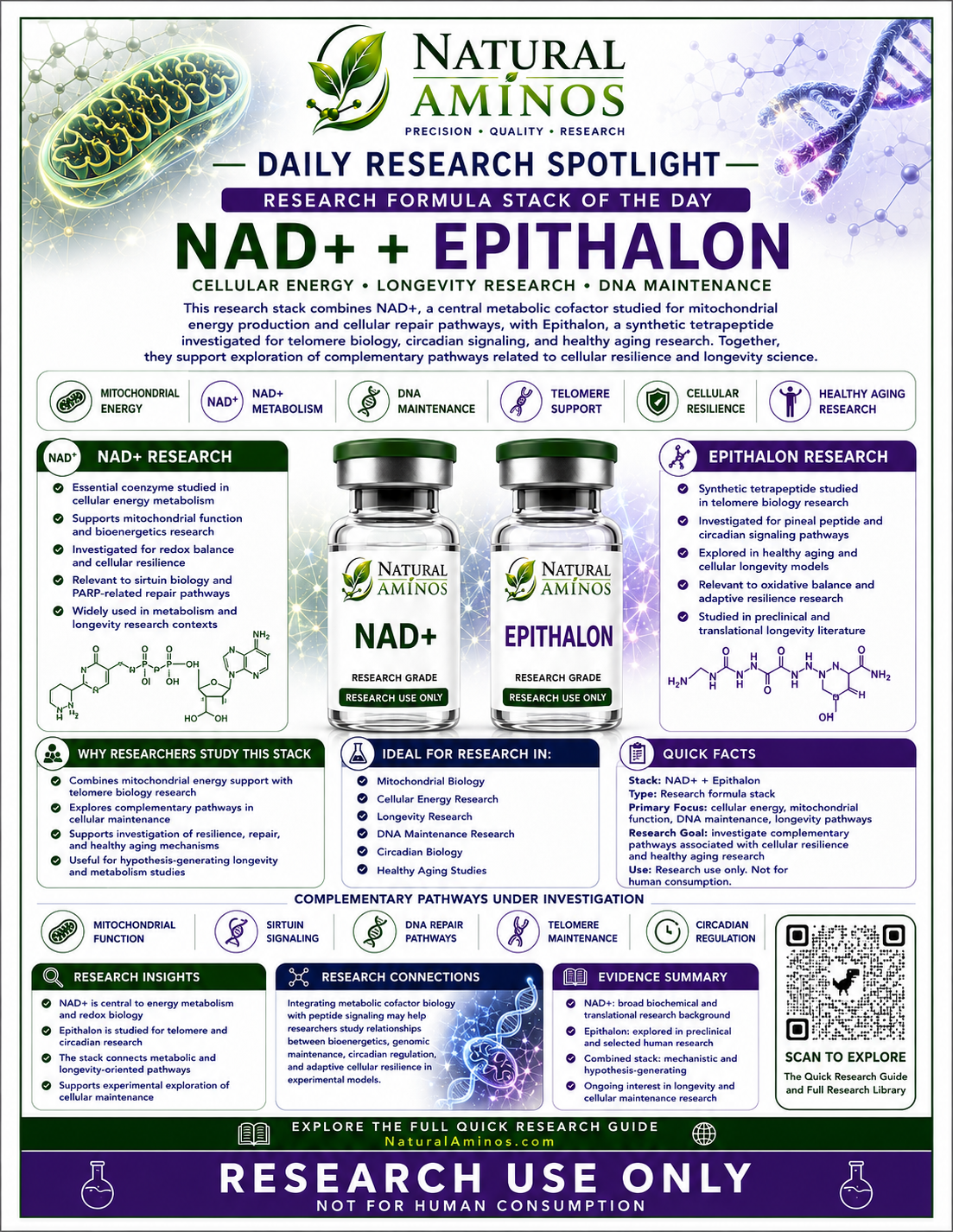
NAD+ + Epithalon Research Data
For laboratory research use only; not for human or veterinary use or consumption. This page provides research information, not personal-use instructions or medical advice.
Natural Aminos Research Stack or Formula of the Day
NAD+ + Epithalon
Cellular Energy, Circadian Signaling, Telomere Biology & Healthy-Aging Research Spotlight
Compound Identity & Evidence Context
NAD+ (nicotinamide adenine dinucleotide) is an endogenous dinucleotide coenzyme rather than a peptide. It is essential for redox metabolism and also serves as a substrate for NAD-consuming enzymes including sirtuins, PARPs and CD38. Human NAD-targeted research is much larger than Epithalon research, but most intervention evidence historically comes from NAD+ precursors such as nicotinamide riboside (NR) and nicotinamide mononucleotide (NMN), not from direct NAD+ administration.
Epithalon, also called Epitalon or AEDG, is the synthetic tetrapeptide Ala-Glu-Asp-Gly. It was developed from the amino-acid composition of Epithalamin, a bovine pineal peptide extract. This distinction is critical: a substantial part of the older human gerontology literature used Epithalamin rather than the synthetic tetrapeptide itself. Those results should not be silently transferred to Epithalon.
No peer-reviewed human, animal or cell study was identified that directly administered NAD+ and Epithalon together as one defined intervention. Searches for Epitalon/Epithalon with NAD+, nicotinamide riboside and NMN found comparison pages and commercial discussions but no controlled combination experiment. The full-stack analysis is therefore mechanistic rather than directly demonstrated.
Benefits
NAD+
NAD+ is central to cellular energy metabolism because the NAD+/NADH redox couple transfers electrons through glycolysis, the tricarboxylic-acid cycle and oxidative phosphorylation. NAD+ is also consumed by signaling enzymes involved in DNA repair, chromatin regulation, stress responses and calcium signaling. This broad biology is the reason NAD metabolism is heavily studied in aging, neurodegeneration, metabolic disease and mitochondrial dysfunction.
The strongest human intervention evidence has historically come from NR and NMN. These precursors can raise NAD-related metabolites in blood and, in some trials, selected tissues, but clinical outcomes are inconsistent and often modest or tissue specific. A 2025 Nature Metabolism review concluded that consistent human evidence for age-related NAD decline exists only in a limited number of studies and that clinical precursor trials have generally shown limited efficacy despite strong preclinical rationale.
Direct NAD+ evidence is now improving. A 2019 Australian/U.S. pilot study of a six-hour intravenous NAD+ infusion characterized plasma and urinary metabolism, showing substantial processing of infused NAD+ rather than establishing therapeutic efficacy. More recently, a 2026 randomized, double-blind Phase 0/1b study in healthy adults aged 45-75 evaluated five days of a modified oral NAD+ formulation. Intracellular whole-blood NAD increased 53% versus placebo by Day 6, while plasma NAD was unchanged. NAD catabolites increased, confirming downstream metabolic flux. Importantly, no secondary clinical, vital-sign, wellbeing or wearable endpoint remained significant after multiplicity correction.
This 2026 trial materially strengthens the claim that direct oral NAD+ can alter intracellular NAD biology under at least one formulation, but it does not establish improved energy, sleep, cognition, body composition, longevity or disease outcomes. It is short-term pharmacodynamic evidence, not proof of clinical benefit.
Epithalon
Epithalon has been studied for pineal/circadian biology, melatonin rhythms, telomerase, telomere length, gene expression, oxidative stress and experimental geroprotection. The strongest human evidence is older and geographically concentrated in Russia and Ukraine, while newer independent work is predominantly cell based.
A 2007 gerontology report involving old monkeys and elderly people found that pineal peptide preparations, including Epitalon and Epithalamin, increased night-time melatonin in subjects with reduced pineal function and shifted the melatonin rhythm toward a more youthful pattern. The study supports a circadian/pineal signal but is not a modern large randomized longevity trial.
A major 2025 review from Polish investigators summarized Epitalon as a highly bioactive pineal tetrapeptide with reported antioxidant, neuroendocrine, antimutagenic and telomerase-related actions. The authors also emphasized major knowledge gaps, including limited physicochemical/structural work and uncertainty over which mechanisms are primary rather than secondary.
Independent 2025 research from Brunel University London tested Epitalon in normal and cancer-derived human cell lines. Epitalon increased telomere length in normal fibroblast and epithelial cells with increased hTERT expression and telomerase activity; cancer-cell lines also showed telomere extension through alternative lengthening of telomeres (ALT)-associated activity. The study was corrected later in 2025, but the core report remains cell-culture evidence. It does not prove human lifespan extension or clinical anti-aging benefit.
FDA currently lists Epitalon among bulk substances that may present significant safety risks in compounding because of potential immunogenicity related to aggregation and peptide impurities. FDA states that it has not identified sufficient safety-related information for the proposed route of administration to know whether the substance would cause harm in humans.
What the Formulas Are Studied For
NAD+ Research Areas
• Cellular redox reactions and ATP-generating metabolism.
• Mitochondrial function and metabolic stress.
• Sirtuin, PARP and CD38-dependent signaling.
• DNA-damage responses and cellular stress regulation.
• Age-related NAD metabolism in blood and tissues.
• Direct intravenous NAD+ pharmacokinetics/metabolism.
• Direct oral NAD+ target engagement in the 2026 Phase 0/1b LNAD+ study.
• NR/NMN precursor trials in metabolic health, aging and physical-function research.
Epithalon Research Areas
• Pineal function and circadian melatonin rhythms.
• Telomerase, hTERT expression and telomere-length biology.
• Cellular senescence and experimental geroprotection.
• Oxidative-stress and antioxidant-response pathways.
• Neuroendocrine regulation.
• Gene-expression and chromatin-associated peptide effects.
• Retinal and age-related tissue research in older Russian clinical literature.
• Experimental longevity research, with substantial dependence on preclinical and non-modern clinical evidence.
Published Research - Worldwide Evidence Review
NAD+ - United States, Australia, Europe and Asia
Human NAD-targeted research is international. Australian and U.S. investigators conducted the 2019 direct intravenous NAD+ pilot, documenting the metabolic fate of a six-hour infusion but not testing a clinical efficacy endpoint. The work showed that direct infusion is rapidly processed and should not be assumed to remain intact in plasma throughout administration.
The 2026 RENEWAL-NAD+ trial from U.S. investigators randomized 60 healthy adults, with 50 in the primary analysis, to five days of oral LNAD+ or placebo. Intracellular whole-blood NAD increased 53% versus placebo at Day 6, while circulating plasma NAD did not change. MeNAM and 2PY increased markedly, consistent with downstream NAD metabolism. Treatment was well tolerated over five days, but no secondary clinical or wearable endpoint survived multiplicity correction. This is strong target-engagement evidence but still not an outcome trial.
European reviewers in 2025 evaluated the wider human NAD field and concluded that claims of a universal age-related decline in human NAD are stronger in animals than in people. Human data vary by tissue, age, disease and measurement technique. They also concluded that precursor supplementation produces more reliable biochemical target engagement than consistent improvements in clinical outcomes.
Human precursor trials provide context but should not be misrepresented as direct NAD+ evidence. NMN has produced selected metabolic or physical-function signals in Japanese and U.S. trials, and NR reliably changes NAD metabolomics in several studies, but effects are not uniform across tissues or endpoints. Direct NAD+, NR and NMN therefore belong in one metabolic pathway but are not interchangeable interventions.
Epithalon - Russia/Ukraine, Poland and United Kingdom
Epithalon research began largely in Russian and Ukrainian gerontology programs led by Khavinson and collaborators. Human reports include pineal/melatonin studies and ophthalmic work, but many long-term gerontology papers actually used Epithalamin, the bovine pineal extract, rather than the synthetic AEDG tetrapeptide. This is one of the most important evidence-quality issues in the field.
The 2007 melatonin study provides one of the clearest direct human Epitalon signals: elderly participants with low pineal function showed increased nocturnal melatonin and partial normalization of circadian rhythm. The report is biologically relevant but small by modern standards and does not establish broader longevity or disease-prevention effects.
Polish investigators published a comprehensive 2025 review describing reported Epitalon effects across melatonin synthesis, telomerase, antioxidant biology, enzyme regulation, immune signaling and gene expression. The review supports biological plausibility while repeatedly exposing the field's dependence on heterogeneous in-vitro, animal and older regional studies.
The independent 2025 Brunel University London study is important because it moves beyond the original Russian research tradition. In cultured human cells, Epitalon increased telomere length and altered hTERT/telomerase or ALT-associated pathways depending on cell type. The observation strengthens cellular telomere biology but also raises a caution: effects on telomere-maintenance pathways in cancer-derived cells require careful mechanistic interpretation, not automatic classification as beneficial.
Direct Research on NAD+ + Epithalon Together
No peer-reviewed study was identified that directly tested NAD+ plus Epithalon together in humans, animals or cell culture. No controlled experiment was found pairing Epithalon with NR or NMN either. Commercial comparison or stacking pages exist, but they are not evidence of interaction, synergy or safety.
The combination therefore has no defined pharmacokinetics, dose-response relationship, safety profile, biomarker signature or clinical endpoint. Any proposed benefit must be inferred from separate NAD-metabolism and Epithalon literature.
Theory of the Stack - How the Combination Could Work
1. Cellular Energy and Redox Capacity - NAD+ Layer
NAD+ would provide the metabolic layer. Adequate NAD availability supports redox reactions, mitochondrial ATP production and NAD-dependent enzymes involved in stress responses, DNA repair and metabolic adaptation. In theory, raising intracellular NAD could improve the energetic and enzymatic environment in which aging cells operate.
2. Pineal and Circadian Signaling - Epithalon Layer
Epithalon would provide a circadian/neuroendocrine layer. Older human research suggests that the peptide can increase nocturnal melatonin in people with reduced pineal function. Because circadian timing regulates metabolism, mitochondrial function, DNA repair and hormone secretion, improved circadian organization could theoretically complement metabolic NAD biology.
3. Telomere Maintenance and DNA-Repair Biology Could Intersect
Epithalon has cell-culture evidence for increasing hTERT/telomerase-related telomere maintenance, while NAD+ is required for PARP- and sirtuin-dependent stress responses that influence chromatin and DNA-repair biology. The theoretical pairing therefore covers two different aspects of genome maintenance: telomere regulation and NAD-dependent repair/signaling.
The link is indirect. No experiment shows that increasing NAD enhances Epithalon-induced telomerase activity, that Epithalon preserves NAD, or that the two together improve DNA repair. The pathways are biologically adjacent but not experimentally proven to cooperate.
4. Mitochondrial Function and Cellular Senescence
NAD depletion and mitochondrial dysfunction are commonly discussed within cellular-senescence biology. Epithalon reviews also describe effects on oxidative stress and mitochondrial markers in experimental systems. This creates a plausible “metabolic resilience plus senescence modulation” theory, but the two interventions have not been tested in the same senescence model.
5. Circadian Timing Could Influence NAD Metabolism
NAD metabolism and circadian clocks are biologically linked through metabolic and sirtuin pathways. If Epithalon genuinely normalizes pineal melatonin rhythm in a given biological state, it could theoretically change the temporal organization of NAD-dependent metabolism. That does not mean Epithalon raises NAD or that NAD reproduces melatonin effects; it means circadian and metabolic systems communicate.
6. The Stack Is More Complementary Than Redundant
Unlike combinations in which two molecules activate the same receptor, NAD+ and Epithalon operate at very different biological levels. NAD+ is a ubiquitous coenzyme; Epithalon is a small regulatory peptide studied for pineal and telomere-related effects. Direct mechanistic redundancy is therefore low.
Low redundancy does not automatically mean high synergy. Complementary mechanisms can simply coexist without increasing one another. Direct combination testing is required to distinguish independent parallel effects from true biological interaction.
7. Direct NAD+ Target Engagement Does Not Prove Longevity
The 2026 oral NAD+ trial is important because it shows that intracellular NAD can be raised directly. Yet clinical endpoints did not survive multiplicity correction after only five days. Therefore, adding Epithalon to a biomarker-responsive NAD intervention cannot be assumed to convert target engagement into a longevity or performance benefit.
8. Telomere Extension Is Not Automatically Beneficial
Longer telomeres are often framed as beneficial, but telomere maintenance is a context-dependent biological process. The 2025 Epitalon cell study reported telomere extension in normal cells and ALT-associated changes in cancer-derived cells. Any longevity theory must therefore distinguish controlled maintenance in normal tissue from inappropriate survival signaling in abnormal cells.
9. Epithalamin Evidence Cannot Be Used as Direct Epithalon Proof
The older longevity literature is frequently discussed as one body of “Epithalon” evidence, but some of the longest-term human reports used Epithalamin. A stack theory based on Epithalon should rely only on studies that actually administered the synthetic tetrapeptide or clearly distinguish extract-derived evidence as indirect.
10. The Most Plausible Combined Endpoint Is Systems-Level Resilience, Not a Single Disease Claim
The most coherent theoretical endpoint is broad cellular resilience: improved NAD-dependent metabolism and stress signaling, plus better circadian organization and possible telomere/senescence regulation. This is a systems-biology hypothesis. It is not evidence that the combination treats a disease, reverses aging or extends human lifespan.
Possible Overall Benefit - Theoretical, Not Proven
The most defensible theoretical benefit of NAD+ + Epithalon is complementary support of cellular aging pathways at different levels. NAD+ could improve intracellular metabolic and redox capacity and support NAD-dependent stress-response enzymes, while Epithalon could influence pineal/circadian signaling and telomere-regulation pathways.
If both component effects translated meaningfully in humans, the combination could theoretically support metabolic resilience, circadian organization and cellular maintenance. This is a more complementary concept than many same-pathway peptide stacks because the two compounds do not simply duplicate one receptor system.
The clinical proof is weak. Direct NAD+ can now be shown to increase intracellular NAD in at least one short human trial, but meaningful clinical outcomes remain unproven. Epithalon has far less modern human evidence, and much of the often-cited longevity literature is preclinical, cell based, geographically concentrated or confounded with Epithalamin. No direct combination evidence exists.
Why More Research Is Needed
• No published study has tested NAD+ + Epithalon together, so synergy, antagonism, pharmacokinetic interaction and combined safety are unknown.
• The 2026 oral NAD+ trial established short-term intracellular target engagement but not sustained clinical benefit, longevity or disease modification.
• Most human NAD intervention evidence still comes from NR or NMN, which are precursors and should not be treated as equivalent to direct NAD+ administration.
• Human evidence for a universal age-related NAD decline is inconsistent across tissues and measurement methods.
• Epithalon human evidence is limited, older and geographically concentrated; modern independent randomized trials are lacking.
• Older long-term gerontology results frequently involve Epithalamin rather than synthetic Epithalon and cannot be transferred without qualification.
• The 2025 Brunel telomere study is in cultured cells, including cancer-derived lines, and does not demonstrate human longevity or safety.
• Telomerase and ALT effects can have different implications in normal versus abnormal cells and require long-term safety study.
• FDA states that safety information is insufficient for compounded Epitalon for proposed routes and notes potential aggregation/peptide-impurity immunogenicity concerns.
• Future studies should measure intracellular NAD, circadian melatonin rhythms, sleep timing, mitochondrial function, inflammatory markers, DNA-damage markers, telomere dynamics and validated clinical outcomes in the same participants.
• Long-duration studies are required because five-day NAD target engagement and short cell-culture telomere changes cannot establish durable healthy-aging benefit.
• Combination studies should include NAD+ alone, Epithalon alone, the combination and placebo so that simple parallel effects can be distinguished from actual synergy.
Research Summary
NAD+ + Epithalon is a mechanistically complementary but clinically unvalidated healthy-aging stack. NAD+ has a strong biological foundation and an expanding human evidence base. The 2026 Phase 0/1b oral NAD+ study demonstrated a large increase in intracellular whole-blood NAD after five days, but no clinical or wearable secondary endpoint survived multiplicity correction. The wider human NAD literature, especially NR/NMN trials, continues to show reliable biochemical target engagement with inconsistent clinical outcomes.
Epithalon has a smaller and less mature evidence base. Older human work supports a pineal/melatonin signal, while a 2025 independent cell study supports effects on telomere-maintenance pathways. However, much of the field remains preclinical or regionally concentrated, and many commonly cited gerontology findings actually involve Epithalamin. No direct NAD+ + Epithalon experiment was identified. The full stack is therefore best viewed as a systems-level hypothesis combining metabolic/coenzyme biology with circadian and telomere-related signaling, not a proven longevity intervention.
Selected Sources
• Grant R, et al. A Pilot Study Investigating Changes in the Human Plasma and Urine NAD+ Metabolome During a 6 Hour Intravenous Infusion of NAD. Frontiers in Aging Neuroscience. 2019;11:257. PMID: 31572171. PMCID: PMC6751327. DOI: 10.3389/fnagi.2019.00257.
• Kornilov SA, et al. Oral LNAD+ rapidly elevates whole blood intracellular NAD and metabolic flux without elevating plasma NAD: evidence from a randomized controlled trial. GeroScience. 2026. PMID: 42530810. DOI: 10.1007/s11357-026-02399-1.
• Vinten KT, et al. NAD+ precursor supplementation in human ageing: clinical evidence and challenges. Nature Metabolism. 2025;7:1974-1990. PMID: 41083806. DOI: 10.1038/s42255-025-01387-7.
• Yoshino M, et al. Nicotinamide mononucleotide increases muscle insulin sensitivity in prediabetic women. Science. 2021;372(6547):1224-1229. PMID: 33888596. PMCID: PMC8550608. DOI: 10.1126/science.abe9985.
• Korkushko OV, et al. Normalizing effect of pineal gland peptides on the daily melatonin rhythm in old monkeys and elderly people. Advances in Gerontology. 2007;20(1):74-85. PMID: 17969590.
• Araj SK, et al. Overview of Epitalon - Highly Bioactive Pineal Tetrapeptide with Promising Properties. International Journal of Molecular Sciences. 2025;26(6):2691. PMID: 40141333. PMCID: PMC11943447. DOI: 10.3390/ijms26062691.
• Al-Dulaimi S, et al. Epitalon increases telomere length in human cell lines through telomerase upregulation or ALT activity. Biogerontology. 2025;26(5):178. PMID: 40908429. PMCID: PMC12411320. DOI: 10.1007/s10522-025-10315-x.
• Al-Dulaimi S, et al. Correction: Epitalon increases telomere length in human cell lines through telomerase upregulation or ALT activity. Biogerontology. 2025. PMID: 41240216. DOI: 10.1007/s10522-025-10326-8.
• Khavinson VK, et al. Pineal peptide and retinal/gerontology studies summarized in the modern Epitalon literature. Older reports should be interpreted by exact compound identity because many used Epithalamin rather than synthetic AEDG.
• U.S. Food and Drug Administration. Certain Bulk Drug Substances for Use in Compounding that May Present Significant Safety Risks. Current 2026 Epitalon entry: potential immunogenicity from aggregation/peptide-related impurities and insufficient safety-related information for proposed routes.
Theory vs. Proof - Verdict
What is supported by evidence: NAD+ is essential for redox metabolism and NAD-dependent signaling; direct human intravenous and oral studies demonstrate substantial NAD metabolism and, with the 2026 LNAD+ formulation, a large short-term increase in intracellular whole-blood NAD. Epithalon has direct human evidence for modulation of nocturnal melatonin in older adults and modern cell evidence for altered telomere-maintenance pathways.
What is not proven: that direct NAD+ improves human longevity, energy, cognition, body composition or recovery; that Epithalon extends human lifespan or reliably improves clinical aging outcomes; that Epithalamin results transfer to synthetic Epithalon; or that NAD+ and Epithalon together are synergistic, safer or more effective than either intervention alone.
Verdict - theory vs. proof: the mechanistic complementarity is moderately strong, but direct proof is absent. NAD+ provides a credible cellular-energy, redox and enzyme-substrate layer, while Epithalon provides a distinct pineal/circadian and telomere-regulation hypothesis. This creates relatively little direct redundancy and a plausible systems-level healthy-aging model. The weakness is evidence maturity: direct NAD+ now has good short-term human target-engagement data but limited outcome evidence, while Epithalon remains dominated by older small human studies, preclinical work and cell biology. Overall, NAD+ + Epithalon is best classified as a biologically coherent but highly unproven longevity/healthy-aging stack with no direct combination study and no evidence that the pairing extends human lifespan or produces superior clinical outcomes.
Research & Educational Use Only !!