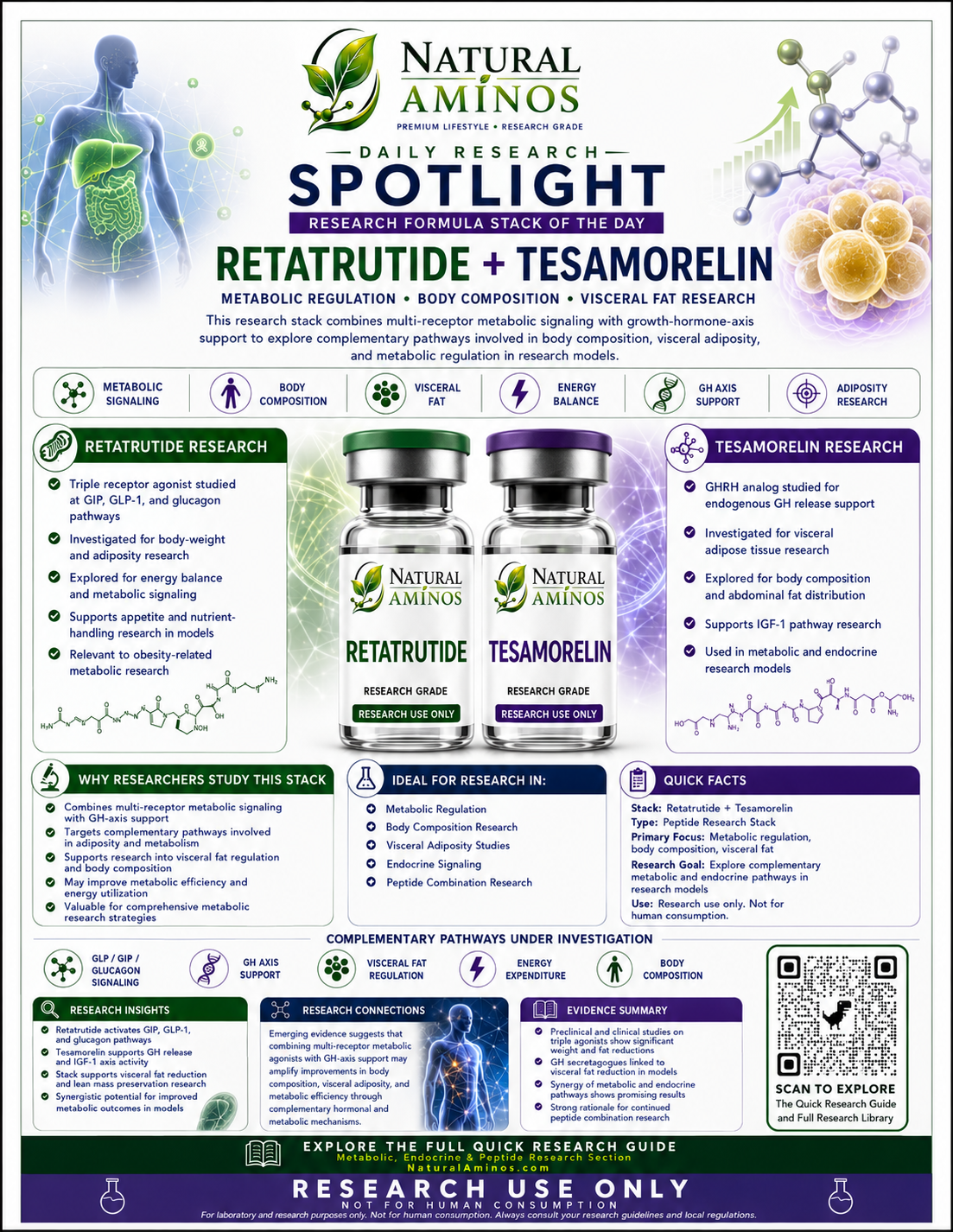
Retatrutide + Tesamorelin Research Data
For laboratory research use only; not for human or veterinary use or consumption. This page provides research information, not personal-use instructions or medical advice.
Natural Aminos Research Stack or Formula of the Day
Retatrutide + Tesamorelin
Triple-Incretin/Glucagon Signaling, Visceral Fat & GH/IGF-1 Research Spotlight
Compound Identity & Current Development Status
Retatrutide (LY3437943) is an investigational once-weekly single peptide engineered to activate three metabolic hormone receptors: glucose-dependent insulinotropic polypeptide (GIP), glucagon-like peptide-1 (GLP-1), and glucagon receptors. Its clinical development targets obesity and cardiometabolic complications through reduced food intake, improved glycemic control, and glucagon-receptor contributions to energy expenditure and substrate utilization. As of September 2026, retatrutide is not approved by FDA or another regulator. Eli Lilly has reported five positive Phase III trials and plans a U.S. Biologics License Application submission in the first quarter of 2027.
Tesamorelin is a 44-amino-acid growth-hormone-releasing-hormone (GHRH) analogue that stimulates endogenous pulsatile growth hormone secretion and raises circulating IGF-1. Unlike retatrutide, tesamorelin is an approved drug. FDA-approved EGRIFTA WR is indicated specifically for reduction of excess abdominal fat in adults with HIV-associated lipodystrophy. The current prescribing information explicitly states that tesamorelin is not indicated for weight-loss management and has a weight-neutral effect.
The combination therefore joins two very different metabolic strategies: retatrutide produces large whole-body weight and fat loss through GIP/GLP-1/glucagon signaling, whereas tesamorelin selectively alters the GH/IGF-1 axis and has demonstrated preferential reductions in visceral adipose tissue within a specific HIV-lipodystrophy population. No peer-reviewed human, animal, or cell study was identified that intentionally administered retatrutide and tesamorelin together.
Benefits
Retatrutide
Retatrutide has demonstrated very large human weight-loss effects. In the 338-participant Phase II obesity trial, mean body-weight reduction reached 24.2% at 48 weeks in the 12 mg group versus 2.1% with placebo. Participants also showed improvements in waist circumference, blood pressure, glucose, insulin, and lipid measures. Gastrointestinal adverse effects were the most common treatment-related events, and heart rate rose in a dose-dependent fashion before declining later in treatment.
The Phase III program has extended those findings. Lilly reported that TRIUMPH-1 participants receiving the highest studied dose lost an average of 28.3% of body weight at 80 weeks, and participants with baseline BMI of at least 35 who entered a prespecified extension reached approximately 30.3% average weight loss at 104 weeks. TRIUMPH-2 reported up to 20.8% average weight loss in adults with obesity or overweight and type 2 diabetes, while TRIUMPH-3 reported up to 22.6% in adults with severe obesity and established cardiovascular disease.
Retatrutide also has direct body-composition evidence. A 2025 DXA substudy in adults with type 2 diabetes found substantial reductions in total fat mass. The proportion of lean-mass loss relative to total weight loss was similar to that observed with other obesity treatments, rather than disproportionately high. This provides reassurance about composition of weight loss but does not show that lean mass is fully preserved.
Liver-fat effects are also substantial. In a randomized Phase IIa substudy of participants with metabolic dysfunction-associated steatotic liver disease, retatrutide reduced liver fat by approximately 81-82% at 24 weeks in the 8 and 12 mg groups, and most participants at those doses reached liver-fat content below 5%. These changes were strongly related to body-weight, abdominal-fat, insulin-sensitivity, and lipid improvements.
Tesamorelin
Tesamorelin's strongest evidence is reduction of visceral adipose tissue in adults with HIV-associated abdominal fat accumulation. In a 412-patient randomized trial, visceral adipose tissue fell approximately 15% with tesamorelin while increasing with placebo. A separate 404-patient randomized study showed about an 11% reduction at six months and approximately 18% reduction among participants who continued therapy for one year.
The effect is compartment specific. Tesamorelin reduces visceral abdominal fat much more consistently than subcutaneous fat and is not a general body-weight drug. The FDA label explicitly describes EGRIFTA WR as weight neutral and not indicated for weight-loss management. Visceral-fat reductions also tend to reverse after treatment stops, demonstrating that the effect depends on continued GH-axis stimulation.
Tesamorelin also affects liver fat in HIV-related metabolic disease. A randomized 2014 JAMA study found reductions in both visceral and hepatic fat over six months. A 2019 randomized 12-month Lancet HIV trial in people with HIV and NAFLD found an absolute liver-fat reduction of 4.1 percentage points versus placebo, corresponding to an approximately 37% relative reduction from baseline.
A 2026 meta-analysis of five randomized trials provides the strongest recent synthesis. Tesamorelin reduced visceral adipose tissue, trunk fat, hepatic fat, and waist circumference and increased lean body mass by a mean of approximately 1.42 kg. No significant reduction in BMI was observed. The findings reinforce the concept that tesamorelin changes body composition more than overall body weight in HIV-associated lipodystrophy.
Tesamorelin's clinical benefit comes with GH/IGF-1-specific safety issues. The current FDA label warns that persistent IGF-1 elevation can occur, fluid retention may cause edema, arthralgia, and carpal-tunnel symptoms, and glucose intolerance or diabetes can develop. Active malignancy, significant hypothalamic-pituitary disruption, pregnancy, and hypersensitivity are contraindications.
What the Formulas Are Studied For
Retatrutide Research Areas
• Obesity and chronic weight management.
• Overweight with weight-related comorbidities.
• Type 2 diabetes and glycemic control.
• Total fat and visceral-fat reduction.
• Metabolic dysfunction-associated steatotic liver disease and liver-fat reduction.
• Knee osteoarthritis pain in people with obesity.
• Moderate-to-severe obstructive sleep apnea associated with obesity.
• Cardiovascular and renal outcomes in ongoing Phase III development.
• GIP/GLP-1/glucagon receptor integration in energy balance.
Tesamorelin Research Areas
• FDA-approved reduction of excess abdominal fat in adults with HIV-associated lipodystrophy.
• Visceral-adipose-tissue reduction through endogenous GH stimulation.
• Hepatic-fat reduction in people with HIV and fatty-liver disease.
• Lean-body-mass and body-composition changes in HIV-associated lipodystrophy.
• GH and IGF-1 physiology.
• Effects on triglycerides and selected cardiometabolic measures.
• Research on muscle composition and ectopic fat in HIV populations.
• Not approved or indicated for general weight-loss management.
Published Research - Worldwide Evidence Review
Retatrutide - United States and Global Phase III Development
Retatrutide's strongest peer-reviewed obesity evidence comes from the 2023 New England Journal of Medicine Phase II trial. The study demonstrated dose-dependent weight loss up to 24.2% at 48 weeks and improvements across multiple cardiometabolic variables. A parallel Phase II program in type 2 diabetes showed substantial reductions in HbA1c and body weight.
The 2024 Nature Medicine liver-fat substudy demonstrated a particularly strong hepatic signal: participants with at least 10% baseline liver fat had approximately 81-82% relative liver-fat reduction at 24 weeks at the 8 and 12 mg doses, compared with essentially no reduction on placebo. This suggests that retatrutide already affects one of the metabolic compartments for which tesamorelin has also been studied.
The 2025 Lancet Diabetes & Endocrinology DXA substudy quantified fat-versus-lean composition. Total body fat decreased substantially, and the fraction of lean-mass loss was similar to that seen with other obesity therapies. These data are directly relevant to the hypothesis that tesamorelin might preserve lean mass during large pharmacologic weight loss, because they show that retatrutide does not appear to cause uniquely disproportionate lean loss in the first place.
In 2026, Lilly announced positive Phase III topline results from TRIUMPH-1, TRIUMPH-2, and TRIUMPH-3. The highest-dose TRIUMPH-1 group lost 28.3% of body weight at 80 weeks. The company has stated that it plans to submit retatrutide to FDA in Q1 2027. Until regulatory review is complete, retatrutide remains investigational.
Tesamorelin - Canada, United States, Europe and 2026 Meta-Analysis
Tesamorelin's pivotal development involved large multinational HIV-lipodystrophy trials with major participation from Canadian and U.S. investigators. The randomized 412-patient trial published in the New England Journal of Medicine found a 15.2% reduction in visceral adipose tissue compared with a 5% increase on placebo, together with improved triglycerides and total-cholesterol/HDL ratio.
The 404-patient randomized placebo-controlled study with a safety extension showed continued visceral-fat reduction during ongoing treatment and rapid regain after discontinuation. This is important for stack theory: tesamorelin does not permanently remodel visceral fat after exposure stops; its body-composition effect appears pharmacologically maintained.
Massachusetts General Hospital and NIH investigators expanded the research into hepatic fat. The 2014 JAMA trial demonstrated reductions in visceral fat and modest reductions in liver fat. The 2019 Lancet HIV trial extended treatment to 12 months and showed a statistically significant liver-fat reduction without significant differences in fasting glucose or HbA1c versus placebo over that study period.
A 2026 meta-analysis from Egyptian and U.S. investigators combined five randomized trials. Tesamorelin significantly reduced visceral fat, trunk fat, hepatic fat, and waist circumference and increased lean body mass by approximately 1.42 kg. However, BMI did not significantly decline. This modern synthesis reinforces FDA's distinction between visceral-fat remodeling and general weight-loss therapy.
Current Regulatory Context
Retatrutide and tesamorelin are in very different regulatory positions. Retatrutide is an investigational Lilly drug candidate and is not approved. Lilly's current public materials warn against taking products claiming to be retatrutide outside company-sponsored clinical trials because identity, purity, and dose cannot be assured. The company plans regulatory submission in 2027.
Tesamorelin is an approved biologic. FDA's current EGRIFTA WR labeling, revised March 2025, indicates it for reduction of excess abdominal fat in adults with HIV-associated lipodystrophy. The label specifically states that long-term cardiovascular safety has not been established and that it is not indicated for weight-loss management.
The label also documents important endocrine effects: 47% of participants treated for 26 weeks had IGF-1 above two standard-deviation scores and 36% exceeded three standard deviations. FDA therefore recommends IGF-1 monitoring and consideration of discontinuation with persistent marked elevation, especially if the efficacy response is not robust.
Direct Research on Retatrutide + Tesamorelin Together
No peer-reviewed human, animal, or in-vitro study was identified that administered retatrutide and tesamorelin together. No registered clinical trial was identified that intentionally combined the two compounds as a therapeutic strategy.
No controlled evidence therefore shows whether tesamorelin adds further visceral-fat or liver-fat reduction during retatrutide therapy, preserves more lean mass, changes weight-loss durability, or alters adverse-event rates. Any claim of synergy is currently an extrapolation from independent trials conducted in different populations.
Theory of the Stack - How the Combination Could Work
1. Whole-Body Energy Balance - Retatrutide Layer
Retatrutide would provide the dominant weight-loss mechanism. GLP-1 and GIP signaling reduce food intake and improve glucose handling, while glucagon-receptor activity may increase energy expenditure and alter hepatic fuel metabolism. The result in humans is large total-body-weight and fat reduction.
2. Visceral-Fat Selectivity - Tesamorelin Layer
Tesamorelin would provide a different body-composition signal through endogenous GH and IGF-1. In HIV lipodystrophy, its most reproducible effect is preferential reduction of visceral abdominal fat rather than generalized weight loss or subcutaneous-fat loss. The theoretical argument is that tesamorelin might further target visceral fat while retatrutide drives global negative energy balance.
3. Lean-Mass Preservation Is the Most Attractive Combination Theory
The 2026 tesamorelin meta-analysis reported an average increase in lean body mass in HIV-associated lipodystrophy. Because large retatrutide-induced weight loss includes some lean-mass loss, it is biologically tempting to hypothesize that GHRH-driven GH/IGF-1 signaling could support lean tissue while retatrutide reduces fat mass.
The evidence does not prove this. Tesamorelin's lean-mass findings come from people with HIV lipodystrophy, not from adults undergoing 20-30% body-weight reduction with a triple incretin/glucagon agonist. Retatrutide's own DXA substudy also found that lean-mass loss was not disproportionately high compared with other obesity treatments.
4. Visceral-Fat Reduction May Be Redundant
Retatrutide already produces large reductions in abdominal and liver fat as body weight falls. Tesamorelin also reduces visceral and hepatic fat. If retatrutide already removes much of the metabolically active visceral-fat compartment, tesamorelin may have little additional substrate on which to demonstrate a clinically meaningful effect.
5. Liver-Fat Effects Also Overlap
Both compounds have human liver-fat data. Retatrutide produced very large liver-fat reductions in metabolic fatty-liver disease, while tesamorelin produced more modest but significant reductions in HIV-associated fatty liver. The mechanisms differ, but the endpoint overlaps substantially. No study shows whether combining them improves histology, fibrosis, or long-term liver outcomes beyond retatrutide alone.
6. Glucose Effects Could Move in Opposite Directions
Retatrutide generally improves glycemia and insulin sensitivity in obesity and type 2 diabetes. Tesamorelin can cause glucose intolerance or diabetes in some patients because GH can oppose insulin action. This creates an important theoretical tension. Retatrutide might offset some GH-related dysglycemia, but there is no evidence that it reliably neutralizes tesamorelin's glucose risk, and assuming so would be unsafe.
7. IGF-1 Elevation Creates a Distinct Safety Layer
Retatrutide does not rely on chronic IGF-1 elevation. Tesamorelin does. The FDA label documents frequent elevations above age-adjusted IGF-1 reference ranges and warns about malignancy considerations. Adding tesamorelin to a powerful metabolic therapy therefore introduces a new endocrine-growth-factor exposure rather than simply improving fat loss.
8. Appetite Suppression Plus GH-Axis Activation Has Not Been Characterized
Large retatrutide-induced appetite reduction can create prolonged negative energy balance. Tesamorelin increases GH/IGF-1 signaling, which changes substrate mobilization, fluid balance, and tissue metabolism. The combined physiology during severe caloric deficit has not been studied. A theoretically anabolic endocrine signal does not guarantee adequate protein intake, resistance training, or preservation of functional muscle.
9. Fluid Retention Can Confuse Body-Composition Interpretation
Tesamorelin can produce edema and other fluid-retention effects. During large weight loss, fluid shifts can complicate scale weight, DXA interpretation, and subjective appearance. Any combination study would need methods capable of distinguishing true lean tissue from changes in hydration.
10. Population Transfer Is a Major Limitation
Tesamorelin's approved and best-supported population is adults with HIV-associated lipodystrophy, a condition with distinctive antiretroviral, endocrine, inflammatory, and fat-distribution biology. It cannot be assumed that the same magnitude of visceral-fat or lean-mass benefit occurs in people with uncomplicated obesity or in people receiving retatrutide.
Possible Overall Benefit - Theoretical, Not Proven
The most defensible theoretical benefit of Retatrutide + Tesamorelin is broad weight/fat reduction plus selective GH-axis body-composition remodeling. Retatrutide could provide the dominant reduction in energy intake, total adiposity, glycemia, and liver fat, while tesamorelin could theoretically add visceral-fat selectivity and support lean tissue through endogenous GH/IGF-1 signaling.
A second possible theory is metabolic compartment targeting: retatrutide reduces total and ectopic fat through incretin/glucagon biology, whereas tesamorelin changes visceral-fat physiology through the GHRH-GH-IGF-1 axis. If these pathways affect different rate-limiting processes, the combination could theoretically improve body composition beyond scale weight alone.
The current evidence does not show that benefit. Retatrutide already produces very large visceral, total-fat, and liver-fat reductions; tesamorelin is weight neutral and validated in HIV lipodystrophy, not general obesity. The addition of tesamorelin would also add IGF-1 elevation, fluid-retention, glucose-intolerance, and malignancy-related considerations without proven incremental benefit.
Why More Research Is Needed
• No published study has tested Retatrutide + Tesamorelin together, and no registered combination trial was identified.
• Retatrutide remains investigational as of September 2026 and has not yet undergone FDA review for approval.
• Several 2026 Phase III retatrutide results remain company-reported topline data pending complete peer-reviewed publication.
• Tesamorelin is FDA-approved only for excess abdominal fat in adults with HIV-associated lipodystrophy and is explicitly not indicated for general weight-loss management.
• Tesamorelin's apparent lean-body-mass benefit was demonstrated in HIV-associated lipodystrophy and cannot be assumed to translate to adults undergoing large retatrutide-induced weight loss.
• Retatrutide already produces large reductions in fat mass, abdominal fat, and liver fat, creating substantial endpoint overlap and possible redundancy.
• Tesamorelin can raise IGF-1 markedly, and the effects of prolonged IGF-1 elevation are not fully known.
• Tesamorelin can cause fluid retention, arthralgia, edema, carpal-tunnel symptoms, hypersensitivity, and injection-site reactions.
• FDA labeling warns that tesamorelin can produce glucose intolerance or diabetes, whereas retatrutide generally improves glycemia; the net effect of combined exposure is unknown.
• Tesamorelin is contraindicated in active malignancy and in significant hypothalamic-pituitary-axis disruption, adding a safety framework absent from retatrutide's primary mechanism.
• Long-term cardiovascular safety of tesamorelin has not been established, while retatrutide cardiovascular-outcomes development is still ongoing.
• Future combination studies would need DEXA lean/fat mass, CT or MRI visceral fat, liver fat, protein intake, physical function, resting energy expenditure, IGF-1, glucose/insulin, fluid status, and long-term safety.
• A valid randomized design should compare retatrutide alone with retatrutide plus tesamorelin; improvement from baseline alone would not establish additive benefit.
Research Summary
Retatrutide + Tesamorelin is a scientifically interesting but clinically untested body-composition stack. Retatrutide has very strong human evidence for large reductions in total body weight, fat mass, glycemia, and liver fat and now has multiple positive Phase III trials, although it remains investigational. Tesamorelin is already FDA-approved, but for a much narrower purpose: reduction of excess abdominal fat in adults with HIV-associated lipodystrophy. Its human evidence supports visceral-fat and liver-fat reduction and, in a 2026 meta-analysis, an increase in lean body mass without meaningful BMI reduction.
The theoretical combination is strongest around body-composition quality rather than additional weight loss: retatrutide would drive total weight and fat reduction, while tesamorelin could theoretically target residual visceral fat and support lean tissue through GH/IGF-1 signaling. The theory is weakened by major overlap in visceral and hepatic fat outcomes, population mismatch, and added endocrine risks from tesamorelin. No direct evidence shows that the combination improves fat distribution, lean-mass retention, function, or safety beyond retatrutide alone.
Selected Sources
• Jastreboff AM, et al. Triple-Hormone-Receptor Agonist Retatrutide for Obesity - A Phase 2 Trial. New England Journal of Medicine. 2023;389:514-526. PMID: 37366315. DOI: 10.1056/NEJMoa2301972.
• Rosenstock J, et al. Retatrutide, a GIP, GLP-1 and glucagon receptor agonist, for people with type 2 diabetes: a randomized Phase 2 trial. Lancet. 2023;402(10401):529-544. PMID: 37385280. DOI: 10.1016/S0140-6736(23)01053-X.
• Sanyal AJ, et al. Triple hormone receptor agonist retatrutide for metabolic dysfunction-associated steatotic liver disease: a randomized Phase 2a trial. Nature Medicine. 2024;30:2037-2048. PMID: 38858523. PMCID: PMC11271400. DOI: 10.1038/s41591-024-03018-2.
• Coskun T, et al. Effects of retatrutide on body composition in people with type 2 diabetes: a substudy of a Phase 2 randomized trial. Lancet Diabetes & Endocrinology. 2025;13(8):674-684. PMID: 40609566. DOI: 10.1016/S2213-8587(25)00092-0.
• Eli Lilly and Company. TRIUMPH-1 Phase III topline results. May 21, 2026. Average weight reduction up to 28.3% at 80 weeks; full peer-reviewed publication pending.
• Eli Lilly and Company. TRIUMPH-2 and TRIUMPH-3 Phase III topline results. July 23, 2026. Lilly announced planned U.S. BLA submission in Q1 2027.
• Eli Lilly and Company. What to know about retatrutide. Current 2026 public information stating retatrutide is not approved by any regulatory agency.
• U.S. Food and Drug Administration. EGRIFTA WR (tesamorelin) Prescribing Information, revised March 2025. Indicated for reduction of excess abdominal fat in HIV-infected adults with lipodystrophy; not indicated for weight-loss management.
• Falutz J, et al. Metabolic effects of a growth hormone-releasing factor in patients with HIV. New England Journal of Medicine. 2007. PMID: 18057338.
• Falutz J, et al. Long-term safety and effects of tesamorelin in HIV patients with abdominal fat accumulation. AIDS. 2008. PMID: 18690162.
• Falutz J, et al. Effects of tesamorelin, a growth hormone-releasing factor, in HIV-infected patients with abdominal fat accumulation: a randomized placebo-controlled trial with a safety extension. Journal of Acquired Immune Deficiency Syndromes. 2010;53(3):311-322. PMID: 20101189. DOI: 10.1097/QAI.0b013e3181cbdaff.
• Stanley TL, et al. Effect of tesamorelin on visceral fat and liver fat in HIV-infected patients with abdominal fat accumulation: a randomized clinical trial. JAMA. 2014;312(4):380-389. PMID: 25038357. PMCID: PMC4363137. DOI: 10.1001/jama.2014.8334.
• Stanley TL, et al. Effects of tesamorelin on non-alcoholic fatty liver disease in HIV: a randomized, double-blind, multicentre trial. Lancet HIV. 2019;6(12):e821-e830. PMID: 31611038. PMCID: PMC6981288. DOI: 10.1016/S2352-3018(19)30338-8.
• Badran AS, et al. Body composition, hepatic fat, metabolic, and safety outcomes of Tesamorelin, a GHRH analogue, in HIV-associated lipodystrophy: A meta-analysis of randomized controlled trials. Obesity Research & Clinical Practice. 2026. PMID: 41545261. DOI: 10.1016/j.orcp.2026.01.002.
• Reduction in visceral adiposity is associated with an improved metabolic profile in HIV-infected patients receiving tesamorelin. Clinical Infectious Diseases. 2012. PMID: 22495074. PMCID: PMC3348954.
Theory vs. Proof - Verdict
What is supported by evidence: retatrutide produces very large reductions in body weight, total fat, liver fat, and glycemia in randomized human studies and has multiple positive Phase III obesity datasets; tesamorelin reliably reduces visceral abdominal fat in adults with HIV-associated lipodystrophy, can reduce liver fat, increases IGF-1, and has been associated with increased lean body mass in randomized-trial meta-analysis.
What is not proven: that tesamorelin improves lean-mass retention during retatrutide-induced weight loss; that it adds further visceral or hepatic fat reduction when retatrutide is already producing large effects; that retatrutide prevents tesamorelin-related glucose intolerance; or that the combination has an acceptable long-term endocrine and cardiovascular safety profile.
Verdict - theory vs. proof: the mechanistic theory is moderately strong but highly outcome-overlapping. Retatrutide provides powerful systemic energy-balance, appetite, glycemic, and fat-loss effects, while tesamorelin contributes a distinct GHRH-GH-IGF-1 pathway with preferential visceral-fat and potential lean-mass effects in HIV lipodystrophy. The most attractive hypothesis is improved body-composition quality rather than more scale weight loss. The main weaknesses are that tesamorelin's evidence comes from a different disease population, retatrutide already reduces visceral and liver fat substantially, and tesamorelin adds IGF-1 elevation, glucose-intolerance, fluid-retention, and malignancy-related considerations. Overall, Retatrutide + Tesamorelin is best classified as a plausible but unproven whole-body-fat-loss plus GH-axis body-composition hypothesis with strong individual human evidence for both agents in different indications, substantial endpoint redundancy, and no direct combination evidence.
Research & Educational Use Only !!