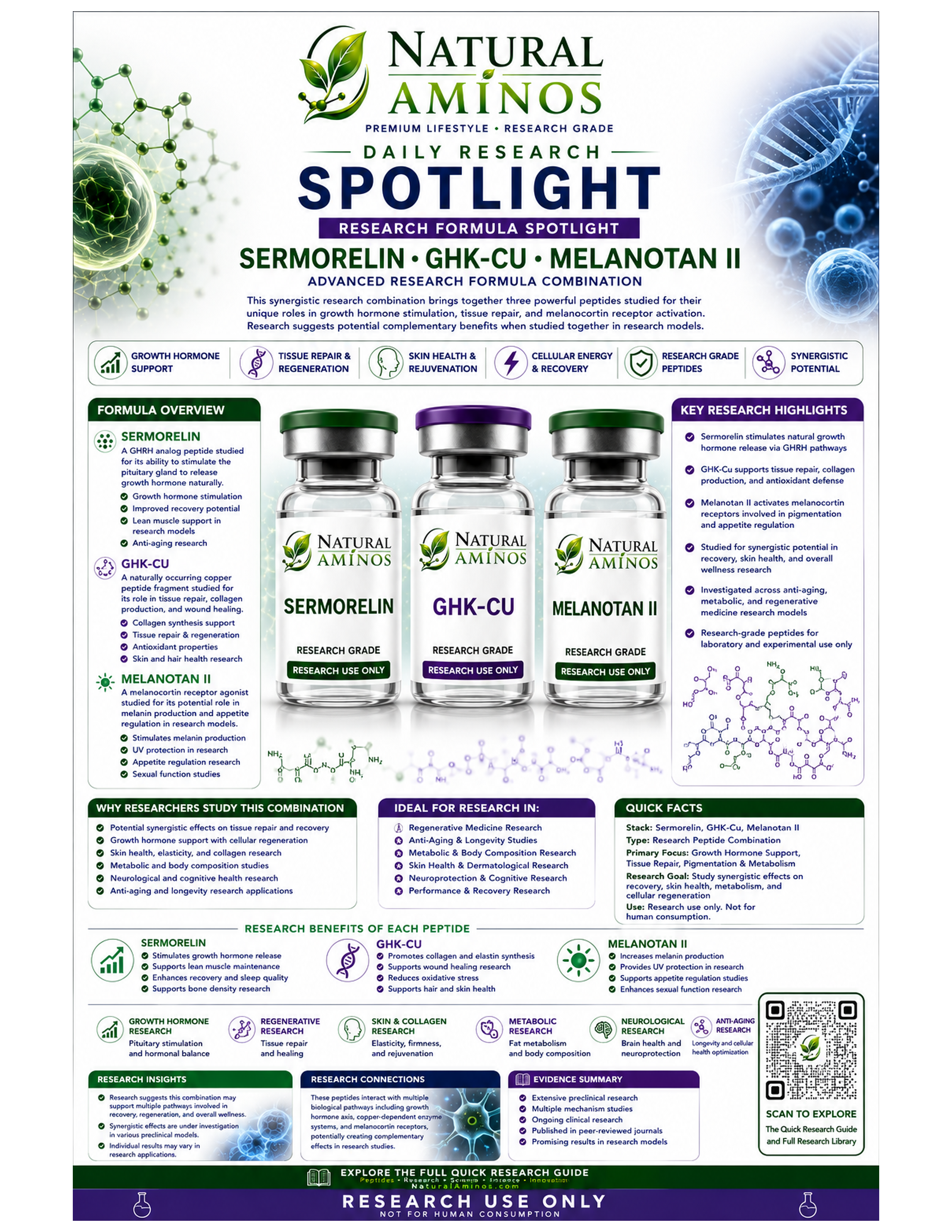
Sermorelin + GHK-Cu + Melanotan II Research Data
For laboratory research use only; not for human or veterinary use or consumption. This page provides research information, not personal-use instructions or medical advice.
Natural Aminos Research Stack or Formula of the Day
Sermorelin + GHK-Cu + Melanotan II
GH/IGF-1 Signaling, Tissue Remodeling & Melanocortin Research Spotlight
Compound Identity & Evidence Context
Sermorelin is synthetic human growth-hormone-releasing hormone (GHRH 1-29 amide), the biologically active N-terminal portion of endogenous GHRH. It stimulates pituitary GHRH receptors, increasing endogenous growth-hormone (GH) secretion and downstream insulin-like growth factor-1 (IGF-1) in people with preserved somatotroph function. Sermorelin acetate was previously marketed in the United States as Geref for pediatric growth-hormone deficiency and for diagnostic assessment of GH reserve; FDA later determined that the discontinued Geref products were not withdrawn for reasons of safety or effectiveness.
GHK-Cu is the copper(II) complex of the endogenous tripeptide glycyl-L-histidyl-L-lysine. It has a large preclinical literature involving collagen synthesis, extracellular-matrix remodeling, glycosaminoglycan production, angiogenesis, antioxidant activity, inflammatory signaling, and tissue repair. Human evidence is much smaller and is concentrated in topical wound and aesthetic applications. A 2026 systematic review identified only 20 eligible standalone GHK-Cu studies in aesthetic medicine, of which 18 were preclinical and only two were randomized controlled trials.
Melanotan II is a synthetic cyclic analogue of alpha-melanocyte-stimulating hormone and is a nonselective melanocortin receptor agonist. Human studies from the 1990s and early 2000s demonstrated tanning/pigmentation, spontaneous penile erections, and increased sexual desire. It is not FDA-approved. Current FDA compounding-safety information cites case reports of serious adverse events including melanoma, posterior reversible encephalopathy syndrome, sympathomimetic toxidrome, and priapism. Australia's TGA also warned in August 2026 that seized Melanotan II nasal products were inconsistently dosed.
No peer-reviewed human, animal, or cell study was identified that administered Sermorelin, GHK-Cu, and Melanotan II together. No controlled pairwise combination study was identified for Sermorelin + GHK-Cu, Sermorelin + Melanotan II, or GHK-Cu + Melanotan II. The three-way stack must therefore be evaluated as a mechanism-based hypothesis rather than a demonstrated combination.
Benefits
Sermorelin
Sermorelin has direct human pharmacodynamic evidence. GHRH(1-29) produces a dose-related rise in endogenous GH in healthy adults with relatively selective pituitary action in acute studies. Unlike direct recombinant GH administration, Sermorelin depends on the patient's pituitary reserve and remains subject to physiologic feedback from somatostatin and IGF-1.
Pediatric treatment evidence is substantial historically. In a multicenter study of 110 previously untreated prepubertal children with GH deficiency, once-daily subcutaneous GHRH(1-29) increased mean height velocity from approximately 4.1 cm/year at baseline to 8.0 cm/year after six months and 7.2 cm/year after twelve months in the efficacy population. The treatment was generally well tolerated.
Older-adult GHRH research provides additional mechanistic context. Repeated GHRH exposure can raise nocturnal GH and IGF-1 and, in selected small studies using GHRH(1-29) or related analogues, modestly alter lean mass or body composition. These studies do not establish modern anti-aging, muscle-building, or fat-loss efficacy for Sermorelin in healthy adults.
GHK-Cu
GHK-Cu's strongest biological rationale is local tissue remodeling. Classic fibroblast studies showed stimulation of collagen and glycosaminoglycan synthesis, while later work reported effects on matrix metalloproteinases, tissue inhibitors of metalloproteinases, angiogenesis, cell proliferation, redox biology, and inflammatory signaling. These findings make GHK-Cu one of the more extensively studied regenerative peptides at the cell and animal level.
Human wound evidence is mixed rather than uniformly positive. In a 1994 multicenter randomized evaluator-blinded trial of diabetic neuropathic plantar ulcers, topical GHK-Cu complex significantly improved median ulcer-area closure and reduced infection incidence compared with vehicle. By contrast, a 1992 randomized trial in venous stasis ulcers found no advantage of a 0.4% tripeptide-copper cream over placebo, and a 2006 randomized post-CO2-laser study found no objective advantage for erythema, wrinkles, or overall skin quality despite higher patient-reported satisfaction.
A 2026 PRISMA systematic review in aesthetic medicine found 20 eligible studies, 18 preclinical and two randomized trials. The review concluded that GHK-Cu has a reasonable regenerative biological basis but emphasized methodological variability, very limited high-quality human evidence, and a persistent translational gap.
Route is critical. The human evidence is predominantly topical. FDA's current compounding-safety page specifically warns that injectable GHK-Cu may pose immunogenicity risk because of aggregation and peptide-related impurities and states that human data are limited for injectable use. Topical human findings therefore should not be generalized to systemic injection.
Melanotan II
Melanotan II has genuine controlled human pharmacology. In a double-blind placebo-controlled crossover study of ten men with psychogenic erectile dysfunction, eight of ten developed clinically apparent erections after Melanotan II, and high-rigidity erection duration was substantially greater than placebo. Transient nausea, stretching, yawning, and appetite reduction occurred more often with active treatment.
A second double-blind crossover study in men with organic erectile-dysfunction risk factors found that Melanotan II produced more erections than placebo and significantly increased reported sexual desire. Severe nausea occurred after a subset of injections. These trials demonstrate central melanocortin effects on sexual response but were small and were not followed by a modern approval program for Melanotan II.
Pigmentation is another direct human effect. Early Phase I development showed increased skin pigmentation after repeated exposure, reflecting melanocortin receptor activation in melanocytes. That cosmetic effect does not establish safety as a tanning drug.
The modern safety record is concerning. FDA cites published reports of melanoma, priapism, posterior reversible encephalopathy syndrome, and sympathomimetic toxidrome. A 2021 case report documented refractory ischemic priapism requiring operative decompression after Melanotan II injection. A 2014 Danish report described melanoma temporally associated with Melanotan II use, although case reports cannot establish causality and ultraviolet exposure can confound interpretation.
What the Formulas Are Studied For
Sermorelin Research Areas
• Pituitary GH stimulation and evaluation of GH reserve.
• Historical treatment of pediatric growth-hormone deficiency.
• Endogenous GH pulsatility and downstream IGF-1 physiology.
• Age-related decline in GH secretion.
• Body-composition and lean-mass research using GHRH or related analogues.
• Sleep and neuroendocrine regulation of GH secretion.
GHK-Cu Research Areas
• Collagen and extracellular-matrix synthesis.
• Wound healing and ulcer closure.
• Glycosaminoglycan production and matrix remodeling.
• Angiogenesis and tissue regeneration.
• Skin photoaging and post-procedure recovery.
• Oxidative-stress and inflammatory signaling.
• Hair and follicular biology, with limited rigorous human evidence.
• Injectable use remains poorly characterized in humans.
Melanotan II Research Areas
• Skin pigmentation and melanogenesis.
• Central melanocortin receptor biology.
• Penile erection and sexual desire in early controlled human studies.
• Appetite and autonomic effects.
• Unlicensed tanning-product safety.
• Priapism and melanocytic-lesion surveillance.
Published Research - Worldwide Evidence Review
Sermorelin - International Human Endocrine and Pediatric Research
Human GHRH(1-29) studies were conducted across North America, Europe, and other international centers. Acute endocrine studies demonstrated dose-dependent GH release with relative hormonal specificity. Pediatric multicenter trials established that repeated subcutaneous administration could accelerate growth in selected GH-deficient children.
Sermorelin's historical U.S. regulatory status distinguishes it from many research peptides. Geref received FDA approval and was later discontinued by the manufacturer. FDA subsequently determined that the withdrawal was not for safety or effectiveness reasons. A 2026 review of performance-enhancing peptides similarly emphasizes that adult off-label body-composition claims remain uncertain because the evidence is limited and largely indirect.
GHK-Cu - United States, Europe, Middle East and 2026 Evidence Synthesis
The GHK-Cu literature spans U.S. wound research, European matrix-biology work, and newer international aesthetic reviews. The 1994 diabetic-foot-ulcer trial reported markedly greater plantar-ulcer closure with topical GHK-Cu than vehicle, whereas the 1992 venous-ulcer study found no advantage over placebo. These conflicting results show that wound type, formulation, debridement, local tissue environment, and study design materially affect outcomes.
A randomized 2006 post-laser-resurfacing study found no objective improvement in erythema, wrinkles, or skin quality from GHK-Cu-containing post-treatment products, although patient-reported satisfaction was higher. This study is important because it demonstrates that strong preclinical regeneration biology does not guarantee objective human benefit.
The August 2026 Aesthetic Surgery Journal systematic review, authored by investigators affiliated with institutions in the United Arab Emirates and the United States, identified only two randomized controlled trials among 20 eligible GHK-Cu aesthetic studies. The authors concluded that larger standardized controlled trials are needed.
A separate 2026 pharmaceutics evidence-mapping review emphasized another translational problem: GHK-Cu is not chemically interchangeable across formulations. Copper occupancy, dissociation, speciation, stability, carrier systems, and route can alter what molecular entity actually reaches tissue. That issue is especially relevant when extrapolating topical studies to injectable research products.
Melanotan II - United States, Europe, Australia and Safety Surveillance
The early controlled human sexual-function program was largely conducted through University of Arizona investigators. Placebo-controlled crossover trials established that Melanotan II can initiate erections in both psychogenic and organic erectile dysfunction and can increase sexual desire. These findings helped establish melanocortin signaling as a central sexual-response pathway and contributed conceptually to later development of bremelanotide/PT-141.
European case literature later raised concerns about melanocytic lesions and melanoma temporally associated with Melanotan II. Causality remains unresolved because case reports cannot control for ultraviolet exposure, baseline nevus risk, or product purity.
In August 2026, Australia's Therapeutic Goods Administration warned against Melanotan II tanning products after laboratory testing of seized nasal sprays found labeled 30 mg products containing estimated amounts ranging from 22 mg to 54 mg. This illustrates a practical product-quality risk separate from the intrinsic pharmacology.
FDA's current compounding-safety list similarly cites potential immunogenicity from aggregation or peptide-related impurities and published serious adverse-event reports. Melanotan II remains unapproved.
Direct Research on Sermorelin + GHK-Cu + Melanotan II Together
No peer-reviewed human, animal, or in-vitro study was identified that administered Sermorelin, GHK-Cu, and Melanotan II together. No registered clinical trial of the full stack was identified.
No controlled pairwise study was identified for Sermorelin + GHK-Cu, Sermorelin + Melanotan II, or GHK-Cu + Melanotan II. A 2026 evidence comparison of GHK-Cu and Melanotan II likewise concluded that the two have not been administered together or tested for interaction. The full three-way theory therefore rests entirely on independent component literatures.
Theory of the Stack - How the Combination Could Work
1. Endocrine Growth and Recovery Signaling - Sermorelin Layer
Sermorelin would provide the systemic endocrine layer. By stimulating pituitary GH release, it can increase pulsatile GH and downstream IGF-1. Those signals influence protein turnover, connective-tissue metabolism, lipolysis, and tissue growth and repair. The effect is constrained by pituitary reserve and normal endocrine feedback.
2. Local Matrix Remodeling - GHK-Cu Layer
GHK-Cu would provide the tissue-remodeling layer. Its most plausible contribution is local regulation of collagen, glycosaminoglycans, metalloproteinases, angiogenesis, and redox/inflammatory signaling. This is conceptually distinct from Sermorelin because it operates largely at the extracellular-matrix and local-tissue level rather than through the pituitary GH axis.
3. Melanocortin Signaling - Melanotan II Layer
Melanotan II would provide a third, unrelated melanocortin-receptor layer. Its best-demonstrated human outputs are pigmentation and sexual arousal/erection. Those endpoints do not naturally complete the GH-plus-regeneration pair; they broaden the stack into cosmetic pigmentation and sexual-function biology.
4. Sermorelin + GHK-Cu Has the Strongest Regenerative Logic
Of the three possible pairings, Sermorelin + GHK-Cu has the most coherent tissue-repair concept. GH/IGF-1 signaling can influence protein synthesis and connective-tissue biology, while GHK-Cu can influence local matrix remodeling. In theory, systemic endocrine support plus local matrix regulation could be complementary. The limitation is that no combination study confirms that these signals are additive. GHK-Cu human evidence is mainly topical, and Sermorelin adult tissue-repair outcomes are not well established.
5. Melanotan II Adds Little to the Repair Theory
Melanotan II does not have a demonstrated role in collagen repair, GH-axis support, or systemic recovery. Its inclusion therefore changes the purpose of the stack rather than strengthening the same regenerative endpoint. A three-way theory would need to define a separate pigmentation or sexual-response objective.
6. GH/IGF-1 and Melanocortin Systems Are Mechanistically Separate
Sermorelin and Melanotan II do not target the same receptor system. This lowers the likelihood of simple receptor competition or saturation, but it also means there is no obvious reason to expect synergistic benefit. Independent pathway activation should not be mistaken for synergy.
7. Skin Biology Creates a Superficial but Unproven Link
GHK-Cu and Melanotan II are both promoted in skin-related contexts, but their mechanisms are fundamentally different. GHK-Cu is studied for fibroblast/matrix biology; Melanotan II activates melanocortin receptors in melanocytes to increase pigmentation. No evidence shows that combining matrix remodeling with increased melanogenesis improves skin health, wound healing, photoaging, or photoprotection.
8. Melanotan II Could Complicate Skin Surveillance
GHK-Cu research may encourage attention to skin quality and regeneration, while Melanotan II deliberately changes pigmentation and can darken pre-existing lesions. Case reports of eruptive nevi and melanoma associations mean that increased pigmentation could complicate visual monitoring of melanocytic lesions. This is a practical safety concern even though causality between Melanotan II and melanoma has not been established.
9. Systemic GH Signaling Adds a Separate Growth-Factor Safety Consideration
Sermorelin can raise GH and IGF-1, which introduces endocrine-growth signaling not shared by GHK-Cu or Melanotan II. In any theoretical long-term stack, unexplained tissue growth, glucose changes, edema, or elevated IGF-1 would require separate consideration. The absence of direct interaction data means one compound cannot be assumed to offset risks from another.
10. Route and Formulation Make the Stack Hard to Generalize
Historical Sermorelin studies used defined pharmaceutical preparations; GHK-Cu human evidence is predominantly topical; and Melanotan II trials used controlled subcutaneous research formulations. A modern research stack using different routes or compounded products may have completely different exposure, impurity, and immunogenicity profiles. Published findings cannot simply be pooled across routes.
Possible Overall Benefit - Theoretical, Not Proven
The most defensible theoretical benefit of Sermorelin + GHK-Cu + Melanotan II is not one unified biological outcome but three parallel effects: Sermorelin for endogenous GH/IGF-1 signaling, GHK-Cu for local matrix/tissue-remodeling biology, and Melanotan II for melanocortin-driven pigmentation and sexual-response signaling.
For a tissue-repair or healthy-aging research question, the scientifically coherent core is Sermorelin + GHK-Cu. Melanotan II does not have a demonstrated regenerative contribution and is better understood as a separate pigmentation/sexual-function compound.
No evidence shows that the three-way stack improves recovery, skin quality, lean mass, sexual function, pigmentation, or overall health more than the components used separately. The widest mechanistic coverage also produces the widest safety uncertainty.
Why More Research Is Needed
• No published study has tested Sermorelin + GHK-Cu + Melanotan II together.
• No controlled pairwise combination study was identified for any of the three possible pairs.
• Sermorelin's strongest clinical evidence is historical pediatric GH-deficiency treatment and human GH-stimulation physiology, not modern adult regenerative or body-composition efficacy.
• GHK-Cu's evidence base is predominantly preclinical; a 2026 systematic review identified only two randomized controlled trials among 20 aesthetic studies.
• GHK-Cu human findings are route specific and predominantly topical; FDA states that human safety data for injectable GHK-Cu are limited.
• GHK-Cu wound studies are inconsistent: one diabetic-foot-ulcer trial was positive while a venous-stasis-ulcer trial was negative.
• Melanotan II human sexual-function trials were small and old and did not establish long-term safety.
• FDA cites serious Melanotan II case reports involving melanoma, priapism, posterior reversible encephalopathy syndrome, and sympathomimetic toxidrome.
• Case reports cannot prove Melanotan II causes melanoma, but deliberate pigmentation may complicate surveillance of changing melanocytic lesions.
• Australian regulator testing in 2026 found major dose inconsistency in seized Melanotan II nasal products, illustrating product-quality uncertainty in unregulated supply.
• Sermorelin-induced GH/IGF-1 changes, GHK-Cu copper/speciation chemistry, and Melanotan II melanocortin activity require different pharmacokinetic and safety monitoring strategies.
• Future combination research would need separate endpoints for GH/IGF-1 physiology, objective matrix/skin repair, pigmentation, sexual response, glucose metabolism, skin-lesion surveillance, and systemic adverse events.
• A valid study would require single-agent arms and pairwise arms before interpreting a three-way combination as additive or synergistic.
Research Summary
Sermorelin + GHK-Cu + Melanotan II is a broad three-system stack rather than a tightly unified pathway combination. Sermorelin has strong evidence that it can stimulate endogenous GH and historical evidence as an FDA-approved pediatric GHRH therapy. GHK-Cu has extensive preclinical tissue-remodeling biology and some human topical wound/aesthetic evidence, but only a small controlled clinical literature and very limited systemic-injection data. Melanotan II has direct controlled human evidence for pigmentation, erection, and sexual desire but remains unapproved and now carries substantial safety and product-quality concerns.
The strongest mechanistic pairing is Sermorelin + GHK-Cu for a theoretical systemic-endocrine plus local-matrix repair model. Melanotan II adds a separate melanocortin pigmentation/sexual-response pathway rather than strengthening that repair model. No direct combination evidence exists, and the full stack should be viewed as multiple independent hypotheses placed together rather than as proven synergy.
Selected Sources
• Geref International Study Group. Once daily subcutaneous growth hormone-releasing hormone therapy accelerates growth in growth hormone-deficient children during the first year of therapy. Journal of Clinical Endocrinology & Metabolism. 1996. PMID: 8772599.
• Sermorelin: a review of its use in the diagnosis and treatment of children with idiopathic growth hormone deficiency. BioDrugs. 2007. PMID: 18031173.
• Dominikowski A, et al. The emerging landscape of performance-enhancing peptides modulating GH-IGF1 axis: bridging the gap between clinical evidence and patient self-administration. Frontiers in Endocrinology. 2026;17:1822475. PMID: 42395176. PMCID: PMC13322892.
• U.S. Food and Drug Administration / Federal Register. Determination that Geref (sermorelin acetate) was not withdrawn from sale for reasons of safety or effectiveness.
• Mulder GD, et al. Enhanced healing of ulcers in patients with diabetes by topical treatment with glycyl-L-histidyl-L-lysine copper. Wound Repair and Regeneration. 1994;2(4):259-269. PMID: 17147644. DOI: 10.1046/j.1524-475X.1994.20406.x.
• Bishop JB, et al. A prospective randomized evaluator-blinded trial of two potential wound healing agents for the treatment of venous stasis ulcers. Journal of Vascular Surgery. 1992;16(2):251-257. PMID: 1495150. DOI: 10.1067/mva.1992.37086.
• Miller TR, et al. Effects of topical copper tripeptide complex on CO2 laser-resurfaced skin. Archives of Facial Plastic Surgery. 2006;8(4):252-259. PMID: 16847171. DOI: 10.1001/archfaci.8.4.252.
• Mokhtar J, et al. The Regenerative Potential of GHK-Cu in Aesthetic Medicine. Aesthetic Surgery Journal. 2026. PMID: 42619529. DOI: 10.1093/asj/sjag169.
• GHK-Cu as a Bioactive Metallopeptide and Drug-Delivery Cargo: Coordination Chemistry, Formulation Science, Therapeutic Evidence, and a Translational Roadmap. Pharmaceutics. 2026;18(9):1077.
• U.S. Food and Drug Administration. Certain Bulk Drug Substances for Use in Compounding that May Present Significant Safety Risks. Current 2026 entry for injectable GHK-Cu: potential immunogenicity from aggregation/peptide-related impurities and limited human safety data.
• Wessells H, et al. Synthetic melanotropic peptide initiates erections in men with psychogenic erectile dysfunction: double-blind, placebo-controlled crossover study. Journal of Urology. 1998;160(2):389-393. PMID: 9679884.
• Wessells H, et al. Effect of an alpha-melanocyte stimulating hormone analog on penile erection and sexual desire in men with organic erectile dysfunction. Urology. 2000;56(4):641-646. PMID: 11018622. DOI: 10.1016/S0090-4295(00)00680-4.
• Mallory CW, et al. Melanotan Tanning Injection: A Rare Cause of Priapism. Sexual Medicine. 2021;9(1):100298. PMID: 33460908. PMCID: PMC7930850. DOI: 10.1016/j.esxm.2020.100298.
• Hjuler KFH, Lorentzen HF. Melanoma associated with the use of melanotan-II. Dermatology. 2014;228(1):34-36. PMID: 24355990. DOI: 10.1159/000356389.
• U.S. Food and Drug Administration. Certain Bulk Drug Substances for Use in Compounding that May Present Significant Safety Risks. Current 2026 Melanotan II entry cites potential immunogenicity and serious published adverse-event reports.
• Therapeutic Goods Administration, Australia. Melanotan II tanning peptide products found to be inconsistently dosed. Safety advisory, August 17, 2026.
Theory vs. Proof - Verdict
What is supported by evidence: Sermorelin/GHRH(1-29) can stimulate endogenous GH in humans and historically increased growth velocity in selected GH-deficient children; topical GHK-Cu has human wound and post-procedure trial data with mixed results and a much larger preclinical matrix-remodeling literature; Melanotan II can produce pigmentation, erections, and increased sexual desire in controlled human studies.
What is not proven: that Sermorelin improves adult recovery or body composition in a modern randomized program; that injectable GHK-Cu produces the same benefits as topical GHK-Cu; that Melanotan II is safe for chronic cosmetic or sexual use; or that any pair or the three-way stack is additive, synergistic, or safer than the individual compounds.
Verdict - theory vs. proof: the stack is mechanistically broad but clinically fragmented. Sermorelin and GHK-Cu form the most coherent theoretical pair because systemic GH/IGF-1 signaling and local extracellular-matrix remodeling could plausibly complement one another. Melanotan II adds a largely independent melanocortin pathway for pigmentation and sexual response rather than a demonstrated repair mechanism. Evidence quality is strongest for Sermorelin's endocrine pharmacology, moderate but route-limited for GHK-Cu, and genuine but old and safety-constrained for Melanotan II. Overall, Sermorelin + GHK-Cu + Melanotan II is best classified as a multi-objective experimental stack with plausible mechanistic separation, no direct combination evidence, substantial route and product-quality uncertainty, and a risk-benefit profile weakened most by the Melanotan II component.
Research & Educational Use Only !!