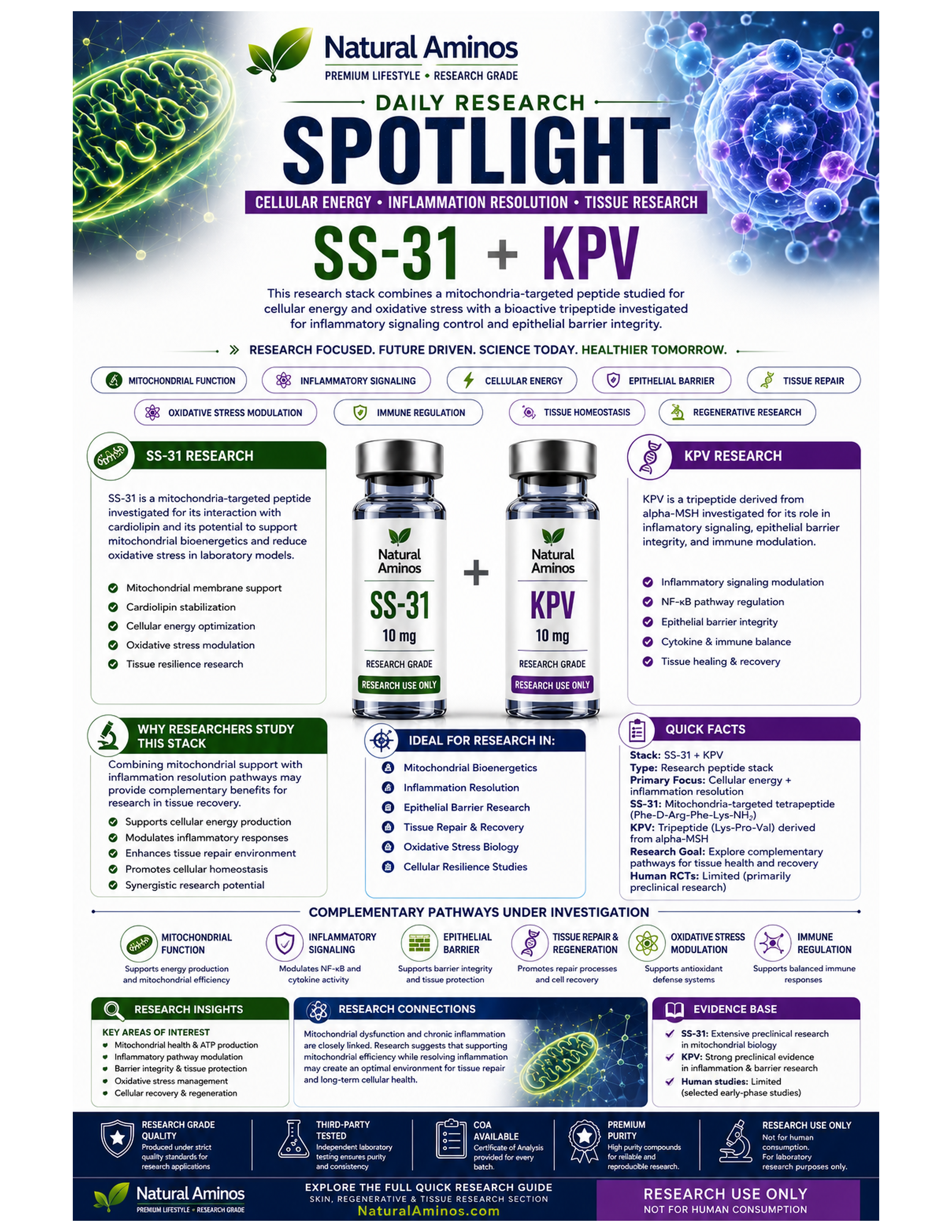
SS-31 + KPV Research Data
For laboratory research use only; not for human or veterinary use or consumption. This page provides research information, not personal-use instructions or medical advice.
Natural Aminos Research Stack or Formula of the Day
SS-31 + KPV
Mitochondrial Bioenergetics, Oxidative Stress & Inflammatory-Signaling Research Spotlight
Compound Identity & Current Evidence Context
SS-31, also known as elamipretide or MTP-131, is a mitochondria-targeting tetrapeptide that partitions into cardiolipin-rich regions of the inner mitochondrial membrane. It is studied for effects on cristae structure, respiratory-chain organization, ATP generation, membrane electrostatics, calcium handling, and reactive-oxygen-species production. In September 2025, FDA granted accelerated approval to elamipretide as Forzinity to improve muscle strength in adults and children with Barth syndrome weighing at least 30 kg.
The approval is narrow. The randomized Barth syndrome study did not meet its original 6-minute-walk or fatigue primary endpoints; FDA relied on increased knee-extensor muscle strength observed during longer open-label follow-up as a surrogate endpoint considered reasonably likely to predict clinical benefit. A confirmatory randomized trial is required.
KPV is the endogenous tripeptide Lys-Pro-Val, corresponding to the C-terminal three amino acids of alpha-melanocyte-stimulating hormone. KPV has been studied for anti-inflammatory activity in intestinal, immune, airway, skin, and other experimental systems. Its best-characterized actions include suppression of NF-kappaB and MAPK signaling, reduction of inflammatory cytokine and chemokine output, and cellular uptake through peptide-transport mechanisms such as PepT1.
The clinical maturity of KPV is dramatically lower than that of elamipretide. FDA's July 2026 review stated that it had not identified any clinical studies or human-exposure data for KPV via any route of administration and therefore could not characterize human safety or effectiveness. FDA proposed that KPV free base and KPV acetate not be included on the 503A Bulks List.
No peer-reviewed human, animal, or cell study was identified that directly administered SS-31/elamipretide and KPV together. The complete stack is therefore a mechanistic hypothesis rather than a demonstrated therapeutic combination.
Benefits
SS-31 / Elamipretide
Elamipretide has the strongest human evidence in the stack and now has a narrowly defined approved use. Mechanistically, it interacts with the inner mitochondrial membrane and cardiolipin, helping preserve membrane structure, respiratory-chain organization, and bioenergetic efficiency. Modern reviews describe it as more than a simple antioxidant: it appears to modify membrane biophysics and cardiolipin-protein interactions that influence oxidative phosphorylation.
In Barth syndrome, a randomized double-blind crossover study enrolled 12 participants. The original randomized portion did not meet its 6-minute-walk or fatigue primary endpoints. During the open-label extension, improvements were observed in knee-extensor strength and several functional measures. FDA granted accelerated approval in 2025 based on the muscle-strength signal because it was considered reasonably likely to predict meaningful functional benefit.
Clinical results outside Barth syndrome are mixed. In the 30-participant MMPOWER-2 primary mitochondrial myopathy crossover trial, the 6-minute-walk difference favored elamipretide numerically but did not reach statistical significance. The larger 218-participant MMPOWER-3 trial subsequently failed both primary endpoints: 6-minute-walk distance and patient-reported fatigue.
These negative mitochondrial-myopathy trials show that improving mitochondrial structure or bioenergetics does not automatically translate into broad clinical benefit across all mitochondrial disorders. Disease mechanism, residual respiratory capacity, tissue remodeling, genotype, and endpoint selection appear to determine whether target engagement becomes measurable patient benefit.
The approved Forzinity program also provides direct human safety information. Injection-site reactions are common, and allergic reactions, including serious reactions, have been reported. The approved Barth syndrome experience cannot establish long-term safety or efficacy for unapproved indications.
KPV
KPV's most consistent experimental effect is anti-inflammatory signaling. In human intestinal epithelial cells and T cells, nanomolar KPV inhibited NF-kappaB and MAPK activation and reduced pro-inflammatory cytokine output. The same 2008 study found that KPV was transported through PepT1 and reduced inflammatory severity in DSS- and TNBS-induced mouse colitis.
Airway research provides an additional human-cell model. In immortalized human bronchial epithelial cells, KPV inhibited NF-kappaB activation, reduced IL-8 and eotaxin secretion, reduced MMP-9 activity, and interfered with nuclear translocation of the NF-kappaB p65 subunit. This supports a direct intracellular anti-inflammatory mechanism that does not require the same mitochondrial target as SS-31.
Skin research expanded in 2025. Using human keratinocytes and a three-dimensional skin model, investigators reported that KPV reduced particulate-matter-induced reactive oxygen species, IL-1beta release, apoptosis-related signaling, and MAPK/NF-kappaB activation. This remains laboratory evidence rather than clinical dermatology evidence.
The major limitation is the absence of established human exposure data. FDA's July 2026 evaluation stated that no clinical studies or human exposure data were identified for KPV through any route and that potential human safety risks remain unknown. FDA also noted the absence of human data addressing immunogenicity or aggregation.
What the Formulas Are Studied For
SS-31 / Elamipretide Research Areas
• FDA-approved improvement of muscle strength in Barth syndrome patients weighing at least 30 kg.
• Cardiolipin stabilization and inner-mitochondrial-membrane structure.
• Oxidative phosphorylation and ATP-production efficiency.
• Primary mitochondrial myopathy and exercise intolerance.
• Cardiac and skeletal-muscle mitochondrial dysfunction.
• Age-related mitochondrial decline in preclinical models.
• Oxidative stress and mitochondrial reactive-oxygen-species regulation.
• Mitochondrial membrane electrostatics, calcium handling, and cristae organization.
KPV Research Areas
• NF-kappaB and MAPK inflammatory signaling.
• Inflammatory bowel disease models and intestinal epithelial inflammation.
• PepT1-mediated peptide uptake in intestinal and immune cells.
• Airway epithelial inflammatory signaling and chemokine release.
• Keratinocyte oxidative stress, apoptosis, and inflammatory signaling.
• Wound-healing and inflammatory-skin hypotheses reviewed by FDA in 2026.
• No established human therapeutic indication or human-exposure dataset.
Published Research - Worldwide Evidence Review
SS-31 / Elamipretide - United States and International Mitochondrial Research
Elamipretide was developed from the Szeto-Schiller mitochondrial-targeting peptide platform and has been studied across U.S. and international mitochondrial-disease programs. Biophysical and proteomic studies show binding within cardiolipin-rich inner-membrane environments and interaction with proteins involved in oxidative phosphorylation and 2-oxoglutarate metabolism.
The MMPOWER-2 randomized crossover study enrolled 30 adults with genetically confirmed primary mitochondrial myopathy. Four weeks of subcutaneous elamipretide produced a numerically greater 6-minute-walk distance than placebo, but the primary comparison did not reach statistical significance.
MMPOWER-3 was substantially larger, randomizing 218 participants. It failed both prespecified primary endpoints at 24 weeks: 6-minute-walk distance and the Primary Mitochondrial Myopathy Symptom Assessment total fatigue score. The trial provided high-level evidence that elamipretide did not improve those outcomes in an unselected primary-mitochondrial-myopathy population.
Barth syndrome produced a different development path. The randomized crossover portion of SPIBA-201 did not show superiority for 6-minute-walk or fatigue endpoints, but longer open-label exposure was associated with gains in knee-extensor muscle strength. FDA granted accelerated approval on September 19, 2025, with a postmarketing randomized confirmatory trial required to verify that the strength improvement translates into patient benefit.
The regulatory evidence therefore supports a disease-specific conclusion: elamipretide has an approved role in Barth syndrome, but broad mitochondrial or anti-aging claims remain unsupported. Recent 2025-2026 reviews emphasize that therapeutic response depends on the underlying mitochondrial defect, tissue architecture, and residual bioenergetic machinery.
KPV - United States, United Kingdom, South Korea and FDA 2026 Review
A foundational 2008 U.S. study from Emory University demonstrated PepT1-mediated KPV uptake and anti-inflammatory effects in human intestinal epithelial cells, human T cells, and two mouse colitis models. KPV suppressed NF-kappaB and MAPK pathways at nanomolar concentrations and reduced inflammatory cytokine expression in vivo.
A 2012 U.K. airway study from the University of Dundee extended the mechanism into bronchial epithelium, showing inhibition of NF-kappaB, MMP-9, IL-8, and eotaxin and interference with nuclear p65 translocation. This supports anti-inflammatory activity in another human-derived cell type.
South Korean investigators reported in 2025 that KPV protected human keratinocytes and a 3D skin model from particulate-matter-induced oxidative injury and inflammatory cell death. The study linked KPV to lower ROS, reduced IL-1beta, and suppression of MAPK/NF-kappaB signaling.
Despite these findings, the July 2026 FDA compounding review found no clinical study or human-exposure data for KPV by any route. FDA concluded that human safety risks are unknown and that available information was insufficient to establish clinical safety or effectiveness for wound healing or inflammatory conditions.
Direct Research on SS-31 + KPV Together
No peer-reviewed human, animal, or in-vitro study was identified that administered SS-31/elamipretide and KPV together as a defined intervention. No registered clinical trial of the pair was identified.
The absence of direct evidence matters because the proposed synergy involves two different stress-response systems rather than two compounds already shown to cooperate. Any claim that the pair produces superior mitochondrial function, lower inflammation, faster recovery, better neuropathy outcomes, or greater exercise capacity is currently theoretical.
Theory of the Stack - How the Combination Could Work
1. Mitochondrial Membrane Stabilization - SS-31 Layer
SS-31 would provide the mitochondrial layer by interacting with cardiolipin-rich inner mitochondrial membranes. In theory, preserving cristae architecture and respiratory-chain organization can improve electron transport, ATP generation, and coupling efficiency while reducing excessive mitochondrial ROS production.
2. Intracellular Anti-Inflammatory Signaling - KPV Layer
KPV would provide the inflammatory-signaling layer. Human-cell studies support inhibition of NF-kappaB nuclear signaling and MAPK pathways, with reductions in cytokines, chemokines, and MMP activity. This mechanism is distinct from cardiolipin stabilization and could theoretically reduce inflammatory stress placed on mitochondria and surrounding tissue.
3. Oxidative Stress Is the Main Point of Convergence
The two pathways converge most clearly at oxidative stress. Dysfunctional mitochondria can generate excessive ROS that activate inflammatory pathways, while chronic inflammation can increase mitochondrial oxidative burden. SS-31 could theoretically reduce mitochondrial ROS generation at the source, while KPV could reduce downstream redox-sensitive inflammatory signaling.
4. The Pair Could Interrupt a Mitochondria-Inflammation Feedback Loop
A common disease model involves a self-reinforcing loop: mitochondrial dysfunction raises ROS and danger signaling; inflammatory NF-kappaB/MAPK activity then increases cytokine production and further disrupts mitochondrial function. Theoretically, SS-31 could act on the mitochondrial side of the loop while KPV acts on the inflammatory side.
5. Complementarity Is Stronger Than Same-Pathway Redundancy
Unlike a stack containing two agonists at the same receptor, SS-31 and KPV target different biological layers. Elamipretide is a mitochondrial membrane-directed therapeutic, whereas KPV's best-supported actions involve peptide uptake and intracellular inflammatory signaling. This makes mechanistic complementarity plausible.
6. Some Downstream Effects Still Overlap
Both compounds can ultimately reduce oxidative or inflammatory stress in experimental systems. SS-31's mitochondrial stabilization can lower ROS-driven inflammatory signals, while KPV directly suppresses redox-sensitive NF-kappaB/MAPK pathways. If oxidative inflammation is the dominant bottleneck, the pair could show diminishing returns rather than additive benefit.
7. Barth Syndrome Approval Does Not Validate a General Mitochondrial Stack
Elamipretide's FDA approval is specific to Barth syndrome and was based on a disease closely linked to cardiolipin remodeling. It does not prove that elamipretide improves generic fatigue, aging, inflammation, neuropathy, or metabolic dysfunction. The failed MMPOWER-3 trial demonstrates that mitochondrial target engagement can fail to translate into broad functional benefit.
8. KPV Is the Clinical Bottleneck
The full stack cannot be more clinically established than its least tested component. KPV has convincing anti-inflammatory cell and animal data but no identified human-exposure dataset. Theoretical complementarity with an approved mitochondrial drug does not convert KPV into a clinically validated therapy.
9. Route and Exposure Could Change the Interaction
Elamipretide's approved Barth syndrome route is daily subcutaneous injection. KPV has been studied experimentally through oral exposure in animal colitis models and in cell systems, while FDA reviewed proposed topical products and found no human exposure data by any route. Different routes could produce very different systemic concentrations and interaction potential.
10. Disease Selection Would Determine Whether the Theory Is Testable
The stack theory is most scientifically testable in disorders where both mitochondrial dysfunction and inflammatory signaling are demonstrably active. Biomarker-guided population selection would be necessary because a primarily cardiolipin-driven disease may derive little added benefit from KPV, while a primarily inflammatory disease may not require a mitochondrial membrane drug.
Possible Overall Benefit - Theoretical, Not Proven
The most defensible theoretical benefit of SS-31 + KPV is coordinated control of mitochondrial dysfunction and inflammatory stress. SS-31 could theoretically improve mitochondrial membrane organization, electron transport, ATP efficiency, and ROS control, while KPV could suppress NF-kappaB/MAPK-driven cytokine and chemokine signaling.
In disorders where mitochondrial dysfunction and inflammation reinforce one another, the pair could theoretically reduce both upstream energetic stress and downstream inflammatory amplification. Potential research endpoints could include fatigue, muscle function, inflammatory biomarkers, mitochondrial respiration, tissue ROS, or organ-specific recovery.
The proof does not establish such combination benefit. Elamipretide has disease-specific human efficacy and one narrow FDA-approved indication, while KPV has no established human exposure or efficacy data. No study shows that KPV improves any clinical response to elamipretide.
Why More Research Is Needed
• No published human, animal, or cell study has tested SS-31/elamipretide + KPV together.
• No clinical trial has established whether KPV adds benefit to elamipretide or changes its safety profile.
• KPV has no identified human clinical study or exposure dataset through any route according to FDA's July 2026 review.
• FDA states that potential KPV safety risks in humans are unknown and that human immunogenicity and aggregation data are absent.
• Elamipretide's 2025 accelerated approval is restricted to Barth syndrome patients weighing at least 30 kg and should not be generalized to other conditions.
• The randomized Barth syndrome trial did not meet its original 6-minute-walk or fatigue primary endpoints; approval relied on a longer-term muscle-strength signal requiring confirmation.
• The 218-participant MMPOWER-3 trial failed both primary endpoints in primary mitochondrial myopathy, showing that mitochondrial mechanism alone does not guarantee clinical efficacy.
• Route differences are substantial: elamipretide has approved subcutaneous exposure, while KPV human pharmacokinetics are unknown.
• Both compounds may reduce oxidative-inflammatory stress, creating possible downstream redundancy despite distinct primary mechanisms.
• Future combination studies should include mitochondrial-respiration measures, ATP production, ROS, inflammatory cytokines, NF-kappaB/MAPK activity, muscle function, fatigue, and pharmacokinetics.
• Randomized studies would need elamipretide-alone and KPV-alone arms to distinguish true synergy from independent or redundant effects.
• Long-term safety requires separate assessment because an approved safety profile for elamipretide cannot be assumed to cover an untested KPV combination.
Research Summary
SS-31 + KPV is one of the more mechanistically coherent mitochondrial-plus-inflammatory research pairings, but the two components sit at very different levels of clinical maturity. SS-31/elamipretide is now an FDA-approved mitochondrial cardiolipin binder for the narrow indication of improving muscle strength in Barth syndrome patients weighing at least 30 kg, although approval was accelerated and confirmatory evidence is still required. Its broader mitochondrial-disease record is mixed, including failure of both primary endpoints in the large MMPOWER-3 primary mitochondrial myopathy trial.
KPV has consistent preclinical and human-cell anti-inflammatory effects involving NF-kappaB, MAPK, cytokine signaling, and oxidative stress, but FDA identified no clinical studies or human exposure data through any route in its 2026 review. The theoretical stack therefore combines a clinically validated mitochondrial target with an experimentally promising but clinically unvalidated inflammatory peptide.
Selected Sources
• U.S. Food and Drug Administration. FDA Grants Accelerated Approval to First Treatment for Barth Syndrome. September 19, 2025. Forzinity (elamipretide) approved to improve muscle strength in patients with Barth syndrome weighing at least 30 kg.
• U.S. Food and Drug Administration. Drug Trials Snapshot: Forzinity. 2025. SPIBA-201 randomized crossover trial and 192-week open-label extension; accelerated approval based on knee-extensor muscle strength.
• Thompson WR, et al. A phase 2/3 randomized clinical trial followed by an open-label extension to evaluate elamipretide in Barth syndrome. Genetics in Medicine. 2021;23(3):471-478. PMID: 33077895. PMCID: PMC7935714. DOI: 10.1038/s41436-020-01006-8.
• Karaa A, et al. A randomized crossover trial of elamipretide in adults with primary mitochondrial myopathy. Journal of Cachexia, Sarcopenia and Muscle. 2020;11(4):909-918. PMID: 32096613. PMCID: PMC7432581. DOI: 10.1002/jcsm.12559.
• Karaa A, et al. Efficacy and Safety of Elamipretide in Individuals With Primary Mitochondrial Myopathy: The MMPOWER-3 Randomized Clinical Trial. Neurology. 2023. PMID: 37268435.
• Elamipretide: A Review of Its Structure, Mechanism of Action, and Therapeutic Potential. 2025. PMID: 39940712.
• Contemporary insights into elamipretide's mitochondrial mechanism of action and therapeutic effects. 2025. PMID: 40294492.
• Mitochondrial protein interaction landscape of SS-31. 2020. PMID: 32554501.
• The mitochondria-targeted peptide SS-31 binds lipid bilayers and modulates surface electrostatics as a key component of its mechanism of action. 2020. PMID: 32273339.
• Dalmasso G, et al. PepT1-mediated tripeptide KPV uptake reduces intestinal inflammation. Gastroenterology. 2008;134(1):166-178. PMID: 18061177. PMCID: PMC2431115. DOI: 10.1053/j.gastro.2007.10.026.
• Land SC. Inhibition of cellular and systemic inflammation cues in human bronchial epithelial cells by melanocortin-related peptides: mechanism of KPV action and a role for MC3R agonists. Int J Physiol Pathophysiol Pharmacol. 2012;4(2):59-73. PMID: 22837805. PMCID: PMC3403564.
• Sung J, et al. Lysine-Proline-Valine peptide mitigates fine dust-induced keratinocyte apoptosis and inflammation by regulating oxidative stress and modulating the MAPK/NF-kappaB pathway. Tissue Cell. 2025;95:102837. PMID: 40073467. DOI: 10.1016/j.tice.2025.102837.
• U.S. Food and Drug Administration. July 23-24, 2026 Pharmacy Compounding Advisory Committee materials: KPV-related bulk drug substances. FDA identified no clinical studies or human-exposure data for KPV via any route and proposed against inclusion on the 503A Bulks List.
Theory vs. Proof - Verdict
What is supported by evidence: SS-31/elamipretide directly targets mitochondrial inner-membrane biology and has human disease-specific efficacy sufficient for accelerated FDA approval in Barth syndrome; KPV suppresses NF-kappaB/MAPK inflammatory signaling and inflammatory mediator production in multiple human-cell and animal models.
What is not proven: that elamipretide improves generalized mitochondrial function, fatigue, neuropathy, recovery, or aging outside validated indications; that KPV is safe or effective in humans; that KPV improves mitochondrial outcomes; or that combining the two compounds is additive, synergistic, or clinically useful.
Verdict - theory vs. proof: the mechanistic complementarity is relatively strong, but the clinical evidence is highly asymmetric. SS-31 provides a mitochondrial cardiolipin/bioenergetic mechanism with narrow approved human proof, while KPV provides a plausible intracellular anti-inflammatory mechanism with no established human exposure dataset. The most coherent hypothesis is interruption of a mitochondrial-ROS/inflammation feedback loop: SS-31 acting at the mitochondrial membrane and KPV suppressing downstream NF-kappaB/MAPK signaling. However, overlap in oxidative-stress outcomes may produce diminishing returns, and the complete theory has never been directly tested. Overall, SS-31 + KPV is best classified as a biologically complementary but clinically unproven mitochondrial-plus-inflammatory stack with strong mechanistic evidence, disease-specific human proof for SS-31, preclinical-only proof for KPV, and no direct combination evidence.
Research & Educational Use Only !!