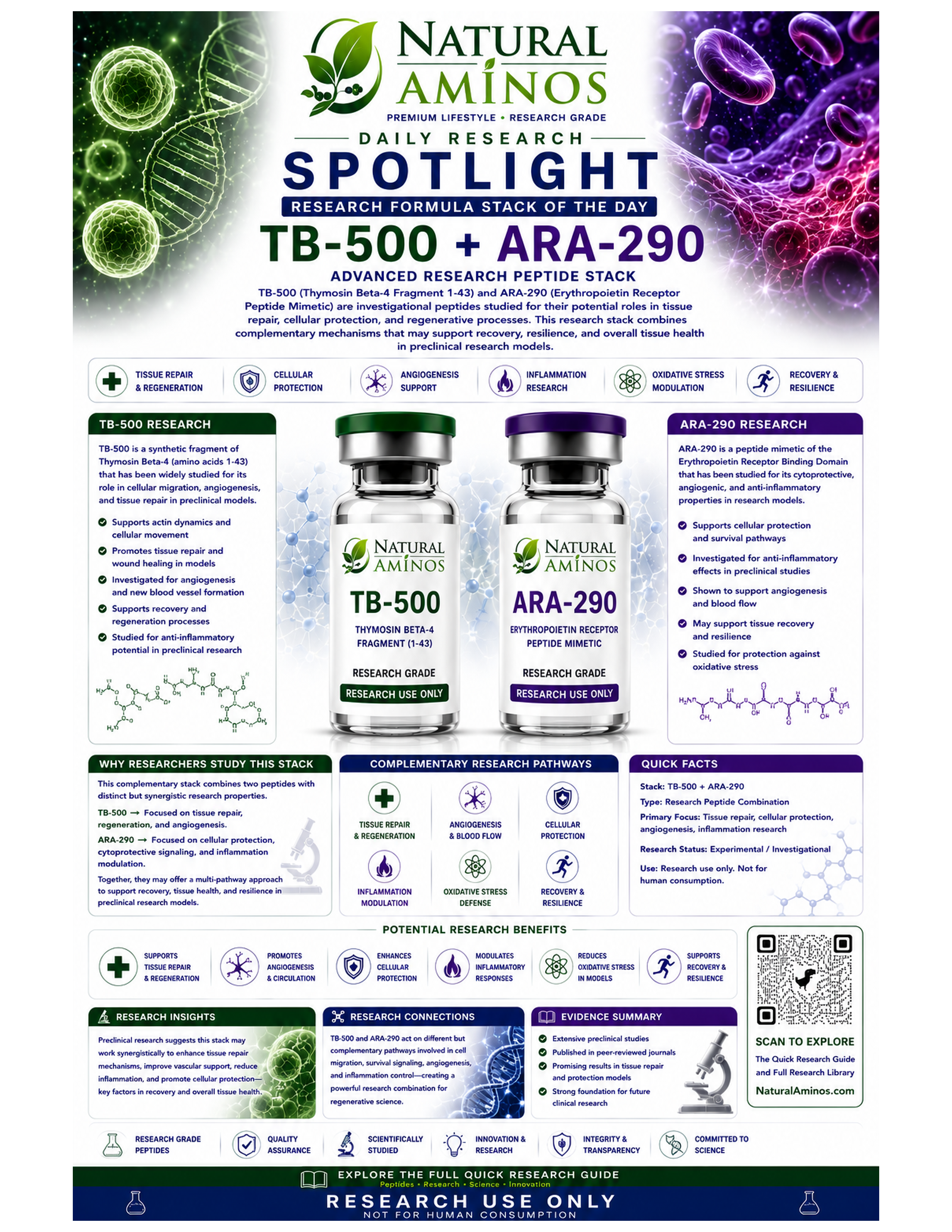
TB-500 + ARA-290 Research Data
For laboratory research use only; not for human or veterinary use or consumption. This page provides research information, not personal-use instructions or medical advice.
Natural Aminos Research Stack or Formula of the Day
TB-500 + ARA-290
Cytoskeletal Repair, Tissue Protection & Small-Fiber Neuropathy Research Spotlight
Compound Identity & Evidence Context
TB-500 and ARA-290 are frequently placed in the same broad “repair” category, but they are very different experimental entities. TB-500 is not full-length thymosin beta-4. FDA’s 2026 review identifies TB-500 as the N-acetylated heptapeptide N-acetyl-LKKTETQ, commonly written Ac-LKKTETQ, derived from residues 17-23 of thymosin beta-4. This fragment contains the LKKTET actin-binding region associated with some functions of the 43-amino-acid parent protein, but evidence obtained with full-length thymosin beta-4 cannot automatically be transferred to TB-500.
ARA-290, now commonly called cibinetide, is an 11-amino-acid peptide engineered from the helix-B region of erythropoietin. It was designed to retain tissue-protective and anti-inflammatory signaling while avoiding erythropoiesis. Its human development has focused most strongly on small-fiber neuropathy, particularly in sarcoidosis and type 2 diabetes. Several small randomized Phase II studies provide direct human exposure and biologic-response data.
The regulatory evidence is highly asymmetric. FDA stated in July 2026 that it had not identified any clinical studies or human-exposure data for TB-500 by any route, and that human safety risks remain unknown. Cibinetide is also investigational and not an approved medicine, but it has been administered to people in multiple trials and holds orphan designations in the European Union for selected rare-disease development programs. Orphan designation is not marketing authorization.
No peer-reviewed human, animal, or cell study was identified that intentionally administered TB-500 and ARA-290 together. The stack therefore rests on a theoretical combination of cytoskeletal/cell-migration biology and anti-inflammatory/tissue-protective neuroregeneration rather than proven synergy.
Benefits
TB-500
TB-500 is best understood as a synthetic thymosin-beta-4 fragment rather than as a clinically validated regenerative peptide. Analytical studies from Hong Kong and Belgium identified the active ingredient in TB-500 preparations as Ac-LKKTETQ and developed mass-spectrometric methods to detect the parent peptide and metabolites in horses. Those studies establish chemical identity and metabolism, not human therapeutic efficacy.
The mechanistic rationale comes largely from the parent protein thymosin beta-4. Full-length thymosin beta-4 binds G-actin, influences cytoskeletal organization, cell migration, angiogenesis, inflammatory signaling, and wound repair, and has been studied in human dermal and corneal wound programs. However, TB-500 contains only a short acetylated fragment. Human trials of full-length thymosin beta-4 should therefore be treated as background biology, not direct evidence that TB-500 produces the same effects.
The most important recent direct TB-500 study was published in 2024. Investigators measured TB-500 metabolism in human serum, enzyme systems, and rats and tested the parent peptide and metabolites in fibroblast wound-healing assays. The parent TB-500 fragment did not significantly promote scratch-wound closure; the metabolite Ac-LKKTE was the fragment showing significant wound-healing activity. This finding raises the possibility that any biological effect of administered TB-500 could depend on metabolism rather than on the intact parent peptide.
FDA’s July 2026 review was even more conservative. FDA reported that the nominator had not supplied and the agency had not identified published in-vivo nonclinical studies assessing TB-500 for wounds, had not identified any published human pharmacokinetic study, and found no information in which TB-500 itself had been administered to patients to treat a disease or condition. FDA also cited possible immunogenicity risks from aggregation and peptide-related impurities for injectable use.
ARA-290 / Cibinetide
ARA-290 has a substantially stronger translational record. The peptide was designed from erythropoietin to activate tissue-protective signaling without stimulating red-cell production. The usual mechanistic model invokes the so-called innate repair receptor, often described as involving erythropoietin receptor and the beta-common receptor CD131. Functional studies support CD131-dependent tissue-protective signaling, but a 2018 biophysical study did not demonstrate a stable extracellular EPOR-beta-common receptor complex, so the precise receptor architecture remains debated.
The strongest human evidence is in sarcoidosis-associated small-fiber neuropathy. A 2012 randomized double-blind pilot enrolled 22 patients and reported improvement in small-fiber-neuropathy symptom scores after four weeks of ARA-290 compared with placebo. A subsequent blinded placebo-controlled study found improvement in neuropathic symptoms together with increased corneal small-nerve-fiber density, altered thermal sensitivity, and improved 6-minute walk performance.
A 2017 Phase IIb trial enrolled 64 participants with sarcoidosis-associated small-nerve-fiber loss and neuropathic pain. The 4 mg group showed increased corneal nerve-fiber area and evidence of regenerating intraepidermal fibers. Pain improved across treatment groups and the dose-response pattern was not cleanly monotonic, so the strongest signal was structural nerve-fiber change rather than simple proof of analgesic efficacy.
ARA-290 was also studied in type 2 diabetes with painful neuropathy. A randomized Phase II study found improvements in PainDetect scores and selected metabolic measures, and a subgroup with reduced baseline corneal nerve-fiber density showed increased density compared with placebo. These findings support a disease-modifying neuropathy hypothesis, but the trials were small and have not led to an approved indication.
Evidence is not uniformly positive. In a 2020 Phase II diabetic-macular-edema study, only nine patients were recruited and eight completed treatment. Mean visual acuity, retinal thickness, central retinal sensitivity, and tear-production outcomes did not improve overall, although selected exploratory outcomes and patient-reported visual-function scores suggested possible signals. This trial illustrates that tissue-protection mechanisms do not automatically translate across diseases.
What the Formulas Are Studied For
TB-500 Research Areas
• Chemical identity and metabolism of Ac-LKKTETQ, the thymosin-beta-4 17-23 fragment.
• Actin-binding and cytoskeletal biology inferred from the LKKTET region of thymosin beta-4.
• Cell migration and wound-healing hypotheses.
• Angiogenesis and tissue-repair claims largely extrapolated from full-length thymosin beta-4.
• Metabolite-specific wound-healing activity in fibroblast assays.
• Doping-control detection and pharmacokinetic studies in horses and rats.
• No established human therapeutic indication or identified human-exposure dataset according to FDA.
ARA-290 / Cibinetide Research Areas
• Sarcoidosis-associated small-fiber neuropathy and neuropathic pain.
• Corneal small-nerve-fiber regeneration as a surrogate of peripheral nerve repair.
• Painful diabetic neuropathy and metabolic-control signals.
• Anti-inflammatory and tissue-protective signaling after cellular injury.
• Diabetic macular edema and retinal/ocular tissue protection.
• Pancreatic-islet and transplant-related tissue protection in orphan-drug development.
• Experimental colitis and innate-immune modulation in animals.
Published Research - Worldwide Evidence Review
TB-500 - Hong Kong, Belgium, South Korea, and FDA 2026 Review
TB-500 entered the peer-reviewed literature largely through anti-doping and analytical chemistry. Hong Kong investigators identified Ac-LKKTETQ and metabolites in equine plasma and urine after administration of a TB-500 preparation. Belgian investigators independently synthesized and characterized the same N-terminally acetylated 17-23 fragment of thymosin beta-4.
These analytical studies are important because they establish what TB-500 actually is. They also show why the common practice of referring to TB-500 simply as “thymosin beta-4” is scientifically inaccurate. Full-length thymosin beta-4 and Ac-LKKTETQ are distinct molecules with different size, pharmacology, and evidence bases.
The 2024 metabolism and fibroblast study added direct biological testing. TB-500 was rapidly metabolized, with Ac-LK and Ac-LKK among detected metabolites; only Ac-LKKTE showed significant scratch-wound-healing activity compared with control. The intact parent did not. This direct result conflicts with broad claims that the intact TB-500 fragment itself has already been proven to accelerate tissue repair.
FDA’s July 2026 Pharmacy Compounding Advisory Committee review found no published human PK studies, no clinical use data, no identified human exposure via any route, and no adequate evidence to evaluate TB-500 effectiveness for wound healing. FDA also stated that the potential safety risks in humans are unknown and highlighted possible immunogenicity and impurity concerns.
Full-length thymosin beta-4 has a separate human wound and corneal research history, including dermal-wound Phase II programs and compassionate-use corneal reports. Those studies support the biological importance of the parent protein but cannot be used as if they were TB-500 trials.
ARA-290 / Cibinetide - Netherlands, United States, United Kingdom, Qatar and International Trials
The strongest cibinetide program was developed through Leiden University Medical Center, Cleveland Clinic, Araim Pharmaceuticals, and collaborating international centers. The initial 22-patient sarcoidosis small-fiber-neuropathy pilot provided randomized double-blind evidence of symptom improvement after four weeks.
A subsequent blinded placebo-controlled sarcoidosis study showed improvements in neuropathic symptoms and objective corneal small-nerve-fiber density, providing a rare example in neuropathy research where patient-reported outcomes were accompanied by structural nerve-fiber measures.
The 64-participant Phase IIb trial broadened the evidence by quantifying corneal nerve-fiber area and regenerating intraepidermal fibers. The highest studied dose produced significant nerve-fiber changes, but pain outcomes were less cleanly dose dependent. This favors interpretation as a potential disease-modifying nerve-repair signal rather than a simple analgesic.
In type 2 diabetes with painful neuropathy, a Phase II trial reported improved PainDetect scores and increased corneal nerve-fiber density in a prespecified low-density subgroup. No major safety issue was identified during the short study. The results are encouraging but remain too small to define long-term effectiveness or safety.
The Belfast diabetic-macular-edema trial was less convincing: eight completers showed no average improvement in key retinal or visual endpoints. This disease-specific failure is important because it demonstrates that cibinetide’s tissue-protection concept is not universally effective across organ systems.
European regulatory development includes orphan designation for prevention of graft loss in pancreatic islet transplantation. The EMA explicitly notes that orphan designation supports development and is not a marketing authorization. Cibinetide remains investigational.
Direct Research on TB-500 + ARA-290 Together
No peer-reviewed human, animal, or in-vitro study was identified that administered TB-500 and ARA-290 together. No registered clinical trial of the exact pair was identified.
Commercial and research-market sources frequently describe the pair as complementary, but those claims are based on separate mechanistic literatures rather than controlled combination experiments. No evidence establishes an optimal ratio, timing, route, interaction profile, or combined safety margin.
Theory of the Stack - How the Combination Could Work
1. Cytoskeletal and Cell-Migration Layer - TB-500
The theoretical TB-500 contribution is cytoskeletal organization and cell migration through the LKKTET region derived from thymosin beta-4. If the fragment or one of its metabolites retains meaningful actin-related activity in vivo, it could theoretically influence fibroblast, endothelial, epithelial, or other reparative-cell movement after injury.
2. Anti-Inflammatory Tissue-Protection Layer - ARA-290
ARA-290 would provide a more receptor-signaling-oriented repair layer. Experimental data support anti-inflammatory, anti-apoptotic, and tissue-protective effects, while human neuropathy studies suggest regeneration of small nerve fibers. This mechanism is distinct from a direct cytoskeletal actin-binding fragment.
3. Peripheral-Nerve Injury Is the Most Coherent Combined Research Context
A damaged peripheral nerve can involve axonal injury, inflammatory signaling, microvascular dysfunction, connective-tissue remodeling, and altered cellular migration. ARA-290 has direct human evidence related to small-fiber regeneration. TB-500 could theoretically contribute to local tissue remodeling if its fragment or metabolites are biologically active. This makes nerve injury a more coherent theoretical context than generic “whole-body healing.”
4. ARA-290 Has the Stronger Evidence for Nerve Regeneration
The stack should not imply equal evidence. ARA-290 has randomized human trials with corneal nerve-fiber endpoints; TB-500 has no human exposure dataset identified by FDA. For a neuropathy hypothesis, ARA-290 is the evidence-bearing component and TB-500 is the speculative adjunct.
5. Full-Length Thymosin Beta-4 Evidence Cannot Fill the TB-500 Gap
It is tempting to use the extensive wound-healing literature on full-length thymosin beta-4 to justify TB-500. That is not scientifically sound. The intact 43-amino-acid protein, Ac-LKKTETQ fragment, and TB-500 metabolites are distinct chemical entities. The 2024 fibroblast study makes this distinction especially important because a metabolite, rather than the intact TB-500 parent, produced the significant scratch-wound signal.
6. Anti-Inflammatory Effects Could Overlap
Both thymosin-beta-4-related biology and ARA-290 literature include anti-inflammatory effects. If TB-500 or its metabolites reproduce part of that parent-protein biology, some downstream overlap could occur. Overlap is not necessarily harmful, but it means the pair may not be purely complementary.
7. Angiogenesis and Microvascular Repair Are Theoretical, Not Combination-Proven
Full-length thymosin beta-4 is associated with angiogenesis and wound vascularization, while ARA-290 is studied for tissue protection and microvascular/nerve repair. This suggests a theoretical vascular-repair intersection. No study shows that TB-500 plus ARA-290 produces superior angiogenesis, perfusion, or nerve recovery compared with either component alone.
8. Receptor Architecture for ARA-290 Is Still Debated
ARA-290 is commonly described as an innate-repair-receptor agonist involving EPOR and CD131. Functional data support CD131/JAK2-dependent tissue-protective signaling, but a 2018 biophysical study did not demonstrate a stable extracellular EPOR-CD131 receptor complex. The pathway is biologically active, but the structural receptor model is not completely settled.
9. Safety Uncertainty Is Dominated by TB-500
ARA-290 has short-term human exposure and trial safety observations. TB-500 does not. FDA specifically states that potential human safety risks are unknown and that there are no human exposure data via any route. Therefore, the combination’s safety uncertainty cannot be inferred from ARA-290 trials.
10. Route, Metabolism, and Product Identity Could Determine the Entire Interaction
ARA-290 clinical studies used defined pharmaceutical material and known subcutaneous or intravenous regimens. TB-500 research-market preparations may vary in salt form, purity, aggregation, and exact identity, and the fragment is metabolized into shorter products that may have different activity. Any meaningful combination study would have to chemically define the TB-500 material and measure its metabolites rather than treating the name alone as a pharmacologic identity.
Possible Overall Benefit - Theoretical, Not Proven
The most defensible theoretical benefit of TB-500 + ARA-290 is broader tissue-repair coverage: ARA-290 could provide anti-inflammatory, cytoprotective, and small-nerve-regenerative signaling, while TB-500 or an active metabolite could theoretically influence actin-linked cell migration and local wound remodeling.
For complex peripheral injury involving nerve damage plus connective-tissue disruption, the mechanisms could plausibly address different components of repair. ARA-290’s human nerve-fiber data give this theory more credibility than a generic “recovery” claim.
The proof remains weak for the complete stack. TB-500 itself has no identified human therapeutic exposure data, and direct wound-healing activity of the intact parent fragment was not demonstrated in the 2024 fibroblast study. No study shows that adding TB-500 improves the nerve-regeneration signals observed with ARA-290.
Why More Research Is Needed
• No published human, animal, or cell study has tested TB-500 + ARA-290 together.
• FDA states that it has not identified any clinical studies or human-exposure data for TB-500 via any route.
• FDA found no human TB-500 pharmacokinetic study and no evidence of TB-500 being administered to patients to treat a disease or condition.
• Full-length thymosin beta-4 studies cannot be treated as TB-500 trials because TB-500 is the distinct Ac-LKKTETQ fragment.
• A 2024 direct TB-500 study found significant fibroblast wound-healing activity for a metabolite, Ac-LKKTE, but not the parent TB-500 fragment.
• TB-500 injectable use raises unresolved aggregation, peptide-impurity, and immunogenicity questions.
• ARA-290 human trials are small, generally short, and concentrated in selected neuropathy populations.
• ARA-290 pain outcomes are not uniformly dose responsive, even when objective nerve-fiber signals are favorable.
• The proposed EPOR-CD131 innate-repair-receptor structural model remains debated, despite functional evidence for tissue-protective signaling.
• ARA-290 failed to produce clear average efficacy on key endpoints in the small diabetic-macular-edema trial, showing that effects are disease specific.
• Future combination studies should define TB-500 chemical identity, metabolites, PK, and immunogenicity before interpreting efficacy.
• Neuropathy studies should include corneal confocal microscopy, intraepidermal nerve-fiber density, quantitative sensory testing, validated pain scales, autonomic function, mobility, and quality-of-life endpoints.
• A valid design should compare ARA-290 alone, TB-500 alone, the combination, and placebo to distinguish true synergy from an ARA-290-only effect.
Research Summary
TB-500 + ARA-290 is a biologically plausible but highly evidence-asymmetric repair stack. ARA-290/cibinetide has small randomized human trials showing neuropathic-symptom improvement and objective corneal-nerve-fiber signals in sarcoidosis and selected diabetic-neuropathy research. TB-500 is a much less established entity: FDA identifies it as the N-acetylated thymosin-beta-4 fragment Ac-LKKTETQ and reported in 2026 that no human exposure or clinical treatment data had been identified.
The combination theory is strongest for complex injury where nerve protection and local tissue remodeling could both matter. ARA-290 supplies the clinically tested tissue-protective and nerve-regeneration layer; TB-500 theoretically supplies actin/cell-migration biology. The theory is weakened by the lack of direct TB-500 efficacy, the distinction between TB-500 and full-length thymosin beta-4, and the absence of any direct combination study.
Selected Sources
• U.S. Food and Drug Administration. July 23-24, 2026 Pharmacy Compounding Advisory Committee materials: TB-500-related bulk drug substances. FDA identifies TB-500 as N-acetyl-LKKTETQ and reports no identified human exposure or clinical-treatment data.
• U.S. Food and Drug Administration. Certain Bulk Drug Substances for Use in Compounding that May Present Significant Safety Risks. Current 2026 TB-500 entry: potential immunogenicity from aggregation/peptide-related impurities and no identified human exposure data.
• Ho ENM, et al. Doping control analysis of TB-500, a synthetic version of an active region of thymosin beta-4, in equine urine and plasma by liquid chromatography-mass spectrometry. J Chromatogr A. 2012;1265:57-69. PMID: 23084823. DOI: 10.1016/j.chroma.2012.09.043.
• Esposito S, et al. Synthesis and characterization of the N-terminal acetylated 17-23 fragment of thymosin beta 4 identified in TB-500. Drug Test Anal. 2012;4(9):733-738. PMID: 22962027. DOI: 10.1002/dta.1402.
• Rahaman KA, et al. Simultaneous quantification of TB-500 and its metabolites and screening by wound-healing activities in vitro. J Chromatogr B. 2024. PMID: 38382158.
• Sosne G, et al. Treatment of chronic nonhealing neurotrophic corneal epithelial defects with thymosin beta4. Ann N Y Acad Sci. 2010. PMID: 20536469. Full-length thymosin beta-4 evidence; not a TB-500 trial.
• Goldstein AL, et al. Thymosin beta4 promotes dermal healing. Vitamins and Hormones. 2016. PMID: 27450738. Full-length thymosin beta-4 review; not direct TB-500 evidence.
• Heij L, et al. Safety and efficacy of ARA 290 in sarcoidosis patients with symptoms of small fiber neuropathy: a randomized, double-blind pilot study. Mol Med. 2012;18:1430-1436. PMID: 23168581. PMCID: PMC3563705. DOI: 10.2119/molmed.2012.00332.
• Dahan A, et al. ARA 290 improves symptoms in patients with sarcoidosis-associated small nerve fiber loss and increases corneal nerve fiber density. Mol Med. 2013;19:334-345. PMID: 24136731. PMCID: PMC3883966. DOI: 10.2119/molmed.2013.00122.
• Culver DA, et al. Cibinetide improves corneal nerve fiber abundance in patients with sarcoidosis-associated small nerve fiber loss and neuropathic pain. Invest Ophthalmol Vis Sci. 2017;58(6):BIO52-BIO60. PMID: 28475703. DOI: 10.1167/iovs.16-21291.
• Brines M, et al. ARA 290, a nonerythropoietic peptide engineered from erythropoietin, improves metabolic control and neuropathic symptoms in patients with type 2 diabetes. Mol Med. 2015;20:658-666. PMID: 25387363. PMCID: PMC4365069. DOI: 10.2119/molmed.2014.00215.
• Lois N, et al. A Phase 2 Clinical Trial on the Use of Cibinetide for the Treatment of Diabetic Macular Edema. J Clin Med. 2020;9(7):2225. PMID: 32674280. PMCID: PMC7408632. DOI: 10.3390/jcm9072225.
• Cheung Tung Shing KS, et al. EPO does not promote interaction between the erythropoietin and beta-common receptors. Sci Rep. 2018. PMID: 30127368.
• European Medicines Agency. Orphan designation EU/3/16/1721 for cibinetide in prevention of graft loss in pancreatic islet transplantation. Orphan designation is not marketing authorization.
Theory vs. Proof - Verdict
What is supported by evidence: ARA-290/cibinetide has direct randomized human exposure and selected evidence of improved neuropathic symptoms, corneal small-nerve-fiber density, and nerve-regeneration markers; TB-500 is chemically identified as Ac-LKKTETQ, is metabolized into shorter fragments, and has limited direct preclinical testing.
What is not proven: that TB-500 accelerates wound healing or tissue repair in humans; that full-length thymosin beta-4 clinical results apply to TB-500; that TB-500 adds nerve-regenerative benefit to ARA-290; or that the pair is safe, additive, or synergistic.
Verdict - theory vs. proof: the mechanistic complementarity is plausible but the evidence is sharply unbalanced. ARA-290 provides the stronger tissue-protection and nerve-regeneration signal with actual human trials, while TB-500 provides a speculative cytoskeletal/cell-migration layer derived from thymosin-beta-4 fragment biology. The 2024 finding that an active metabolite rather than intact TB-500 drove fibroblast wound closure further weakens simple claims about the parent peptide. Overall, TB-500 + ARA-290 is best classified as a plausible tissue-repair plus neuroprotection hypothesis with meaningful human evidence for ARA-290, no identified human therapeutic evidence for TB-500, major identity/extrapolation limitations, and no direct combination proof.
Research & Educational Use Only !!