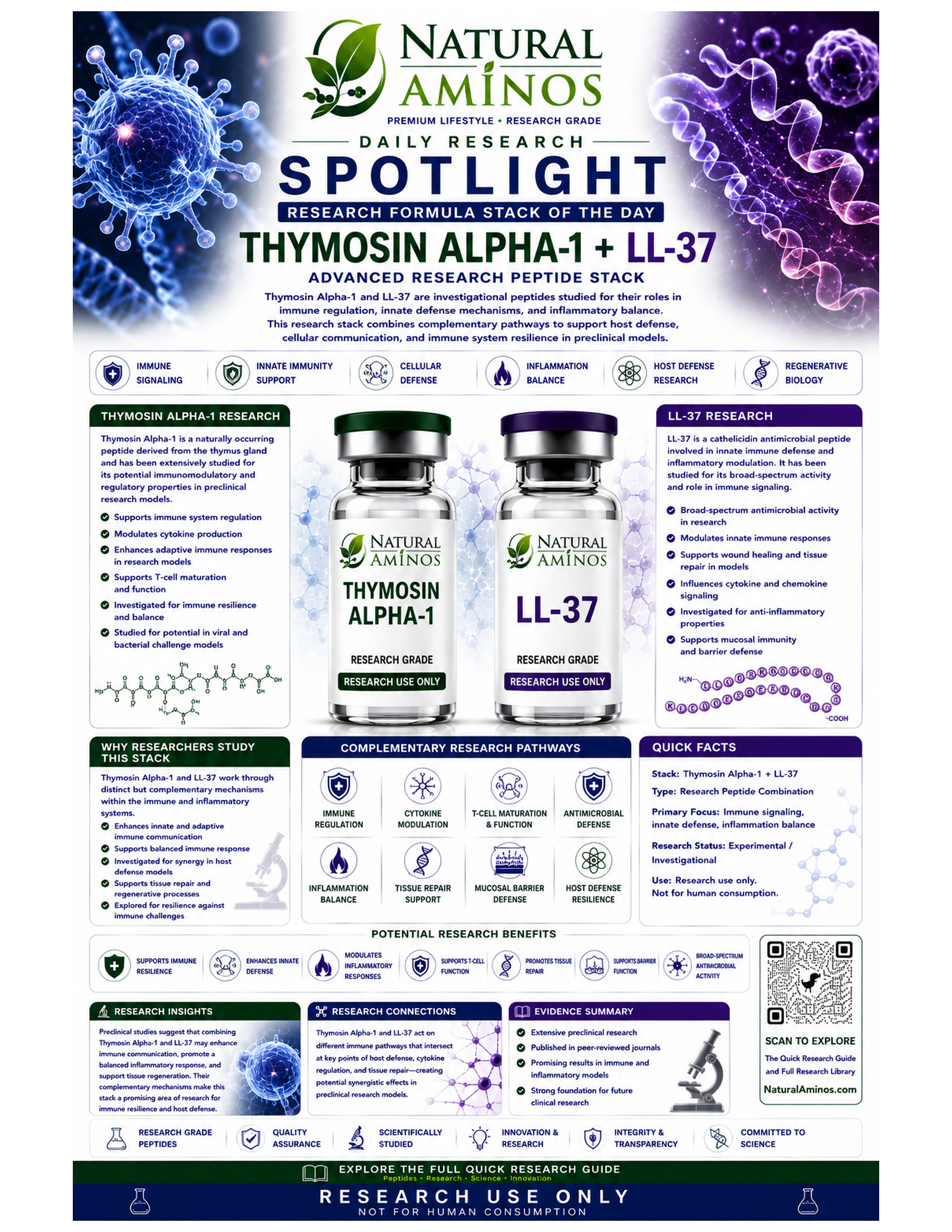
Thymosin Alpha-1 + LL-37 Research Data
For laboratory research use only; not for human or veterinary use or consumption. This page provides research information, not personal-use instructions or medical advice.
Natural Aminos Research Stack or Formula of the Day
Thymosin Alpha-1 + LL-37
Adaptive Immune Modulation, Innate Host Defense & Wound-Healing Research Spotlight
Compound Identity & Current Evidence Context
Thymosin Alpha-1 (Tα1), also called thymalfasin, is a 28-amino-acid peptide derived from prothymosin alpha and originally isolated from thymic tissue. It acts as an immunomodulator rather than as a direct antimicrobial drug. Its literature includes dendritic-cell activation, Toll-like receptor signaling, T-cell maturation and function, natural-killer-cell activity, cytokine regulation, and restoration of immune competence during selected states of immune suppression. Synthetic thymalfasin has been marketed outside the United States under brands including Zadaxin and has a substantial international human clinical history.
LL-37 is the 37-amino-acid human cathelicidin released from the hCAP18 precursor. It is a multifunctional host-defense peptide with direct membrane-active antimicrobial effects in laboratory systems and broad immunologic signaling effects involving chemotaxis, endotoxin binding, epithelial repair, angiogenesis, inflammatory amplification, inflammatory suppression, and wound closure. Its biology is unusually context dependent: the same molecule can suppress microbial endotoxin signaling in one setting yet promote chemokine production, inflammatory-cell recruitment, or tumor-cell behavior in another.
The evidence maturity of the two compounds is very different. Thymosin Alpha-1 has been studied in many human clinical programs, including hepatitis, cancer adjunctive care, sepsis, immune suppression, and other infectious or immune conditions. LL-37 has a much smaller therapeutic human literature. Its best published controlled human evidence is topical treatment of chronic venous leg ulcers; a small first-in-human trial was encouraging, but a larger Phase IIb study failed to show significant benefit in the full randomized population.
No peer-reviewed human, animal, or cell study was identified that administered intact Thymosin Alpha-1 and intact LL-37 together as separate agents and compared the combination with either compound alone. Researchers have designed hybrid molecules that fuse an LL-37 fragment with an active Thymosin Alpha-1 segment, and those chimeric peptides have shown anti-inflammatory or immunomodulatory effects in cell and mouse models. Those chimeras are new molecules and do not establish synergy between the two intact parent peptides.
Benefits
Thymosin Alpha-1
Thymosin Alpha-1 has one of the larger human evidence bases among research-associated immune peptides. Its best-supported role is immune modulation rather than generalized immune stimulation. Mechanistic studies and reviews describe effects on dendritic cells, T lymphocytes, natural-killer cells, macrophages, antigen presentation, cytokine balance, and Toll-like receptor pathways. This broad immune-network activity helps explain why it has been studied in infections, cancer-associated immune suppression, vaccine response, and critical illness.
Sepsis provides the most important modern test of the clinical hypothesis. Earlier smaller trials and meta-analyses suggested that Tα1 might reduce mortality or improve immune markers. The definitive 2025 TESTS Phase III trial enrolled 1,106 adults at 22 centers in China. In the corrected analysis, 28-day mortality was 23.4% with Tα1 and 24.1% with placebo, hazard ratio 0.97, with no statistically significant difference. No secondary or safety outcome differed significantly. The trial therefore validated short-term tolerability in that setting but did not confirm an overall mortality benefit.
The sepsis literature remains heterogeneous rather than uniformly negative. A 2025 systematic review and meta-analysis of 11 randomized trials found a pooled reduction in 28-day mortality, but the mortality signal disappeared in higher-quality and multicenter subgroups, and trial-sequential analysis indicated that the information size remained inadequate. This is an important example of why pooled small studies and one large rigorous trial can lead to different conclusions.
Tα1 also has clinically relevant liver-disease evidence. In a 2022 randomized controlled study of 120 patients with HBV-related acute-on-chronic liver failure, Tα1 was associated with higher 90-day liver-transplant-free survival and fewer new infections, although competing-risk analysis did not confirm every survival comparison. Older chronic hepatitis B studies reported virologic or biochemical responses in some patients, while a double-blind chronic hepatitis C pilot did not show virologic clearance or meaningful biochemical benefit. The evidence is therefore indication specific, not a general antiviral effect.
Regulatory context matters. Tα1 is not FDA-approved in the United States. FDA reviewed Tα1-related bulk substances at the December 2024 Pharmacy Compounding Advisory Committee meeting. The committee voted 4 yes and 17 no on inclusion of Tα1 acetate on the 503A Bulks List, citing lack of convincing effectiveness data for the reviewed uses. FDA also lists compounded Tα1 among peptide substances with potential immunogenicity, impurity, aggregation, and characterization concerns for certain routes.
LL-37
LL-37 is a natural host-defense peptide with several experimentally demonstrated functions. Its cationic amphipathic structure allows interaction with microbial membranes and negatively charged microbial components such as lipopolysaccharide. It can neutralize endotoxin signaling, recruit immune cells, alter epithelial responses, stimulate angiogenesis, influence re-epithelialization, and modify inflammatory signaling. The same multifunctionality also creates unpredictability because its effect varies with concentration, tissue, microbial environment, inflammatory state, and receptor context.
The strongest published human therapeutic evidence is topical wound treatment. In a 34-participant first-in-human randomized venous-leg-ulcer trial, the lower LL-37 concentrations produced faster healing-rate constants than placebo, with the 0.5 mg/mL group showing the clearest signal. The highest concentration did not outperform placebo, demonstrating an early non-linear dose-response pattern rather than a simple “more is better” relationship.
The larger 148-patient Phase IIb HEAL LL-37 trial produced a less favorable result. Across the full randomized population, neither tested LL-37 concentration significantly improved complete wound closure or overall healing compared with placebo. Post-hoc analysis suggested possible benefit in participants with larger baseline ulcers, but that finding was exploratory and requires prospective confirmation. The study drug was generally well tolerated when applied topically.
LL-37 also has oncology-related human exposure. A small completed intratumoral melanoma study tested LL-37 in cutaneous metastatic lesions, but detailed peer-reviewed efficacy results remain limited. Cancer biology is especially complicated because LL-37 can act as an immune-stimulatory host-defense peptide in some contexts while laboratory and tumor-expression studies suggest that it can promote proliferation, migration, invasion, or angiogenic signaling in selected tumor types, including melanoma models.
FDA currently highlights this duality. Its compounding-safety page states that LL-37 may pose immunogenicity and peptide-impurity risks, that human safety information is insufficient, and that nonclinical research suggests detrimental effects on male reproduction and protumorigenic effects in some tissues. These concerns make systemic or injectable extrapolation from topical wound trials scientifically inappropriate.
What the Formulas Are Studied For
Thymosin Alpha-1 Research Areas
• Dendritic-cell, T-cell, natural-killer-cell, and macrophage immune modulation.
• Sepsis and sepsis-associated immune dysfunction.
• Chronic hepatitis B and hepatitis C research.
• HBV-related acute-on-chronic liver failure and infection prevention.
• Cancer adjunctive immunotherapy, including melanoma, hepatocellular carcinoma, and non-small-cell lung cancer research.
• Immune recovery after chemotherapy, transplantation, or other immunosuppressive states.
• Vaccine-response enhancement and immune-aging hypotheses.
• Not FDA-approved in the United States.
LL-37 Research Areas
• Innate host defense and direct antimicrobial membrane activity.
• Endotoxin binding and modulation of TLR-related inflammatory responses.
• Chemotaxis and recruitment of immune cells.
• Epithelial repair, angiogenesis, and re-epithelialization.
• Topical chronic-wound treatment, especially venous leg ulcers.
• Intratumoral immune stimulation in exploratory melanoma research.
• Inflammatory skin disease and context-dependent auto-inflammatory signaling.
• Cancer biology in which both antitumor and protumorigenic effects have been reported.
• No FDA-approved therapeutic indication.
Published Research - Worldwide Evidence Review
Thymosin Alpha-1 - China, Europe, United States and International Programs
Thymosin Alpha-1 has been developed across multiple countries and indications over several decades. Reviews describe international use of synthetic thymalfasin in more than 35 countries, particularly in chronic viral hepatitis and immune-support settings. The worldwide clinical record is therefore much broader than the U.S. regulatory status alone suggests.
The largest modern trial is the 2025 TESTS study in China. It randomized 1,106 adults with sepsis at 22 centers. The corrected analysis found 28-day mortality of 23.4% with Tα1 and 24.1% with placebo, with no significant benefit and no significant difference in secondary or safety outcomes. Subgroup signals in older adults and participants with diabetes were hypothesis generating and did not establish an approved personalized indication.
The 2025 sepsis meta-analysis incorporated 11 randomized trials and 1,927 participants. Pooled analysis favored Tα1, but higher-quality and multicenter subgroups did not show a significant mortality reduction, publication bias was present, and trial-sequential analysis indicated that the accumulated evidence had not reached the required information size. The correct interpretation is possible subgroup benefit, not established sepsis efficacy.
In viral-liver disease, results vary by condition and trial design. Chronic hepatitis B studies reported selected virologic responses; the 2022 HBV acute-on-chronic liver-failure randomized trial reported fewer infections and improved transplant-free survival signals. In contrast, a 1996 double-blind chronic hepatitis C pilot showed no HCV-RNA clearance and no meaningful sustained biochemical response. This heterogeneity argues against describing Tα1 as a broad-spectrum antiviral treatment.
The United States regulatory review is more conservative than international marketing history. FDA evaluated Tα1 free base and acetate at the December 2024 Pharmacy Compounding Advisory Committee meeting for numerous proposed conditions and concluded that the evidence did not convincingly establish effectiveness and safety for the reviewed compounding uses. The committee overwhelmingly voted against placement on the 503A Bulks List.
LL-37 - Sweden, Poland, United States and International Host-Defense Research
LL-37 therapeutic development has been much smaller and more route specific. The first-in-human venous-leg-ulcer trial was conducted in Sweden and included 34 participants. Topical lower-concentration LL-37 improved early wound-healing measures, while the highest concentration did not. This non-linear pattern is consistent with LL-37 biology, in which concentration strongly influences antimicrobial, inflammatory, and cytotoxic behavior.
The subsequent Phase IIb HEAL LL-37 study enrolled 148 treated participants across 15 sites in Poland and Sweden. Neither 0.5 nor 1.6 mg/mL LL-37 significantly improved the primary healing outcomes in the full randomized cohort. A post-hoc subgroup with larger ulcers showed possible benefit, but the result must be considered exploratory because the overall trial was negative.
The oncology literature shows the opposite side of LL-37 biology. Intratumoral LL-37 was explored in a very small melanoma trial as an immune-stimulatory treatment. At the same time, human melanoma-cell and tumor-tissue studies have reported increased LL-37 expression and laboratory evidence that LL-37 can promote melanoma proliferation, migration, invasion, or pro-angiogenic signaling. These apparently contradictory findings reflect cell context, concentration, route, and immune-tumor interactions rather than a single universal cancer effect.
A 2025 host-defense review summarized LL-37 as both anti-inflammatory and pro-inflammatory depending on context. The peptide can neutralize LPS and suppress LPS-induced TNF-alpha, but it can also induce chemokines, promote mast-cell migration, amplify selected cytokine responses, and increase immune-cell recruitment. The stack theory must therefore avoid describing LL-37 as simply “anti-inflammatory.”
Direct Research on Thymosin Alpha-1 + LL-37 Together
No study was identified in which intact Thymosin Alpha-1 and intact LL-37 were administered together as separate interventions in humans, animals, or standard cell-combination experiments. No randomized clinical trial of the pair was identified.
There is, however, an important adjacent research program involving chimeric peptides. Chinese investigators designed hybrid molecules by fusing an active LL-37 fragment with an active Thymosin Alpha-1 segment. The LL-37-Tα1 hybrid showed anti-inflammatory activity in cell experiments and mouse intestinal-inflammation or immunosuppression models, including modulation of TLR4/MD-2 and NF-kappaB signaling.
Those chimeric findings demonstrate that selected sequence elements from the two peptide families can be engineered into one bioactive molecule. They do not show that dosing full-length LL-37 and full-length Tα1 together produces the same pharmacology, because a covalently fused hybrid has different structure, stability, receptor exposure, tissue distribution, and concentration relationships.
Theory of the Stack - How the Combination Could Work
1. Adaptive-Immune Coordination - Thymosin Alpha-1 Layer
Tα1 would provide the immune-coordination layer. It can influence dendritic-cell maturation, antigen presentation, T-cell function, natural-killer activity, and Toll-like receptor signaling. In an infection or immune-suppression model, the theoretical goal would be restoration of effective cellular immunity rather than direct killing of microbes.
2. Front-Line Innate Host Defense - LL-37 Layer
LL-37 would provide the local innate-defense layer. Its amphipathic cationic structure can disrupt microbial membranes in vitro, neutralize microbial products such as LPS, recruit immune cells, and influence epithelial repair. This is biologically distinct from Tα1-mediated adaptive-immune organization.
3. Innate-to-Adaptive Complementarity Is Plausible
The strongest theoretical rationale is division of labor across the immune response. LL-37 could act early at barrier surfaces and sites of microbial exposure, while Tα1 could support antigen-presenting cells and downstream T-cell and natural-killer-cell responses. This makes the pair more mechanistically complementary than two peptides targeting the same receptor.
4. Complementarity Does Not Mean More Immune Activation Is Better
Both peptides can amplify parts of immune signaling. In a patient whose pathology is driven by excessive inflammation rather than immune paralysis, additional stimulation could theoretically worsen tissue injury. Tα1 itself can have regulatory as well as stimulatory effects, and LL-37 can be either anti-inflammatory or pro-inflammatory depending on context. Disease phase would be critical.
5. LL-37 Has Direct Microbial Effects That Tα1 Does Not
Tα1 is not a conventional antimicrobial peptide that directly disrupts bacterial membranes. LL-37 can do so under suitable experimental conditions. A theoretical pair could therefore combine microbial-surface activity with immune-system coordination. However, serum proteins, salts, local pH, proteases, and tissue binding can markedly alter LL-37 activity, so in-vitro antimicrobial potency should not be assumed to translate into systemic efficacy.
6. Both Peptides Converge on Toll-Like and NF-kappaB Biology
Although their dominant roles differ, the two compounds are not fully independent. Tα1 can signal through Toll-like receptor pathways in dendritic cells, while LL-37 can modulate TLR-associated responses and endotoxin signaling. Hybrid-peptide experiments specifically exploited this overlap at TLR4/MD-2 and NF-kappaB. The pair could therefore show either coordinated regulation or redundant pathway effects.
7. Wound Repair Is a Possible but Uneven Combination Target
LL-37 has direct topical wound-healing clinical data; Tα1 does not have a comparable wound-closure development program. Tα1 could theoretically influence immune competence at a chronic wound, but no study shows that it improves LL-37-mediated re-epithelialization or angiogenesis. Any wound-repair synergy remains hypothetical.
8. Infection Research Would Need to Distinguish Immune Failure from Hyperinflammation
Severe infection can involve both excessive early inflammation and later immune exhaustion. Tα1 has been studied specifically as an immunomodulator for sepsis-associated immune dysfunction. LL-37 can neutralize LPS but can also recruit inflammatory cells and amplify selected cytokine pathways. Timing relative to the immune phase could determine whether the combination is beneficial, neutral, or harmful.
9. Cancer Biology Makes Broad Immune Claims Unsafe
Tα1 has been studied as an immune adjunct in cancer, whereas LL-37 can be antitumor in selected immune-stimulation strategies yet protumorigenic in some tissues and cell systems. A generalized “immune surveillance” claim for the pair would ignore this context dependence. Tumor type, receptor expression, route, and local concentration would need specific testing.
10. Route Is a Major Translational Barrier
Tα1 has substantial human subcutaneous exposure history. LL-37 published therapeutic trials are predominantly topical, with a very small intratumoral program. There is no established systemic pharmacokinetic and safety framework showing that injectable or systemic LL-37 reproduces topical wound biology. This route mismatch is one of the largest barriers to translating the stack theory into human claims.
Possible Overall Benefit - Theoretical, Not Proven
The most defensible theoretical benefit of Thymosin Alpha-1 + LL-37 is coordinated innate and adaptive immune support. LL-37 could theoretically contribute barrier-level host defense, microbial-product neutralization, chemotaxis, and epithelial repair, while Tα1 could support dendritic-cell function, T-cell responses, natural-killer activity, and immune recovery during selected immune-suppressed states.
In infection research, the pair could theoretically address both pathogen-facing innate defenses and host immune competence. In chronic-wound research, LL-37 could contribute local repair and innate signaling while Tα1 could theoretically improve systemic immune coordination. The hybrid-peptide literature shows that sequence elements from the two systems can be engineered into a molecule with anti-inflammatory activity, which supports conceptual compatibility at the molecular level.
The evidence does not establish that the intact peptides work better together. The largest rigorous Tα1 sepsis trial was negative overall, the largest LL-37 wound trial was negative in its full population, systemic LL-37 safety remains poorly characterized, and no direct co-administration study exists. The pair should therefore be viewed as a plausible immune-network hypothesis rather than a proven immune stack.
Why More Research Is Needed
• No published study has tested intact Thymosin Alpha-1 + intact LL-37 as a co-administered combination.
• Hybrid LL-37/Tα1 chimeric peptides are new molecular entities and cannot establish parent-peptide synergy.
• The 1,106-participant TESTS Phase III sepsis trial found no overall 28-day mortality benefit from Thymosin Alpha-1.
• A 2025 sepsis meta-analysis produced a favorable pooled estimate, but higher-quality and multicenter subgroups were not significant and trial-sequential analysis remained inconclusive.
• Thymosin Alpha-1 is not FDA-approved in the United States, and the 2024 PCAC voted strongly against adding Tα1 acetate to the 503A Bulks List.
• The first-in-human LL-37 venous-ulcer study was encouraging, but the larger 148-patient Phase IIb trial failed in the overall randomized population.
• Published LL-37 therapeutic evidence is largely topical; systemic and injectable exposure cannot be inferred from wound trials.
• FDA states that LL-37 human safety information is insufficient and highlights potential immunogenicity, peptide-impurity, male-reproductive, and protumorigenic concerns.
• LL-37 can be both anti-inflammatory and pro-inflammatory depending on tissue, concentration, and stimulus.
• LL-37 cancer biology is context dependent, with both immune-stimulatory antitumor concepts and protumorigenic laboratory findings reported.
• The immune stage of infection matters: immune suppression and cytokine-driven hyperinflammation may require opposite interventions.
• Future studies should include pathogen burden, cytokines, monocyte HLA-DR, T-cell phenotype, NK-cell activity, epithelial repair, wound closure, pharmacokinetics, immunogenicity, and systematic adverse-event monitoring.
• A valid trial would require Tα1-alone, LL-37-alone, combination, and placebo/control arms to distinguish synergy from independent or antagonistic effects.
Research Summary
Thymosin Alpha-1 + LL-37 is a mechanistically attractive innate-plus-adaptive immune pairing with very uneven clinical evidence. Thymosin Alpha-1 has decades of international human use and a broad clinical research record, but its largest modern sepsis trial did not show an overall mortality benefit. LL-37 is a biologically powerful human cathelicidin with direct antimicrobial, immunomodulatory, and wound-repair properties, but its therapeutic human evidence is small and highly route specific. A positive 34-patient topical wound trial was not confirmed in the full population of the larger Phase IIb study.
The theoretical division of labor is coherent: LL-37 can act at barrier surfaces and in innate host defense, while Tα1 can support antigen presentation and adaptive immune competence. The theory is weakened by overlapping Toll-like/NF-kappaB signaling, the possibility of excessive inflammation, LL-37 cancer and reproductive safety concerns, and the absence of systemic LL-37 safety data. Chimeric LL-37/Tα1 peptides provide interesting proof that sequence elements can be engineered together, but they do not validate co-administration of the intact parent peptides.
Selected Sources
• Wu J, et al. The efficacy and safety of thymosin α1 for sepsis (TESTS): multicentre, double blinded, randomised, placebo controlled, phase 3 trial. BMJ. 2025;388:e082583; corrected survival analysis BMJ. 2025;389:r1098. PMID: 39814420. DOI: 10.1136/bmj-2024-082583.
• Gu B, et al. Efficacy of thymosin α1 for sepsis: a systematic review and meta-analysis of randomized controlled trials. Frontiers in Cellular and Infection Microbiology. 2025;15:1673959. PMID: 40969554. PMCID: PMC12440967.
• Chen JF, et al. Safety and efficacy of Thymosin α1 in the treatment of hepatitis B virus-related acute-on-chronic liver failure: a randomized controlled trial. Hepatology International. 2022;16(4):775-788. PMID: 35616850. DOI: 10.1007/s12072-022-10335-6.
• Andreone P, et al. A double-blind, placebo-controlled, pilot trial of thymosin alpha 1 for the treatment of chronic hepatitis C. Liver. 1996;16(3):207-210. PMID: 8873009. DOI: 10.1111/j.1600-0676.1996.tb00729.x.
• King R, Tuthill C. Immune Modulation with Thymosin Alpha 1 Treatment. Vitamins and Hormones. 2016;102:151-178. PMID: 27450734. DOI: 10.1016/bs.vh.2016.04.003.
• Romani L, et al. Thymosin alpha1: an endogenous regulator of inflammation, immunity, and tolerance. Annals of the New York Academy of Sciences. 2007;1112:326-338. PMID: 17495242. DOI: 10.1196/annals.1415.002.
• U.S. Food and Drug Administration. December 4, 2024 Pharmacy Compounding Advisory Committee materials: Thymosin alpha-1-related bulk drug substances. Committee vote for Tα1 acetate inclusion on the 503A Bulks List: Yes 4, No 17, Abstain 0.
• U.S. Food and Drug Administration. Certain Bulk Drug Substances for Use in Compounding that May Present Significant Safety Risks. Current 2026 entries for Thymosin-alpha 1 and cathelicidin LL-37.
• Grönberg A, et al. Treatment with LL-37 is safe and effective in enhancing healing of hard-to-heal venous leg ulcers: a randomized, placebo-controlled clinical trial. Wound Repair and Regeneration. 2014;22(5):613-621. PMID: 25041740. DOI: 10.1111/wrr.12211.
• Mahlapuu M, et al. Evaluation of LL-37 in healing of hard-to-heal venous leg ulcers: a multicentric prospective randomized placebo-controlled clinical trial. Wound Repair and Regeneration. 2021;29(6):938-950. PMID: 34687253. PMCID: PMC9298190. DOI: 10.1111/wrr.12977.
• Kim JE, et al. The antimicrobial peptide human cationic antimicrobial protein-18/cathelicidin LL-37 as a putative growth factor for malignant melanoma. British Journal of Dermatology. 2010;163(5):959-967. PMID: 20977442. DOI: 10.1111/j.1365-2133.2010.09957.x.
• LL-37 Might Promote Local Invasion of Melanoma by Activating Melanoma Cells and Tumor-Associated Macrophages. 2023. PMID: 36980564.
• Human antimicrobial/host defense peptide LL-37 may prevent the spread of a local infection through multiple mechanisms: an update. 2025. PMCID: PMC11893641.
• Development of a Highly Efficient Hybrid Peptide That Increases Immunomodulatory Activity Via the TLR4-Mediated Nuclear Factor-κB Signaling Pathway. International Journal of Molecular Sciences. 2019;20(24):6161. PMCID: PMC6940896.
• Design and Development of a Novel Peptide for Treating Intestinal Inflammation. Frontiers in Immunology. 2019;10:1841. PMCID: PMC6691347. DOI: 10.3389/fimmu.2019.01841.
Theory vs. Proof — Verdict
What is supported by evidence: Thymosin Alpha-1 has substantial human immunomodulatory exposure, international clinical use, and randomized-trial data across several indications; LL-37 has direct human topical wound exposure, measurable wound-healing signals in a small trial, and a larger Phase IIb safety dataset; both compounds have extensive mechanistic evidence involving innate or adaptive immune signaling.
What is not proven: that Thymosin Alpha-1 improves outcomes across all immune-suppressed or infectious states; that LL-37 is safe or effective when used systemically or by routine injection; that LL-37 is uniformly anti-inflammatory or antitumor; or that intact Tα1 and intact LL-37 together are additive, synergistic, or safer than either alone.
Verdict - theory vs. proof: the mechanistic complementarity is moderately strong because Tα1 primarily coordinates adaptive and antigen-presenting immune responses while LL-37 functions as a front-line host-defense and barrier peptide with direct antimicrobial, chemotactic, inflammatory, and repair effects. The pair could theoretically bridge innate microbial defense and adaptive immune competence. However, both influence Toll-like/NF-kappaB biology, LL-37 can shift from protective to inflammatory or protumorigenic behavior depending on context, and the best modern trials for each compound did not confirm broad efficacy in their full populations. Overall, Thymosin Alpha-1 + LL-37 is best classified as a biologically complementary but clinically unproven immune-defense stack with strong human evidence depth for Tα1, limited and route-specific human evidence for LL-37, intriguing chimeric-peptide preclinical research, and no direct proof of benefit from co-administering the intact peptides.
Research & Educational Use Only !!