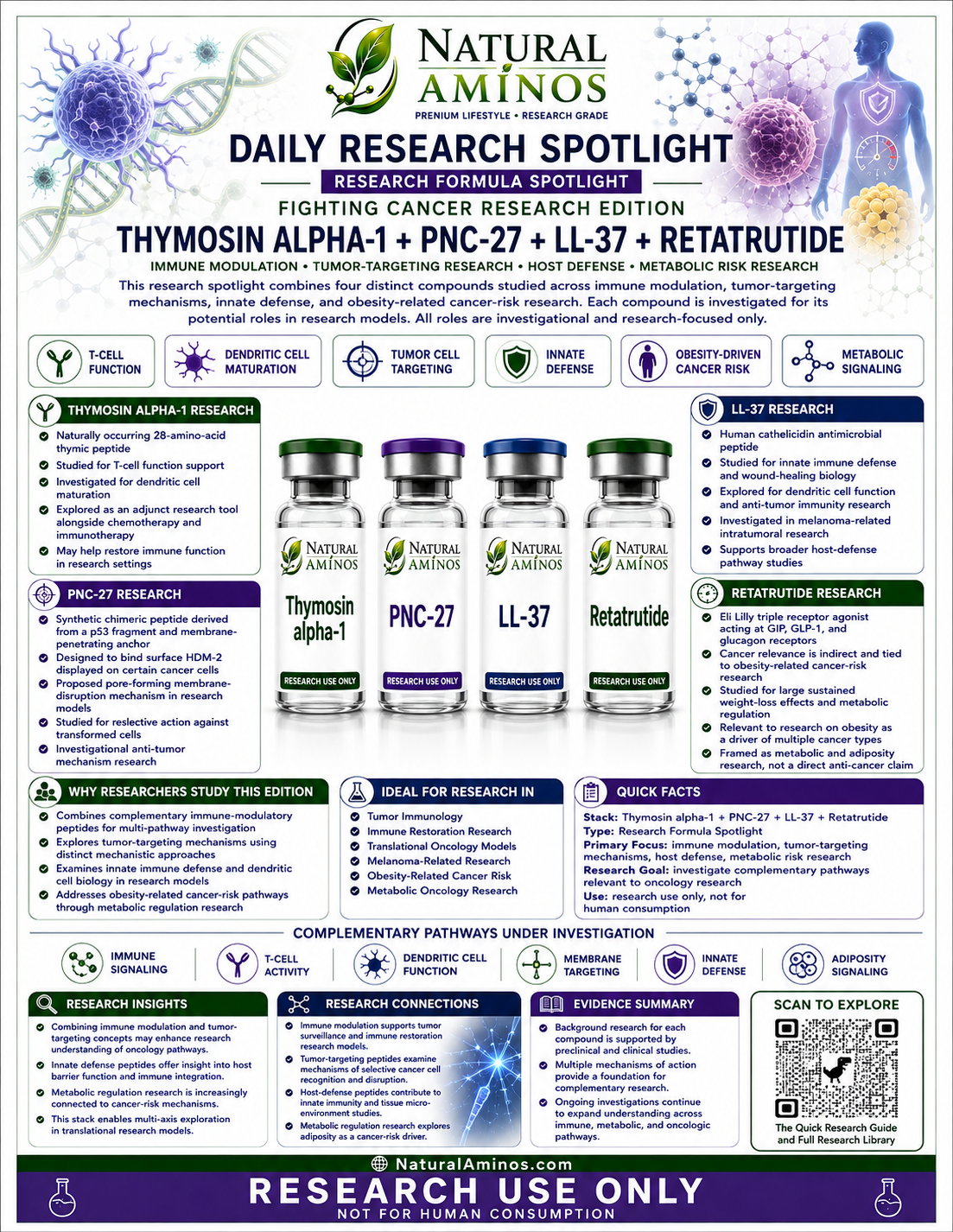
Thymosin Alpha-1 + PNC-27 + LL-37 + Retatrutide Research Data
For laboratory research use only; not for human or veterinary use or consumption. This page provides research information, not personal-use instructions or medical advice.
Natural Aminos Research Stack or Formula of the Day
Thymosin Alpha-1 + PNC-27 + LL-37 + Retatrutide
Immune Modulation, Membrane-Targeted Anticancer Biology, Innate Defense & Metabolic Signaling Research Spotlight
Compound Identity & Current Evidence Context
Thymosin Alpha-1 (Tα1; thymalfasin) is a 28-amino-acid thymic peptide with immunomodulatory activity involving dendritic cells, T-cell function, innate immune signaling, and immune homeostasis. It has substantial human clinical experience internationally, including studies in hepatitis, cancer-support settings, sepsis, and viral illness. However, the largest modern sepsis study, the 1,106-patient Phase III TESTS trial, did not reduce 28-day mortality compared with placebo. In the United States, Tα1 is not an FDA-approved drug; FDA currently lists compounded thymosin-alpha-1 among substances for which safety-related information is inadequate and immunogenicity/product-characterization risks may be relevant.
PNC-27 is a 32-residue experimental anticancer peptide containing a p53-derived HDM-2/MDM2-binding sequence linked to a membrane-residency/cell-penetrating sequence. The published evidence is preclinical. In cancer-cell lines and animal leukemia models, PNC-27 binds membrane-associated HDM-2 and induces pore formation, membrane disruption, and predominantly necrotic tumor-cell death while sparing selected nontransformed control cells. No completed human therapeutic trial or established human exposure dataset was identified.
LL-37 is the 37-amino-acid human cathelicidin antimicrobial peptide generated from the precursor hCAP18. It participates in innate defense, membrane disruption of microbes, chemotaxis, inflammatory signaling, angiogenesis, and wound biology. Human therapeutic evidence is limited. A small first-in-man venous-ulcer study was encouraging, but the larger 148-patient Phase IIb HEAL LL-37 trial did not show significant healing improvement in the full randomized population. FDA currently states that it lacks sufficient human safety information for compounded LL-37 and notes nonclinical concerns involving male reproduction and protumorigenic activity in some tissues.
Retatrutide (LY3437943) is an investigational once-weekly single peptide agonist of GIP, GLP-1, and glucagon receptors. It has strong human Phase II and now Phase III evidence for obesity and metabolic disease, but it remains unapproved as of September 2026. Lilly reports 28.3% average weight loss at 80 weeks with the 12-mg arm in TRIUMPH-1, while TRIUMPH-2 and TRIUMPH-3 also met Phase III endpoints. Lilly plans a U.S. Biologics License Application submission in Q1 2027. FDA states that retatrutide cannot legally be used in compounding under U.S. federal law and has not been found safe and effective for any approved condition.
No peer-reviewed human, animal, or cell study was identified that administered all four compounds together. No meaningful direct study was identified for PNC-27 with retatrutide, Tα1 with retatrutide, LL-37 with retatrutide, PNC-27 with Tα1, or PNC-27 with LL-37 as a therapeutic combination. The proposed stack therefore combines four largely independent research programs rather than a clinically validated multi-agent regimen.
Benefits
Thymosin Alpha-1
Tα1 has the strongest immune-modulation human literature in the stack. Mechanistically, it has been studied for effects on dendritic-cell maturation, Toll-like receptor signaling, T-cell differentiation, natural-killer-cell function, and restoration of immune competence during severe illness or immunosuppression. Earlier small trials and meta-analyses suggested possible benefit in sepsis and infectious disease, but the modern Phase III TESTS trial provides a more conservative benchmark.
TESTS enrolled 1,106 adults with sepsis across 22 centers in China. In the corrected analysis, 28-day mortality was 23.4% with Tα1 versus 24.1% with placebo, with no statistically significant mortality benefit and no significant difference in secondary or safety outcomes. This does not mean Tα1 has no biological activity; it shows that immune-modulatory mechanisms did not translate into improved survival in that large sepsis population.
Tα1 has also been studied as an adjunct in chronic hepatitis and oncology, generally with the goal of supporting immune responsiveness rather than directly killing tumor cells. Those data vary in design and quality and should not be generalized into a claim that Tα1 treats cancer.
PNC-27
PNC-27 has a distinctive preclinical anticancer mechanism. The p53-derived region adopts an HDM-2-binding conformation, and experimental work has found HDM-2 on the plasma membrane of multiple cancer-cell lines but not selected normal controls. PNC-27 binding to membrane HDM-2 is associated with transmembrane pore formation and rapid membranolysis/necrosis rather than classical p53-dependent apoptosis.
The mechanism has been demonstrated in breast, pancreatic, ovarian, leukemia, and other experimental cancer systems. A 2019 AML study reported membrane HDM2 on human and murine AML blasts, including leukemia-stem-cell-enriched populations, and found that PNC-27 killed AML cells while sparing normal hematopoietic stem-cell activity in transplant models. Later work has continued to characterize pore structure and mitochondrial disruption in treated cancer cells.
The central limitation is translational: all meaningful efficacy evidence remains laboratory or animal based. No human pharmacokinetic, dose-ranging, randomized efficacy, long-term toxicity, immunogenicity, or organ-safety program was identified. PNC-27 should therefore be described as an experimental anticancer peptide, not as an established cancer therapy.
LL-37
LL-37 has broad innate-defense activity. It can disrupt microbial membranes, neutralize some pathogen products, recruit immune cells, affect epithelial migration, and alter cytokine and angiogenic responses. This makes it biologically attractive for infected or chronic wounds, but its context dependence is substantial: the same inflammatory and growth-related pathways can be beneficial in one tissue and harmful in another.
A first-in-man randomized trial in 34 patients with hard-to-heal venous leg ulcers found markedly improved healing-rate measures at lower topical concentrations, with no major local or systemic safety signal. The larger Phase IIb HEAL LL-37 trial enrolled 148 patients and did not show significant improvement over placebo in the full study population, although exploratory subgroup signals were reported.
FDA now emphasizes safety uncertainty. Its current compounding-safety page notes potential immunogenicity and peptide-impurity issues, insufficient safety-related human information, nonclinical male-reproductive findings, and protumorigenic activity in some tissues. This is particularly important in a stack that also contains an experimental anticancer peptide: LL-37 cannot be assumed to be uniformly antitumor or uniformly immune-protective.
Retatrutide
Retatrutide has the strongest modern randomized efficacy program in the stack. In the 338-participant Phase II obesity trial, mean weight reduction at 48 weeks reached 24.2% in the 12-mg group versus 2.1% with placebo. Gastrointestinal adverse events were the most common treatment-related events, and heart rate increased in a dose-dependent manner before declining from peak values.
Metabolic-liver data are also substantial. In a Phase IIa MASLD substudy, mean relative liver-fat reduction at 24 weeks reached approximately 81-82% in the 8- and 12-mg groups, and most participants at those doses reached liver fat below 5%. The effects were strongly associated with body-weight and metabolic changes.
Phase III results announced in 2026 strengthened the obesity evidence. In TRIUMPH-1, the 12-mg arm produced 28.3% average weight loss at 80 weeks and 30.3% in a severe-obesity extension at 104 weeks. TRIUMPH-2 and TRIUMPH-3 also met primary endpoints, with average weight reductions up to 20.8% and 22.6%, respectively, in more metabolically complex populations. These remain company-reported topline/presentation data pending full peer-reviewed publication of all Phase III datasets.
Retatrutide is still investigational. Lilly states that it has not been approved by any regulatory agency and should not be used outside sponsored clinical trials. FDA separately states that retatrutide cannot be used in compounding under U.S. federal law because it is not a component of an approved drug and has not been found safe and effective.
What the Formulas Are Studied For
Thymosin Alpha-1 Research Areas
• Immune modulation during severe infection and sepsis.
• Dendritic-cell, T-cell, natural-killer-cell, and Toll-like-receptor signaling.
• Adjunctive immune support in chronic viral hepatitis and selected oncology settings.
• Immune recovery during immunosuppression.
• COVID-19 and other viral-disease research with mixed observational and interventional evidence.
PNC-27 Research Areas
• Membrane HDM-2/MDM2 as a cancer-cell target.
• Selective pore formation and membranolysis of cancer cells.
• Breast, pancreatic, ovarian, leukemia, and other tumor-cell models.
• Leukemia stem-cell targeting in preclinical AML models.
• Mitochondrial disruption after cancer-cell membrane targeting.
• No established human therapeutic indication or human efficacy program.
LL-37 Research Areas
• Innate antimicrobial defense and microbial-membrane disruption.
• Chronic wound healing and epithelial repair.
• Chemotaxis, angiogenesis, and inflammatory signaling.
• Biofilm and host-pathogen interactions.
• Cancer biology with both antitumor and protumor findings depending on tissue context.
• Human topical wound trials; systemic therapeutic exposure remains poorly characterized.
Retatrutide Research Areas
• Obesity and overweight with cardiometabolic comorbidity.
• Type 2 diabetes and glycemic control.
• Metabolic dysfunction-associated steatotic liver disease.
• Knee osteoarthritis pain associated with obesity.
• Obstructive sleep apnea associated with obesity.
• Cardiovascular and renal outcomes programs.
• Body composition and preservation of lean tissue during large weight loss.
Published Research - Worldwide Evidence Review
Thymosin Alpha-1 - China, Europe, Asia, and International Clinical Use
Tα1 has decades of international research and commercial use outside the United States. The most decisive recent evidence is the Chinese multicenter TESTS Phase III trial. Despite a strong immunologic rationale and prior small-trial meta-analyses, the large trial showed no overall mortality benefit in sepsis. Subgroup findings by age and diabetes were exploratory and should not be treated as proof of benefit in those populations.
The FDA compounding position adds a U.S. product-quality perspective. FDA states that compounded Tα1 may pose immunogenicity risk for some routes and that peptide-related impurities and API characterization are complex. The agency considers available safety information inadequate to fully characterize compounded human use.
PNC-27 - U.S. Preclinical Cancer Program
PNC-27 research is concentrated in U.S. academic and translational laboratories. A 2010 PNAS study showed that PNC-27 binds membrane-associated HDM-2 in cancer cells and that forcing HDM-2 to the membrane of previously resistant nontransformed cells could make them susceptible, supporting target dependence. A separate 2010 study demonstrated that the intact peptide, rather than fragments, accumulates in cancer-cell membranes during lysis.
Subsequent leukemia research showed selective killing of K562 and multiple AML cell lines, while an in-vivo AML study found killing of bulk blasts and leukemia-stem-cell populations with preservation of normal hematopoietic stem-cell activity. A 2022 structural/immuno-electron-microscopy paper further supported a model in which PNC-27-HDM2 complexes line membrane pores. In 2024, investigators reported evidence of selective mitochondrial disruption after PNC-27 treatment in pancreatic-cancer cells.
Despite this mechanistic depth, no human clinical efficacy trial was identified. The absence of human exposure, pharmacokinetics, biodistribution, dose-limiting toxicity, and immunogenicity data is the defining limitation of PNC-27.
LL-37 - Sweden/Europe and Human Wound Research
The first-in-man LL-37 wound study was performed in Sweden and enrolled 34 patients with difficult venous leg ulcers. Lower topical concentrations improved healing-rate measures relative to placebo, while the highest tested concentration did not. This non-linear response illustrates an important principle in LL-37 biology: more peptide is not necessarily more effective.
The later multicenter Phase IIb HEAL LL-37 trial enrolled 148 patients and failed to show significant improvement in the full randomized population. This larger negative result substantially weakens simple claims that topical LL-37 is proven to accelerate chronic wound healing.
FDA current safety language is particularly relevant for systemic research products. The agency lacks sufficient safety information to know whether compounded LL-37 would cause harm in humans and cites nonclinical male-reproductive and protumorigenic findings. Human topical wound tolerability cannot be extrapolated to systemic administration.
Retatrutide - Global Phase II and Phase III Metabolic Development
Retatrutide development is multinational and clinically advanced. The Phase II obesity program established large dose-dependent weight loss, while Phase II type 2 diabetes trials showed meaningful HbA1c and weight reductions. The MASLD substudy demonstrated very large reductions in liver fat.
The 2026 Phase III TRIUMPH program has now produced multiple positive trials across obesity, type 2 diabetes, severe obesity with cardiovascular disease, knee osteoarthritis pain, and obstructive sleep apnea. Lilly announced plans for U.S. regulatory submission in Q1 2027. As of September 2026, retatrutide remains investigational and not publicly available as an approved medicine.
A 2025 DXA substudy showed that retatrutide produces major fat-mass reductions while the proportion of lean-mass loss relative to total weight loss was broadly similar to that observed with other effective obesity treatments. This is important when considering any theoretical immune or cancer-oriented stack because large body-weight changes can independently alter nutrition, muscle mass, inflammatory biomarkers, and drug exposure.
Direct Research on the Four-Formula Combination
No direct study was identified for Thymosin Alpha-1 + PNC-27 + LL-37 + Retatrutide. No trial has established pharmacokinetic compatibility, immune interactions, cancer effects, metabolic interactions, or safety of the four compounds together.
The stack also lacks a single unified therapeutic target. Tα1 is an immune-modulatory peptide; PNC-27 is a preclinical membrane-targeted anticancer peptide; LL-37 is an innate-defense peptide with tissue-dependent inflammatory and growth effects; and retatrutide is a metabolic triple-hormone-receptor agonist. Theoretical benefit must therefore be evaluated as parallel mechanisms rather than assumed synergy.
Theory of the Stack - How the Combination Could Work
1. Immune Competence - Thymosin Alpha-1 Layer
Tα1 could theoretically support immune-cell function, dendritic-cell signaling, and adaptive immune responsiveness. In a cancer-oriented research model, this could be framed as host-immune support rather than direct tumor killing. The negative TESTS result cautions that measurable immune effects do not necessarily improve hard clinical outcomes.
2. Direct Tumor-Membrane Lysis - PNC-27 Layer
PNC-27 would provide the most direct antitumor mechanism in the stack by targeting membrane-associated HDM-2 and forming cytotoxic pores. This mechanism is largely independent of the immune and metabolic pathways used by the other three agents. In principle, a direct membrane-killing mechanism could complement host immune activity.
3. Innate Defense and Tissue Signaling - LL-37 Layer
LL-37 could theoretically contribute antimicrobial defense, chemotaxis, and wound-repair signaling. In a cancer model, however, its role is not predictably beneficial. LL-37 can influence angiogenesis, epithelial growth, inflammation, and tumor biology differently by tissue and receptor context. It should therefore be treated as a context-dependent modifier, not a universally antitumor peptide.
4. Systemic Metabolic Remodeling - Retatrutide Layer
Retatrutide would provide an entirely separate metabolic layer: appetite reduction, major weight loss, improved glycemia, reduced liver fat, and changes in adipose distribution. In obesity-associated inflammation, these changes could indirectly lower inflammatory burden. There is no evidence that retatrutide enhances PNC-27 cytotoxicity, Tα1 immune activity, or LL-37 antimicrobial action.
5. Tα1 + LL-37 Has a Plausible Innate/Adaptive Immune Logic
Tα1 and LL-37 occupy different but interacting levels of host defense. LL-37 participates in first-line innate defense and immune-cell recruitment; Tα1 modulates dendritic and lymphocyte function. Theoretical complementarity is plausible, particularly in infection or immune-dysregulation models.
The risk is inflammatory unpredictability. Both can alter cytokine networks, and LL-37 can be pro-inflammatory in some contexts. There is no direct human trial demonstrating that the pair improves infection control or immune outcomes more than either alone.
6. PNC-27-Induced Necrosis Could Theoretically Alter Immune Signaling
PNC-27 causes rapid necrotic membrane disruption rather than a purely apoptotic process. Necrosis can release damage-associated molecular patterns, tumor antigens, and intracellular contents that may alter innate and adaptive immunity. Tα1 or LL-37 could theoretically modify that response, but no study has tested whether the net effect is antitumor immune activation, excessive inflammation, tolerance, or no meaningful interaction.
7. LL-37 Creates the Largest Biological Ambiguity in an Anticancer Stack
LL-37 is sometimes antimicrobial, pro-repair, immunomodulatory, or antitumor, but FDA specifically notes protumorigenic findings in some tissues. A stack containing PNC-27 should therefore not assume that LL-37 adds anticancer benefit. Depending on tumor type and microenvironment, LL-37 could theoretically help, do nothing, or oppose the desired biology.
8. Retatrutide Does Not Have a Demonstrated Anticancer Role in This Stack
Retatrutide is being developed for obesity and metabolic complications, not as a cancer therapy. Large reductions in adiposity and liver fat could improve cardiometabolic health, but no direct evidence connects those changes to PNC-27 effectiveness or to improved Tα1/LL-37 immune outcomes. Metabolic improvement should be considered a separate objective.
9. Major Weight Loss Could Confound Cancer or Immune Research
Retatrutide can produce weight loss approaching 20-30% in some trial populations. Such a large physiologic change affects caloric intake, fat mass, lean mass, insulin sensitivity, inflammatory markers, and potentially pharmacokinetics of other agents. In any multi-agent research design, those effects could make it difficult to determine whether changes in immune or cancer biomarkers are due to the peptides themselves or to systemic weight loss.
10. The Stack Has High Mechanistic Breadth but Low Integration
The four agents cover immune regulation, innate defense, tumor-cell membrane lysis, and metabolic disease. Broad mechanistic coverage can look attractive on paper, but biological breadth is not the same as synergy. The absence of direct interaction data means that overlap, antagonism, inflammatory amplification, nutritional confounding, and unexpected toxicity remain unresolved.
Possible Overall Benefit - Theoretical, Not Proven
The most defensible theoretical interpretation is a multi-objective research model rather than a single validated stack. Tα1 could theoretically support adaptive/innate immune coordination; PNC-27 could provide direct preclinical membrane-targeted tumor-cell lysis; LL-37 could contribute antimicrobial and tissue-defense signaling; and retatrutide could improve obesity-associated metabolic dysfunction and systemic inflammatory burden.
In an obesity-plus-cancer research hypothesis, retatrutide might improve the metabolic host environment while Tα1, PNC-27, and LL-37 address different immune/tumor-defense pathways. That concept is biologically interesting but completely unproven. No evidence shows that metabolic improvement enhances PNC-27 killing, that Tα1 improves the response to PNC-27, or that LL-37 is beneficial across tumor types.
The possible overall benefit is therefore highly speculative. The stack contains two compounds with meaningful human data for very different indications (Tα1 and retatrutide), one compound with limited topical human research (LL-37), and one preclinical-only anticancer compound (PNC-27). The total evidence does not support describing the four-way combination as an established immune, anticancer, or metabolic treatment.
Why More Research Is Needed
• No human, animal, or cell study has tested the complete four-formula combination.
• No clinical pharmacokinetic or toxicology program has evaluated interactions among Tα1, PNC-27, LL-37, and retatrutide.
• PNC-27 remains preclinical, with no established human exposure, dose-ranging, pharmacokinetic, immunogenicity, or efficacy dataset.
• LL-37 showed encouraging results in a small first-in-man wound study but failed to improve healing in the full population of a larger 148-patient Phase IIb trial.
• FDA states that LL-37 has insufficient human safety information and cites nonclinical male-reproductive and protumorigenic findings.
• The large TESTS Phase III sepsis trial found no overall mortality benefit from Tα1 despite earlier positive small studies and mechanistic rationale.
• FDA currently identifies immunogenicity, impurity, and characterization concerns for compounded Tα1.
• Retatrutide remains investigational and unapproved despite multiple positive Phase III trials; Lilly plans regulatory submission in 2027.
• FDA states that retatrutide cannot be used in compounding under U.S. federal law and has not been found safe and effective for any approved condition.
• Large retatrutide-induced weight loss can independently alter inflammatory biomarkers, body composition, nutrition, and drug exposure, confounding interpretation of immune or anticancer endpoints.
• LL-37 has tissue-dependent tumor biology, so its effect would need to be characterized separately for each tumor type before combining it with PNC-27.
• PNC-27-induced necrosis could theoretically amplify inflammatory signaling or immune recognition, but the interaction with Tα1 or LL-37 has never been tested.
• Any future study would need single-agent and pairwise arms before a four-way arm, with tumor response, immune phenotyping, inflammatory cytokines, body composition, nutritional status, liver and renal function, and adverse-event monitoring.
• Cancer-oriented studies would require conventional oncology oversight and should not substitute an experimental peptide stack for established cancer treatment.
Research Summary
Thymosin Alpha-1 + PNC-27 + LL-37 + Retatrutide is a broad four-pathway research concept with highly unequal evidence. Tα1 has extensive human immune-modulation experience but failed to improve mortality in the 1,106-patient TESTS Phase III sepsis trial. PNC-27 has a distinctive and well-developed preclinical cancer-cell membrane mechanism involving HDM-2-directed pore formation, but no human efficacy or safety program. LL-37 has limited human topical wound data, including a negative Phase IIb result in the full population, and has context-dependent inflammatory and tumor biology. Retatrutide has the strongest modern clinical efficacy program in the stack, producing very large weight and liver-fat reductions, but remains investigational and unapproved as of September 2026.
The full stack has no direct evidence. The most plausible theoretical relationships are Tα1 plus LL-37 for innate/adaptive immune coordination and Tα1 plus PNC-27 as a speculative host-immunity plus direct-tumor-lysis concept. Retatrutide largely represents a separate metabolic objective. LL-37 is the most biologically ambiguous component in a cancer-oriented stack because its tissue-specific effects can be pro-repair, inflammatory, antimicrobial, antitumor, or protumorigenic.
Selected Sources
• Wu J, et al. The efficacy and safety of thymosin alpha1 for sepsis (TESTS): multicentre, double blinded, randomised, placebo controlled, phase 3 trial. BMJ. 2025;388:e082583. PMID: 39814420. DOI: 10.1136/bmj-2024-082583. Corrected May 30, 2025.
• U.S. Food and Drug Administration. Certain Bulk Drug Substances for Use in Compounding that May Present Significant Safety Risks. Current 2026 entry for Thymosin-alpha 1: potential immunogenicity and peptide-related impurity/API-characterization concerns; safety information considered inadequate.
• Sarafraz-Yazdi E, et al. Anticancer peptide PNC-27 adopts an HDM-2-binding conformation and kills cancer cells by binding to HDM-2 in their membranes. Proc Natl Acad Sci U S A. 2010;107(5):1918-1923. PMID: 20080680. PMCID: PMC2836618. DOI: 10.1073/pnas.0909364107.
• Sookraj KA, et al. The anti-cancer peptide, PNC-27, induces tumor cell lysis as the intact peptide. Cancer Chemother Pharmacol. 2010;66(2):325-331. PMID: 20182728. DOI: 10.1007/s00280-009-1166-7.
• Targeting cell membrane HDM2: A novel therapeutic approach for acute myeloid leukemia. 2019. PMID: 31337857.
• Targeting Membrane HDM-2 by PNC-27 Induces Necrosis in Leukemia Cells But Not in Normal Hematopoietic Cells. Anticancer Res. 2020. PMID: 32878773. DOI: 10.21873/anticanres.14488.
• Sarafraz-Yazdi E, et al. PNC-27, a Chimeric p53-Penetratin Peptide Binds to HDM-2 in a p53 Peptide-like Structure, Induces Selective Membrane-Pore Formation and Leads to Cancer Cell Lysis. Biomedicines. 2022;10(5):945. PMID: 35625682. PMCID: PMC9138867. DOI: 10.3390/biomedicines10050945.
• Anti-Cancer Peptide PNC-27 Kills Cancer Cells by Unique Interactions with Plasma Membrane-Bound hdm-2 and with Mitochondrial Membranes Causing Mitochondrial Disruption. 2024. PMID: 38802154.
• Gronberg A, et al. Treatment with LL-37 is safe and effective in enhancing healing of hard-to-heal venous leg ulcers: a randomized, placebo-controlled clinical trial. Wound Repair Regen. 2014;22(5):613-621. PMID: 25041740. DOI: 10.1111/wrr.12211.
• Evaluation of LL-37 in healing of hard-to-heal venous leg ulcers: A multicentric prospective randomized placebo-controlled clinical trial. 2021. PMID: 34687253.
• U.S. Food and Drug Administration. Certain Bulk Drug Substances for Use in Compounding that May Present Significant Safety Risks. Current 2026 LL-37 entry: insufficient safety-related human information; potential immunogenicity/impurity issues; nonclinical male-reproductive and protumorigenic findings.
• Jastreboff AM, et al. Triple-Hormone-Receptor Agonist Retatrutide for Obesity - A Phase 2 Trial. N Engl J Med. 2023;389:514-526. PMID: 37366315. DOI: 10.1056/NEJMoa2301972.
• Sanyal AJ, et al. Triple hormone receptor agonist retatrutide for metabolic dysfunction-associated steatotic liver disease: a randomized phase 2a trial. Nat Med. 2024;30:2037-2048. PMID: 38858523. PMCID: PMC11271400. DOI: 10.1038/s41591-024-03018-2.
• Coskun T, et al. Effects of retatrutide on body composition in people with type 2 diabetes: a substudy of a phase 2 randomized trial. Lancet Diabetes Endocrinol. 2025;13(8):674-684. PMID: 40609566. DOI: 10.1016/S2213-8587(25)00092-0.
• Eli Lilly and Company. TRIUMPH-1 Phase III topline and ADA 2026 data, May-June 2026: 28.3% average weight loss at 80 weeks with 12 mg; severe-obesity extension approximately 30.3% at 104 weeks.
• Eli Lilly and Company. TRIUMPH-2 and TRIUMPH-3 Phase III topline results, July 23, 2026: up to 20.8% and 22.6% average weight loss at 80 weeks; planned U.S. BLA submission Q1 2027.
• Eli Lilly and Company. What to know about retatrutide. Updated July 2026: retatrutide remains investigational and has not been approved by any regulatory agency.
• U.S. Food and Drug Administration. FDA Concerns with Unapproved GLP-1 Drugs Used for Weight Loss. Current 2026 guidance states retatrutide cannot be used in compounding under federal law and is not a component of an FDA-approved drug.
Theory vs. Proof - Verdict
What is supported by evidence: Tα1 has substantial human immune-modulation experience; PNC-27 selectively disrupts HDM-2-positive cancer-cell membranes in multiple preclinical systems; LL-37 has human topical wound exposure and extensive innate-immune biology; retatrutide produces very large weight, glycemic, adipose, and liver-fat effects in randomized human trials.
What is not proven: that Tα1 improves outcomes when combined with PNC-27 or LL-37; that PNC-27 is safe or effective in humans; that LL-37 improves cancer control or systemic immunity; that retatrutide improves anticancer or immune-peptide responses; or that the four-way combination is additive, synergistic, tolerable, or clinically useful.
Verdict - theory vs. proof: the stack is mechanistically broad but poorly integrated. Tα1 provides an immune-modulatory hypothesis; PNC-27 provides a highly experimental direct tumor-membrane-lysis mechanism; LL-37 provides context-dependent innate-defense and tissue-signaling biology; and retatrutide provides a powerful but separate metabolic pathway. The Tα1-PNC-27 and Tα1-LL-37 pairings have plausible conceptual complementarity, but neither has direct proof. LL-37 introduces the greatest uncertainty in a cancer-oriented model because of tissue-dependent protumor and antitumor behavior. Retatrutide has the strongest clinical efficacy evidence but almost no mechanistic reason to assume direct synergy with the other three compounds. Overall, Thymosin Alpha-1 + PNC-27 + LL-37 + Retatrutide is best classified as a highly speculative multi-objective research stack with meaningful human evidence for two individual components, limited human evidence for LL-37, preclinical-only evidence for PNC-27, and no direct combination proof.
Research & Educational Use Only !!