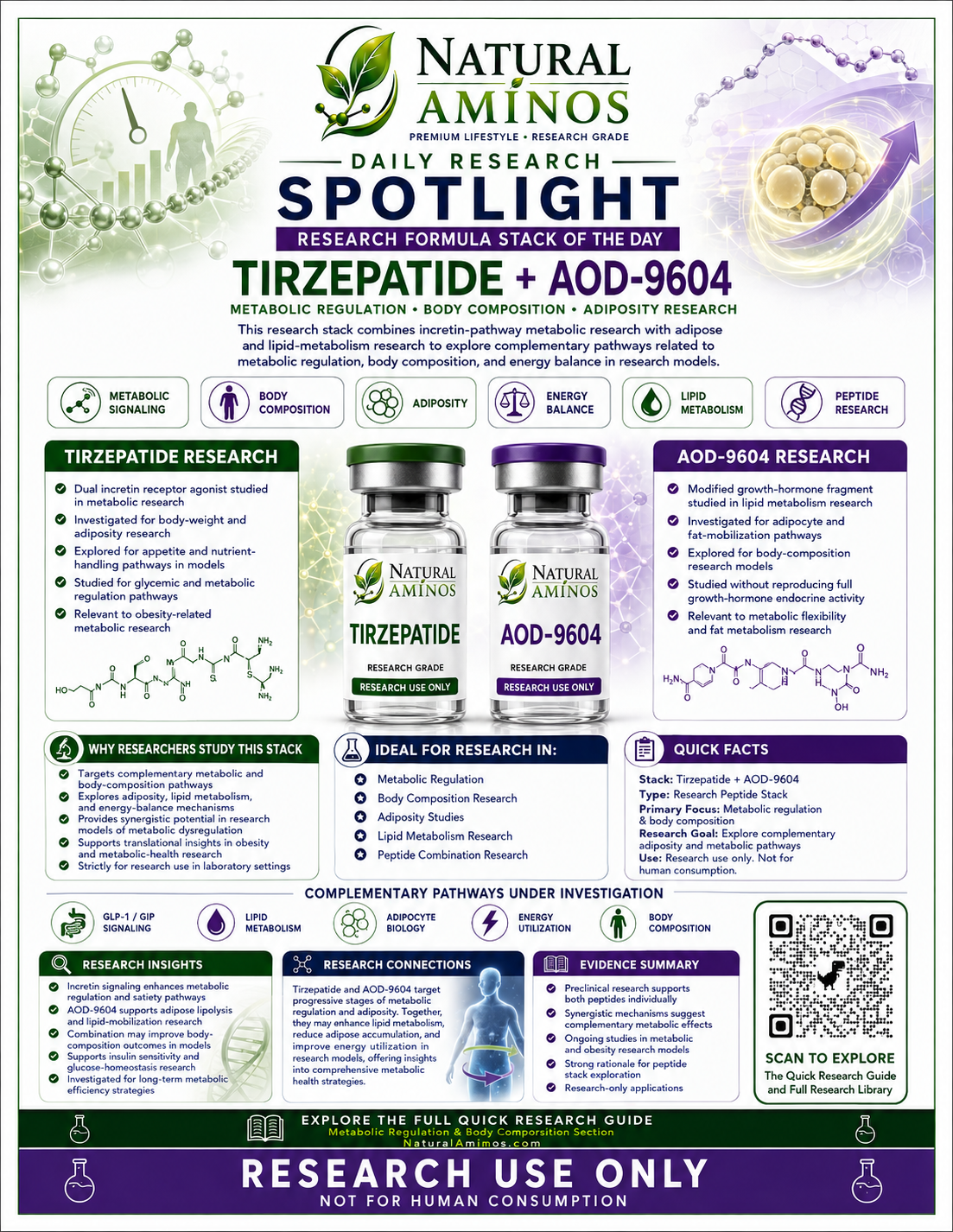
Tirzepatide + AOD-9604 Research Data
For laboratory research use only; not for human or veterinary use or consumption. This page provides research information, not personal-use instructions or medical advice.
Natural Aminos Research Stack or Formula of the Day
Tirzepatide + AOD-9604
Dual-Incretin Weight Management, Lipolysis & Body-Composition Research Spotlight
Compound Identity & Current Evidence Context
Tirzepatide is a long-acting dual agonist of the glucose-dependent insulinotropic polypeptide (GIP) and glucagon-like peptide-1 (GLP-1) receptors. It is an FDA-approved medicine marketed as Mounjaro for type 2 diabetes and as Zepbound for chronic weight management in adults with obesity or overweight plus a weight-related comorbidity. Zepbound is also FDA-approved for moderate-to-severe obstructive sleep apnea in adults with obesity. The current U.S. labeling therefore rests on a large modern clinical-development program with randomized trials in obesity, diabetes, sleep apnea, and cardiometabolic disease.
AOD-9604 is a synthetic 16-amino-acid peptide derived from the C-terminal lipolytic region of human growth hormone. It was developed to preserve selected fat-mobilizing effects of growth hormone while avoiding classical growth-hormone-receptor activation, IGF-1 elevation, hyperglycemia, and proliferative signaling. Animal models support increased lipolysis and fat oxidation, but the human obesity-development program did not establish clinically meaningful weight-loss efficacy.
The evidence levels are therefore highly asymmetric. Tirzepatide has large Phase III trials, FDA-approved obesity and obstructive-sleep-apnea indications, and cardiovascular-outcomes data. AOD-9604 remains an unapproved research compound whose pivotal obesity study failed its primary efficacy endpoint. FDA reviewed AOD-9604-related bulk substances in December 2024 and concluded that available data did not support effectiveness for obesity.
No peer-reviewed randomized human study, animal study, or registered clinical trial was identified that directly tested tirzepatide and AOD-9604 together. The combination must therefore be evaluated from separate component evidence and mechanism rather than direct combination data.
Benefits
Tirzepatide
Tirzepatide has robust human weight-loss evidence. In SURMOUNT-1, 2,539 adults with obesity or overweight without diabetes were randomized to tirzepatide or placebo for 72 weeks. Mean body-weight changes were -15.0% with 5 mg, -19.5% with 10 mg, and -20.9% with 15 mg, compared with -3.1% with placebo. At the 10-mg and 15-mg doses, approximately half or more of participants achieved at least 20% weight reduction.
Longer-term follow-up in participants with obesity and prediabetes showed sustained effects through 176 weeks. Mean weight change was -12.3%, -18.7%, and -19.7% with the 5-, 10-, and 15-mg doses, versus -1.3% with placebo. Only 1.3% of tirzepatide-treated participants developed type 2 diabetes compared with 13.3% receiving placebo, corresponding to a hazard ratio of 0.07 during treatment.
Tirzepatide also has disease-specific evidence beyond scale weight. In SURMOUNT-OSA, it produced large reductions in apnea-hypopnea index and body weight in adults with obesity and moderate-to-severe obstructive sleep apnea. Those data supported FDA approval of Zepbound for that indication in December 2024.
In obesity-related heart failure with preserved ejection fraction, the SUMMIT trial randomized 731 participants and found a lower risk of cardiovascular death or worsening heart failure together with improved health status. The benefit was driven primarily by fewer worsening-heart-failure events.
SURPASS-CVOT subsequently enrolled more than 13,000 people with type 2 diabetes and established atherosclerotic cardiovascular disease. Tirzepatide was noninferior to dulaglutide for cardiovascular death, myocardial infarction, or stroke; superiority over dulaglutide was not statistically established.
The safety profile is also far better characterized than that of AOD-9604. Current U.S. labeling includes a boxed warning regarding thyroid C-cell tumors observed in rats and contraindication in people with a personal or family history of medullary thyroid carcinoma or MEN2. Other important risks include severe gastrointestinal adverse reactions, pancreatitis, gallbladder disease, volume-depletion kidney injury, hypoglycemia with insulin or insulin secretagogues, delayed gastric emptying, and pulmonary aspiration during anesthesia or deep sedation.
AOD-9604
AOD-9604 has a credible preclinical lipid-metabolism signal. In obese mice, chronic exposure reduced weight gain and increased fat oxidation and plasma glycerol, consistent with enhanced lipolysis. Unlike full-length growth hormone, AOD-9604 did not bind the classical growth-hormone receptor, did not induce receptor-dependent cell proliferation, and did not produce the same hyperglycemic effect in that model.
The older human development program included six randomized, double-blind, placebo-controlled studies and approximately 893 participants in the pooled 2013 safety analysis. Across those studies, AOD-9604 did not significantly raise IGF-1, did not meaningfully worsen glucose tolerance, and did not generate detectable anti-AOD-9604 antibodies in the tested subsets. These findings supported tolerability under the studied oral and intravenous conditions.
However, efficacy was the limiting issue. FDA summarized the pivotal OPTIONS study as a randomized, double-blind, placebo-controlled trial in approximately 502 analyzable adults with obesity, from 536 enrolled. Participants received oral AOD-9604 or placebo for 24 weeks with diet and exercise. There was no significant difference in weight loss between AOD-9604 and placebo at the primary 12-week endpoint, and the sponsor terminated obesity development after the program failed to demonstrate commercially meaningful efficacy.
Route-specific uncertainty remains important. FDA stated that it did not identify human studies of AOD-9604 administered by the commonly proposed subcutaneous or transdermal routes for obesity. Current FDA compounding-safety language also notes potential immunogenicity, peptide-impurity and API-characterization concerns, limited safety information, and serious adverse events of uncertain causality.
AOD-9604 has separate preclinical cartilage-repair evidence. In a rabbit osteoarthritis model, intra-articular AOD-9604 improved morphologic and histologic cartilage outcomes, particularly when combined with hyaluronic acid. This does not establish systemic human fat-loss or joint-repair efficacy.
What the Formulas Are Studied For
Tirzepatide Research and Approved Use Areas
• Chronic weight management in adults with obesity or overweight plus a weight-related comorbidity.
• Type 2 diabetes mellitus and glycemic control.
• Moderate-to-severe obstructive sleep apnea in adults with obesity.
• Prevention or delay of progression from prediabetes to type 2 diabetes in obesity research.
• Obesity-related heart failure with preserved ejection fraction.
• Cardiovascular outcomes in type 2 diabetes with established atherosclerotic cardiovascular disease.
• Appetite regulation, caloric intake, gastric emptying, insulin secretion, glucagon biology, and body-composition change.
AOD-9604 Research Areas
• Lipolysis and fat oxidation in obesity models.
• Body-weight and adipose-mass regulation in obese animals.
• Attempts to separate selected GH-fragment lipid effects from GH-receptor and IGF-1 signaling.
• Historical human obesity drug development, including the failed OPTIONS study.
• Glucose and insulin-sensitivity comparisons with full-length GH.
• Cartilage and osteoarthritis repair in animal models.
• No FDA-approved therapeutic indication.
Published Research - Worldwide Evidence Review
Tirzepatide - Global Phase III and Outcomes Evidence
SURMOUNT-1 was conducted across 119 sites in nine countries and established tirzepatide as one of the most effective approved obesity medicines studied in a large randomized program. At 72 weeks, mean weight loss was dose dependent and reached 20.9% with the 15-mg dose in the treatment-regimen analysis.
The 176-week SURMOUNT-1 extension in people with obesity and prediabetes demonstrated that the weight-loss effect can remain substantial for more than three years while markedly reducing progression to type 2 diabetes. The finding is important because it moves tirzepatide evidence beyond short-term weight reduction toward metabolic-disease prevention during continued treatment.
SURMOUNT-OSA enrolled 469 adults internationally. In the two parallel studies, the estimated treatment differences in apnea-hypopnea index at 52 weeks were approximately -20.0 and -23.8 events per hour versus placebo. FDA subsequently approved Zepbound for moderate-to-severe OSA in adults with obesity.
SUMMIT extended the evidence into obesity-related HFpEF. In 731 participants, tirzepatide reduced the composite risk of cardiovascular death or worsening heart failure and improved Kansas City Cardiomyopathy Questionnaire health-status scores. This establishes that tirzepatide benefits can extend beyond weight loss alone in selected obesity-related disease.
SURPASS-CVOT provides the most current large cardiovascular-outcomes comparison. More than 13,000 people with type 2 diabetes and established atherosclerotic cardiovascular disease were randomized to tirzepatide or dulaglutide. Tirzepatide met noninferiority for major cardiovascular events but did not meet the prespecified threshold for superiority over dulaglutide.
AOD-9604 - Australia, Germany and South Korea
AOD-9604 originated from Australian GH-fragment research. Monash University investigators showed in obese mice that the fragment could increase fat oxidation and lipolysis without binding the classical GH receptor. These animal data provided the rationale for human obesity development.
Human trials were conducted between 2001 and 2006. The 2013 pooled analysis from German and Australian investigators summarized six randomized controlled studies and emphasized favorable tolerability, absence of meaningful IGF-1 elevation, and no clear deterioration in glucose handling. That publication focused on safety rather than proving obesity efficacy.
FDA re-reviewed the program in 2024 and reached a more conservative efficacy conclusion. The agency noted that most identified human studies did not show significant weight reduction and that the large OPTIONS study failed its primary endpoint. FDA also emphasized the lack of human subcutaneous and transdermal data for the proposed compounded uses.
South Korean investigators later reported cartilage-regeneration effects in a rabbit osteoarthritis model. That line of research supports possible local tissue biology but is independent of the failed human obesity-development program.
Direct Research on Tirzepatide + AOD-9604 Together
No peer-reviewed randomized trial, prospective observational study, animal experiment, or registered clinical trial was identified that administered tirzepatide and AOD-9604 together as a defined combination.
Commercial clinic protocols and online discussions describing the pair do not constitute combination evidence. At present, the correct research statement is that tirzepatide and AOD-9604 have different proposed mechanisms, but the incremental efficacy, pharmacokinetics, body-composition effects, and combined safety profile have not been established.
Theory of the Stack - How the Combination Could Work
1. Central and Gastrointestinal Energy-Intake Control - Tirzepatide Layer
Tirzepatide would provide the dominant clinically proven mechanism. Dual GIP/GLP-1 receptor signaling reduces appetite and food intake, improves glucose-dependent insulin secretion, lowers glucagon in appropriate metabolic contexts, slows gastric emptying, and drives large sustained negative energy balance.
2. Peripheral Lipolysis/Fat-Oxidation Hypothesis - AOD-9604 Layer
AOD-9604 would theoretically provide a more peripheral adipose-tissue signal. Animal studies suggest increased lipolysis and fat oxidation without direct GH-receptor activation or IGF-1 elevation. This creates a conceptual division between reduced energy intake from tirzepatide and increased fat mobilization from AOD-9604.
3. Why the Mechanisms Are Complementary on Paper
The two compounds do not target the same receptor system. Tirzepatide acts through incretin receptors, whereas AOD-9604 was developed from a GH fragment and appears to act independently of the classical GH receptor. In theory, appetite suppression plus adipose fat mobilization could be complementary rather than receptor-redundant.
4. The Human Efficacy Imbalance Is the Central Problem
Mechanistic complementarity is only valuable if both components contribute meaningful human effects. Tirzepatide has repeatedly produced double-digit percentage weight loss in large randomized trials. AOD-9604 failed to separate significantly from placebo in its pivotal obesity trial. Therefore, the combination is likely to be dominated by tirzepatide, and there is no evidence that AOD-9604 materially increases total weight loss.
5. Body-Composition Quality Is a More Plausible Hypothesis Than Extra Scale Weight Loss
A more defensible research question would be whether AOD-9604 changes the composition of tirzepatide-associated weight loss - for example, greater fat-mass reduction for a given amount of total weight loss. That hypothesis is not established. No DEXA or MRI trial has compared tirzepatide alone with tirzepatide plus AOD-9604.
6. Lean-Mass Preservation Cannot Be Assumed
AOD-9604 is sometimes discussed as if selective fat mobilization would automatically preserve lean mass during incretin-driven weight loss. The published human AOD-9604 program did not establish lean-mass preservation, and no combination study has measured whether the peptide changes the ratio of fat to lean tissue lost with tirzepatide.
7. Glycemic Effects Are Unlikely to Be Symmetrically Important
Tirzepatide has profound human glycemic effects through GIP/GLP-1 signaling. AOD-9604 was specifically developed to avoid the hyperglycemic and IGF-1 effects associated with full-length GH and did not meaningfully worsen glucose tolerance in its older oral/IV development program. Theoretically, this reduces obvious metabolic conflict, but there is no interaction study confirming neutrality when the two are combined.
8. Route Mismatch Weakens Modern Extrapolation
Most contemporary interest in AOD-9604 involves subcutaneous administration, yet FDA found no human subcutaneous or transdermal obesity studies. Tirzepatide has well-defined once-weekly subcutaneous pharmacology. Combining a thoroughly characterized subcutaneous medicine with an inadequately characterized subcutaneous research peptide produces major exposure uncertainty.
9. More Components Mean More Attribution Problems
If body weight, visceral fat, glucose, appetite, or adverse effects change while both compounds are used, the very large known tirzepatide effect makes it difficult to determine whether AOD-9604 contributed anything. Without a randomized tirzepatide-alone arm, apparent combination success could simply reflect expected tirzepatide pharmacology.
10. Modern Obesity Evidence Raises the Bar for Add-On Therapy
AOD-9604 was developed before the current incretin era. Tirzepatide now produces 15-21% mean weight reduction at 72 weeks and substantial long-term metabolic benefit. An add-on compound should therefore demonstrate incremental benefit beyond an already highly effective therapy, not merely show mechanistic plausibility or modest animal lipolysis.
Possible Overall Benefit - Theoretical, Not Proven
The most defensible theoretical benefit of tirzepatide + AOD-9604 is a two-level energy-balance strategy: tirzepatide would reduce caloric intake and improve incretin-driven metabolic control, while AOD-9604 could theoretically increase peripheral fat mobilization and oxidation without activating the classical GH/IGF-1 axis.
If AOD-9604 has clinically meaningful activity at a relevant route and exposure, the most interesting research endpoint would be body-composition quality - whether more of the weight lost is adipose tissue, particularly visceral fat, rather than simply whether scale weight falls faster.
The available evidence does not show such an effect. Tirzepatide alone already produces large, sustained weight loss and disease-specific clinical benefits. AOD-9604 failed its pivotal obesity endpoint and has no direct combination data. Any incremental benefit is therefore speculative and, based on current evidence, likely to be much smaller than the tirzepatide effect.
Why More Research Is Needed
• No published human, animal, or cell study has directly tested tirzepatide + AOD-9604.
• No registered clinical trial was identified evaluating the exact combination.
• Tirzepatide has large modern Phase III and outcomes programs, while AOD-9604 obesity efficacy remains unsupported by its pivotal human trial.
• The AOD-9604 OPTIONS study found no significant weight-loss difference versus placebo at the primary endpoint.
• FDA concluded in 2024 that available evidence did not support AOD-9604 effectiveness for obesity.
• FDA found no human AOD-9604 studies using commonly proposed subcutaneous or transdermal routes for obesity.
• Current FDA compounding-safety language cites potential immunogenicity, peptide-impurity, API-characterization, and limited safety-information concerns for AOD-9604.
• No study has tested whether AOD-9604 changes the fat-to-lean-mass ratio during tirzepatide-associated weight loss.
• No study has established whether AOD-9604 adds visceral-fat reduction beyond tirzepatide alone.
• No pharmacokinetic interaction study has established whether either compound changes the exposure or tolerability of the other.
• Because tirzepatide has a large expected effect, uncontrolled before-and-after observations cannot reliably attribute additional benefit to AOD-9604.
• A valid study should randomize participants to tirzepatide alone, AOD-9604 alone, the combination, and placebo or an appropriate active-control design.
• Future endpoints should include total weight, DEXA fat and lean mass, MRI/CT visceral fat, appetite, resting energy expenditure, glucose and insulin, lipids, GI tolerability, gallbladder outcomes, pancreatitis surveillance, and immunogenicity.
Research Summary
Tirzepatide + AOD-9604 is a mechanistically plausible but clinically unvalidated weight-management stack with an extreme evidence imbalance. Tirzepatide has FDA-approved obesity and obstructive-sleep-apnea indications, double-digit weight-loss effects in large Phase III trials, durable three-year metabolic benefits, and cardiovascular and heart-failure outcomes data. AOD-9604 has strong animal lipolysis data and a historical human tolerability program, but its pivotal obesity study failed to show significant weight-loss benefit over placebo.
The theoretical combination is straightforward: tirzepatide reduces energy intake and improves incretin-driven metabolism, while AOD-9604 could theoretically increase peripheral fat mobilization. The human evidence does not show that AOD-9604 adds meaningful weight loss, improves body-composition quality, preserves lean mass, or changes tirzepatide outcomes. Modern subcutaneous AOD-9604 use is especially difficult to extrapolate from older oral and intravenous studies.
Selected Sources
• U.S. Food and Drug Administration. ZEPBOUND (tirzepatide) Prescribing Information. Revised September 2025. Indicated for chronic weight management and moderate-to-severe obstructive sleep apnea in adults with obesity.
• U.S. Food and Drug Administration. MOUNJARO (tirzepatide) Prescribing Information. Revised January 2026. Approved for glycemic control in adults and pediatric patients 10 years and older with type 2 diabetes mellitus.
• Jastreboff AM, et al. Tirzepatide Once Weekly for the Treatment of Obesity. New England Journal of Medicine. 2022;387:205-216. PMID: 35658024. DOI: 10.1056/NEJMoa2206038.
• Jastreboff AM, et al. Tirzepatide for Obesity Treatment and Diabetes Prevention. New England Journal of Medicine. 2025;392:958-971. PMID: 39536238. DOI: 10.1056/NEJMoa2410819.
• Malhotra A, et al. Tirzepatide for the Treatment of Obstructive Sleep Apnea and Obesity. New England Journal of Medicine. 2024;391:1193-1205. PMID: 38912654. PMCID: PMC11598664. DOI: 10.1056/NEJMoa2404881.
• U.S. Food and Drug Administration. FDA Approves First Medication for Obstructive Sleep Apnea. December 20, 2024.
• Packer M, et al. Tirzepatide for Heart Failure with Preserved Ejection Fraction and Obesity. New England Journal of Medicine. 2025;392:427-437. PMID: 39555826. DOI: 10.1056/NEJMoa2410027.
• Nicholls SJ, et al. Cardiovascular Outcomes with Tirzepatide versus Dulaglutide in Type 2 Diabetes. New England Journal of Medicine. 2025;393:2409-2420. DOI: 10.1056/NEJMoa2505928.
• Heffernan M, et al. Increase of fat oxidation and weight loss in obese mice caused by chronic treatment with human growth hormone or a modified C-terminal fragment. International Journal of Obesity. 2001. PMID: 11673763. DOI: 10.1038/sj.ijo.0801740.
• Stier H, Vos E, Kenley D. Safety and Tolerability of the Hexadecapeptide AOD9604 in Humans. Journal of Endocrinology and Metabolism. 2013;3(1-2):7-15. DOI: 10.4021/jem157w.
• Kwon DR, Park GY. Effect of intra-articular injection of AOD9604 with or without hyaluronic acid in rabbit osteoarthritis model. Annals of Clinical and Laboratory Science. 2015;45(4):426-432. PMID: 26275694.
• U.S. Food and Drug Administration. December 4, 2024 Pharmacy Compounding Advisory Committee briefing document for AOD-9604-related bulk drug substances. FDA concluded that available data lacked evidence of effectiveness for obesity and summarized failure of the OPTIONS study.
• U.S. Food and Drug Administration. Certain Bulk Drug Substances for Use in Compounding that May Present Significant Safety Risks. Current AOD-9604 entry notes potential immunogenicity, peptide-impurity/API-characterization concerns, limited safety information, and serious adverse events of uncertain causality.
Theory vs. Proof - Verdict
What is supported by evidence: tirzepatide produces large, sustained human weight loss, improves glycemic control, delays progression to type 2 diabetes in people with obesity and prediabetes, improves obesity-related obstructive sleep apnea, and has clinically meaningful outcomes data in selected cardiovascular populations. AOD-9604 increases lipolysis and fat oxidation in obese-animal models and historically showed relatively little IGF-1 or glucose disruption in oral and intravenous human development studies.
What is not proven: that AOD-9604 causes clinically meaningful human weight loss; that modern subcutaneous AOD-9604 has the same exposure or safety profile as older oral/IV studies; that AOD-9604 preserves lean mass during incretin-induced weight loss; that it reduces visceral fat beyond tirzepatide alone; or that tirzepatide + AOD-9604 is additive, synergistic, safer, or more effective than tirzepatide alone.
Verdict - theory vs. proof: the mechanisms are conceptually complementary, but the evidence does not justify calling the stack synergistic. Tirzepatide provides a highly validated appetite, glycemic, and energy-balance mechanism with large human effect sizes. AOD-9604 provides an experimental peripheral lipolysis hypothesis whose pivotal obesity program failed to demonstrate significant human weight-loss efficacy. The most scientifically interesting possible role for AOD-9604 would be improving the composition of tirzepatide-associated weight loss rather than adding large additional scale-weight reduction, but that question has never been tested. Overall, Tirzepatide + AOD-9604 is best classified as a theoretically compatible but clinically unproven obesity/body-composition stack dominated by the proven tirzepatide effect, with weak evidence that AOD-9604 adds meaningful benefit and substantial uncertainty around modern injectable AOD-9604 use.
Research & Educational Use Only !!