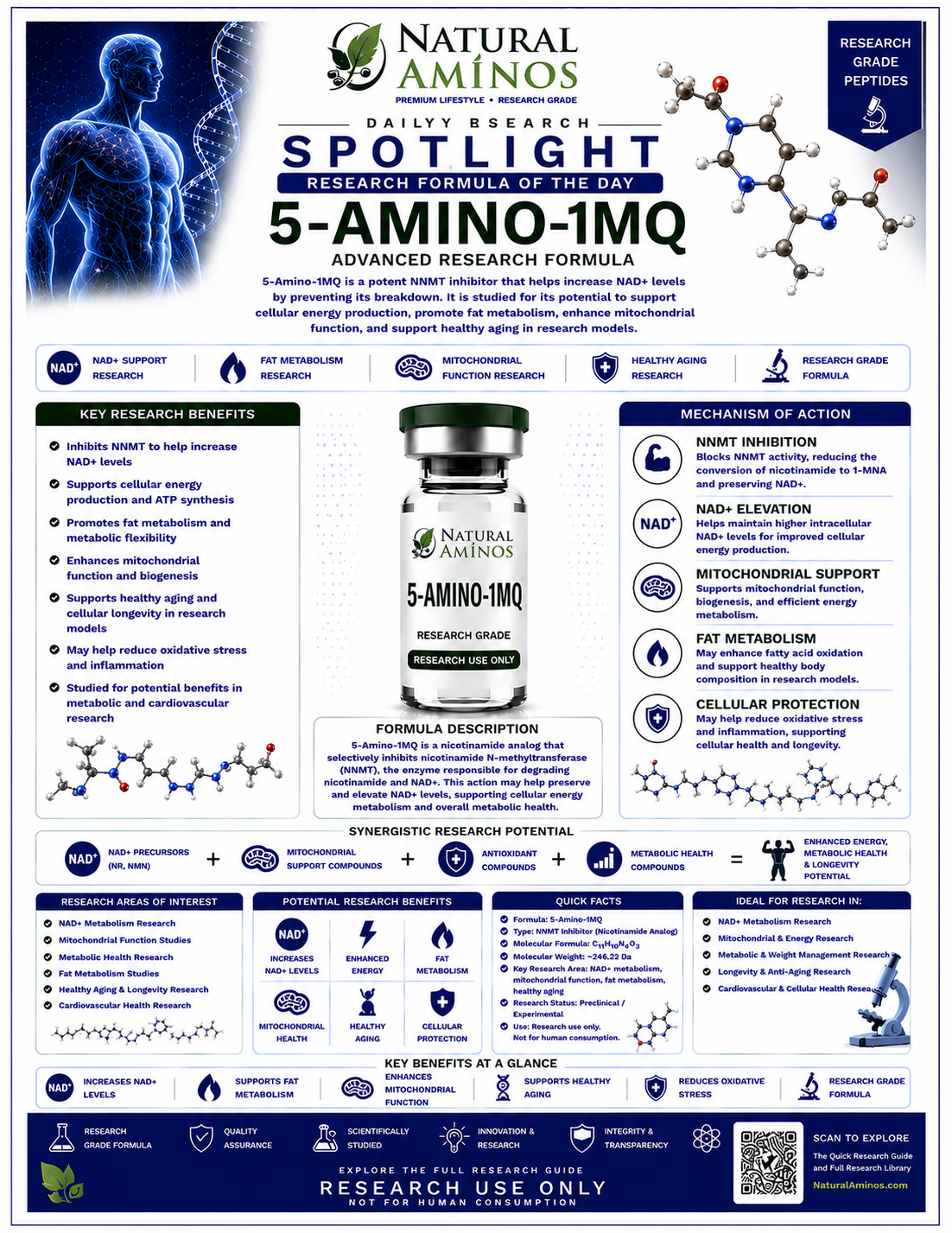
5-Amino-1MQ Research Data
5-Amino-1MQ is a small molecule studied as an inhibitor of nicotinamide N-methyltransferase, or NNMT. This profile explains the questions researchers investigated, how they tested them, and the limits of the findings. The studies summarized here involve laboratory experiments and mice; they do not establish benefits in people. [1] [2] [3] [4]
For laboratory research use only; not for human or veterinary use or consumption. This page provides research information, not personal-use instructions or medical advice.
Overview
The name refers to 5-amino-1-methylquinolinium. It is a small-molecule research compound, rather than a peptide. NNMT transfers a methyl group from S-adenosylmethionine, abbreviated SAM, to nicotinamide. Researchers investigate this enzyme because it connects nicotinamide metabolism with the use of cellular methyl donors. Inhibiting NNMT provides a way to examine these relationships experimentally. [1] [4]
Research Applications
The published work uses 5-Amino-1MQ as a tool to investigate enzyme activity, cellular metabolism, and tissue responses. These are experimental applications: they describe what scientists tested, rather than recommended uses for a person. The useful distinction is between a measured change in a particular model and a broader claim that has not been demonstrated in that model or in people.
Published Research and Reported Findings
2017 · Identifying an NNMT inhibitor
Research question: Could small molecules be designed to inhibit NNMT, and which chemical features affected their activity? Neelakantan and colleagues compared several related chemical families using enzyme assays. Their structure–activity work identified quinolinium compounds as a promising group of inhibitors, with activity in the low-micromolar range. [1]
What this establishes: The work provided a chemical starting point for studying NNMT inhibition. An enzyme-assay result is evidence of activity under the assay conditions; it does not demonstrate a health outcome or establish that every related compound behaves identically. [1]
2018 · Cellular metabolism and a short mouse study
Research question: Could a membrane-permeable NNMT inhibitor produce measurable effects in cells and in an animal model? The researchers examined inhibitor selectivity, cellular activity, and an 11-day experiment in mice with diet-induced obesity. Outcomes included body weight, food intake, adipose-tissue measurements, and circulating cholesterol. [2]
Reported findings: The paper describes reductions in body weight, adipose-tissue measures, and cholesterol in treated mice, without a significant reduction in measured food intake. This supports further investigation of NNMT in that experimental setting. It does not establish that 5-Amino-1MQ leaves human appetite unchanged: recorded mouse food intake and human appetite are different endpoints. The brief study also cannot establish sustained effects or long-term safety. [2]
2019 · Aged mouse muscle after experimental injury
Research question: Does inhibiting NNMT alter the response of aged skeletal muscle to injury? Neelakantan and colleagues studied aged mice after an experimentally induced muscle injury, alongside laboratory work on muscle cells. They assessed stem-cell activity, regenerating muscle fibers, and muscle function. [3]
Reported findings: Treated aged mice showed increased activation of muscle stem cells, larger regenerating fibers, and improved measured function in the injured limb. These findings concern regeneration in a specific aged-animal injury model. They do not demonstrate muscle preservation during human weight loss, athletic performance benefits, or effects on ordinary exercise recovery. [3]
2024 · A longer metabolic study in mice
Research question: Would NNMT inhibition affect several metabolic measurements over a longer observation period? Babula and colleagues compared a control group with two treatment groups over 28 days in diet-induced obese male mice, with eight animals per group. They tracked body composition, glucose handling, insulin, and liver-related measurements. [4]
Reported findings: The higher-exposure group gained less body weight and fat mass than controls. The authors also reported improvements in glucose tolerance, insulin-related measures, and liver findings. There was no significant overall treatment effect on lean mass or food intake. Importantly, limiting weight gain is not the same outcome as losing weight; the distinction should be retained when describing this study. [4]
Why More Research Is Needed
Taken together, these papers support NNMT inhibition as a subject for further laboratory investigation. They cover different questions, models, and endpoints, so their findings should not be combined into a single promise of benefit. Short animal experiments cannot determine long-term human safety, and results from aged injured muscle cannot automatically be applied to other tissues or circumstances.
This focused review did not identify a published controlled human trial of 5-Amino-1MQ. That is a statement about the evidence located for this profile, not proof that every registry or unpublished study has been exhausted. Independent replication, longer observation, and careful characterization of tissue-specific effects would strengthen the evidence. Research on other NNMT inhibitors must also remain separate unless the tested compound is clearly identified.
The practical reading is therefore narrow: 5-Amino-1MQ has a preclinical research history, with experimentally measured findings that justify further study. Those findings should be presented with their models and limitations, rather than converted into personal-use recommendations.
Sources
- Neelakantan H et al. (2017). NNMT inhibitor structure–activity study. Journal of Medicinal Chemistry, 60:5015–5028. DOI: 10.1021/acs.jmedchem.7b00389. Read the publication record.
- Neelakantan H et al. (2018; published online 2017). Cell and diet-induced-obesity mouse experiments. Biochemical Pharmacology, 147:141–152. DOI: 10.1016/j.bcp.2017.11.007. Read the research paper.
- Neelakantan H et al. (2019). NNMT inhibition in aged skeletal muscle. Biochemical Pharmacology, 163:481–492. DOI: 10.1016/j.bcp.2019.02.008. Read the research paper.
- Babula JJ et al. (2024). NNMT inhibition and metabolic dysfunction in mice. Diabetes, Obesity and Metabolism, 26:5272–5282. DOI: 10.1111/dom.15879. Read the publication record.