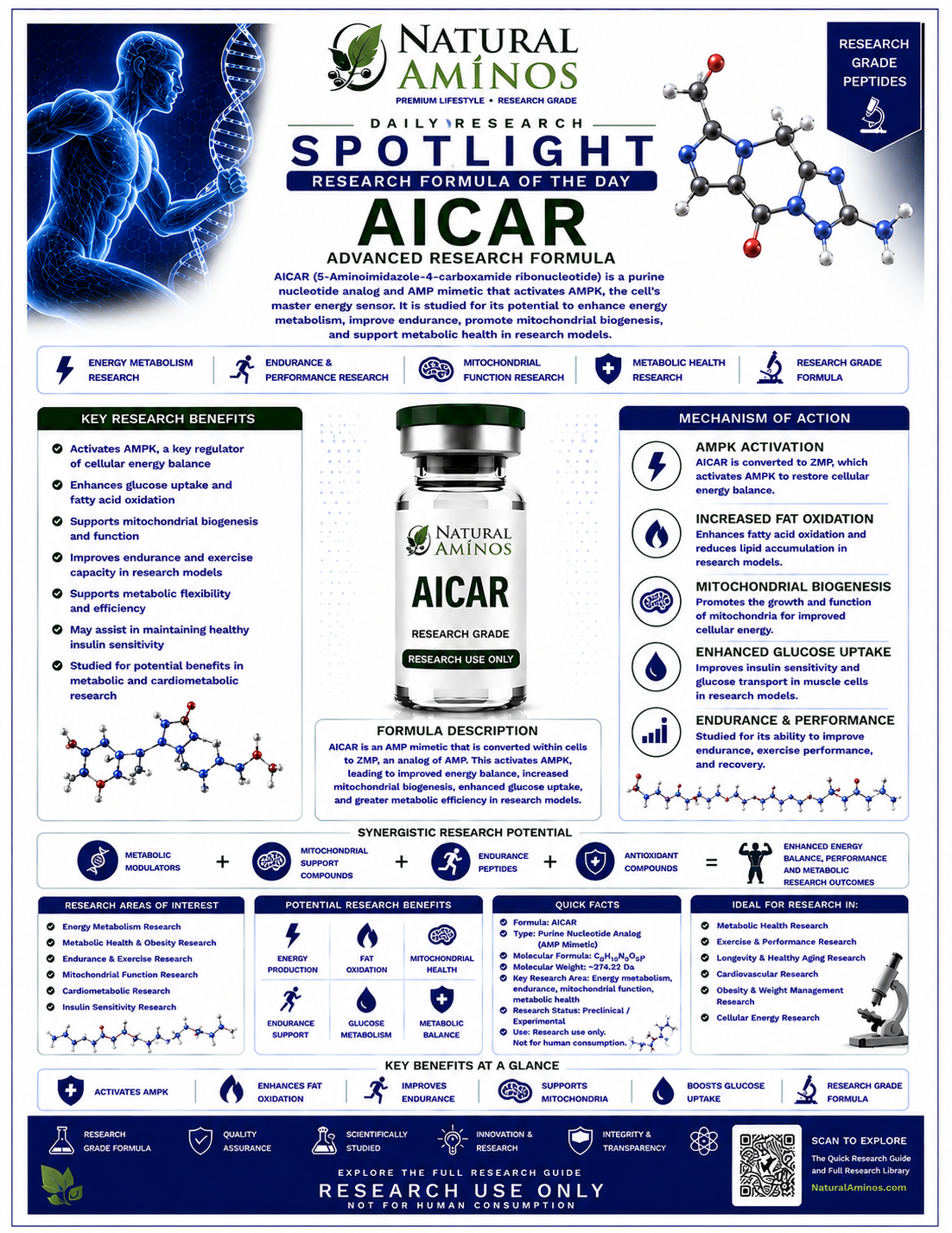
AICAR Research Data
For laboratory research use only; not for human or veterinary use or consumption. This page provides research information, not personal-use instructions or medical advice.
Natural Aminos Research Formula of the Day — AICAR
Benefits
AICAR (5-aminoimidazole-4-carboxamide ribonucleoside) is a synthetic AMP-mimetic that directly activates AMPK, the cell's central energy-sensing enzyme. In animal research it has been shown to meaningfully boost endurance and induce genes tied to oxidative metabolism, even without exercise — a landmark 2008 mouse study found four weeks of AICAR alone improved running endurance by 44% in sedentary animals. It also improves glucose uptake and reduces fatty acid storage in adipose tissue across various insulin-resistance models.
Uses
AICAR is used in research settings for direct AMPK activation tied to endurance and glucose/fat-oxidation demand — its 'exercise-in-a-pill' reputation stems largely from the 2008 mouse endurance study. It also has an older, separate clinical history in cardiovascular contexts, specifically reducing ischemic injury around cardiac surgery (coronary artery bypass grafting).
Published Research
AICAR has the oldest human trial history of any of the AMPK-pathway compounds covered in this series, dating to 1980s cardiac-surgery research. A 1997 meta-analysis of early trials found AICAR reduced early cardiac death and combined adverse cardiovascular outcomes after bypass surgery — a genuinely positive early signal. However, those results weren't confirmed by later, larger trials, and the RED-CABG trial was stopped early in 2012 after showing no benefit, effectively ending its cardiac-surgery development path. Outside cardiac surgery, AICAR's human data is thin; the landmark 2008 mouse study establishing its endurance and 'exercise mimetic' reputation has not been replicated as a performance outcome in humans, meaning the effect that AICAR is most known for today has no human confirmation at all.
AICAR is also notable in sports contexts for a different reason: it has been used as a doping agent and is banned by the World Anti-Doping Agency, based specifically on the animal endurance data rather than confirmed human performance effects.
Why More Research Is Needed
AICAR's evidence tells two very different stories depending on which use you're looking at. Its cardiac-surgery data is real human RCT evidence, but the overall trajectory is negative — an initial positive meta-analysis followed by a large trial (RED-CABG) that was stopped for futility, meaning the honest read is that AICAR does not have confirmed cardiac benefit despite decades of study. Its endurance/metabolic reputation, meanwhile, rests entirely on a single mouse study from 2008 — genuinely striking findings, but never tested for a performance outcome in humans in the 18 years since. That's an unusually large gap between how the compound is marketed (an exercise-mimetic performance enhancer) and what's actually been shown in people (essentially nothing on that specific claim, and a discontinued cardiac development program).
Sources
MDPI Cells — AICAr, a Widely Used AMPK Activator with Important AMPK-Independent Effects: A Systematic Review
Superpower — AICAR: AMP-Mimetic Nucleoside & AMPK Activator
RSC Advances — Quantification of AICAR and Study of Metabolic Markers After Administration
Cell — AMPK and PPARdelta Agonists Are Exercise Mimetics (Narkar et al., 2008)
ClinicalTrials.gov — RED-CABG: Adenosine and AICAR in Cardiac Surgery
Hashtags
#PeptideResearch #ResearchPeptides #Biohacking #ScienceBased #Metabolism #MetabolicHealth #MetabolicScience #FatLossResearch #BodyComposition #CellularHealth #MuscleMetabolism