AOD-9604 Research Data
For laboratory research use only; not for human or veterinary use or consumption. This page provides research information, not personal-use instructions or medical advice.
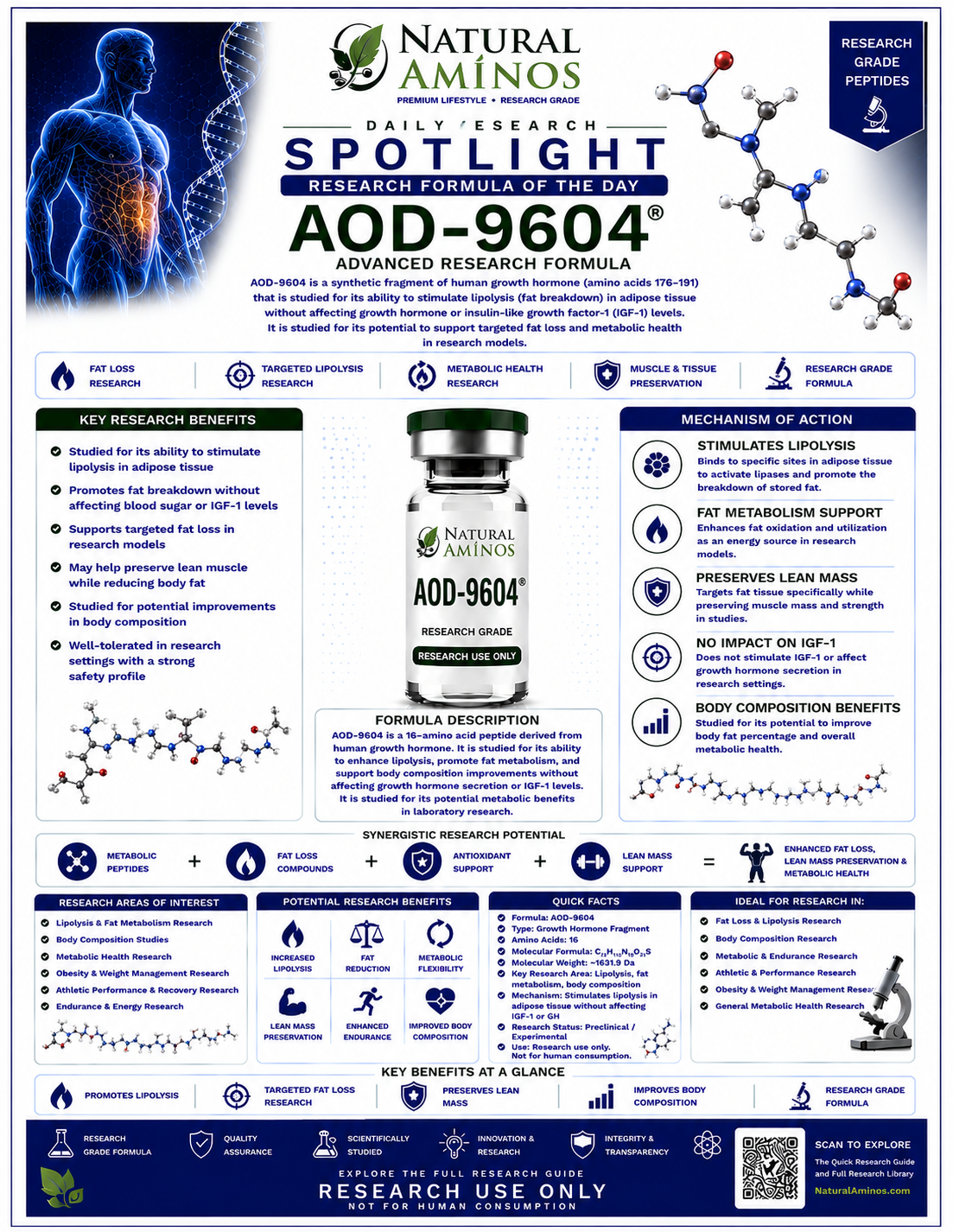
Natural Aminos Research Formula of the Day — AOD-9604
Benefits
AOD-9604 is a 16-amino-acid fragment of human growth hormone (the C-terminal region linked to hGH's fat-metabolizing activity, without its growth-promoting effects). It's designed to trigger lipolysis (fat breakdown) and inhibit lipogenesis (new fat storage) via beta-3 adrenergic receptor activity in fat tissue, while leaving glucose and insulin levels largely unaffected — the rationale behind its original positioning as an obesity treatment distinct from full-length growth hormone.
Uses
AOD-9604 has been studied specifically for obesity and fat loss, particularly targeting visceral/abdominal fat, and more recently for potential cartilage and joint-repair applications, distinct from its original weight-loss indication. It has no current FDA approval for any use.
Published Research
AOD-9604 has a genuinely substantial human trial history for a compound now marketed largely in research/wellness spaces — and that history includes a clear, well-documented failure worth stating plainly. It has been tested in approximately 900 human participants across six clinical trials, including both IV and oral dosing studies. An early 23-week randomized trial reported 2.8 kg of weight loss versus 0.8 kg for placebo, and animal studies (Ng et al., 2000, Hormone Research) established its fat-selective mechanism in genetically obese rodents. However, its pivotal Phase 2b trial — 534 obese adults over 24 weeks, sponsored by Metabolic Pharmaceuticals — failed to separate from placebo on its primary weight-loss endpoint. Development as a prescription obesity drug was discontinued in 2007 as a direct consequence of that result, and no further clinical development toward an obesity indication has occurred since.
Separately, more recent preclinical interest has explored AOD-9604 for cartilage and joint applications, based on growth-hormone-fragment activity on chondrocytes, though this remains an early-stage research direction rather than a validated human use.
Why More Research Is Needed
The core issue with AOD-9604 isn't a lack of human data — it's that the largest, best-controlled human trial available (534 participants, the kind of sample size most research peptides never get close to) produced a negative result on the primary outcome it's marketed for. That's a meaningfully different and more serious gap than 'needs more studies': it's an existing negative trial that current marketing for the compound generally doesn't mention. Its favorable safety profile across roughly 900 total participants is real and worth noting, but safety without demonstrated efficacy doesn't support the weight-loss claims still commonly made about it. Its newer cartilage/joint research direction is at a much earlier stage and would need its own dedicated human trials before any claims there could be considered supported.
Sources
Beverly Hills Rejuvenation Center — AOD-9604 Appetite-Neutral Fat Loss Process
TrimRx — AOD-9604: What the Research Actually Says (Evidence Review)
Journal of Endocrinology and Metabolism — Safety and Metabolism of AOD9604
Weight Loss and Vitality — AOD-9604 Peptide for Weight Loss
Regeneris Therapy — AOD-9604: The Fat-Loss Peptide, Does It Really Work?
Hormone Research — Ng, F.M. et al. (2000), AOD9604 Fat-Selective Mechanism in Obese Rodents
Hashtags
#PeptideResearch #ResearchPeptides #Biohacking #ScienceBased #MetabolicHealth #FatLossResearch #BodyComposition #Metabolism #WeightManagement #MetabolicScience