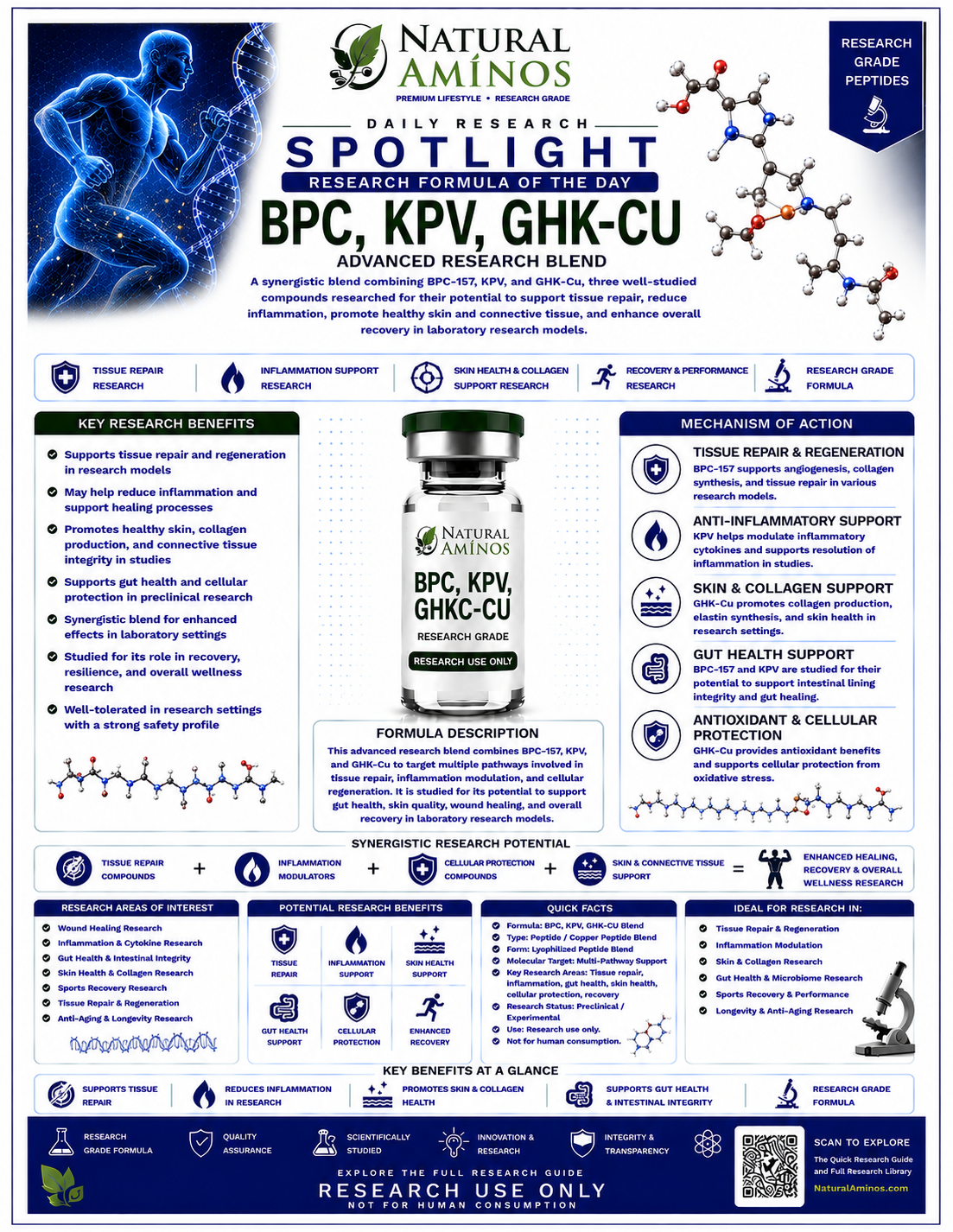
BPC, KPV, GHK-CU Combo Blend Research Data
For laboratory research use only; not for human or veterinary use or consumption. This page provides research information, not personal-use instructions or medical advice.
NATURAL AMINOS RESEARCH
Formula of the Day
BPC-157, KPV & GHK-Cu
Systemic Repair & Inflammation Blend — Spotlight
Benefits
BPC-157 is a 15-amino-acid fragment originally isolated from human gastric juice, studied almost entirely in rodents for promoting angiogenesis, modulating nitric oxide signaling, and upregulating local growth-factor activity at sites of tissue injury — the basis for its reputation as a gut- and connective-tissue-repair compound.
KPV is the C-terminal tripeptide of alpha-MSH (Lys-Pro-Val). Its anti-inflammatory effect is well documented in mouse models, working through inhibition of NF-κB and MAP kinase inflammatory signaling. Its own research base is almost entirely focused on gut inflammation, not systemic or dermal inflammation, so its contribution to this blend is a mechanistic extrapolation — the same anti-inflammatory pathway plausibly applies wherever that signaling is active, though that broader application hasn't itself been tested.
GHK-Cu is a naturally occurring copper-binding tripeptide (glycyl-histidyl-lysine) present in human blood plasma, where it declines from roughly 200 ng/mL at age 20 to about 80 ng/mL by age 60 — a decline that tracks with reduced wound healing, collagen loss, and skin thinning. It stimulates collagen, elastin, and glycosaminoglycan synthesis, modulates the enzymes that break down and rebuild connective tissue, promotes new blood vessel formation, and has documented antioxidant and anti-inflammatory activity. Among the three peptides in this blend, GHK-Cu has by far the deepest human evidence — but that evidence is specifically for topical, not injectable, use.
Uses
BPC-157 is used in research and off-label practice for gut healing, tendon and ligament injury, and general tissue-repair support; it is sold only as a research chemical and is not FDA-approved. KPV is used almost exclusively in inflammatory bowel disease research; any use for skin, joint, or systemic inflammation is off-label extrapolation from its gut-inflammation mechanism, not a studied application. GHK-Cu has well-established, mainstream uses in topical cosmetic and wound-care products — anti-aging skin creams, hair-growth serums, and surgical/donor-site wound dressings — and is separately used off-label as a subcutaneous injection for proposed systemic anti-aging and tissue-remodeling effects, a use case that sits well outside its tested evidence base.
Published Research
Across the three, human trial evidence is uneven and, for two of the three compounds, essentially absent. BPC-157 has no completed human clinical trials of any kind — a 2025 systematic review found no confirmed human safety or efficacy data, with virtually everything published coming from rodent studies of gut ulcers, tendon healing, and ligament repair. KPV's evidence is similarly rodent-only and gut-specific: it reliably reduces inflammatory markers in mouse models of colitis by inhibiting NF-κB and MAP kinase signaling, but no human trial — gut, skin, or otherwise — has tested KPV directly.
GHK-Cu stands apart: controlled human trials, mostly funded by the cosmetic industry, have shown that topical GHK-Cu creams and serums increase measurable skin collagen production and thickness over 12-week use, accelerate healing of surgical and donor-site wounds, and in preliminary trials increased hair follicle size and hair growth comparably to 5% minoxidil. That is real, published human data — but it applies to topical application. Subcutaneous or injectable GHK-Cu, the form most commonly used when it's added to a peptide blend like this one, has no published controlled human trial behind it; its use that way rests on gene-expression data, the plasma-decline-with-age correlation, and extrapolation from the topical wound-healing results, not on a systemic human trial. No published research has evaluated BPC-157, KPV, and GHK-Cu together, or any two of the three in combination, for any outcome.
Why More Research Is Needed
What's actually proven, formula by formula: GHK-Cu has genuine, repeated human trial evidence — but only for topical use in skin, wound, and hair applications. BPC-157 has zero completed human trials of any kind. KPV has zero completed human trials of any kind, and even its animal evidence is confined to gut inflammation. Of the three, none has human trial evidence for the systemic, injectable use this kind of blend is typically marketed for.
The theory behind combining them: the pitch is that each peptide addresses a different layer of tissue repair — KPV damping the inflammatory signal, BPC-157 supporting local vascular and growth-factor repair, and GHK-Cu rebuilding the structural collagen and connective-tissue matrix once inflammation and vascular repair have done their part. Mechanistically that sequencing story is coherent and the three pathways genuinely don't overlap, which is a reasonable foundation for a theory.
Where the theory is weaker in practice: this blend is a case where the theory is carrying unusually more weight than the proof, because the one member with strong human data (GHK-Cu) has that data for a different route of delivery (topical) than the one the blend is actually used by (injectable/systemic), while the other two members have no human data of any kind, in any form. The plausible mechanism explains why someone might design this combination; it does not mean the combination — injected, together — has been shown to do anything in a person.
Verdict — theory vs. proof: the mechanistic theory for this blend is reasonably strong (three non-overlapping repair pathways: anti-inflammatory, vascular/growth-factor, and structural/collagen), but the practical evidence is weak and unevenly distributed — real but route-mismatched proof for GHK-Cu, and no human proof at all for BPC-157 or KPV. Treat this as a mechanistically reasoned hypothesis, not as three proven treatments stacked together.
Sources
• Vasireddi et al. (2025) — Systematic Review: No Completed Human Clinical Trials or Confirmed Human Safety Data for BPC-157
• PubMed — Dissection of the Anti-Inflammatory Effect of the Core and C-Terminal (KPV) Alpha-MSH Peptides
• PubMed — Melanocortin-Derived Tripeptide KPV Has Anti-Inflammatory Potential in Murine Models of IBD
• PMC — Regenerative and Protective Actions of the GHK-Cu Peptide in the Light of the New Gene Data
• PMC — GHK Peptide as a Natural Modulator of Multiple Cellular Pathways in Skin Regeneration
• PRIME Journal — Copper Tripeptide GHK-Cu and Regenerative Aesthetics
• NPR — The Copper Peptide Trend Has Gone from Creams to Injections — Ahead of the Science (2026)
Hashtags
#Peptidetherapy #PeptideResearch #PeptideScience #Biohacking #ResearchPeptides #ScienceBased #BPC157 #KPV #GHKCu #TissueRepair #AntiInflammatory
This material is for research and educational purposes only and is not medical advice. None of these three peptides is FDA-approved, and this specific combination has never been studied.