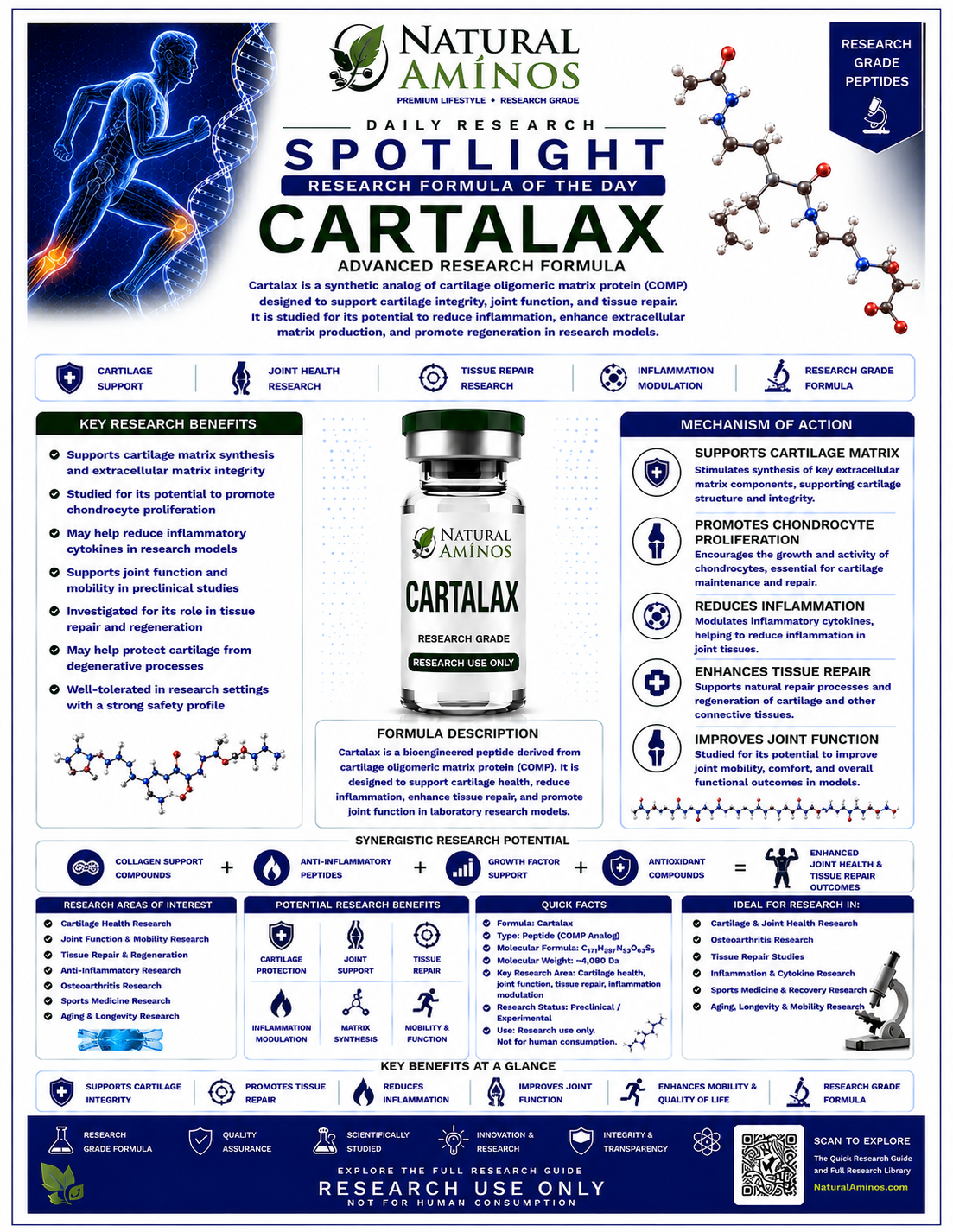
Cartalax Research Data
For laboratory research use only; not for human or veterinary use or consumption. This page provides research information, not personal-use instructions or medical advice.
Natural Aminos Research Formula of the Day — Cartalax
Benefits
Cartalax is a short-chain synthetic peptide developed within the Khavinson bioregulator research program at the St. Petersburg Institute of Bioregulation and Gerontology in Russia. It's proposed to act on chondrocytes (cartilage cells) and connective tissue by interacting with gene-regulatory regions of DNA, modulating expression of extracellular matrix components like collagen type II and aggrecan — the proteins that give cartilage its structure. Vendor material describes observed changes in matrix protein expression and proliferation markers in chondrocyte culture models.
Uses
Cartalax is positioned for cartilage and connective-tissue research, joint-health applications, and age-related cartilage decline. It has no approved medical use anywhere and is sold exclusively as a research-use-only laboratory reagent — not for human or veterinary administration.
Published Research
This is the thinnest and most uncertain evidence base covered in this series so far, and it's worth being unusually direct about why. Multiple commercial supplier pages attribute Cartalax's research to specific named sources — a 2009 and 2010 Bulletin of Experimental Biology and Medicine paper by Khavinson and colleagues, and a 2012 Advances in Gerontology paper by Grigoriev and colleagues — describing chondrocyte gene expression and cytokine-profile studies in animal models. However, none of these specific citations could be independently located or verified in standard indexed research databases during this search; they appear only within promotional/vendor content, not in a searchable, citable published record.
A separate concern: supplier pages disagree with each other on Cartalax's basic chemical identity. Different vendors describe it as a tripeptide (Ala-Glu-Asp), a tetrapeptide (Ala-Glu-Asp-Leu), and a tetrapeptide with a different fourth residue (Ala-Glu-Asp-Lys) — three different molecular structures for the same product name. That kind of inconsistency across commercial sources, on a basic structural fact rather than an interpretive one, is itself informative: it suggests the available information ecosystem for this compound is not well-anchored to a single, verifiable published source.
Cartalax does appear to sit within a genuinely real broader research tradition — the Khavinson 'cytomedin' class of short bioregulatory peptides (which includes Epitalon, a more independently documented compound) has decades of Russian biogerontology literature behind it as a category. But for Cartalax specifically, this search did not surface an independently verifiable, indexed published study — the evidence consists of vendor-page claims about preclinical work, not a confirmable citation trail.
Why More Research Is Needed
The gap here is more fundamental than 'needs more human trials' — it's that the preclinical evidence itself couldn't be independently verified in this search, despite specific journal names and years being cited by commercial sources. Combined with vendors disagreeing on the compound's basic amino acid sequence, the honest assessment is that Cartalax's evidence base is currently unconfirmable from publicly accessible, indexed literature, which is a meaningfully different and more serious problem than simply lacking human trials. Before any claims about this compound could be evaluated, the basic step of establishing a verifiable, consistent published record — starting with confirming its actual chemical structure — would need to happen first.
Sources
Luxe Peptides — Cartalax 20mg — Khavinson Bioregulator
VPeptide — Cartalax — 20mg | AEDL Khavinson Cartilage Peptide
BioEdge Research Labs — Cartalax Peptide: Preclinical Research Overview
Cartalax.net — Cartalax (20mg) 99% Purity USA-Made Peptide
Note: Journal citations referenced by the above sources (Bulletin of Experimental Biology and Medicine 2009/2010; Advances in Gerontology 2012) could not be independently verified in this search and are reported here only as vendor claims, not confirmed published literature.
Hashtags
#PeptideResearch #ResearchPeptides #Biohacking #ScienceBased #CellularHealth #TissueRepair #Longevity #HealthyAging