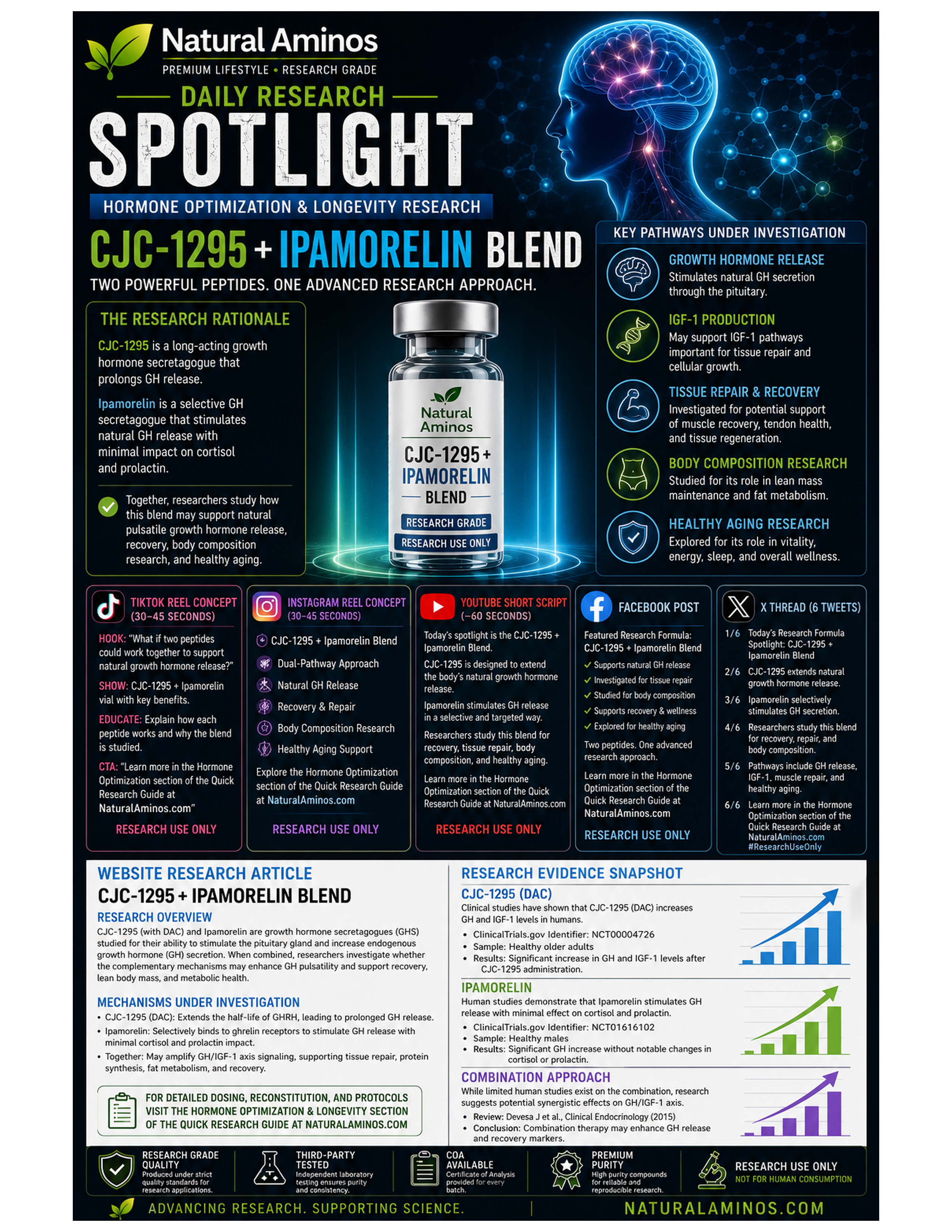
CJC-1295 + Ipamorelin Blend Research Data
For laboratory research use only; not for human or veterinary use or consumption. This page provides research information, not personal-use instructions or medical advice.
Natural Aminos Research Formula of the Day — CJC-1295 & Ipamorelin (Blend)
Benefits
CJC-1295 is a long-acting synthetic analog of growth hormone-releasing hormone (GHRH). Its DAC (Drug Affinity Complex) version covalently binds circulating albumin after injection, extending native GHRH's 7–10-minute half-life out to roughly 6–8 days. In a 2006 randomized, placebo-controlled, double-blind Phase 1/2 dose-escalation trial in 66 healthy adults, a single injection produced dose-dependent growth hormone increases of 2- to 10-fold and IGF-1 increases of 1.5- to 3-fold, sustained for 6–14 days, with evidence of a cumulative effect across repeated doses.
Ipamorelin is a synthetic pentapeptide that activates the ghrelin receptor (GHS-R1a) to stimulate pulsatile GH release. Its defining pharmacological feature, established in a 1998 animal study, is that it stimulates GH without meaningfully raising cortisol, ACTH, or prolactin — unlike older ghrelin-receptor agonists such as GHRP-6 or GHRP-2, which do raise those hormones. Ipamorelin also shows a built-in ceiling effect, where higher doses plateau rather than producing proportionally higher GH levels, distinguishing it from directly injected exogenous GH.
Because the two peptides act on different pituitary receptors (CJC-1295 on the GHRH receptor, ipamorelin on the ghrelin receptor) that converge on the same GH-release pathway, they are commonly stacked together. Veldhuis and Bowers documented in 2009 that simultaneous activation of both receptor systems can produce a larger GH pulse than either pathway alone — a real, published pharmacological finding, though not itself a study of this branded combination in a controlled human trial.
Uses
Neither peptide is FDA-approved for any indication. CJC-1295 reached Phase 2 testing for HIV-associated lipodystrophy, but that trial was halted in 2006 after a participant died during the study (a death that was determined to be unrelated to the study drug); commercial development did not continue past that point. As of April 2026, CJC-1295 is classified under the FDA's 503A Category 2 list, restricting its use in compounded medications for human administration. Ipamorelin received the same FDA Category 2 classification in September 2023.
The one indication where ipamorelin reached a genuine human efficacy trial is unrelated to bodybuilding or anti-aging use: a randomized, controlled, proof-of-concept Phase 2 study tested ipamorelin for postoperative ileus (delayed bowel function) after bowel resection surgery, confirming safety and meaningful GH elevation in a surgical population, though primary efficacy endpoint results were mixed.
Outside these formal trial contexts, the CJC-1295/ipamorelin combination is one of the most commonly prescribed peptide protocols at anti-aging and sports-medicine clinics in the United States, used for GH-axis support, body composition (lean mass gain, fat reduction), recovery, sleep quality, and general anti-aging goals. These are investigational, off-label uses; no regulatory body has evaluated or approved the combination for any of them.
Published Research
Each peptide individually has real, controlled human trial data. CJC-1295's foundational human evidence is the 2006 Teichman et al. Phase 1/2 program (two randomized, double-blind, placebo-controlled, ascending-dose trials, 66 healthy adults total), establishing dose-dependent, sustained GH and IGF-1 elevation with a favorable short-term safety profile. Ipamorelin's human evidence includes pharmacokinetic/pharmacodynamic characterization plus the 2014 Beck, Sweeney, and McCarter randomized controlled Phase 2 trial in postoperative ileus patients — a genuine controlled human trial, though for a gastrointestinal-motility indication rather than growth-hormone or body-composition outcomes.
No published human randomized controlled trial of the CJC-1295 + ipamorelin combination itself has been identified, as of the most recent review of this literature (2026). Every source describing the combination — clinical training programs, peptide-industry reviews, and orthopaedic and cardiology commentary alike — states the same thing in different words: the combination's rationale rests on combining each peptide's separate dataset and general GHRH/ghrelin receptor physiology, not on a dedicated trial of the pairing. One frequently cited mechanistic source (Veldhuis and Bowers, 2009) supports that simultaneous GHRH- and ghrelin-receptor activation produces a larger GH pulse than either pathway alone, but this is basic endocrine physiology research, not a clinical outcomes trial of the branded CJC-1295/ipamorelin stack.
Why More Research Is Needed
What's actually proven, peptide by peptide: CJC-1295 has real, randomized, placebo-controlled human trial evidence for sustained GH/IGF-1 elevation, though its clinical development program was discontinued after Phase 2 following an unrelated trial death, and no efficacy trial for any specific health outcome was completed. Ipamorelin has real randomized controlled human trial evidence too, but the one completed efficacy trial tested a GI-motility outcome (postoperative ileus), not GH-axis, body-composition, or recovery outcomes — the uses it is actually marketed for today.
The theory behind stacking them: CJC-1295 and ipamorelin activate two distinct pituitary receptor systems (GHRH receptor and ghrelin receptor, respectively) that both converge on GH secretion through non-overlapping intracellular pathways. Mechanistically, this is a genuinely strong theory — it is not two compounds competing for the same receptor, and basic endocrine physiology research (Veldhuis and Bowers, 2009) directly supports that dual-pathway activation produces a larger combined GH pulse than either pathway alone. This is one of the more mechanistically coherent peptide stacks in this series.
Where the theory is weaker in practice: mechanistic synergy at the level of a single GH pulse is not the same as demonstrated benefit for the downstream outcomes people actually use this stack for — lean mass, fat loss, sleep quality, recovery, or anti-aging effects. No controlled human trial of the combination exists for any of those outcomes, and neither individual peptide's own completed human trials tested them either (CJC-1295's trials measured hormone levels, not body composition or clinical outcomes; ipamorelin's one efficacy trial measured bowel recovery, not GH-related goals). So the honest picture has two separate gaps stacked on top of each other: first, whether the combination produces a bigger GH pulse than either peptide alone is well-supported in theory and general physiology, but not tested head-to-head in this specific branded combination; second, and more importantly, even a larger GH pulse has not itself been shown in controlled trials to produce the body-composition, recovery, or anti-aging outcomes this stack is marketed for. If choosing based on strength of evidence rather than strength of theory, the honest read is: mechanistically strong, clinically unconfirmed — for the combination itself and for every downstream outcome currently marketed alongside it.
Sources
Journal of Clinical Endocrinology & Metabolism (2006) — Teichman et al.: Prolonged Stimulation of GH and IGF-I Secretion by CJC-1295, a Long-Acting Analog of GH-Releasing Hormone, in Healthy Adults
American Journal of Physiology – Endocrinology and Metabolism — Once-Daily Administration of CJC-1295 Normalizes Growth in the GHRH Knockout Mouse
PubMed (1998) — Raun et al.: Ipamorelin, the First Selective Growth Hormone Secretagogue
International Journal of Colorectal Disease (2014) — Beck, Sweeney, McCarter: Randomized, Controlled, Proof-of-Concept Study of Ipamorelin for Postoperative Ileus in Bowel Resection Patients
JCSM Rapid Communications (2020) — Ishida et al.: Growth Hormone Secretagogues: History, Mechanism of Action, and Clinical Development
U.S. FDA — 503A Bulk Drug Substances / Category 2 List (CJC-1295 and Ipamorelin classifications)
Superpower (peptide research guide, 2026) — CJC-1295 and Ipamorelin: Mechanism & Research (citing Veldhuis & Bowers, 2009, on dual-pathway GH synergy)
Hashtags
#Peptidetherapy #PeptideResearch #PeptideScience #Biohacking #ResearchPeptides #ScienceBased #CJC1295 #Ipamorelin #GrowthHormone #BodyComposition #RecoveryScience