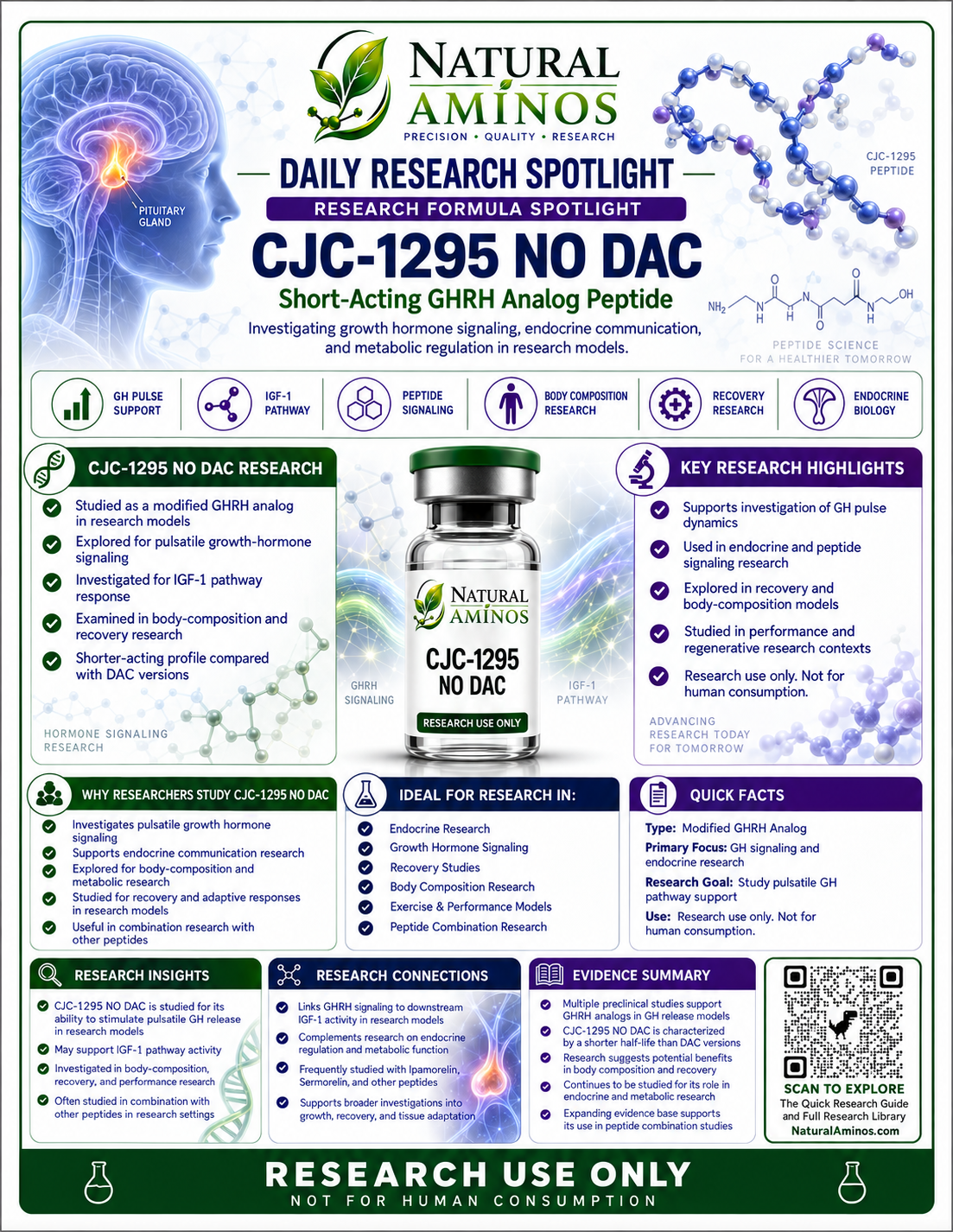
CJC-1295 No DAC Research Data
For laboratory research use only; not for human or veterinary use or consumption. This page provides research information, not personal-use instructions or medical advice.
Natural Aminos Research Formula of the Day — CJC-1295 (No DAC)
Benefits
CJC-1295 without DAC — also known as Modified GRF (1-29) or Mod GRF 1-29 — is a synthetic 30-amino-acid analog of the bioactive portion of human growth hormone-releasing hormone (GHRH). It contains four amino-acid substitutions that confer enhanced enzymatic stability compared to native GHRH, binding GHRH receptors on the pituitary to stimulate GH release. Unlike its DAC counterpart, it clears from the body in roughly 30 minutes, producing pulsatile rather than continuous GH stimulation — a profile its proponents argue better preserves the body's natural GH release pattern.
Uses
CJC-1295 no DAC is researched for growth-hormone-dependent effects: muscle growth, fat metabolism, recovery, and sleep quality, typically administered multiple times daily due to its short half-life. It has no FDA approval, no prescribing information, and cannot be legally obtained through a licensed U.S. compounding pharmacy — it's sold strictly as a research chemical.
Published Research
This is a case where getting the specific version right matters a great deal, and it's worth being direct: the actual human clinical trial evidence for 'CJC-1295' was conducted specifically on the DAC-modified version, not the no-DAC version being spotlighted today. The landmark 2006 study (Teichman et al., published in the Journal of Clinical Endocrinology & Metabolism) — two randomized, placebo-controlled, double-blind trials in healthy adults ages 21-61 — found CJC-1295 with DAC produced dose-dependent GH elevations of 2- to 10-fold and sustained IGF-1 elevations of 1.5- to 3-fold lasting 9-11 days after a single dose. That trial, and the broader evidence base built on it (3 published human trials totaling roughly 55 participants, plus 15+ preclinical studies, reaching Phase 2 trials for lipodystrophy and GH deficiency before discontinuation), was specifically testing the long-acting DAC formulation designed for sustained, weekly dosing.
The no-DAC version was not the subject of that trial or, as far as this search identified, any dedicated human clinical trial of its own. Its shorter, pulsatile pharmacokinetic profile is different enough from the DAC version's sustained-release mechanism that findings from one don't straightforwardly transfer to the other — the DAC version's albumin-binding mechanism is precisely what the no-DAC version lacks. Separately, worth noting for full context on the compound family: the DAC version's Phase 2 clinical trial program was discontinued after the death of one trial participant, though the attending physician attributed this to unrelated pre-existing coronary artery disease rather than the treatment itself; research was still halted as a precaution.
Why More Research Is Needed
The core gap here is a version-specific one that's easy to miss: most of what gets cited as 'CJC-1295 research' — including the human GH/IGF-1 elevation data — was established using the DAC formulation, not the no-DAC version most commonly used in research and fitness contexts today. That means the no-DAC version's popular use is supported largely by extrapolation from a differently-behaving molecule, plus general GHRH-class reasoning, rather than dedicated human trials of its own. The wider CJC-1295 development program is also worth remembering: it reached actual Phase 2 human trials before being discontinued following a participant death, even though investigators attributed the death to an unrelated cause — a level of clinical scrutiny (and a reason for discontinuation) that most research peptides never encounter at all.
Sources
PubMed — Prolonged Stimulation of Growth Hormone (GH) and Insulin-Like Growth Factor I Secretion by CJC-1295, a Long-Acting Analog of GH-Releasing Hormone, in Healthy Adults (Teichman et al., 2006)
Superpower — CJC-1295: Long-Acting GHRH Analog Research
Omnix Peptides — CJC-1295 No DAC: GHRH Analog Research & SKUs
Wikipedia — CJC-1295 (citing Andersen, Hartvig-Bjerre & Holm, 2014; ConjuChem, 2006)
FormBlends — CJC 1295 Peptide: Evidence, DAC vs No DAC, Clinical Reality
Hashtags
#Peptidetherapy #PeptideResearch #PeptideScience #Biohacking #ResearchPeptides #ScienceBased #HormonalHealth #MuscleRecovery #Metabolism #RecoveryScience