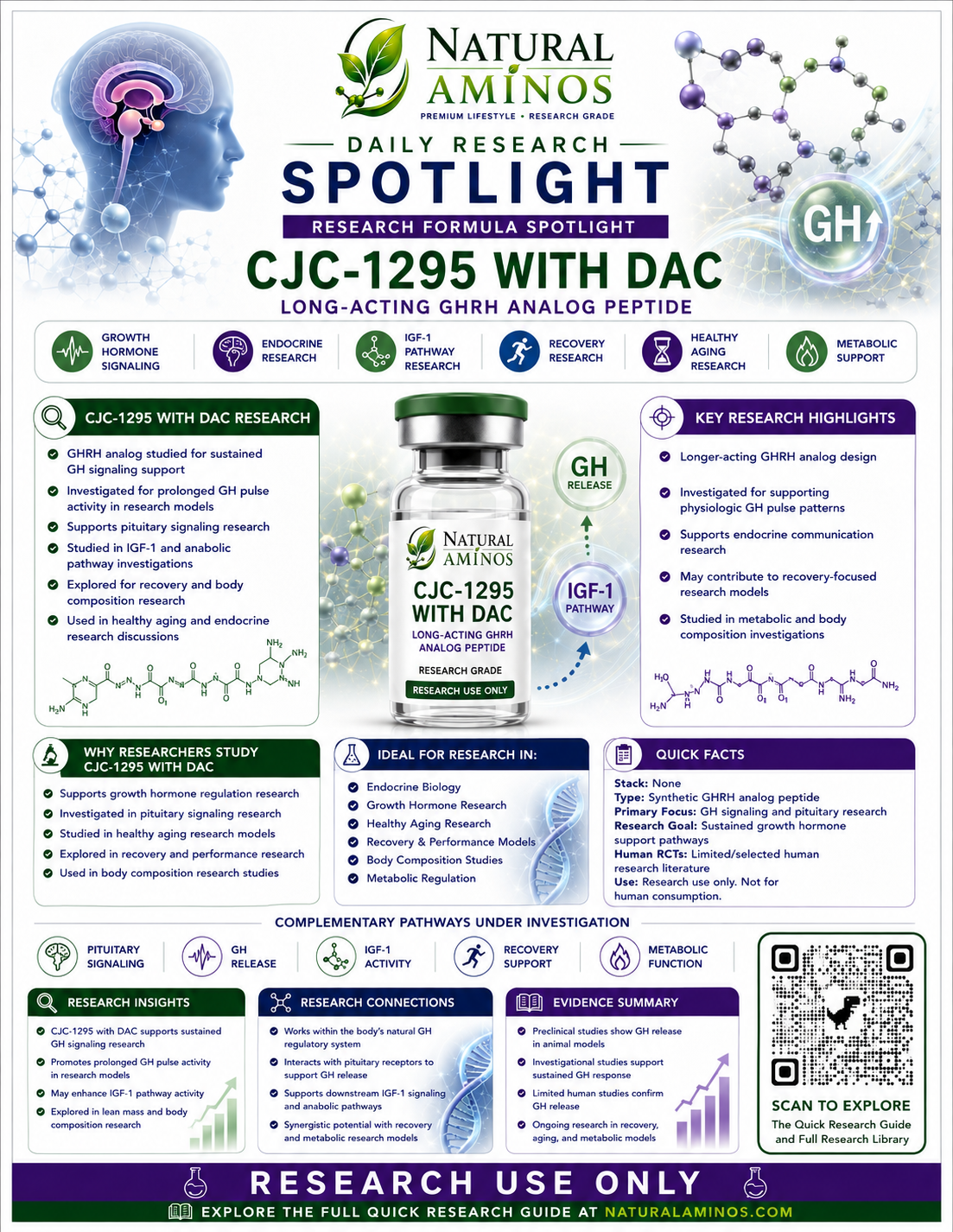
CJC-1295 with DAC Research Data
For laboratory research use only; not for human or veterinary use or consumption. This page provides research information, not personal-use instructions or medical advice.
NATURAL AMINOS RESEARCH
Formula of the Day
CJC-1295 with DAC
Long-Acting GHRH Analog — Spotlight
Benefits
CJC-1295 is a synthetic analog of human growth-hormone-releasing hormone (GHRH), modified with four amino acid substitutions that make it resistant to the enzyme (DPP-IV) that normally breaks GHRH down within minutes. The “with DAC” version adds a Drug Affinity Complex — a chemical handle that lets the peptide covalently bind to circulating albumin once injected. Because albumin itself has a long half-life in blood, that binding extends CJC-1295's own half-life from minutes to roughly 6–8 days, which is the entire point of the DAC modification and what distinguishes it from plain CJC-1295 (“without DAC,” also called Mod GRF 1-29), a much shorter-acting version dosed multiple times a day.
Its proposed benefit is a sustained, less frequent way to stimulate the body's own growth hormone and downstream IGF-1 production, rather than injecting synthetic GH directly. In the human trial data available, this worked as designed: GH and IGF-1 rose in a dose-dependent way, IGF-1 stayed elevated well after each dose, and the effect held up over repeated weekly or biweekly dosing — a real, measured pharmacological effect, not merely a proposed one.
Uses
CJC-1295 with DAC was originally developed by a biotech company (ConjuChem) as an investigational drug candidate for growth hormone deficiency and related indications, tested in Phase 1 human trials in the mid-2000s; that clinical development program did not proceed to FDA approval, and no FDA-approved drug based on CJC-1295 exists today. It is not legally available through licensed compounding pharmacies in the United States as of the most recent FDA guidance, and it has no approved prescribing label. In practice, it is used exclusively off-label and through unregulated research-chemical sourcing, most commonly for proposed anti-aging, body-composition (increased lean mass, reduced fat), and general GH-optimization purposes — all uses outside anything the original clinical trials were designed to test.
Published Research
The core human evidence is a 2006 Phase 1 program (Teichman et al., Journal of Clinical Endocrinology & Metabolism): two randomized, placebo-controlled, double-blind, ascending-dose trials (28 and 49 days) in healthy adults aged 21–61. A single subcutaneous dose produced dose-dependent GH increases of 2- to 10-fold sustained for 6 or more days, and IGF-1 increases of 1.5- to 3-fold sustained for 9–11 days; with repeated weekly or biweekly dosing, mean IGF-1 stayed above baseline for up to 28 days. No serious adverse events were reported at the doses tested, and a companion study confirmed that GH release remained pulsatile (matching the body's natural release pattern) rather than being flattened into constant elevation, which is generally viewed as a safety-relevant distinction from continuous GH exposure. A related mouse study in GHRH-deficient animals confirmed CJC-1295 has genuine trophic (growth-stimulating) effects on the GH-producing cells of the pituitary itself, not just a downstream hormonal effect.
What has not been studied: there is no completed long-term human trial — the published human data covers weeks, not months or years — and no trial has tested any of the off-label uses (anti-aging, athletic recovery, body recomposition) the compound is actually marketed for today. A 2026 narrative review that stratified longevity-related peptides by evidence quality placed CJC-1295 among compounds with real short-term human pharmacokinetic data but explicitly flagged a theoretical, biologically plausible but clinically unproven concern: sustained GH/IGF-1 elevation is mitogenic (growth-signal-promoting) in principle, and no study has been designed or powered to rule out a long-term cancer-risk signal from extended use.
Why More Research Is Needed
What's actually proven: CJC-1295 with DAC has genuine, randomized, placebo-controlled human trial data confirming it does what it's designed to do — raise and sustain GH and IGF-1 through pulsatile, physiologic-pattern release, with no serious adverse events reported over the tested dosing periods. That's real, direct human proof of its core mechanism, unusual for a peptide in this series.
Where theory has to fill the gap: the reasoning behind off-label anti-aging and body-composition use extends logically from the proven GH/IGF-1 elevation — higher GH and IGF-1 are mechanistically linked to lean mass, fat metabolism, and tissue repair, so the theoretical case isn't invented from nothing. But no trial has actually measured body composition, athletic performance, or aging-related outcomes as an endpoint for CJC-1295 itself; that's an extrapolation from the hormone data, not a separately demonstrated benefit.
Where the theory is weaker in practice: the trials that exist ran for weeks, while real-world off-label use commonly runs for months to years — a duration gap the original safety data was never designed to cover. The mitogenic-signaling concern is the clearest example of theory outrunning proof here: it's a biologically coherent worry given what's known about sustained GH/IGF-1 exposure generally, but it remains unconfirmed specifically for CJC-1295 because no trial has run long enough or been designed to detect it.
Verdict — theory vs. proof: for its core mechanism — sustained, pulsatile GH/IGF-1 elevation — CJC-1295 with DAC has real short-term human proof behind it. For the long-term, off-label uses it's actually taken for, the case rests on a reasonable extrapolation from that hormone data, layered against a plausible but unverified long-term safety question that the short trials were never built to answer.
Sources
• Teichman et al. — Prolonged Stimulation of Growth Hormone (GH) and Insulin-Like Growth Factor I Secretion by CJC-1295, a Long-Acting Analog of GH-Releasing Hormone, in Healthy Adults, Journal of Clinical Endocrinology & Metabolism, 2006
• Ionescu & Frohman — Pulsatile Secretion of Growth Hormone (GH) Persists During Continuous Stimulation by CJC-1295, Journal of Clinical Endocrinology & Metabolism, 2006
• American Journal of Physiology–Endocrinology and Metabolism — Once-Daily Administration of CJC-1295 Normalizes Growth in the GHRH Knockout Mouse, 2006
• 2026 Narrative Review — Longevity Peptide Evidence Tiers: Pharmacokinetic/Pharmacodynamic Data vs. Online Self-Administration Protocols
• PMC — Qualitative Identification of Growth Hormone-Releasing Hormones (Including CJC-1295) in Human Plasma by LC-HRMS/MS
• FDA-2024-N-4777 Docket — CJC-1295 Regulatory Submission and Compounding Status Materials
Hashtags
#Peptidetherapy #PeptideResearch #PeptideScience #Biohacking #ResearchPeptides #ScienceBased #CJC1295 #GrowthHormone #IGF1 #GHRH #LongevityScience
This material is for research and educational purposes only and is not medical advice. CJC-1295 is not FDA-approved, has no approved prescribing label, and long-term human safety data does not exist.