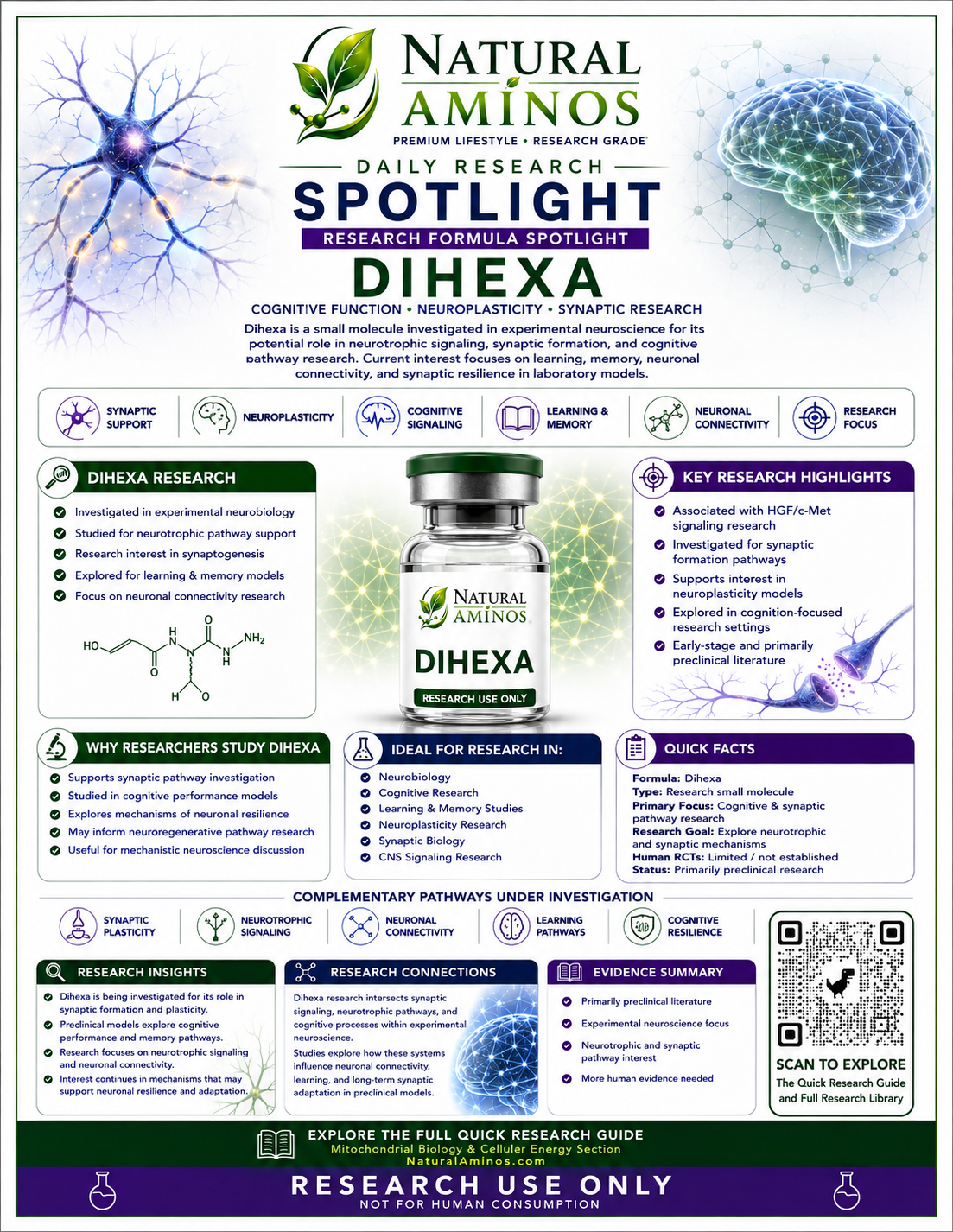
Dihexa Research Data
For laboratory research use only; not for human or veterinary use or consumption. This page provides research information, not personal-use instructions or medical advice.
Natural Aminos Research Formula of the Day — Dihexa
Benefits
Dihexa (N-hexanoic-Tyr-Ile-(6)-aminohexanoic amide, also called PNB-0408) is a small synthetic oligopeptide derived from angiotensin IV, engineered at Washington State University with an N-terminal hexanoyl cap and C-terminal amidation to resist enzymatic breakdown and cross the blood-brain barrier. It is proposed to potentiate hepatocyte growth factor (HGF) signaling through the c-Met receptor, a pathway involved in neuronal survival, synaptogenesis, and hippocampal learning and memory.
In rodent studies, angiotensin IV analogs including dihexa restored cognitive performance in scopolamine-induced amnesia models and in aged rats, and increased dendritic spine density in cultured hippocampal neurons — an effect reported to disappear when HGF/c-Met signaling was pharmacologically blocked, which was the primary evidence that this pathway matters. An independent 2021 study by a separate research group (Sun et al.) reported cognitive rescue and improved synaptic markers in an APP/PS1 Alzheimer's-model mouse, via PI3K/AKT pathway activation.
Important context: the foundational papers establishing dihexa's proposed HGF/c-Met mechanism have since been formally retracted (see Why More Research Is Needed, below), so the benefits described above should be read as reported findings from a literature that has subsequently been called into serious question, not as settled science.
Uses
Dihexa has no approved use and is not being tested in any registered human clinical trial. It exists purely as a laboratory research compound, discussed almost entirely for one proposed property: enhancing synaptogenesis and cognitive function in a BDNF-like manner, framed around potential relevance to Alzheimer's disease and general nootropic/cognitive-enhancement use. It is sold as a research-use peptide by supplement and peptide vendors, and used off-label by individuals in nootropic communities, based entirely on the rodent and cell-culture literature described above plus self-reported anecdote — there is no clinical indication it has been tested for in humans.
As of 2026, dihexa's regulatory status has shifted: the FDA removed it from its Category 2 bulk-substance list in April 2026, but this did not place it on a list pharmacies may legally compound from — it remains in regulatory limbo pending a compounding advisory committee review. It is not approved by the FDA, EMA, or any other major regulator for any indication.
Published Research
All published evidence for dihexa is preclinical — cell culture and rodent studies only. No human clinical trial of dihexa has ever been published or registered. That alone puts it at an earlier evidence stage than most peptides covered in this series.
More significantly, the specific studies that established dihexa's core mechanism and behavioral claims have suffered serious integrity problems. A Washington State University investigation found that the lead author on the foundational papers, Leen H. Kawas (later CEO of Athira Pharma), altered images in her doctoral dissertation and in at least four co-authored papers between 2011 and 2014, with WSU's investigation finding Kawas and Harding "solely responsible" for falsified and/or fabricated data. As a direct result: the 2012 Kawas et al. paper that first proposed dihexa as an HGF-dimerization mimetic was formally retracted in April 2025; the 2014 Benoist et al. paper that provided the primary evidence for dihexa's HGF/c-Met binding mechanism (including its widely cited picomolar binding affinity figure) was also formally retracted in April 2025; and the 2013 McCoy et al. paper — the source of the widely repeated claim that dihexa is "seven orders of magnitude more potent than BDNF" — carries a 2021 Expression of Concern and has not been retracted outright, but its central potency claim came from an assay-specific in-vitro measurement, not a whole-brain effect.
Not all dihexa-adjacent research is affected: the independent 2021 Sun et al. study, conducted by an unrelated research group in an Alzheimer's-model mouse, reported real cognitive and synaptic benefits, though through a different proposed mechanism (PI3K/AKT) than the now-retracted HGF/c-Met claims. Separately, Athira Pharma's related drug candidate fosgonimeton (developed from this same research program) failed to meet its primary endpoint in a Phase 2 Alzheimer's trial (2023) and again in a subsequent Phase 2/3 trial designed to be definitive; Athira later agreed to pay over $4 million to settle a False Claims Act case tied to NIH grants that had cited the compromised research.
Why More Research Is Needed
What's actually proven: essentially nothing at the human level — there is no published or registered human trial of dihexa, and therefore no human efficacy or safety data exists at all. Even at the preclinical level, what can be said to be reliably "proven" has shrunk substantially: the papers that established dihexa's core mechanism (HGF/c-Met binding, synaptogenesis via that specific pathway) have been formally retracted for fabricated and falsified data, not merely questioned on methodological grounds. What remains standing is a single independent 2021 replication in an Alzheimer's mouse model using a different mechanistic explanation, plus the broader (also retraction-tainted) rodent behavioral literature.
This is a fundamentally different evidence problem than the other formulas covered in this series. With most under-researched peptides, the gap is simply an absence of human trials layered on a small but honestly reported animal literature. With dihexa, the foundational animal and mechanistic literature itself has been found, by the university that produced it, to contain fabricated data — which means the theoretical case for dihexa's mechanism is no longer just "unconfirmed in humans," it is actively undermined at its preclinical source. The theory that HGF/c-Met potentiation drives cognitive enhancement is not disproven outright — the independent Sun et al. work and the broader HGF/c-Met neuroscience literature outside dihexa specifically still offer some support for the general biology — but the specific claims used to market dihexa (its extreme potency versus BDNF, its precise binding affinity, its mechanism of action) trace directly back to retracted or flagged sources, and should not be treated as established even provisionally.
Given the total absence of human data, the retraction of foundational mechanism papers, and an unresolved regulatory status, dihexa currently sits at the least-supported end of the peptides covered in this series. Any future research would need to start by independently re-establishing dihexa's actual mechanism and basic pharmacology in preclinical models free of the data-integrity problems that affected the original research program, well before any human testing could be responsibly considered.
Sources
Wikipedia — Dihexa (chemical identifiers, developmental history, PNB-0408)
Journal of Pharmacology and Experimental Therapeutics — Kawas et al. 2012 (RETRACTED April 2025) and Benoist et al. 2014 (RETRACTED April 2025): original HGF/c-Met mechanism papers
McCoy et al. 2013 (PMID 23055539) — oral cognitive restoration in scopolamine and aged rats; carries a 2021 Expression of Concern, not retracted
Sun et al. 2021 (PMID 34827486) — independent study reporting cognitive rescue in APP/PS1 Alzheimer's-model mice via PI3K/AKT pathway
Retraction Watch / For Better Science — reporting on the WSU data-integrity investigation into Kawas and Harding
PeptideInsight — Dihexa: Research Evidence & Safety Profile (summary of retraction timeline and evidence classification)
Coverage of Athira Pharma's fosgonimeton Phase 2 (ACT-AD, 2023) and Phase 2/3 (LIFT-AD) trial failures and related False Claims Act settlement
Hashtags
#Peptidetherapy #PeptideResearch #PeptideScience #Biohacking #ResearchPeptides #ScienceBased #Dihexa #Nootropic #CognitiveHealth #ResearchIntegrity