Glow Research Data
For laboratory research use only; not for human or veterinary use or consumption. This page provides research information, not personal-use instructions or medical advice.
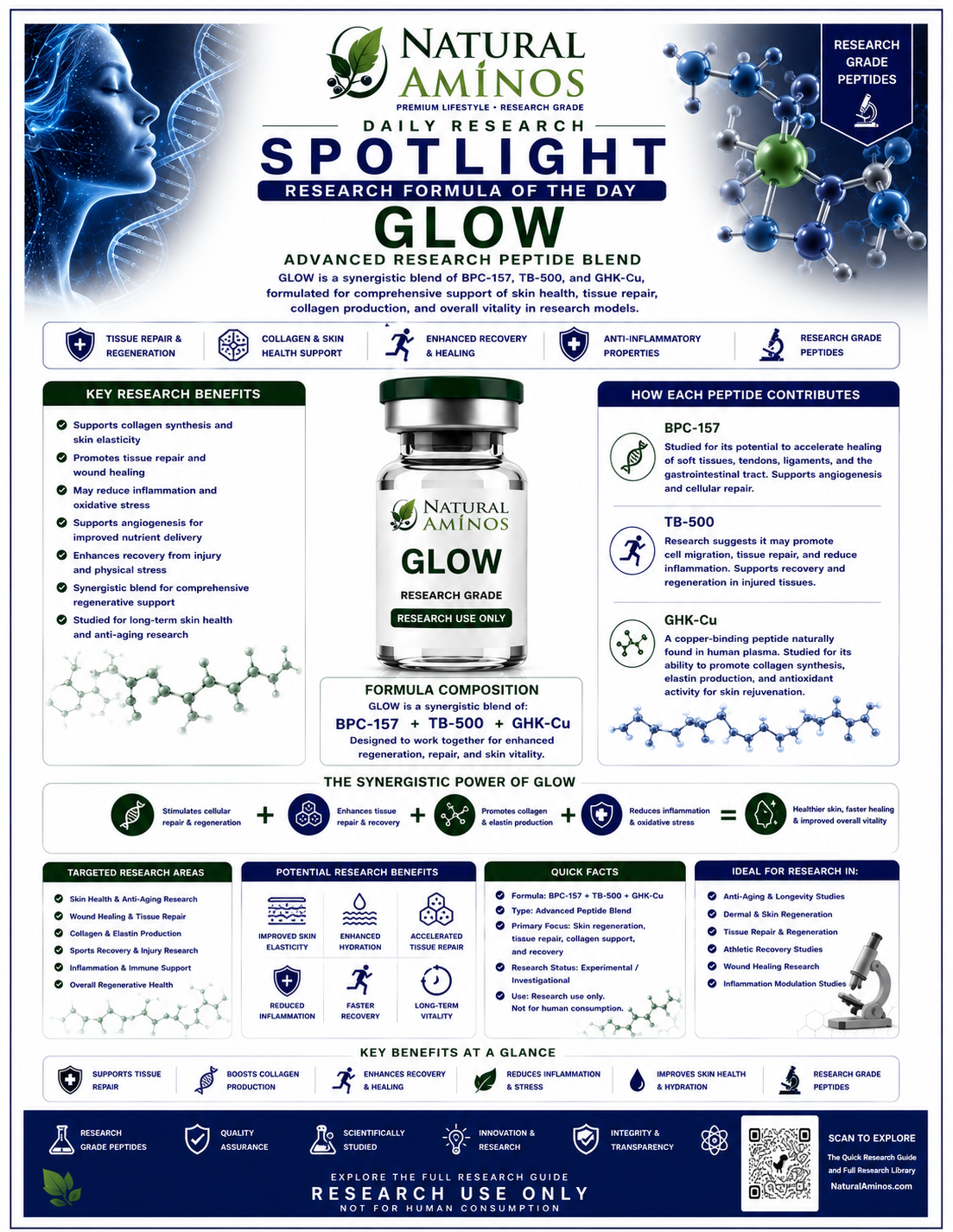
Natural Aminos Research Formula of the Day — GLOW Blend (GHK-Cu, BPC-157 & TB-500)
Benefits
GHK-Cu (glycyl-L-histidyl-L-lysine bound to copper) is a naturally occurring tripeptide found in human plasma that declines with age. It is the best-evidenced of the three components in humans: it stimulates fibroblast collagen and elastin production, and gene-expression mapping data (Broad Institute) shows it can influence expression of a large share of human genes toward more youthful patterns. A 2023 IRB-approved clinical trial of a topical GHK-Cu gel in 21 women found an average 28% increase in skin collagen density after 3 months of daily application, with the top quartile of participants showing a 51% increase.
BPC-157 is a synthetic 15-amino-acid peptide derived from a protective protein in human gastric juice, researched since the 1990s primarily by one laboratory (Sikiric group, University of Zagreb). Its proposed mechanisms include upregulation of VEGF (supporting new blood vessel growth), modulation of nitric oxide signaling, and general anti-inflammatory and cytoprotective action, with well over 100 published animal and cell studies supporting tissue and gut healing effects.
TB-500 is the commercial name for a synthetic fragment of Thymosin Beta-4 (TB4), a peptide involved in actin regulation and cell migration. Full-length TB4 research (much more extensive than direct TB-500 research) supports roles in angiogenesis, wound healing, and cytoprotection.
Uses
GLOW is marketed and sold as a combined injectable blend (a common formulation is 50mg GHK-Cu, 10mg BPC-157, and 10mg TB-500 per vial) aimed at skin rejuvenation, collagen and elastin production, hair health, general tissue repair, and anti-inflammatory support — essentially pairing GHK-Cu's skin/collagen reputation with BPC-157 and TB-500's tissue-repair reputation in one product.
Each individual component does have a real, distinct area of use in the literature: GHK-Cu is used almost exclusively as a topical skincare ingredient in its tested human research; BPC-157's strongest human-relevant rationale is gastrointestinal (an unpublished Phase 2 inflammatory bowel disease trial is its most-cited human study); and TB-500/TB4 is most associated with wound and ocular healing in the limited human data that exists. None of the three peptides has FDA approval for any indication, and none has been tested — alone or combined — for the specific injectable, whole-body "anti-aging glow" application the blend is sold for.
Published Research
Across the three formulas, there is a meaningful research-quality gradient. GHK-Cu has the most human data of the three, but it is concentrated in topical application: multiple small, industry-funded randomized trials (including a 2005 12-week RCT and the 2023 collagen-density trial) support topical GHK-Cu for skin thickness, elasticity, and collagen density. This is a different route of administration than the subcutaneous injection GLOW is marketed as. One patent filing on GHK-Cu-based skin formulations specifically notes that copper itself is not considered suitable for subcutaneous use due to toxicity concerns at higher exposure — a consideration directly relevant to an injectable copper-peptide product that the topical cosmetic literature does not address.
BPC-157's evidence base is essentially the reverse: extensive preclinical replication (100+ animal/cell studies, largely from one research group) but almost no published human trial data. A Phase 2 trial for inflammatory bowel disease was initiated in Croatia, and is the most-cited human study, but as of 2026 its results have not appeared in peer-reviewed literature. No completed, published Phase 2 or Phase 3 trial data exists for BPC-157 in any indication, including the musculoskeletal/tissue-repair use it is most commonly sold for.
TB-500 has already been separately covered in this series: a 2026 scoping review found only one study anywhere in the published literature that directly tested TB-500 itself (an in vitro/rat metabolite and wound-healing screening study), with all other human evidence belonging to the parent molecule TB4, concentrated in ocular and skin/wound settings — not musculoskeletal or systemic tissue repair.
No published study of any kind — human or animal — has tested GHK-Cu, BPC-157, and TB-500 together as a combination. Every source describing the GLOW blend's rationale (vendor sites, clinic marketing, and peptide-industry guides alike) describes it as combining each peptide's separate literature, not citing a dedicated combination study.
Why More Research Is Needed
What's actually proven, formula by formula: GHK-Cu has real, randomized, controlled human trial evidence — but only for topical skin application, not injection. BPC-157 has an enormous, consistent preclinical (animal/cell) literature but essentially no published human trial data for any use. TB-500 itself (as distinct from TB4) has almost no direct evidence of any kind — one in vitro/rat study.
The theory behind stacking them: the rationale for GLOW is that each peptide targets a different piece of tissue regeneration — GHK-Cu for collagen/elastin and gene-expression signaling, BPC-157 for angiogenesis and general cytoprotection, TB-500 for cell migration via actin regulation. Mechanistically, this is a reasonably coherent theory: the three proposed mechanisms are largely non-overlapping rather than redundant, similar in structure to other multi-pathway stacks in this series. That is a genuine point in the theory's favor.
Where the theory is weaker in practice: this stack combines the peptide with the strongest human evidence (GHK-Cu) tested only by a different route of administration (topical, not injection) than the one it's sold in; the peptide with the largest evidence base but almost zero human data (BPC-157); and the peptide with the thinnest direct evidence of the entire series (TB-500 itself, as opposed to TB4). None of the three has been tested by injection in combination with the others, and the injectable-copper safety question raised in the GHK-Cu patent literature is a specific, unresolved consideration for this exact delivery method that the topical GHK-Cu trials do not speak to. If choosing based on strength of evidence rather than strength of theory, GHK-Cu's topical skin benefit is the only piece of this blend with real controlled human data behind it — and even that evidence does not transfer automatically to the injectable form or to the other two ingredients riding alongside it. The honest read: a mechanistically plausible three-pathway theory, built on three very differently-evidenced peptides, combined by injection in a form none of them has actually been tested in, whether alone or together.
Sources
EurekAlert! (2023) — Epigenetic Mechanisms Activated by GHK-Cu Increase Skin Collagen Density in Clinical Trial (Yuvan Research Inc., 21-woman IRB-approved trial)
PMC — Regenerative and Protective Actions of the GHK-Cu Peptide in the Light of the New Gene Data (review, incl. Krüger et al. topical pilot study)
Dermatologic Surgery (2005) — Leyden: Anti-Aging Benefits of a GHK-Cu Facial and Eye Cream: A Randomized 12-Week Clinical Trial
NPR (2026) — The Copper Peptide Trend Has Gone From Creams to Injections — Ahead of the Science
USPTO Patent Filing — Peptides for Skin Rejuvenation and Methods of Using the Same (notes on copper toxicity and subcutaneous use)
PeptideMark (2026) — BPC-157 Human Trials: What the Evidence Shows (summary of Phase 2 IBD trial status, FDA classification)
The Peptide Catalog (2026) — BPC-157 Research: Human Trial Status
Applied Sciences (MDPI, 2026) — Thymosin Beta-4 and TB-500 in Tissue Healing, Regeneration, and Musculoskeletal Repair: A Scoping Review (as covered in the prior TB-500 spotlight in this series)
Hashtags
#Peptidetherapy #PeptideResearch #PeptideScience #Biohacking #ResearchPeptides #ScienceBased #GLOWblend #GHKCu #BPC157 #TB500 #SkinHealth