Retatrutide Research Data
For laboratory research use only; not for human or veterinary use or consumption. This page provides research information, not personal-use instructions or medical advice.
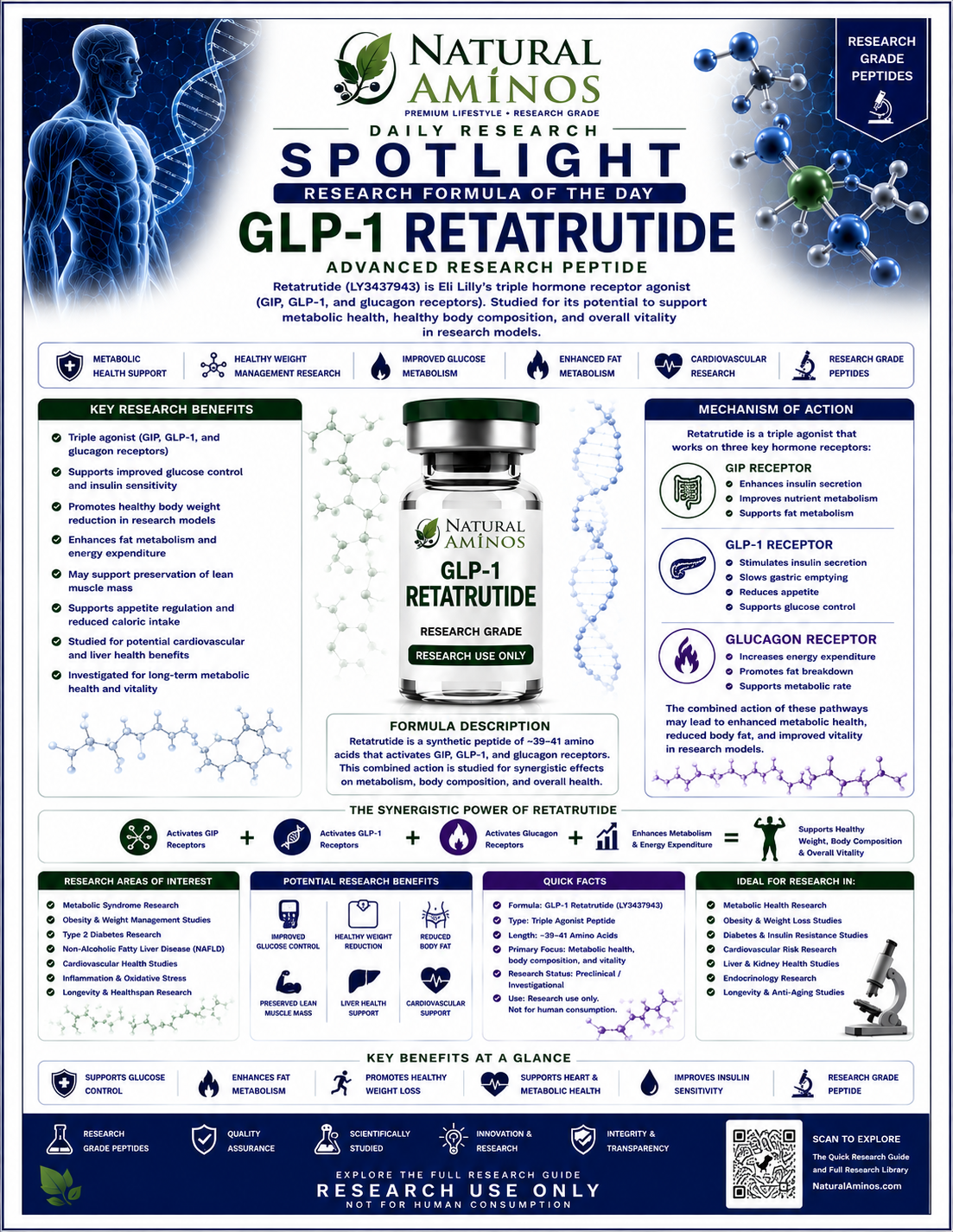
Natural Aminos Research Formula of the Day — Retatrutide (GLP-1R)
Benefits
Retatrutide (LY3437943) is Eli Lilly's triple hormone receptor agonist, acting on GIP, GLP-1, and glucagon receptors simultaneously rather than a single pathway — the added glucagon receptor activity is what distinguishes it mechanistically from single-target GLP-1 drugs. Its Phase 2 obesity trial reported a mean 24.2% weight reduction at 48 weeks, the largest effect reported for any anti-obesity medication to date, driven by appetite suppression, slowed gastric emptying, and increased energy expenditure.
Uses
Retatrutide is in Eli Lilly's Phase 3 TRIUMPH program, covering obesity, knee osteoarthritis, and obstructive sleep apnea, plus separate ongoing trials in type 2 diabetes, cardiovascular/renal outcomes, and liver disease (MASLD) — a broader clinical program than a typical single-indication weight-loss drug. It has no cancer-treatment indication; its only cancer-relevant research use to date is as a weight-loss intervention studied for downstream effects on obesity-driven cancer risk.
Published Research
Retatrutide's core metabolic evidence is genuinely strong and human-trial-backed. Its Phase 2 obesity trial (published in the New England Journal of Medicine) enrolled hundreds of participants across multiple dose arms and reported zero cases of medullary thyroid cancer or C-cell hyperplasia, addressing a specific safety concern relevant to this drug class. Separately, a 2025 preclinical study (npj Metabolic Health and Disease) tested retatrutide in diet-induced obese mouse models and found it slowed tumor progression in both obesity-driven and non-obesity-driven cancers, with evidence of durable anti-tumor immune reprogramming — elevated antigen-presenting cells, reduced immunosuppressive cell populations, and activation of pro-inflammatory anti-tumor pathways. No Eli Lilly-sponsored clinical trial currently tests retatrutide as a direct cancer treatment in humans; that evidence remains preclinical.
Separately from its clinical research, retatrutide is the subject of an active, unresolved legal dispute between Eli Lilly and the FDA over whether it should be regulated as a biologic rather than a conventional small-molecule drug. Lilly argues retatrutide's structure — a 39-amino-acid backbone connected to a second, shorter chain via an isopeptide bond, totaling 41 amino acids by Lilly's count — clears the FDA's 40-amino-acid threshold for biologic status. The FDA has counted only the primary 39-amino-acid backbone and classified it as a conventional drug. In September 2025, a federal judge (Southern District of Indiana) vacated the FDA's reasoning as arbitrary and remanded the question back to the agency; Lilly appealed to the Seventh Circuit in February 2026 seeking a direct biologic determination. The distinction carries real weight: biologic status would grant 12 years of market exclusivity versus 5 for a conventional drug, and would restrict whether it could ever be legally compounded. As of mid-2026 the litigation remains unresolved, and Lilly has said it plans to submit its completed Phase 3 package for approval in Q1 2027 regardless of outcome.
Why More Research Is Needed
Retatrutide's weight-loss and metabolic evidence is comparatively mature, but its cancer-relevant findings remain preclinical (mouse models only) or drawn from retrospective, class-level observational data on GLP-1 drugs broadly — no dedicated prospective human trial exists using cancer incidence or outcomes as a primary endpoint. Its biologic-classification status is a separate, live legal question rather than a scientific research gap; it will be resolved through the courts and FDA's regulatory process, not additional clinical data, though the outcome will shape how retatrutide and future amino-acid-count-adjacent peptides are regulated going forward. Long-term safety data beyond the current trial windows (48 weeks in the Phase 2 program) is also still accumulating as the Phase 3 TRIUMPH program continues.
Sources
New England Journal of Medicine — Triple-Hormone-Receptor Agonist Retatrutide for Obesity: A Phase 2 Trial
npj Metabolic Health and Disease — Incretin Triple Agonist Retatrutide (LY3437943) Alleviates Obesity-Associated Cancer Progression
PMC — Retatrutide: A Game Changer in Obesity Pharmacotherapy
BioSpace — Lilly, FDA Retatrutide Biologic Dispute Comes to a Head as Submission Nears
The Compound Protocol — Is Retatrutide a Biologic? The FDA Lawsuit Explained
Pienomial — Lilly, FDA Retatrutide Obesity Biologic Dispute Nears Resolution
Hashtags
#Peptidetherapy #PeptideResearch #PeptideScience #Biohacking #ResearchPeptides #ScienceBased #Retatrutide #EliLilly #MetabolicHealth #FatLossResearch #WeightManagement #CancerResearch #BiologicDrug