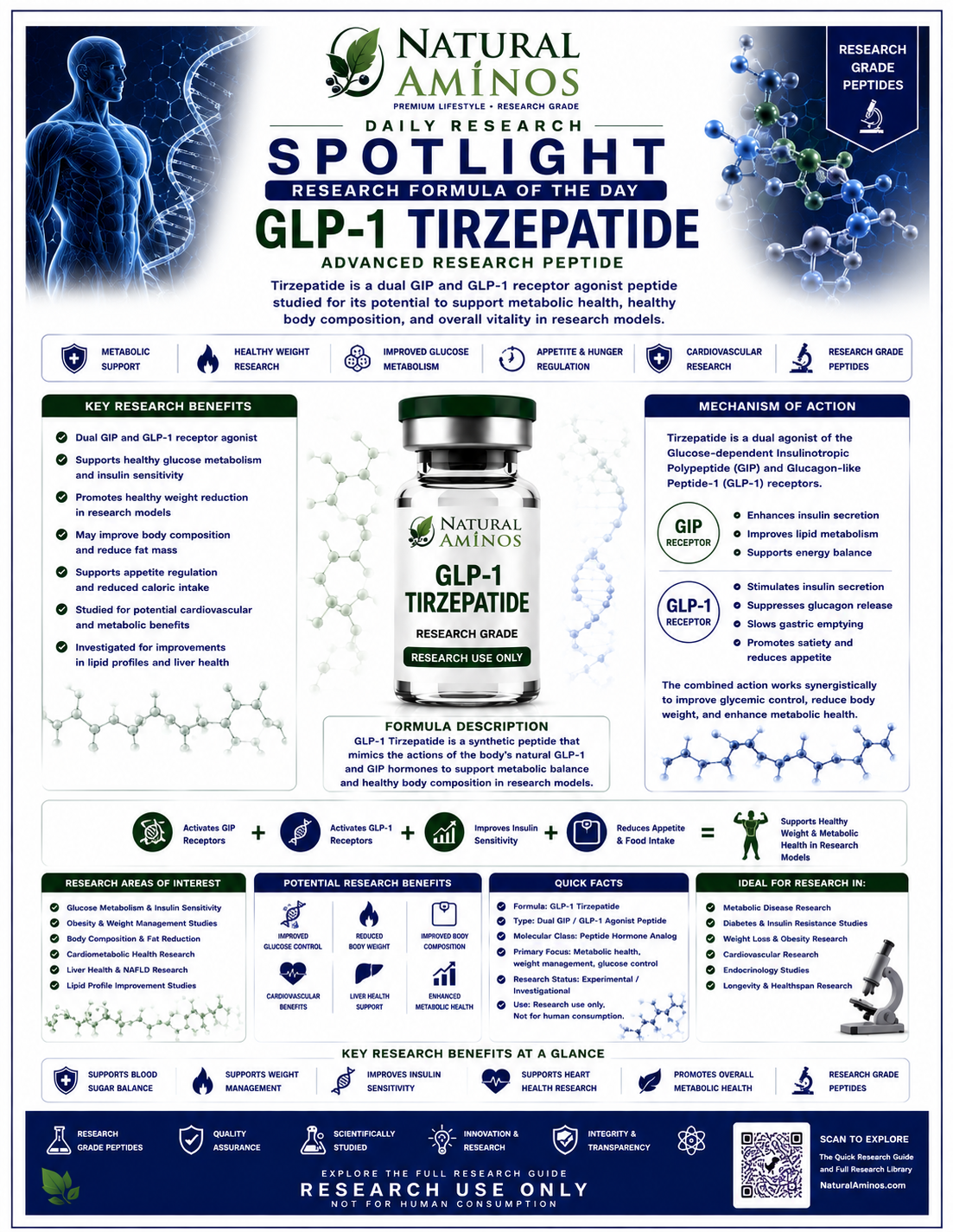
GLP-1 Tirzepatide Research Data
For laboratory research use only; not for human or veterinary use or consumption. This page provides research information, not personal-use instructions or medical advice.
NATURAL AMINOS RESEARCH
Formula of the Day
Tirzepatide
Metabolic Health & Weight Management Spotlight
Benefits
Tirzepatide is a synthetic peptide that acts as a dual agonist at both the GIP (glucose-dependent insulinotropic polypeptide) and GLP-1 (glucagon-like peptide-1) receptors — the first approved medication to combine both mechanisms in a single molecule. Its dual action is the core of its proposed advantage over single-target GLP-1 medications: it slows gastric emptying, suppresses appetite and food intake, and enhances insulin secretion in response to meals, while the added GIP activity is believed to improve insulin sensitivity and fat metabolism beyond what GLP-1 activity alone produces.
The most substantiated benefit is significant, dose-dependent body weight reduction — large trials in adults with obesity report average reductions of roughly 15–22% of body weight sustained over as long as three years, alongside meaningful drops in waist circumference and BMI. In people with type 2 diabetes, tirzepatide produces substantial reductions in HbA1c (blood sugar control), in some analyses larger than existing GLP-1 medications at comparable doses. Additional documented benefits include improved blood pressure, triglycerides, and inflammatory markers, better obstructive sleep apnea severity, and, in adults with obesity and prediabetes, a markedly higher rate of reverting to normal blood sugar compared with placebo.
Uses
Tirzepatide is FDA-approved for three specific uses: type 2 diabetes management (as Mounjaro), chronic weight management in adults with obesity or overweight plus at least one weight-related condition such as hypertension or sleep apnea (as Zepbound), and moderate-to-severe obstructive sleep apnea in adults with obesity, used alongside diet and exercise. Beyond these approved indications, it is being actively studied for type 1 diabetes (as an off-label adjunct to insulin), heart failure with preserved ejection fraction in people with obesity, and broader cardiovascular risk reduction — uses that remain investigational rather than approved.
Published Research
Tirzepatide has one of the largest and most mature published clinical trial programs of any peptide covered in this series, built around two major randomized controlled trial programs: SURPASS (type 2 diabetes) and SURMOUNT (obesity/weight management), together spanning well over 14,000 participants across published meta-analyses.
A pivotal SURMOUNT-1 trial, published in the New England Journal of Medicine, found substantial and durable weight reduction sustained over a 72-week primary period and, in later reporting, over three years, with nearly all participants who had prediabetes at baseline returning to normal blood sugar versus a much smaller share on placebo. A systematic review and meta-analysis of four randomized controlled trials (n=3,553) in adults without diabetes found tirzepatide reduced body weight by a mean of roughly 16.5% versus placebo, with a clear dose-response relationship, alongside improvements in BMI, waist circumference, HbA1c, and quality-of-life scores. A separate meta-analysis of 14 randomized controlled trials (n=14,713) across diabetes and obesity populations confirmed significantly greater weight loss and glycemic improvement than placebo and, in several comparisons, than active GLP-1 comparators.
In type 1 diabetes, a Phase 2 randomized, placebo-controlled trial found tirzepatide produced significantly greater weight loss than placebo over 12 weeks in adults with type 1 diabetes and obesity, and separate retrospective cohort and observational studies have reported meaningful weight loss and reduced insulin requirements in this population, though this remains an off-label use outside the approved indications.
On cardiovascular outcomes, the large-scale SURPASS-CVOT trial (over 13,000 participants with type 2 diabetes at elevated cardiovascular risk) has demonstrated non-inferiority to dulaglutide for major adverse cardiovascular events, supporting cardiovascular safety; the dedicated SUMMIT trial in heart failure with preserved ejection fraction and obesity has also been conducted. Gastrointestinal adverse events (nausea, vomiting, diarrhea) are consistently reported as the most common side effect across the published trial base, occurring significantly more often than with placebo, though serious adverse event rates have not differed significantly from placebo.
Why More Research Is Needed
Tirzepatide is unusual among formulas covered in this series in that its core benefits — weight loss and glycemic control — rest on a large, mature base of randomized, placebo-controlled human trials rather than theoretical extrapolation. Even so, published reviews consistently flag specific gaps that remain open. Safety and efficacy data in special populations, including patients with significant renal impairment, are still described as needing further investigation. Long-term cardiovascular benefit is still being formally established: SURPASS-CVOT and the SUMMIT heart failure trial were designed specifically because a favorable trend in earlier trials was not, on its own, sufficient to confirm a cardiovascular protective effect. Head-to-head, long-duration comparisons of tirzepatide against other incretin-based therapies for hard cardiovascular endpoints (rather than risk-factor surrogates or modeled projections) remain limited. Real-world, long-term data beyond the multi-year trial windows — covering sustained safety, weight regain after discontinuation, and outcomes in broader, less-selected patient populations — is also still accumulating. High treatment cost is repeatedly noted in the literature as a practical barrier that limits how representative existing trial populations are of the broader patient population who might benefit.
Sources
• New England Journal of Medicine — Tirzepatide Once Weekly for the Treatment of Obesity (SURMOUNT-1)
• New England Journal of Medicine — Tirzepatide for Obesity Treatment and Diabetes Prevention (SURMOUNT-1, 3-year follow-up)
• PMC — Efficacy and Safety of Tirzepatide on Weight Loss in Patients Without Diabetes Mellitus: Systematic Review and Meta-Analysis of RCTs
• PMC — The Efficacy and Safety of Tirzepatide in Patients with Diabetes and/or Obesity: Systematic Review and Meta-Analysis
• PMC — Dose-Dependent Efficacy and Safety of Tirzepatide for Weight Loss in Non-diabetic Adults With Obesity: Meta-analysis of RCTs
• Diabetes Care (American Diabetes Association) — Tirzepatide in Adults With Type 1 Diabetes: A Phase 2 Randomized Placebo-Controlled Clinical Trial
• PMC — Tirzepatide Is Associated With Improved Metabolic Outcomes in People With Type 1 Diabetes and Overweight or Obesity: Retrospective Cohort Study
• Frontiers in Pharmacology — Tirzepatide's innovative applications in the management of type 2 diabetes and its future prospects in cardiovascular health
• PMC / PubMed — Tirzepatide and the Cardiovascular Continuum: Metabolic, Cardiorenal and Heart Failure Evidence
• ScienceDirect — Cardiovascular Outcomes in Adults With Type 2 Diabetes Treated With Tirzepatide: Systematic Review of Real-World Studies
• ScienceDirect — The promise of tirzepatide: A narrative review of metabolic benefits
Hashtags
#Tirzepatide #GLP1 #GIPReceptor #MetabolicHealth #WeightManagement #DiabetesResearch #PeptideResearch #ScienceBased #ClinicalTrials #CardiometabolicHealth
This material is for research and educational purposes only and is not medical advice.