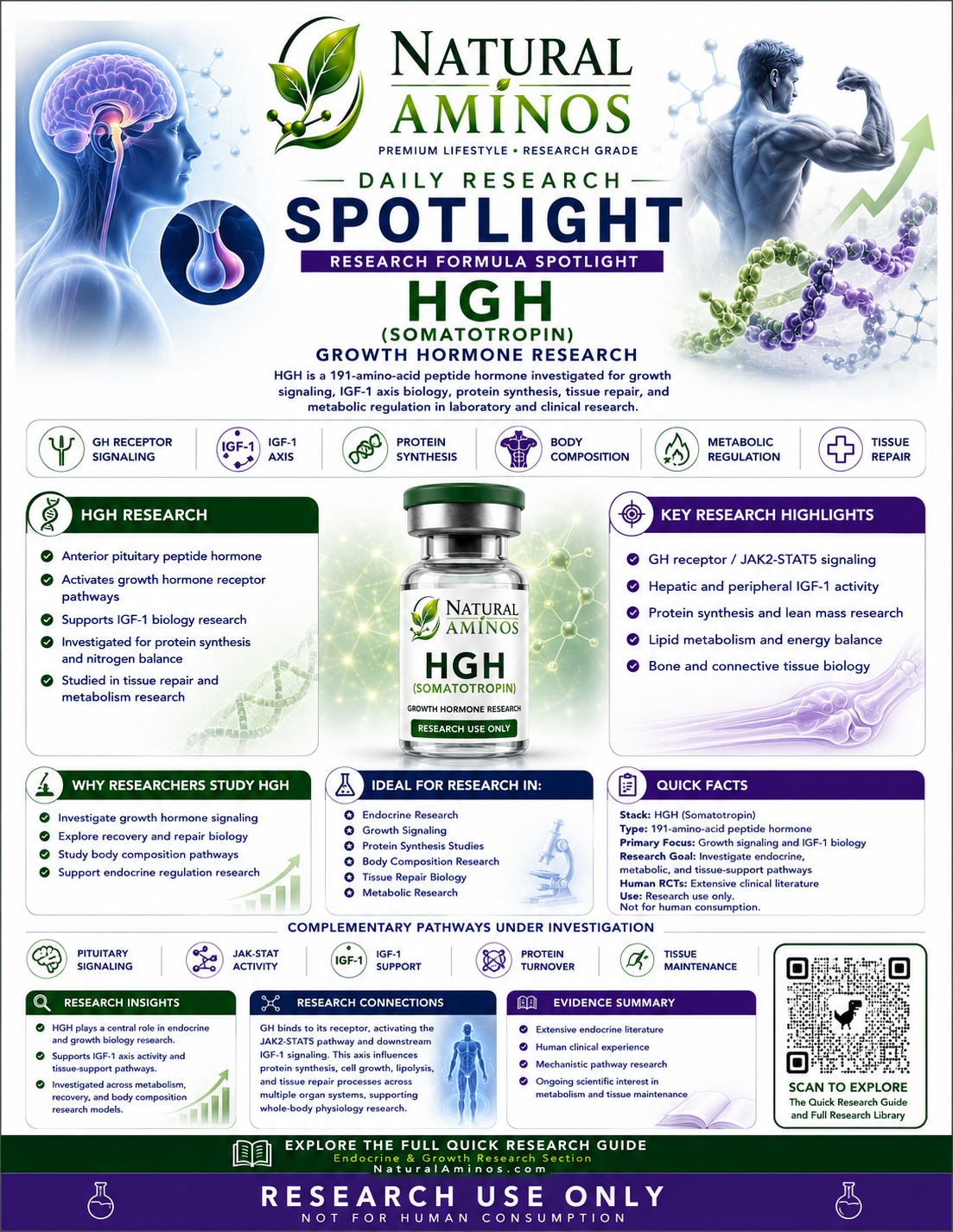
HGH Research Data
For laboratory research use only; not for human or veterinary use or consumption. This page provides research information, not personal-use instructions or medical advice.
Natural Aminos Research Formula of the Day — HGH (Human Growth Hormone / Somatropin)
Benefits
Recombinant human growth hormone (rhGH, somatropin) is a bioidentical copy of the body's own growth hormone, produced by recombinant DNA technology. In its approved indications, decades of randomized controlled trials show consistent, well-established benefits: increased lean body mass, decreased fat mass, improved bone mineral density, improved lipid metabolism (including reduced LDL cholesterol), reduced high-sensitivity CRP, and improved quality of life in adults with diagnosed GH deficiency.
The famous 1990 Rudman et al. study in the New England Journal of Medicine, which effectively launched the anti-aging HGH industry, found that six months of GH treatment in 12 healthy older men (ages 61–81) with below-normal IGF-1 levels produced a 4.7 kg increase in lean body mass and a 3.5 kg decrease in fat mass, along with increased lumbar spine bone density — but also came with significant increases in blood pressure and fasting glucose.
Uses
HGH is FDA-approved for a narrow, specific list of indications: growth hormone deficiency-related short stature in children, adult growth hormone deficiency caused by pituitary disease or its treatment, and muscle-wasting disease associated with HIV/AIDS, along with several other rare pediatric growth conditions (Turner syndrome, Prader-Willi syndrome, small-for-gestational-age children who fail to catch up in growth). These uses rest on a strong, long-standing evidence base of randomized controlled trials.
Critically, off-label use of HGH for anti-aging, athletic performance, or general body-composition purposes in otherwise healthy adults is not simply unapproved — it is illegal in the United States. Because of 1988 and 1990 amendments to the Food, Drug and Cosmetic Act, HGH may legally be distributed or prescribed only for the conditions specifically authorized by the Secretary of Health and Human Services; aging and age-related decline are not among them. This makes HGH's off-label legal status meaningfully different from most other peptides in this series, which are simply unapproved or restricted from compounding — prescribing HGH for anti-aging is a federal offense, not just an off-label gray area.
Published Research
For its approved indications, the human evidence is extensive and high quality: decades of randomized, double-blind, placebo-controlled trials across pediatric GHD, adult GHD, Turner syndrome, Prader-Willi syndrome, small-for-gestational-age children, and HIV-associated wasting, plus large postmarketing immunogenicity and safety studies (a 2018 multicenter Phase IV trial in 78 adults with GHD, for example, found no clinically meaningful antibody response to a newer liquid rhGH formulation and no new safety signals).
For anti-aging and body-composition use in healthy adults, the picture is very different. Following Rudman's 1990 findings, subsequent research did not support the broader anti-aging narrative: a 2007 meta-analysis in the Annals of Internal Medicine (Liu et al.), pooling 31 trials of rhGH in healthy elderly adults, found only small lean-mass increases (attributed mostly to fluid retention rather than genuine muscle growth), no meaningful improvement in functional strength, and a substantial burden of adverse effects, including soft-tissue edema, joint pain, carpal tunnel syndrome, and increased risk of diabetes. Rudman himself stated until his death that his study had no anti-aging implications, and a 2003 NEJM editorial explicitly criticized the anti-aging industry for misrepresenting his findings in advertising.
At the basic-science level, the GH/IGF-1 axis is one of the most thoroughly characterized systems in endocrinology — but animal longevity research runs in the opposite direction from the anti-aging marketing narrative: growth hormone receptor-knockout (Laron) mouse models, which have essentially no GH signaling, show extended lifespan rather than accelerated aging, a finding that directly complicates the premise that more GH signaling in adulthood is broadly beneficial for longevity.
Why More Research Is Needed
What's actually proven: for its approved indications — genuine growth hormone deficiency in children and adults, and specific wasting conditions — HGH has one of the strongest, most mature evidence bases of any compound covered in this series, built on decades of randomized controlled trials. This is a fundamentally different evidence category than most peptides discussed here.
What's theory, contested, or actively contradicted by evidence: the anti-aging and healthy-adult body-composition use case, which is the most commercially promoted application of HGH outside its approved indications, does not hold up under the same scrutiny. This is not simply an "absence of evidence" situation like most other formulas in this series — it is a case where dedicated follow-up research (the Liu et al. meta-analysis of 31 trials) directly tested the anti-aging premise and found modest-to-no functional benefit alongside real adverse effects, and where the animal longevity literature (GH-receptor-knockout models) points toward reduced, not increased, GH signaling as favorable for lifespan. Combined with the fact that off-label anti-aging use is a specific federal legal violation, not merely an unapproved use, the theory-versus-proof gap here is unusually stark: the theory that more GH restores youthful function has been directly tested and has not held up, while the specific harms (elevated blood pressure, blood glucose, cancer-risk concerns raised by endocrinologists, joint and soft-tissue problems) are better documented than the claimed benefits. Anyone weighing HGH for anti-aging purposes should know that the strongest research on this exact question argues against the premise, not merely that more research is needed.
Sources
New England Journal of Medicine (1990) — Rudman et al.: Effects of Human Growth Hormone in Men Over 60 Years Old
New England Journal of Medicine (2003) — Can Growth Hormone Prevent Aging? (editorial critique of anti-aging marketing citing Rudman)
Annals of Internal Medicine (2007) — Liu et al.: Meta-Analysis of Growth Hormone in Healthy Elderly Adults (cited via secondary review)
JAMA (2005) — Perls, Reisman, Olshansky: Legal and Regulatory Analysis of Off-Label HGH Use for Anti-Aging (ScienceDaily/Newswise coverage)
PMC — Multi-Centre Phase IV Trial: Immunogenicity of a New Liquid Formulation of Recombinant Human Growth Hormone in Adult GHD
World Journal of Men's Health — Growth Hormone and Aging: Updated Review
Endocrinology Advisor — Medication Misuse: Growth Hormone for Athletic Performance and Anti-Aging (AACE position statement, Crime Control Act of 1990)
Cedars-Sinai — Growth Hormone Therapy a Potential Risk to Older Adults
Hashtags
#Peptidetherapy #PeptideResearch #PeptideScience #Biohacking #ResearchPeptides #ScienceBased #HGH #Somatropin #GrowthHormone #EndocrineHealth #AntiAgingScience