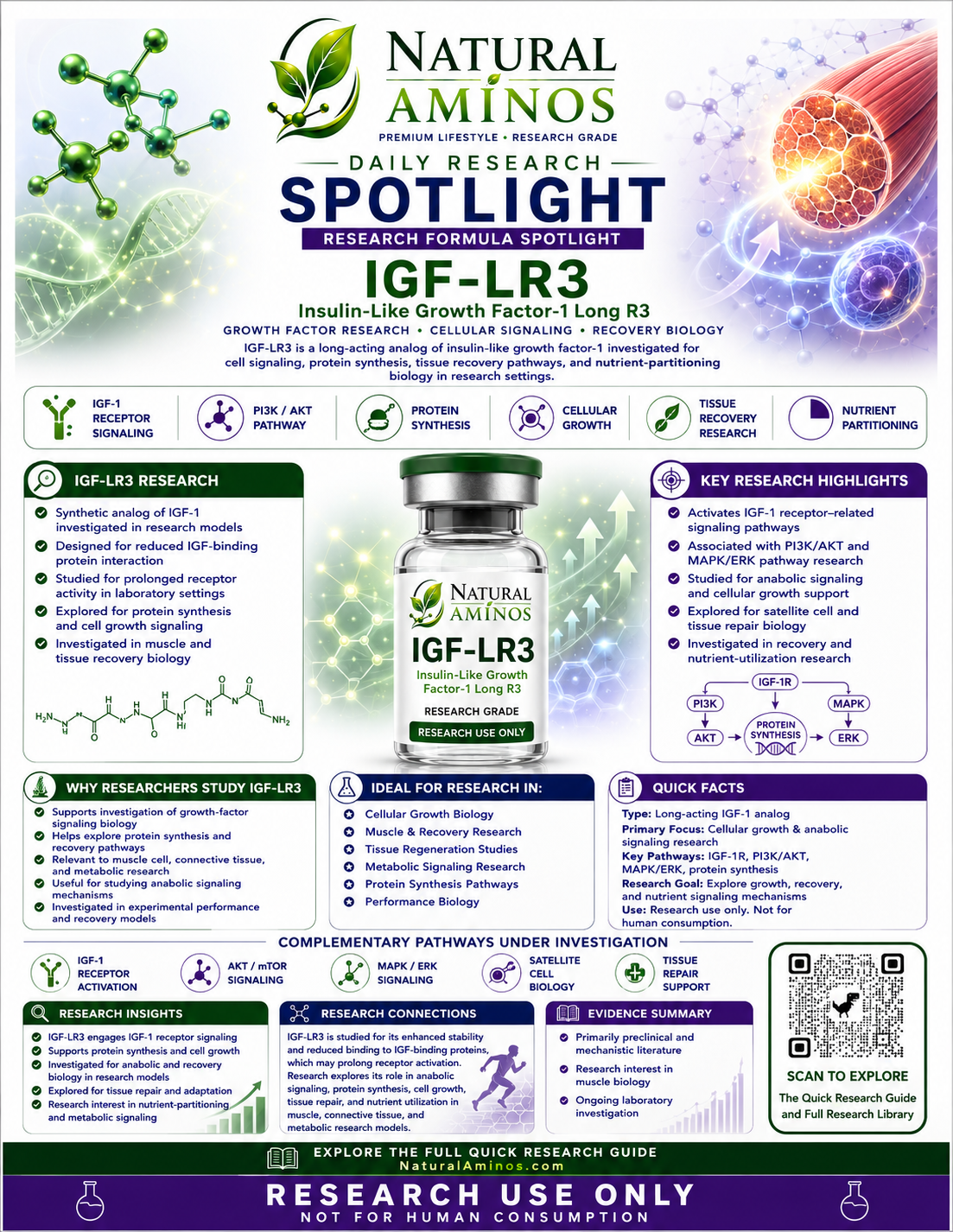
IGF-1 LR3 Research Data
For laboratory research use only; not for human or veterinary use or consumption. This page provides research information, not personal-use instructions or medical advice.
Natural Aminos Research Formula of the Day — IGF-1 LR3
Benefits
IGF-1 LR3 (Long Arginine-3 IGF-1) is a synthetic, longer-acting analog of native insulin-like growth factor 1, modified with an arginine substitution at position 3 and a 13-amino-acid N-terminal extension (83 amino acids total versus IGF-1's native 70). These modifications sharply reduce its binding affinity for IGF binding proteins, the carrier proteins that normally regulate and limit how much active IGF-1 reaches tissue — which is what gives it a longer effective action window than native IGF-1.
The underlying biology is extremely well characterized: IGF-1/IGF-1R signaling through the PI3K/Akt/mTOR pathway is one of the best-studied drivers of skeletal muscle hypertrophy, activating muscle stem (satellite) cells, promoting protein synthesis, and suppressing the E3 ubiquitin ligases responsible for muscle protein breakdown. IGF-1 also inhibits myostatin and NF-κB-mediated muscle-atrophy signaling. This mechanism is documented across a large body of cell, animal, and human research on native IGF-1 and general growth-factor biology — not IGF-1 LR3 specifically.
Uses
IGF-1 LR3 was originally developed as a laboratory research reagent (by GroPep) to study IGF-1 receptor signaling in cell culture without interference from binding proteins — not as a therapeutic candidate. It has no FDA-approved human indication and is not the subject of any registered human clinical trial. Its off-label use, concentrated in bodybuilding and physique-enhancement communities, is based entirely on extrapolating from native IGF-1's biology, not from any dedicated study of the modified analog in humans.
The relevant FDA-approved comparison point is mecasermin (brand name Increlex), recombinant native human IGF-1, approved specifically for children with severe primary IGF-1 deficiency — a narrow pediatric endocrine condition. IGF-1 LR3 is a structurally different, unapproved research analog and is not interchangeable with that approved product; its label and safety data do not transfer directly. IGF-1 LR3 is also prohibited in competitive sport under anti-doping rules.
Published Research
No human clinical trial of IGF-1 LR3 itself has been published or registered. Everything known about it in a living organism comes from its use as a laboratory tool in cell-based and rodent experiments studying IGF-1 receptor signaling, and from theoretical extrapolation of native IGF-1's well-documented biology onto the modified compound.
The clinical/human evidence that does exist concerns native IGF-1 and mecasermin, not the LR3 analog: mecasermin has real randomized controlled trial data in pediatric severe IGF-1 deficiency, and separate epidemiological research has repeatedly linked higher circulating IGF-1 levels to increased cancer risk — a pooled analysis of 17 prospective studies covering 4,790 breast cancer cases found women with relatively high circulating IGF-1 had roughly 30% higher breast cancer risk than those with lower IGF-1, an association not attributable to reverse causation and consistent across adjustment for other risk factors (though it varied by estrogen-receptor tumor subtype). This epidemiological signal on IGF-1 broadly is a major reason the FDA-approved mecasermin label explicitly contraindicates use in patients with active or suspected malignancy. Separately, cancer-drug developers have pursued anti-IGF-1R antibodies and inhibitors as a treatment strategy specifically because IGF-1 signaling can be mitogenic and anti-apoptotic in tumor cells — the opposite therapeutic direction from boosting IGF-1 activity.
Why More Research Is Needed
What's actually proven: the general biology of IGF-1/IGF-1R signaling in muscle growth and repair is genuinely well established, across decades of cell, animal, and human research. Mecasermin (native IGF-1) has real randomized trial data for its narrow approved pediatric indication. Separately, the association between elevated circulating IGF-1 and increased cancer risk is also well replicated in human epidemiological research.
What's theory, not proof: IGF-1 LR3 specifically — the modified, longer-acting analog actually sold and used off-label — has never been tested in a human clinical trial of any kind. The case for its muscle-building benefit rests entirely on extrapolating native IGF-1's mechanism onto a structurally different molecule with deliberately altered binding-protein interaction, which changes its pharmacokinetics and tissue exposure in ways that haven't been characterized in humans. This is a case where the theory is genuinely strong at the receptor-biology level, but the safety picture is not merely "unstudied and therefore neutral" — it is "unstudied against a backdrop of known mitogenic risk in the general IGF-1 signaling pathway." The cancer-risk association tied to elevated IGF-1 broadly, combined with an unapproved analog specifically engineered to prolong and amplify that same signaling with no binding-protein brake, means the honest picture skews toward caution rather than neutral uncertainty: a well-understood, biologically powerful growth pathway, activated by a compound with zero human safety data, in a signaling system independently linked to increased cancer risk when chronically elevated.
Sources
PMC — Mechanisms of IGF-1-Mediated Regulation of Skeletal Muscle Hypertrophy and Atrophy (review)
PMC — Crucial Role of Androgen Receptor in Resistance and Endurance Training-Induced Muscle Hypertrophy Through IGF-1/IGF-1R-PI3K/Akt-mTOR Pathway
bioRxiv — Insulin-Like Growth Factor-1 (IGF-1), IGFBP-3, and Breast Cancer Risk: Observational and Mendelian Randomization Analyses (pooled 17-study, 4,790-case analysis)
FDA label — Increlex (mecasermin) Prescribing Information (approved indication, malignancy contraindication)
ClinicalTrials.gov — BI 836845 and AXL1717 (anti-IGF-1R cancer-therapy trials, illustrating the inverse therapeutic rationale)
PeptideDosingProtocols — IGF-1 LR3 Peptide Dosage Guide: Cycle, Side Effects & Safety (structural description, mecasermin comparison, contraindication summary)
Rite Aid Health — IGF-1 LR3: Status and Safety (regulatory status summary)
Hashtags
#Peptidetherapy #PeptideResearch #PeptideScience #Biohacking #ResearchPeptides #ScienceBased #IGF1LR3 #MuscleGrowth #GrowthFactor #ResearchPeptideSafety