Kisspeptin Research Data
For laboratory research use only; not for human or veterinary use or consumption. This page provides research information, not personal-use instructions or medical advice.
Natural Aminos Research Formula of the Day — Kisspeptin
Benefits
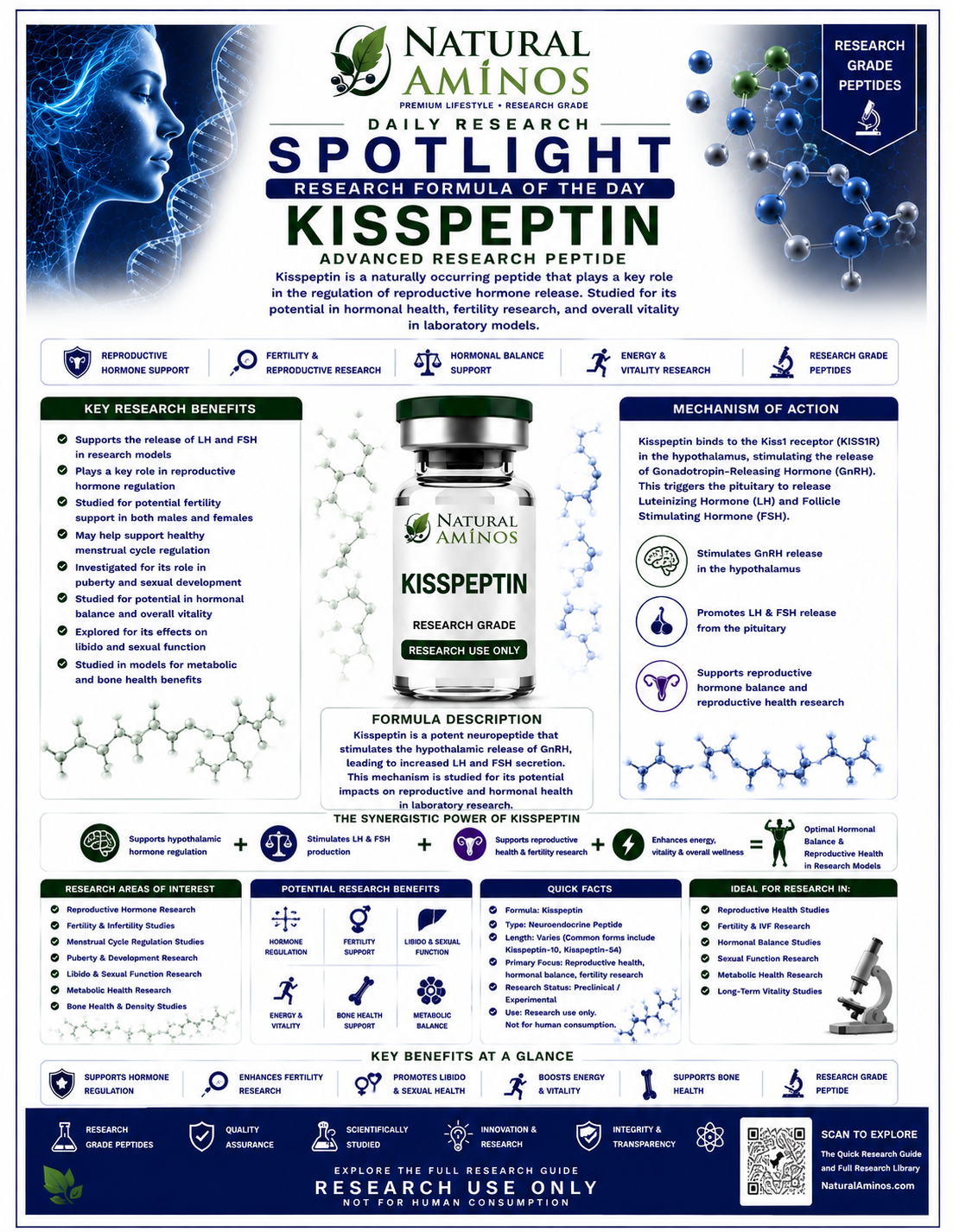
Kisspeptin is the master upstream regulator of the hypothalamic-pituitary-gonadal (HPG) axis — the signaling chain that ultimately produces sex hormones including testosterone and estrogen. It binds KISS1R receptors on GnRH-secreting neurons, triggering the cascade GnRH to LH/FSH to downstream sex hormone production. Human trials show it potently and reliably raises LH, LH pulse frequency, and downstream testosterone in men, working through the body's natural signaling pathway rather than replacing a hormone directly. It has also shown effects on sexual brain processing and arousal-related measures independent of its hormonal effects.
Uses
Kisspeptin is researched for men with low LH-driven testosterone, including hypogonadotropic hypogonadism and men whose natural axis has been suppressed by prior exogenous testosterone use, since it stimulates the body's own signaling axis rather than replacing the hormone downstream. It's also researched for hypoactive sexual desire disorder (HSDD) in both sexes, and as a reproductive/fertility research tool given its central role in the HPG axis.
Published Research
Kisspeptin's human trial evidence is unusually strong for a research peptide — a real distinction from most compounds in this series. The original 2005 study (Dhillo et al.) found kisspeptin-54 infusion in healthy men raised mean LH from 4.2 to 10.8 U/L, a clear and reproducible hormonal effect. Kisspeptin-10 trials replicated this finding, and a proof-of-concept study in men with type 2 diabetes and mild hypogonadism found it restored LH pulsatility and raised testosterone in a population where the natural axis was already impaired. Beyond hormones, a 2023 randomized clinical trial in JAMA Network Open (32 men with HSDD) found kisspeptin-54 significantly modulated sexual brain processing and increased penile tumescence — a genuinely rigorous, peer-reviewed RCT result. Imperial College London researchers have safely administered kisspeptin to more than 500 human subjects across multiple trials, a substantial cumulative human safety record.
Despite this real depth, kisspeptin remains entirely investigational and is not FDA-approved for any indication. Nearly all of its trial data comes from single-dose or short-infusion protocols administered in controlled hospital or research settings, typically intravenously — a meaningfully different delivery pattern than the sustained self-administered subcutaneous use common in off-label research/wellness contexts today.
Why More Research Is Needed
Kisspeptin's gap is translational rather than foundational: the underlying hormonal and even brain-level effects are genuinely well-demonstrated in controlled trials, but researchers have specifically cautioned against extrapolating those results directly to sustained, self-administered subcutaneous use outside hospital settings, since the pharmacokinetics of that use pattern differ from the IV/short-infusion protocols the trials actually tested. Larger, longer-duration trials using the delivery method and dosing schedule people are actually using would be needed to confirm the same benefits hold up outside the tightly controlled conditions of the existing research.
Sources
Superpower — Kisspeptin: The Upstream HPG Axis Neuropeptide
Journal of Clinical Endocrinology & Metabolism (Oxford Academic) — Kisspeptin-10 Is a Potent Stimulator of LH and Increases Pulse Frequency in Men
JAMA Network Open — Effects of Kisspeptin on Sexual Brain Processing and Penile Tumescence in Men With HSDD: A Randomized Clinical Trial
PubMed — Kisspeptin-10 Stimulates Serum Testosterone and LH Secretion in Men with Type 2 Diabetes
Hashtags
#Peptidetherapy #PeptideResearch #PeptideScience #ResearchPeptides #ScienceBased #Kisspeptin #HormonalHealth #TestosteroneOptimization #MensHealth #WellnessScience