Klow Research Data
For laboratory research use only; not for human or veterinary use or consumption. This page provides research information, not personal-use instructions or medical advice.
NATURAL AMINOS RESEARCH
Formula of the Day
KLOW
Recovery, Skin & Tissue Repair Spotlight
Benefits
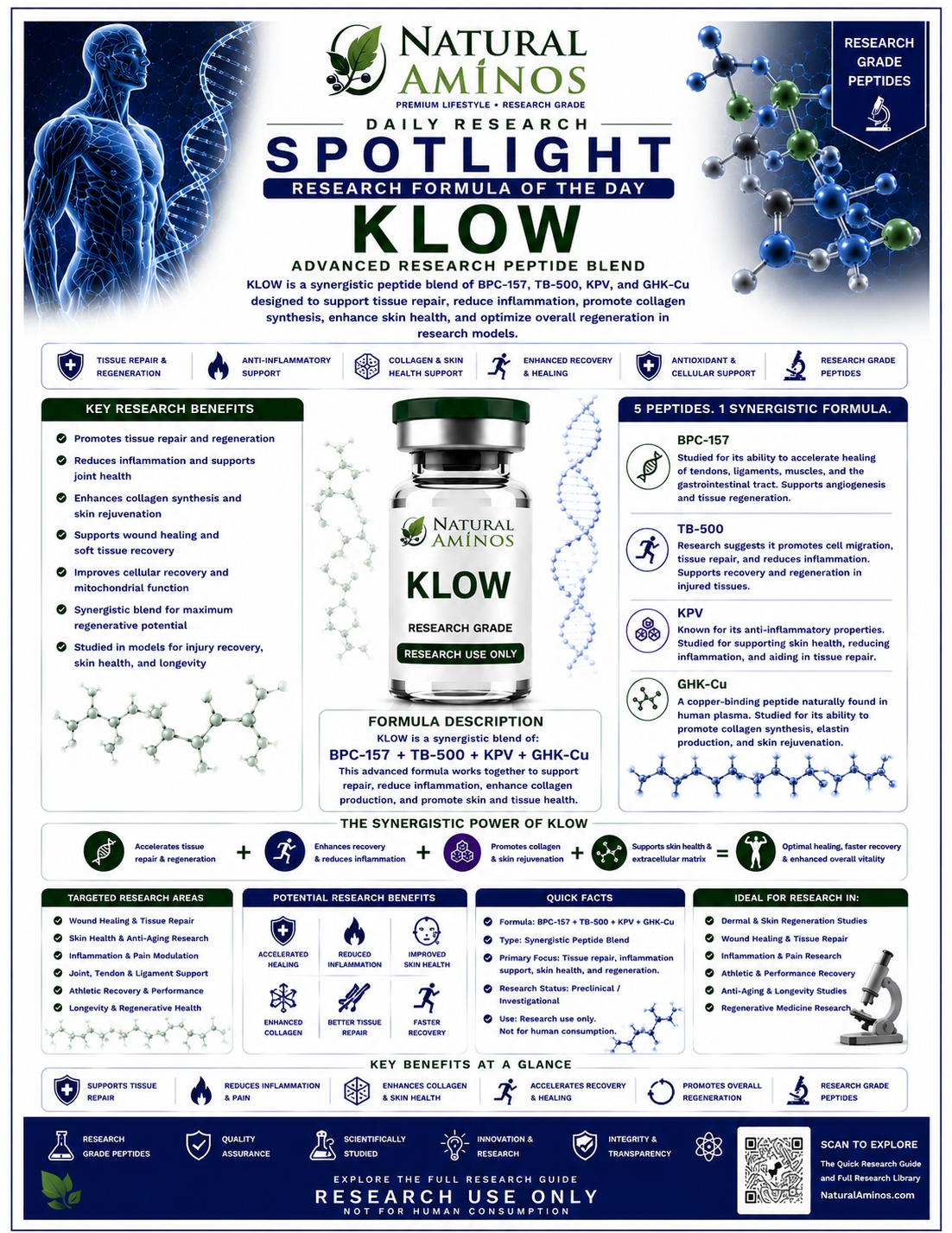
KLOW is a four-peptide blend combining GHK-Cu, BPC-157, TB-500, and KPV, marketed together as a comprehensive recovery, skin, and anti-inflammatory stack. Each component brings a distinct proposed benefit, and the blend's overall pitch rests on stacking those individual actions rather than on any effect unique to the combination itself.
GHK-Cu (glycyl-L-histidyl-L-lysine bound to copper) is a naturally occurring copper-binding tripeptide that declines with age. It is the most clinically supported component for its studied use: stimulating collagen and elastin synthesis, improving skin firmness and texture, and supporting wound remodeling. It also has documented anti-inflammatory and antioxidant actions, reducing pro-inflammatory cytokines while increasing antioxidant enzyme activity.
BPC-157 is a synthetic peptide derived from a protective protein found in human gastric juice. It is researched almost entirely in animal models for accelerating healing across skin, muscle, tendon, ligament, bone, and gut tissue, largely through angiogenesis (new blood vessel formation), fibroblast activity, and modulation of nitric oxide signaling. Human evidence is minimal.
TB-500 is a synthetic version of a fragment of thymosin beta-4, a protein involved in cell migration and wound closure. Its proposed benefit is accelerating soft-tissue repair (tendon, ligament, muscle) and supporting angiogenesis, largely by helping cells migrate to injury sites faster. Some early clinical-stage human work exists, concentrated in wound healing and dry eye rather than musculoskeletal recovery.
KPV is the C-terminal tripeptide of alpha-MSH. Its proposed benefit here is systemic anti-inflammatory and immune-modulating support, working through inhibition of NF-κB and MAP kinase inflammatory signaling. As covered in a prior spotlight, its own research base is built almost entirely around gut inflammation, not skin or musculoskeletal tissue.
Combined, the marketed benefit of KLOW is a broader, multi-front recovery effect — collagen support, tissue repair, cell migration, and inflammation control acting together. That combined effect is a marketing and mechanistic proposition; it has not itself been tested.
Uses
GHK-Cu is used primarily for skin rejuvenation (fine lines, elasticity, texture), general anti-aging support, and as an adjunct to wound and post-procedure skin recovery. BPC-157 is used almost exclusively in animal and cell-culture research for musculoskeletal injury recovery (tendon, ligament, muscle strain) and gastrointestinal healing; human use is off-label and unregulated. TB-500 is used for soft-tissue injury recovery and wound healing, with its formally studied clinical uses limited to dermal wounds and dry eye disease rather than sports-medicine applications. KPV is used for inflammation and immune modulation, most specifically studied in inflammatory bowel disease, with its role in this blend being a general anti-inflammatory contribution rather than a skin- or tissue-repair-specific one.
As a combined product, KLOW is marketed and sold for post-procedure and injury recovery, general tissue regeneration, and skin/anti-aging support — a use case built by combining each peptide's individual, separately-studied use rather than a use that has itself been clinically evaluated.
Published Research
GHK-Cu has the strongest human clinical evidence of the four. A randomized, double-blind 12-week trial in women aged 50–59 with photodamaged skin found measurable improvements in fine lines and skin texture from topical GHK-Cu. A separate IRB-approved clinical study using high-resolution dermal ultrasound in 21 women found an average 28% increase in collagen/elastin density after three months of daily topical application, with the top quartile of participants showing a 51% increase. Comparative trial data has also found GHK-Cu increased collagen deposition in a higher proportion of participants than either vitamin C or retinoic acid over one month. Cell-culture work shows GHK-Cu stimulates fibroblast collagen synthesis at picomolar concentrations.
TB-500 (thymosin beta-4) has the next-most human data, though it is older and narrower in scope than commonly assumed. Developer RegeneRx completed Phase II clinical trials specifically for dermal wound healing and dry eye disease, with results described as promising, but development stalled before Phase III for funding reasons — a pattern echoing ARA-290 and SS-31 in a prior spotlight. A recent scoping review found that direct human data on thymosin beta-4 concentrates in ocular/corneal and skin/wound settings, while musculoskeletal applications (tendon, ligament, muscle) remain represented mainly by preclinical and cell-culture studies rather than human trials.
BPC-157's human evidence is the thinnest of the four despite its popularity. A 2026 narrative review identified only three small human pilot studies in the literature: a retrospective study of 12 people with knee pain, a small interstitial cystitis study, and a two-person intravenous safety/pharmacokinetics study — none randomized or placebo-controlled, and none exceeding roughly a dozen participants. A separate 2015 Phase I trial in 42 patients was conducted but its results were never published. As of this year, the first controlled human trial of BPC-157 (for hamstring injury recovery) had just begun recruiting, meaning no completed controlled human trial yet exists for any use.
KPV's published research, as established previously, remains entirely preclinical and gut-focused: its anti-inflammatory action is documented in murine models of inflammatory bowel disease, with no human trials and no skin- or tissue-repair-specific studies of any kind.
No published research — human or animal — has evaluated GHK-Cu, BPC-157, TB-500, and KPV together, or any subset of the four in combination, for any outcome. Multiple independent reviews of the KLOW blend explicitly note that the combination itself has never been the subject of a clinical trial.
Why More Research Is Needed
What's actually proven, formula by formula: GHK-Cu has real, randomized human trial evidence for skin collagen and texture outcomes — the strongest evidence base in the blend. TB-500 has real but narrow human evidence, concentrated in wound healing and dry eye rather than the musculoskeletal recovery it's typically marketed for, and its development stalled before large-scale trials. BPC-157 has almost no human evidence: three tiny, uncontrolled pilot studies and one unpublished trial, despite extensive animal data. KPV has zero skin- or tissue-repair-specific evidence of any kind, human or animal; everything documented about it concerns gut inflammation.
The theory behind stacking them: recovery and tissue repair involve multiple distinct processes — structural rebuilding (collagen/elastin synthesis), cell signaling and migration to the injury site, blood vessel formation, and inflammation control. The rationale for combining GHK-Cu (structural/collagen), BPC-157 and TB-500 (repair signaling and angiogenesis), and KPV (inflammation control) is that each targets a different piece of the recovery process. Mechanistically this is a moderately reasonable theory — the four pathways are largely non-overlapping, though BPC-157 and TB-500 target genuinely similar territory (both promote angiogenesis and cell migration in tissue repair), making that pair more redundant with each other than complementary.
Where the theory is weaker in practice: only one of the four components (GHK-Cu) has solid randomized human evidence, and that evidence is specific to skin, not the musculoskeletal or systemic recovery many users seek the blend for. BPC-157, the peptide most associated with "repair" in this stack's marketing, has the weakest human proof of any component. Stacking four peptides whose individual human evidence ranges from strong-but-narrow (GHK-Cu) to essentially absent (BPC-157) does not average out to a proven combination — it means the blend's real-world effect for any given user is currently unverifiable, and any perceived full-body "synergy" is a hypothesis layered on top of uneven individual evidence.
Verdict — theory vs. proof: the mechanistic theory for this stack is moderate, not strong — three genuinely distinct targets (collagen structure, inflammation, and repair signaling) but with meaningful overlap between two of the four components (BPC-157 and TB-500 both drive angiogenesis/cell migration). The practical evidence is uneven and, for the blend as a whole, absent: GHK-Cu alone is currently the best-evidenced single component, specifically for skin outcomes. Treat KLOW as a plausible but unproven recovery hypothesis built from one well-evidenced peptide and three peptides with thin-to-nonexistent human data — not as four validated treatments combined into a tested protocol.
Sources
• Journal of Investigative Dermatology — Leyden et al., Anti-aging benefits of a GHK-Cu facial and eye cream: a randomised 12-week clinical trial
• EurekAlert! / Yuvan Research — IRB-approved clinical trial of topical GHK-Cu, 21-subject dermal ultrasound collagen density study
• PRIME Journal — Copper tripeptide GHK-Cu and Regenerative Aesthetics
• PMC — Regenerative and Protective Actions of the GHK-Cu Peptide in the Light of New Gene Data
• PubMed — Regeneration or Risk? A Narrative Review of BPC-157 for Musculoskeletal Healing
• PubMed / MDPI — From Regeneration to Analgesia: The Role of BPC-157 in Tissue Repair and Pain Management
• PeptIQ — BPC-157's First Controlled Human Trial Is Now Recruiting
• MDPI — Thymosin Beta-4 and TB-500 in Tissue Healing, Regeneration, and Musculoskeletal Repair: A Scoping Review
• HealingMaps / clinical summaries — RegeneRx Phase II trials of TB-500 for wound healing and dry eye disease
• PubMed — Dissection of the Anti-Inflammatory Effect of the Core and C-Terminal (KPV) Alpha-MSH Peptides
• Peptide Mind / industry reviews — confirming no published study has tested the KLOW combination
Hashtags
#Peptidetherapy #PeptideResearch #PeptideScience #Biohacking #ResearchPeptides #ScienceBased #KLOW #GHKCu #BPC157 #TB500 #SkinScience #RecoveryScience
This material is for research and educational purposes only and is not medical advice.