KPV Research Data
For laboratory research use only; not for human or veterinary use or consumption. This page provides research information, not personal-use instructions or medical advice.
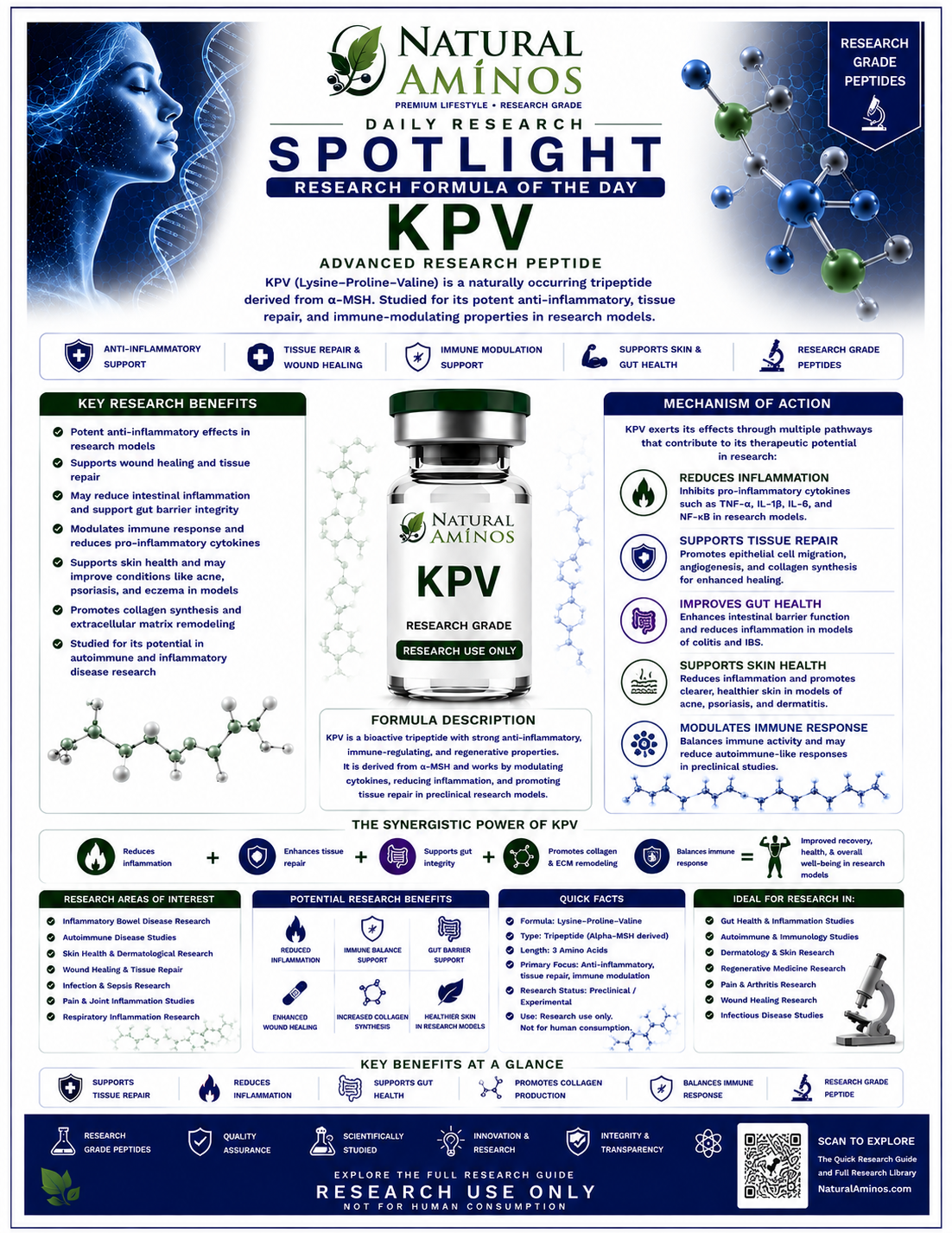
Natural Aminos Research Formula of the Day — KPV
Benefits
KPV is the C-terminal tripeptide of alpha-MSH (Lys-Pro-Val), and it retains much of alpha-MSH's anti-inflammatory activity in a smaller, more stable package. Its core action is dampening NF-κB and IL-1β–driven inflammatory signaling in a model of crystal-induced peritonitis, where systemic treatment with KPV significantly reduced immune cell accumulation, an anti-inflammatory effect that appears distinct from the classic melanocortin-receptor pathway used by other MSH peptides.
Beyond inflammation control, alpha-MSH and its C-terminal fragments have also shown direct antimicrobial activity against fungal and bacterial pathogens, giving KPV a proposed dual anti-inflammatory/antimicrobial profile relevant to wound and tissue-repair contexts.
Separately, a mouse traumatic brain injury study found that a single dose of the alpha-MSH(11–13)/KPV tripeptide reduced secondary brain lesion volume, pointing to a broader neuroprotective signal beyond the gut.
Uses
KPV's research base is overwhelmingly built around gut inflammation — specifically inflammatory bowel disease. Preclinical work has repeatedly shown that oral KPV successfully treats murine colitis, and researchers have used gut-targeted delivery systems such as PepT1-mediated transport to improve KPV uptake and reduce intestinal inflammation.
Outside the gut, KPV is increasingly explored — mostly in industry and clinical-compounding circles rather than peer-reviewed trials — for topical use in wound healing and inflammatory skin conditions like eczema, acne, and hidradenitis suppurativa, where its anti-inflammatory mechanism is assumed to transfer to skin tissue.
As of mid-2026, that skin/wound-healing use case has reached a regulatory milestone: the FDA's Pharmacy Compounding Advisory Committee reviewed KPV in July 2026 for possible inclusion on the Section 503A Bulk Drug Substances List specifically for wound healing and inflammatory skin conditions, and the panel voted to recommend inclusion — though final FDA rulemaking is still pending, and KPV remains unapproved for any indication.
Published Research
The strongest and most repeated evidence for KPV comes from animal colitis models, where oral and nanoparticle-delivered KPV formulations reduced disease severity, improved weight recovery, and lowered inflammatory cytokines in colon tissue — a body of work dating back to a 2005–2009 series of gut-inflammation studies out of the William Harvey Research Institute and collaborators. Its anti-inflammatory mechanism has been characterized in several follow-up papers, including 2012 dermatology-adjacent work on skin barrier and IL-1β inhibition. The single-dose TBI mouse study adds a neuroprotection data point outside the gut.
Despite this, no randomized controlled human trial of KPV has been identified — every mechanism paper, colitis model, and wound-healing claim currently rests on cell culture or animal data. Wound-healing, acne, and rosacea claims circulating in clinical and consumer sources are extrapolations from KPV's anti-inflammatory mechanism, not from KPV-specific human trial results; the human rosacea/acne studies findable in the literature test other compounds (azelaic acid, ferulic acid, topical ivermectin), not KPV itself.
Why More Research Is Needed
What's actually proven: KPV reliably reduces inflammatory markers and improves outcomes in mouse models of colitis, and its anti-inflammatory mechanism (NF-κB/IL-1β inhibition, largely independent of classic melanocortin receptor signaling) is well-characterized at the cell and animal level. One single-dose mouse TBI study suggests a neuroprotective effect beyond the gut.
What's theory, not proof: nearly every human-facing use case people currently reach for KPV for — skin conditions, wound healing, acne, rosacea, general “anti-inflammatory support” — has never actually been tested on KPV in humans. The theoretical case for these uses is coherent: KPV's core mechanism (blocking NF-κB–driven inflammatory signaling) isn't tissue-specific, so if it works in gut epithelium it's mechanistically plausible it could work in skin or other inflamed tissue too. That's a real, biologically grounded rationale — not a wild leap. But plausible generalization across tissue types is still just theory until it's tested directly; the FDA's own review scope (wound healing and skin, not IBD) shows that even regulators are treating the skin/wound application as its own open question, separate from the gut evidence.
Until human trials exist for the specific use someone has in mind, the honest read is: strong mechanistic theory, essentially no direct human proof, for any indication beyond a cell-and-mouse evidence base.
Sources
PubMed — Dissection of the Anti-Inflammatory Effect of the Core and C-Terminal (KPV) Alpha-MSH Peptides
PubMed/PMC — Alpha-Melanocyte Stimulating Hormone: An Emerging Anti-Inflammatory Antimicrobial Peptide
PMC — Single Administration of Tripeptide α-MSH(11–13) Attenuates Brain Damage After Experimental Traumatic Brain Injury in Mice
PMC — Alpha-Melanocyte Stimulating Hormone Protects against Cytokine-Induced Barrier Damage in Caco-2 Intestinal Epithelial Monolayers
SpringerLink — Terminal Signal: Anti-Inflammatory Effects of α-MSH Related Peptides Beyond the Pharmacophore (review, incl. Kannengiesser/Maaser murine colitis series)
HealingMaps — KPV: The Anti-Inflammatory Peptide Under FDA Review (regulatory status, July 2026 PCAC vote)
Hashtags
#Peptidetherapy #PeptideResearch #PeptideScience #Biohacking #ResearchPeptides #ScienceBased #KPV #AntiInflammatory #GutHealth #SkinHealth #WoundHealing