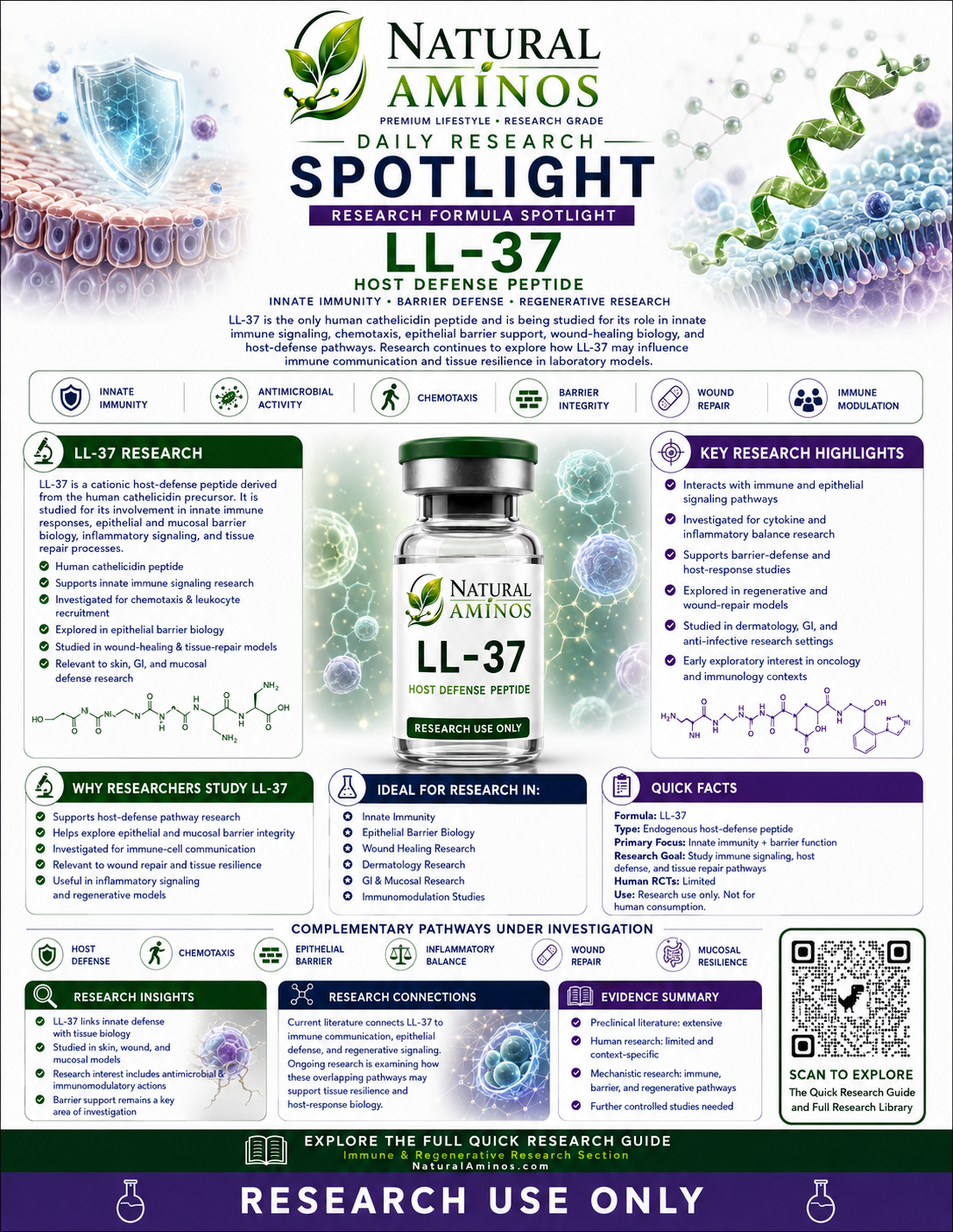
LL-37 Research Data
For laboratory research use only; not for human or veterinary use or consumption. This page provides research information, not personal-use instructions or medical advice.
NATURAL AMINOS RESEARCH
Formula of the Day
LL-37
Antimicrobial & Innate Immune Peptide Spotlight
Benefits
LL-37 is the only cathelicidin antimicrobial peptide produced naturally in the human body — a 37-amino-acid, positively charged peptide released by neutrophils, monocytes, and skin cells as part of the innate immune system. Its best-documented benefit is broad-spectrum antimicrobial activity: it disrupts the membranes of Gram-positive and Gram-negative bacteria, and has documented antiviral, antifungal, and antiparasitic effects, positioning it as one of the body's frontline chemical defenses against infection.
Beyond direct pathogen killing, LL-37 has anti-biofilm activity, breaking down the protective matrix that lets bacteria resist antibiotics and immune clearance — a property researchers are especially interested in for chronic, hard-to-treat wound infections. It also signals directly to host cells: it binds the IGF-1 receptor and activates wound-healing-related signaling pathways, and it activates immune cells called plasmacytoid dendritic cells, which is the basis for early investigation into it as a tumor-destabilizing agent when injected directly into tumors.
This same immune-activating property is a double-edged sword, however. LL-37 is not a purely beneficial molecule — published research also documents it as a driver of chronic inflammatory skin disease when overexpressed, and this dual nature is treated in this write-up as a benefit and a risk simultaneously rather than a benefit alone.
Uses
LL-37's studied uses fall into three distinct categories with very different levels of support. First, and most established, is its role as the body's own innate antimicrobial defense in skin and mucosal tissue — this is an endogenous, already-occurring function rather than a therapeutic use. Second, researchers are investigating topical or wound-applied LL-37 (and, more often, engineered analogs of it) as a treatment for polymicrobial and biofilm-infected wounds, including chronic and antibiotic-resistant infections. Third, LL-37 has been explored experimentally as a cancer immunotherapy adjunct, most notably via direct intra-tumoral injection in melanoma, and as a molecular tool to boost dendritic-cell-based cancer immunotherapies in the lab.
Outside of these investigational uses, LL-37 is also studied as a disease biomarker — its salivary levels have been examined as a non-invasive marker for potentially malignant oral lesions — and as a factor in the pathology of several chronic inflammatory skin conditions (psoriasis, rosacea, atopic dermatitis), where the goal of research is often to block or modulate LL-37 rather than to administer it.
Published Research
Human trial data on administered LL-37 itself is limited and comes almost entirely from oncology. A Phase 1 clinical trial administered intra-tumoral LL-37 injections to melanoma patients with cutaneous metastases; a published case report from that trial documented visible shrinkage of injected lesions over eight weekly injections in one patient, but also documented a dermatologic toxicity (a vesiculo-bullous skin reaction) that emerged roughly 45 days into treatment — illustrating that even this positive human data point carries a real, published adverse effect. Separate observational human research (a completed case-control study) found salivary LL-37 levels distinguished potentially malignant oral lesions from healthy controls with notable diagnostic accuracy, though this is a biomarker study, not a treatment trial.
The larger body of published evidence is preclinical and mechanistic. In vitro and animal work supports LL-37's antimicrobial, anti-biofilm, and wound-healing signaling properties, including activity against multiple bacterial species and mediation of wound-healing pathways via IGF-1 receptor signaling. Because natural LL-37 is unstable, cytotoxic at higher doses, expensive to produce, and rapidly degraded in the body, a large and active research program focuses instead on engineered LL-37 fragments and analogs (such as FK-16 and GF-17), which have shown effective antibacterial activity against clinical orthopedic-infection isolates in lab testing with a improved, though not eliminated, toxicity profile versus the parent peptide.
Working against a simple "more LL-37 is better" reading of the evidence, a separate and substantial published research base documents LL-37 as actively harmful in specific contexts. It is established as overexpressed in psoriatic skin, where it complexes with self-DNA to trigger a chronic autoimmune interferon cascade, and is similarly implicated in rosacea (via disturbed processing into inflammatory fragments) and atopic dermatitis. In melanoma specifically, published research beyond the Phase 1 trial has found LL-37 expression correlates with more advanced tumor invasion stage and can promote pro-angiogenic, invasion-supporting signaling in both mouse models and human melanoma cells — the same immune-activating property investigated as a treatment can also, in a different tissue context, be documented as tumor-promoting.
Why More Research Is Needed
LL-37 is a case where more research is needed less because evidence is entirely absent, and more because the existing evidence points in genuinely opposite directions depending on tissue and dose — a pattern distinct from the theory-vs-proof gaps covered in prior spotlights. What's established: natural LL-37 has real antimicrobial, anti-biofilm, and wound-signaling activity, backed by extensive preclinical work and a small amount of human trial and biomarker data. What's also established, from the same published literature, is that LL-37 overexpression is a documented contributor to at least three chronic inflammatory skin diseases, and that in melanoma tissue it has been linked to both a therapeutic response (Phase 1 tumor shrinkage) and a tumor-promoting effect (invasion and angiogenesis), depending on the study.
This makes the central research gap different in kind from a typical unproven-formula write-up: the open question is not primarily "does this work," but "under what conditions does this help versus harm, and at what dose, tissue, and delivery route." Published reviews of LL-37 itself are explicit that its clinical translation remains limited by cytotoxicity, short half-life, rapid enzymatic degradation, and high production cost, and that the field's own answer to these problems — engineered analogs rather than the native peptide — is itself still in early-stage development with long-term human safety and efficacy not yet validated. No large-scale randomized controlled trial of native LL-37, for any indication, has been published to date; the single Phase 1 oncology trial is small, uncontrolled in the traditional sense, and already documents a significant adverse skin reaction in at least one reported patient.
Verdict — theory vs. proof: the theoretical case for LL-37's antimicrobial and wound-healing benefit is strong at the mechanistic level and well-supported in preclinical models. The practical evidence for administering it therapeutically is thin, mixed, and in the one human oncology trial available, accompanied by a documented adverse event. Given the separately published evidence that overexpression of this same peptide drives inflammatory and, in some tissue contexts, tumor-promoting disease, LL-37 should be treated as a biologically powerful but context-dependent molecule — not a therapeutic with an established net-positive profile in humans.
Sources
• Frontiers in Immunology — The Human Cathelicidin Antimicrobial Peptide LL-37 as a Potential Treatment for Polymicrobial Infected Wounds
• PMC — Antimicrobial Peptides of the Cathelicidin Family: Focus on LL-37 and Its Modifications
• PMC — The Human Cathelicidin Antimicrobial Peptide LL-37 and Mimics are Potential Anticancer Drugs
• Journal of Cutaneous Pathology (Wiley) / PubMed — Dermatologic Toxicity From Novel Therapy Using Antimicrobial Peptide LL-37 in Melanoma
• PMC — LL-37 as a Powerful Molecular Tool for Boosting the Performance of Ex Vivo-Produced Human Dendritic Cells for Cancer Immunotherapy
• PMC — LL-37 Might Promote Local Invasion of Melanoma by Activating Melanoma Cells and Tumor-Associated Macrophages
• ClinicalTrials.gov (NCT06219330) — Cathelicidin LL-37 Relation to Potentially Malignant Lesions
• PMC — Antimicrobial Properties and Cytotoxicity of LL-37-Derived Synthetic Peptides to Treat Orthopedic Infections
• Frontiers in Immunology — Therapeutic Strategies Focusing on Immune Dysregulation and Neuroinflammation in Rosacea
• PubMed — Cathelicidin LL-37: A Defense Molecule With a Potential Role in Psoriasis Pathogenesis
• PubMed — Cathelicidin LL-37: An Antimicrobial Peptide With a Role in Inflammatory Skin Disease
• PMC — Immunomodulatory Role of the Antimicrobial LL-37 Peptide in Autoimmune Diseases and Viral Infections
Hashtags
#LL37 #Cathelicidin #AntimicrobialPeptide #InnateImmunity #PeptideResearch #WoundHealing #ScienceBased #ImmunologyResearch #ClinicalTrials
This material is for research and educational purposes only and is not medical advice.