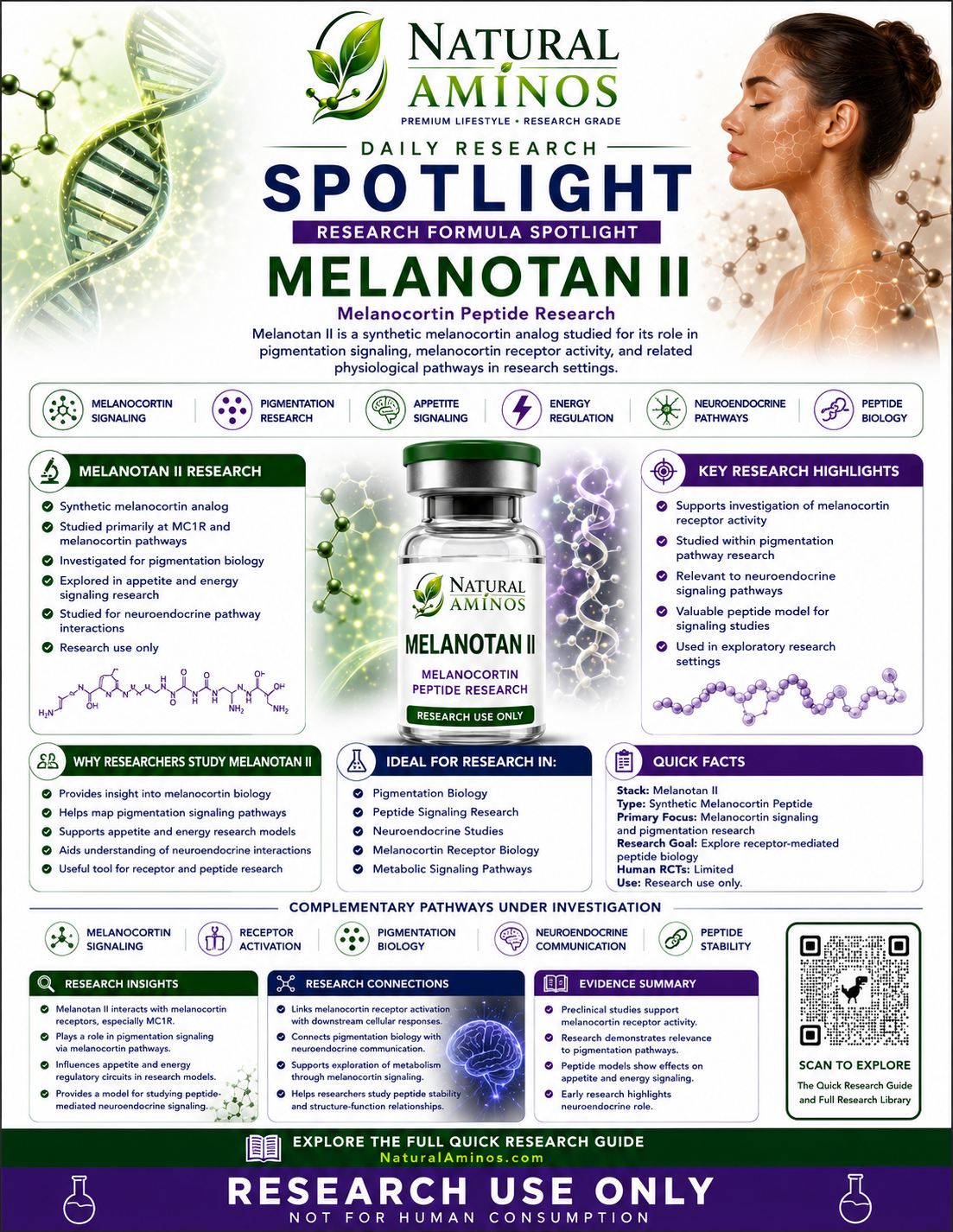
Melanotan II Research Data
For laboratory research use only; not for human or veterinary use or consumption. This page provides research information, not personal-use instructions or medical advice.
Natural Aminos Research Formula of the Day — Melanotan II
Benefits
Melanotan II is a non-selective synthetic analog of alpha-melanocyte-stimulating hormone (α-MSH), up to 1,000 times more potent than the natural hormone, binding MC1R (skin pigmentation), MC3R (appetite/energy), and MC4R (sexual behavior) broadly rather than selectively. Its tanning and libido effects are well documented — increased erectile response was actually discovered as a side effect during early 1990s tanning trials, a finding that later led directly to the development of PT-141 (bremelanotide) as a separate, more targeted compound.
Uses
Melanotan II is used off-label, entirely unregulated, for cosmetic tanning without UV exposure and, secondarily, for libido enhancement. It has no approved medical indication anywhere and no legitimate clinical development program.
Published Research
Melanotan II's clinical picture is genuinely mixed and includes real, documented risk — this is one of the more important compounds in this series to be direct about. Early 1990s pilot trials confirmed dose-dependent tanning alongside dose-limiting nausea, flushing, and spontaneous erections. But a 2021 systematic review in Clinical Toxicology identified 47 documented cases of melanotan-2 toxicity requiring emergency medical intervention across the UK, Australia, and the US, most commonly presenting as hypertensive crises. Case reports have also documented darkening and changes to existing moles (dysplastic nevi) — a finding of real clinical concern, since pigment changes in existing moles are exactly the kind of visual warning sign used to catch early melanoma, meaning Melanotan II use could plausibly mask or complicate that detection. There's also at least one published case report of renal infarction associated with use.
Unlike compounds such as PT-141 or Kisspeptin, Melanotan II has no ongoing formal clinical trial program of any kind — most modern data about it comes from case reports and toxicology reviews rather than controlled research, meaning the evidence base is fundamentally different in character from a compound still being actively studied.
Why More Research Is Needed
Melanotan II's gap is the most serious of any compound covered in this series so far, and it's a different kind of gap than 'needs more trials': it has essentially no modern controlled clinical trial program at all, and its documented risks — melanoma-masking pigment changes, hypertensive crisis, and at least one reported case of renal injury — exist without the systematic monitoring, dosing standardization, or safety infrastructure that an active clinical program would normally provide. Because the current evidence base consists primarily of toxicology case reports rather than trial data, there's no reliable way to estimate how common these adverse events actually are relative to total unregulated use, which makes the real-world risk profile genuinely harder to characterize than for compounds still being formally studied.
Sources
Superpower — Melanotan II: Mechanism, Safety Risks, and Status
RealPeptides — Melanotan-2 Safety Profile: Research Risks Explained (citing Clinical Toxicology systematic review, 2021)
British Journal of Dermatology (Oxford Academic) — User Experiences of Melanotan II Injection for Tanning
Hashtags
#ResearchPeptides #Biohacking #ScienceBased #WellnessScience #HormonalHealth