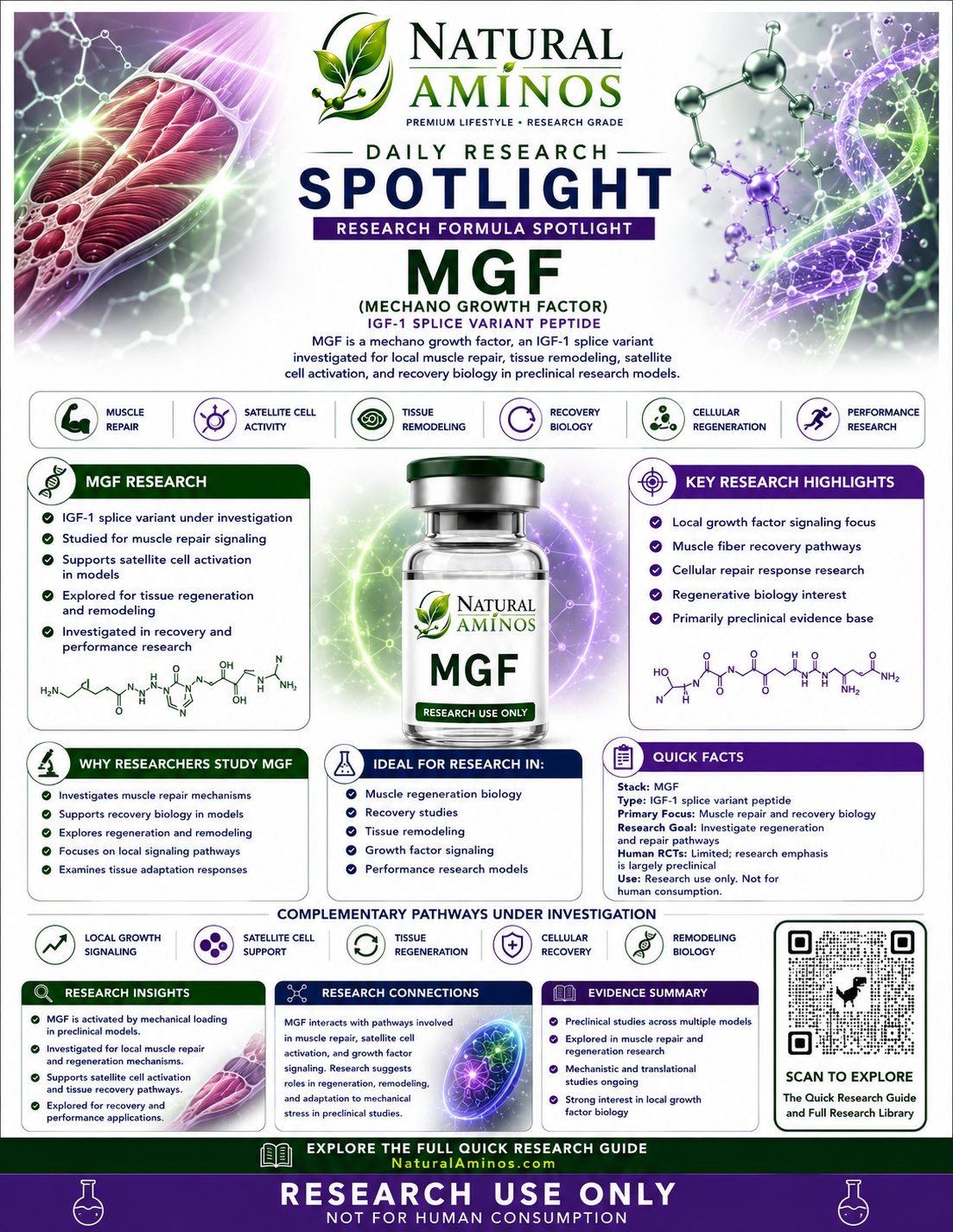
MGF Research Data
For laboratory research use only; not for human or veterinary use or consumption. This page provides research information, not personal-use instructions or medical advice.
Natural Aminos Research Formula of the Day — MGF (Mechano Growth Factor)
Benefits
MGF (Mechano Growth Factor) is a 24-amino-acid splice variant of IGF-1 (IGF-1Ec in humans), first identified in a 1999 study when mechanically stretched muscle produced a distinct local IGF-1 isoform separate from liver-derived IGF-1. Research links it to activating satellite cells — the muscle stem cells responsible for repair — and it has shown effects on cell migration, proliferation, and delayed cellular senescence in young muscle tissue in some preclinical work. It's mechanically induced (via exercise or stretch), acting as a local, context-specific repair signal rather than a circulating hormone, which is the mechanistic basis for its reputation as a targeted muscle-repair compound.
Uses
MGF is researched primarily for muscle repair, hypertrophy, and recovery after mechanical stress or injury, with additional preclinical interest in muscular dystrophy, cardiac muscle regeneration after heart attack, bone/cartilage repair, tendon and ligament healing (including anterior cruciate ligament research), and early neuroprotection studies in brain ischemia models. It has no FDA approval and no human clinical use.
Published Research
MGF's evidence base is entirely preclinical — no completed human clinical trials exist. What's more important, and worth stating directly, is that even the animal and cell-culture evidence is genuinely mixed rather than uniformly supportive. Multiple studies (from the Goldspink research group and others) report the MGF-E peptide activates human muscle progenitor cells and increases their proliferative lifespan, and separate work shows it accelerates ACL fibroblast repair and reduces cardiac cell death after induced injury in microrod delivery models. However, a notable 2014 study directly tested native and stabilized MGF peptide on myoblasts and primary muscle stem cells and found no significant proliferative or differentiation effect — a direct contradiction of the muscle-repair claims that much of MGF's reputation rests on, from a study specifically designed to test that exact claim.
This split in the preclinical literature is the central fact about MGF's evidence base: it isn't simply 'promising but unconfirmed in humans' — the more basic question of whether MGF reliably does what it's claimed to do at the cellular level hasn't been consistently replicated even in the lab.
Why More Research Is Needed
MGF's gap is more fundamental than most compounds in this series. The typical research-peptide gap is 'good animal data, no human trials yet' — but MGF's problem sits one level deeper: at least one well-designed study failed to replicate the core proliferative/differentiation effect that MGF's reputation is built on, meaning the basic biological mechanism itself is contested, not just its translation to humans. Until that underlying question is resolved with more replication studies, human trials would be premature, since researchers wouldn't yet know reliably what effect they're even testing for.
Sources
Journal of Physiology — McKoy et al. (1999), Original MGF/IGF-1Ec Characterization
ScienceDirect — Mechano Growth Factor E Peptide (MGF-E) Activates Human Muscle Progenitor Cells
PubMed — Mechano-Growth Factor Peptide Has No Apparent Effect on Myoblasts or Primary Muscle Stem Cells
PMC — Mechano Growth Factor Accelerates ACL Repair in Human ACL Fibroblasts
PMC — Sustained Delivery of MGF Peptide from Microrods Attracts Stem Cells and Reduces Apoptosis of Myocytes
Superpower — MGF (Mechano Growth Factor): An IGF-1 Splice Variant
Hashtags
#Peptidetherapy #PeptideResearch #PeptideScience #Biohacking #ResearchPeptides #ScienceBased #MuscleRecovery #TissueRepair #MuscleRepair #RecoveryScience