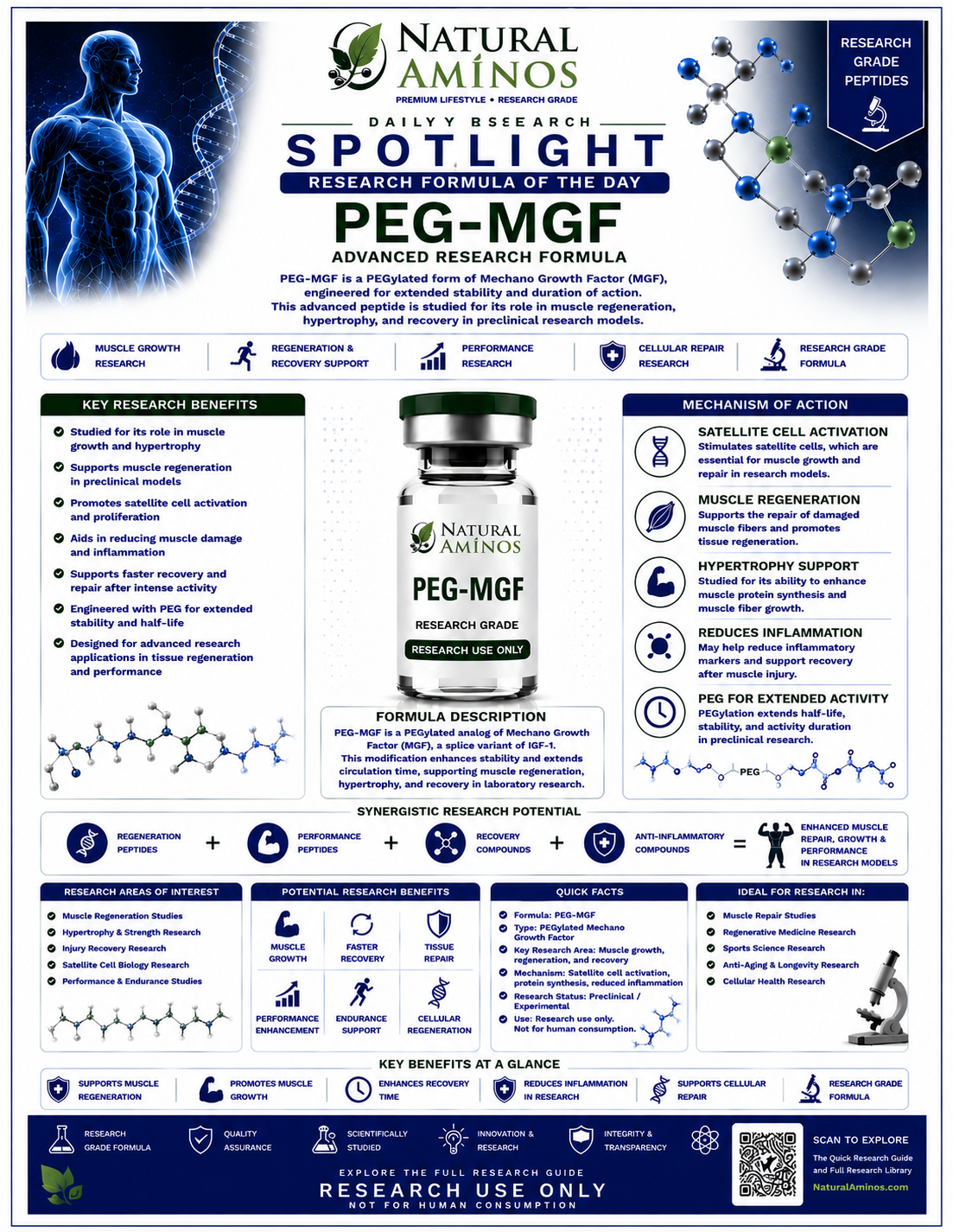
PEG-MGF Research Data
For laboratory research use only; not for human or veterinary use or consumption. This page provides research information, not personal-use instructions or medical advice.
Natural Aminos Research Formula of the Day — PEG-MGF
Benefits
PEG-MGF is a pegylated (chemically stabilized) version of MGF's E-domain peptide — a splice variant of IGF-1. Native MGF has an extremely short half-life of just minutes, so attaching polyethylene glycol chains extends that to roughly 24 hours, making sustained research use possible. It's studied preclinically for satellite cell activation, cardiac stem cell recruitment after injury, reduced cell death in oxygen-deprived tissue, and connective tissue/tenocyte migration — all effects inherited conceptually from the base MGF molecule it's built from.
Uses
PEG-MGF is researched primarily for muscle repair, hypertrophy, and recovery after mechanical or training-induced stress, with additional preclinical interest in tendon/ligament healing, bone/cartilage repair, and cardiac muscle regeneration after injury. It has no FDA approval and no human clinical use.
Published Research
PEG-MGF has no completed human clinical trials — its research base remains entirely preclinical, and it's worth being direct about a further limitation: even its own dedicated preclinical literature is thin. Much of what's published about PEG-MGF specifically discusses extending native MGF's biological activity through pegylation as a delivery/engineering achievement, rather than reporting new, independent efficacy findings unique to the pegylated version. In practice, this means PEG-MGF inherits its reputation almost entirely from base MGF research rather than having its own separate evidence base.
That inherited reputation is itself contested. While some preclinical work reports the MGF-E peptide activates human muscle progenitor cells and extends their proliferative lifespan, a notable 2014 study directly testing native and stabilized MGF peptide on myoblasts and primary muscle stem cells found no significant proliferative or differentiation effect — directly contradicting the muscle-repair claims that PEG-MGF's popularity, by extension, rests on. Since PEG-MGF is essentially a longer-acting delivery format of the same underlying molecule, this contested mechanism applies to it just as much as it applies to unmodified MGF.
Why More Research Is Needed
PEG-MGF's gap compounds two separate problems. First, like base MGF, the core biological mechanism it's supposed to work through has not been consistently replicated even at the cell-culture level — a foundational uncertainty, not just a translation-to-humans gap. Second, PEG-MGF adds its own additional unknown on top of that: because there's so little independent research on the pegylated version specifically, it's not established whether extending the molecule's half-life via PEGylation preserves, weakens, or otherwise changes whatever biological activity MGF does or doesn't have. Both questions — whether MGF's core mechanism is real, and whether pegylation changes its behavior — would need to be resolved before PEG-MGF's research reputation could be considered evidence-based rather than inherited and extrapolated.
Sources
CorePeptides — PEG-MGF Peptide Research in Tissue Repair and Cell Regeneration
ScienceDirect — Mechano Growth Factor E Peptide (MGF-E) Activates Human Muscle Progenitor Cells
PubMed — Mechano-Growth Factor Peptide Has No Apparent Effect on Myoblasts or Primary Muscle Stem Cells
Journal of Physiology — McKoy et al. (1999), Original MGF/IGF-1Ec Characterization
Hashtags
#PeptideResearch #ResearchPeptides #Biohacking #ScienceBased #MuscleRecovery #TissueRepair #RecoveryScience