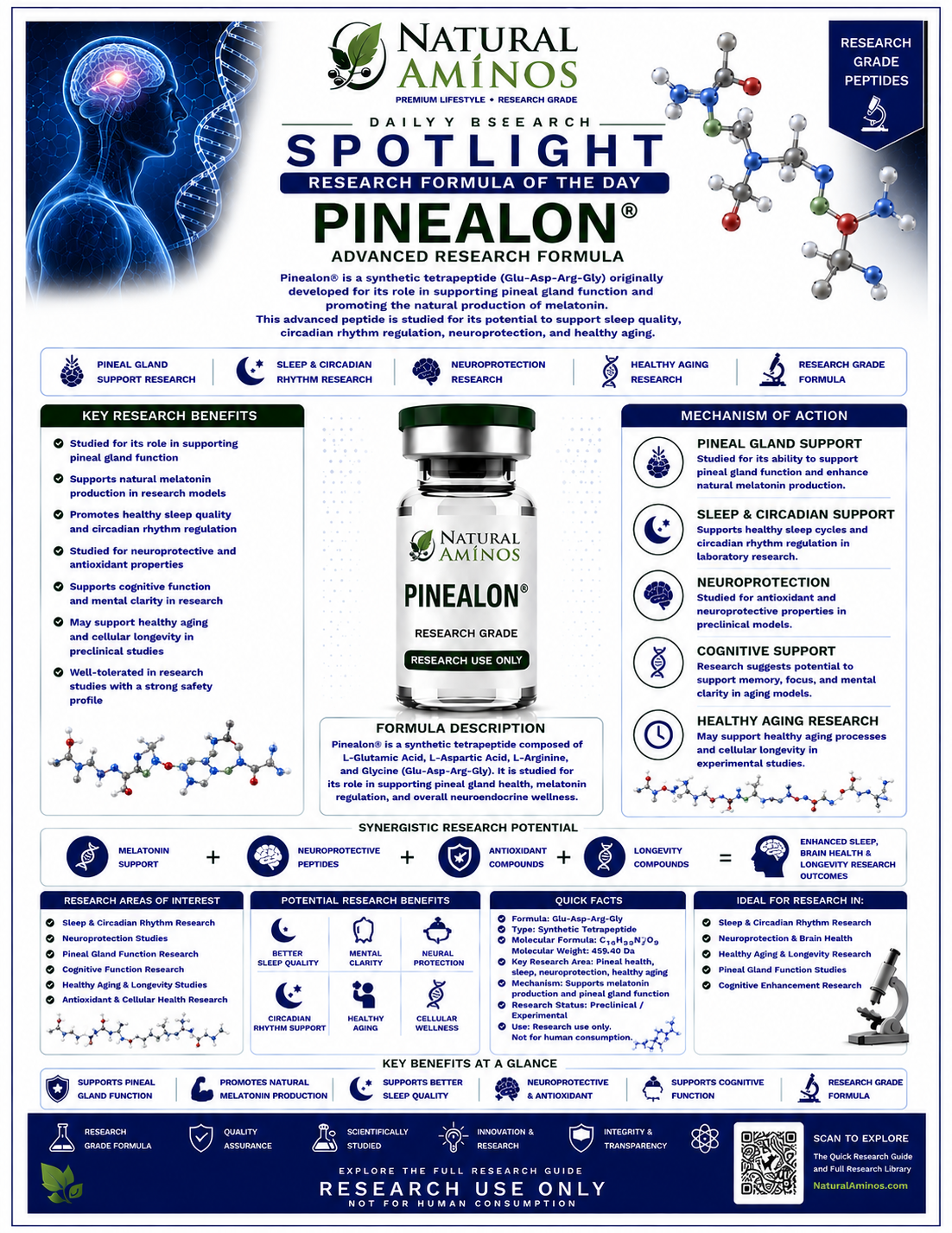
Pinealon Research Data
For laboratory research use only; not for human or veterinary use or consumption. This page provides research information, not personal-use instructions or medical advice.
Natural Aminos Research Formula of the Day — Pinealon (EDR)
Benefits
Pinealon is a synthetic tripeptide (Glu-Asp-Arg, abbreviated EDR) from the Khavinson bioregulator family, developed at the St. Petersburg Institute of Bioregulation and Gerontology and identified while analyzing peptides present in Cortexin, a bovine/porcine brain cortex extract. It's positioned as a brain-and-CNS-targeted counterpart to Epitalon within the same research tradition. Published animal studies from the Khavinson group report it improves learning and memory in aged rats, and a notable 2021 paper found EDR (along with a related tripeptide, KED) preserved dendritic spines and neuroplasticity markers in a mouse model of Alzheimer's disease — described by one independent research summary as the strongest recent Pinealon preclinical finding.
Uses
Pinealon is researched for cognitive aging, neuroprotection, and neurodegenerative disease models (particularly Alzheimer's-relevant pathology), sold strictly as a research compound with no approved medical use anywhere.
Published Research
Pinealon sits in a genuinely different evidence category than some other Khavinson-family peptides covered in this series (such as Cartalax) — real, independently locatable, PMID-indexed publications exist, including foundational work by Ashmarin and colleagues (1998, Bulletin of Experimental Biology and Medicine) on short peptides regulating brain gene expression, and more recent papers by Khavinson, Popovich, and Linkova (2021, Molecules) and Ilina, Khavinson, Linkova and colleagues (2022, International Journal of Molecular Sciences). Preclinical findings include reduced lipid peroxidation, lower pro-inflammatory brain cytokines, and preserved anti-apoptotic protein expression in rodent ischemia models, plus tissue-distribution studies using radioactively labeled EDR peptide showing it penetrates the CNS after systemic administration in rodents.
That said, several real limitations are worth stating directly. First, nearly the entire evidence base — including the life-extension and broader anti-aging claims associated with the wider Khavinson framework — originates from a single research lineage, and independent replication by Western research groups is essentially absent from the peer-reviewed literature. Second, the core proposed mechanism (that a three-amino-acid peptide can bind specific DNA promoter sequences to modulate gene transcription) is considered biophysically implausible by mainstream molecular biology standards and is one of the most contested parts of the entire framework outside the originating lab. Third, most of the neuroprotection studies used a pretreatment design — dosing before an induced injury rather than after — which is an easier effect to demonstrate and has more limited translational relevance to real-world treatment scenarios, where injury has usually already occurred by the time treatment would start. Fourth, no human clinical trial data for Pinealon was identified in this search.
Why More Research Is Needed
Pinealon's gap is layered rather than simple. Its evidence is more independently verifiable than the thinnest peptides in this series, but it remains confined almost entirely to one research group's output, which limits confidence regardless of how internally consistent that group's findings are across papers. Its proposed core mechanism (direct sequence-specific DNA binding by a tripeptide) faces real, substantive scientific skepticism on biophysical grounds, separate from any question about human trials. And its most relevant preclinical design choice — pretreatment before injury rather than treatment after — means even the animal data doesn't fully answer the more clinically relevant question of whether Pinealon would help someone who already has age-related cognitive decline or existing neurological injury. Independent replication by labs outside the Khavinson network, mechanistic studies addressing the DNA-binding skepticism directly, and post-injury (rather than pretreatment) trial designs would all meaningfully strengthen the evidence base before any human use could be considered supported.
Sources
Superpower — Pinealon (EDR): Khavinson Tripeptide Research
Spartan Peptides — Pinealon Tripeptide Research Guide
4Neuroscience — Pinealon: The Khavinson Bioregulator Tripeptide and Cognitive Research
Peptides.GG — Khavinson Bioregulators: The Complete Guide
Bulletin of Experimental Biology and Medicine — Ashmarin et al. (1998), Short Peptides Regulate Gene Expression in the Brain of Rats
Molecules — Khavinson, Popovich & Linkova (2021), Systematic Review on Ultrashort Peptide Transcription Modulation
Hashtags
#PeptideResearch #ResearchPeptides #Biohacking #ScienceBased #NeuroScience #BrainHealth #CognitiveHealth #Longevity