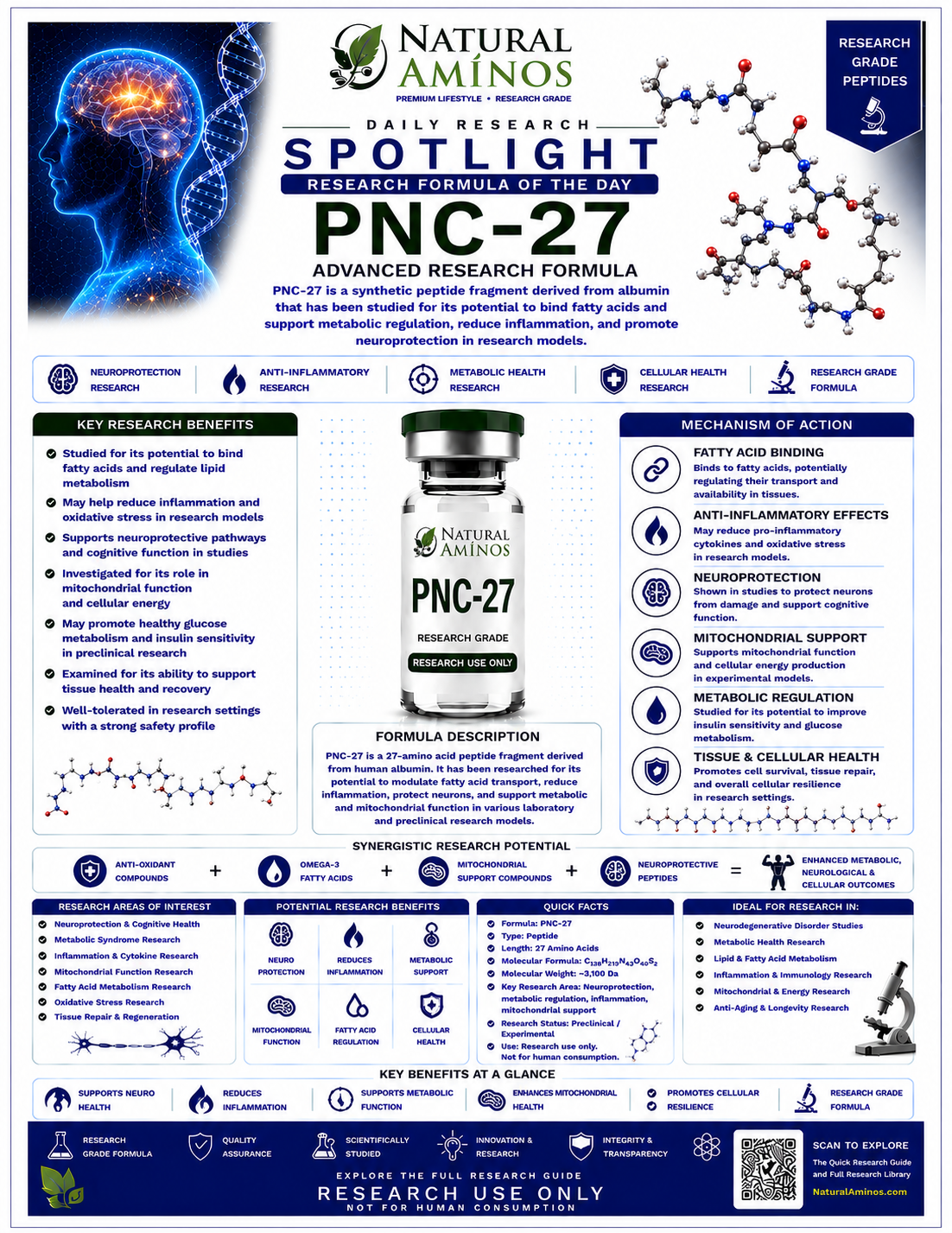
PNC-27 Research Data
For laboratory research use only; not for human or veterinary use or consumption. This page provides research information, not personal-use instructions or medical advice.
NATURAL AMINOS RESEARCH
Formula of the Day
PNC-27
Experimental Anticancer Peptide Spotlight
Benefits
PNC-27 is a synthetic 32-residue peptide engineered by fusing a fragment of the tumor-suppressor protein p53 (the HDM-2/MDM2-binding region, residues 12–26) to a cell-penetrating "leader" sequence. Its proposed benefit is a tumor-selective killing mechanism unlike conventional chemotherapy: rather than damaging DNA or dividing cells broadly, PNC-27 is designed to bind specifically to HDM-2 protein when that protein is abnormally present on the outer surface of cancer cell membranes, then trigger the formation of physical pores in that membrane, causing rapid cell lysis and necrosis within minutes to hours.
The core claimed advantage is selectivity: published laboratory research reports that PNC-27 kills a wide range of cancer cell types while sparing normal, non-cancerous cells, including normal fibroblasts, keratinocytes, pancreatic cells, and blood-forming (hematopoietic) stem cells — because HDM-2 is not present on the outer membrane surface of healthy cells in the same way. This is proposed as a meaningful benefit over standard chemotherapy, which typically also damages healthy dividing tissue and bone marrow.
Uses
PNC-27's only studied use is as an experimental, laboratory-stage anticancer agent. It has been tested in vitro against more than 20 human epithelial cancer cell lines, including pancreatic, colon, lung, breast, and ovarian cancer, as well as leukemia cell lines, and in xenograft (tumor-implanted) mouse models of leukemia, breast cancer, glioma, melanoma, and pancreatic cancer. It has no approved or established clinical use in humans, and no legitimate human therapeutic application exists outside of a formal clinical trial setting — which, to date, has not occurred for this peptide.
Published Research
PNC-27's evidence base is exclusively preclinical — in vitro, ex vivo, and animal — with no published human clinical trial data of any kind. Foundational structural work published in peer-reviewed biophysics journals used two-dimensional NMR and immuno-electron microscopy to characterize how PNC-27 binds HDM-2 and forms ring-shaped transmembrane pore structures in cancer cell membranes, with no equivalent pore formation observed in treated normal fibroblasts used as controls.
Cell-line studies have extended this selectivity finding across a wide range of solid tumor types, and separate published work found PNC-27 induces necrosis in a leukemia cell line (K-562) even though these particular cells lack normal p53 expression — suggesting the peptide's killing mechanism can act independently of the cancer cell's own p53 status, which is notable because many cancers have p53 mutations that disable normal apoptosis pathways. An ex vivo study using primary human tissue (rather than long-established lab cell lines) found PNC-27 was dose-dependently cytotoxic to cancer cells freshly isolated from two ovarian cystadenocarcinoma patients, including cells from a chemotherapy-resistant tumor type, while a control peptide (PNC-29) lacking the HDM-2-binding sequence had no effect — an important comparison because it helps rule out the leader sequence alone as the source of the killing effect.
Animal xenograft research, presented at oncology research conferences, has reported that PNC-27 and the related peptide PNC-28 caused tumor regression or stabilization in immunocompromised mice bearing various human cancers, administered intraperitoneally or intravenously, again without observed toxicity to normal tissue or measurable disruption of blood cell differentiation. No results of a registered human Phase 1, 2, or 3 clinical trial for PNC-27 have been published or located in this search, and it does not appear on ClinicalTrials.gov as an interventional study.
Why More Research Is Needed
PNC-27's preclinical selectivity findings are unusually consistent for an experimental peptide — the same core result (kills cancer cells, spares normal cells, via membrane-associated HDM-2 binding) has been reproduced across cell lines, primary patient-derived tissue, and multiple animal xenograft models over roughly two decades of published work from the same core research group. What has not been established is anything about its behavior in a living human body: no published data exists on human pharmacokinetics, appropriate human dosing, immune response to repeated dosing, off-target effects in human tissue architecture (which is more complex than a mouse xenograft or a cell culture dish), or whether the same tumor-normal cell membrane HDM-2 distinction holds reliably across the full range of human cancers and individual patient biology.
A significant portion of the existing evidence base also comes from a relatively concentrated set of research groups, which is a normal feature of an early-stage compound but means the finding has not yet been broadly independently replicated by unrelated laboratories at the same depth as more established cancer therapeutics. The peptide's very short plasma half-life (reported in the range of minutes) is also a genuine translational hurdle: preclinical protocols have relied on continuous infusion or repeated dosing in xenografts, and it is not yet established what dosing strategy would be feasible, safe, or effective in a human patient.
Verdict — theory vs. proof: the mechanistic theory behind PNC-27 is well-articulated and unusually well-supported at the preclinical level — structural, cell-line, primary-tissue, and animal data all point in the same direction. But "proof" here still means proof in mice and lab dishes, not proof in humans: zero human trial data exists, of any phase, for any indication. This is best treated as one of the more mechanistically promising experimental compounds in this series, but also one of the furthest from clinical validation — a preclinical success story, not a treatment with any established human safety or efficacy profile.
Sources
• PMC / Biophysical Journal (or related) — PNC-27, a Chimeric p53-Penetratin Peptide Binds to HDM-2 in a p53 Peptide-like Structure, Induces Selective Membrane-Pore Formation and Leads to Cancer Cell Lysis
• Cancer Research (AACR) — PNC-27 and PNC-28 Anticancer Peptides Selectively Kill Cancer Cells by Pore Formation Dependent on the Binding of These Peptides to HDM2 in Cancer Cell Membranes
• PubMed — The Anti-Cancer Peptide, PNC-27, Induces Tumor Cell Necrosis of a Poorly Differentiated Non-Solid Tissue Human Leukemia Cell Line That Depends on Expression of HDM-2 in the Plasma Membrane
• PubMed — Ex Vivo Efficacy of Anti-Cancer Drug PNC-27 in the Treatment of Patient-Derived Epithelial Ovarian Cancer
• Cancer Research (AACR) — Abstract C44: Ex Vivo Cytotoxicity of PNC-27 on Primary Human Ovarian and Endometrial Cancers
• Peptides.wiki — PNC-27: Complete Guide (research summary and mechanism overview)
• Industry research summary — PNC-27 Dosage Chart, Schedule & Reconstitution Protocol (preclinical pharmacology and regulatory status)
Hashtags
#PNC27 #AnticancerPeptide #p53Research #HDM2 #PeptideResearch #OncologyResearch #PreclinicalResearch #ScienceBased #CancerBiology
This material is for research and educational purposes only and is not medical advice.