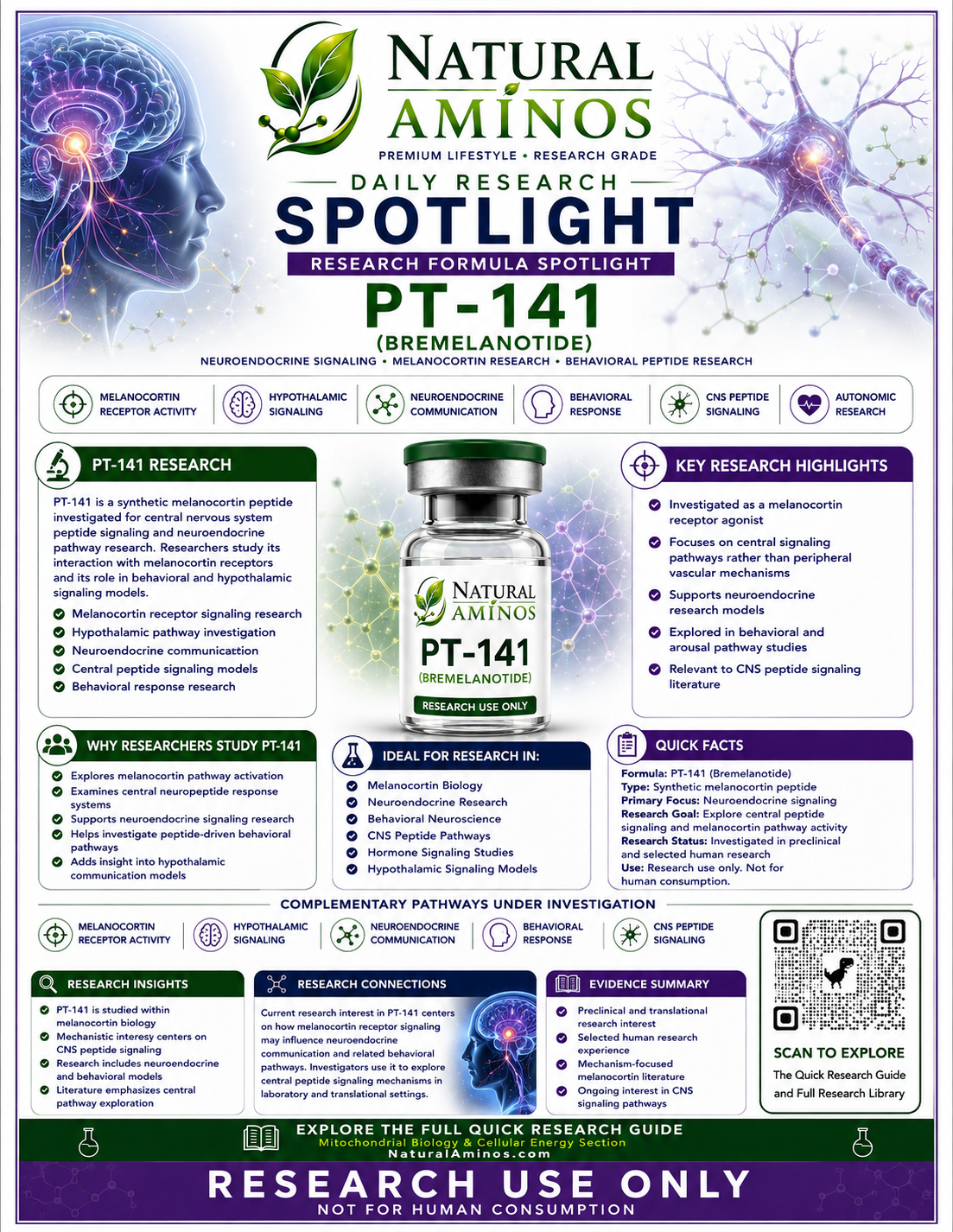
PT-141 Research Data
For laboratory research use only; not for human or veterinary use or consumption. This page provides research information, not personal-use instructions or medical advice.
NATURAL AMINOS RESEARCH
Formula of the Day
PT-141 (Bremelanotide)
Melanocortin Receptor Agonist — Spotlight
Benefits
PT-141 (bremelanotide) is a synthetic analog of alpha-melanocyte-stimulating hormone (α-MSH) that activates melanocortin receptors — primarily MC4R, with some MC3R activity — concentrated in the hypothalamus. Unlike PDE5 inhibitors (e.g., sildenafil), which work by increasing blood flow to the genitals, PT-141 acts centrally, in the brain's desire and arousal circuitry, engaging dopamine-linked pathways rather than vascular ones. That distinct mechanism is the basis for its main proposed benefit: a treatment option for sexual dysfunction that is not primarily about blood flow, potentially useful for people whose dysfunction doesn't respond well to vascular-acting drugs.
Its best-established benefit is increased sexual desire in women with hypoactive sexual desire disorder (HSDD), supported by the largest and highest-quality human evidence of any peptide covered in this series so far — two identically designed Phase 3 trials in over 1,200 women. In men, the proposed benefit extends to libido, arousal, confidence, and erectile function, with early clinical and real-world data showing promise, particularly as an add-on for men who don't fully respond to PDE5 inhibitors alone — though this use remains off-label and less thoroughly proven than the approved indication.
Uses
PT-141 is FDA-approved, under the brand name Vyleesi, specifically for acquired, generalized HSDD in premenopausal women — low sexual desire that causes personal distress and isn't explained by another condition, medication, or relationship problem. This is one of only two FDA-approved drugs ever for female sexual desire disorder, and the first with a non-hormonal mechanism. Every other use of PT-141 is off-label: low libido or erectile dysfunction in men, use in postmenopausal women, and compounded formulations such as nasal sprays, none of which carry FDA approval or the same weight of trial evidence as the approved indication.
Published Research
The approved indication rests on the RECONNECT program: two identically designed, randomized, double-blind, placebo-controlled Phase 3 trials (combined n=1,267) in premenopausal women with HSDD, followed by a 52-week open-label extension. Women receiving bremelanotide showed statistically significant improvement in the Female Sexual Function Index–Desire domain and in sexual-distress scores compared with placebo, with effect sizes described by investigators as modest but consistent across both trials. The safety profile from the pooled Phase 3 program (n=1,247) is well characterized: nausea was the most common adverse effect (about 40% vs. 1% on placebo), followed by flushing (20%), injection-site reactions, and headache; nausea was the leading reason people stopped treatment. Small, transient blood pressure increases were observed on ambulatory monitoring, and focal skin hyperpigmentation — more common in darker skin — occurred in over a third of subjects who received up to 16 consecutive daily doses, well beyond the approved dosing schedule.
For men, the evidence base is thinner. A Phase IIB trial in men with diabetes-related erectile dysfunction found statistically significant improvement in International Index of Erectile Function scores over three months. A 2024 observational (non-randomized, non-placebo-controlled) study followed 21 men using off-label subcutaneous bremelanotide for various sexual dysfunctions and reported favorable real-world outcomes. A larger, controlled Phase III program specifically for male sexual dysfunction has been discussed by the manufacturer but has not yet produced published results.
Why More Research Is Needed
What's actually proven: for premenopausal women with HSDD, PT-141 clears an unusually high evidence bar for this series — two large, randomized, placebo-controlled Phase 3 trials, FDA approval, and a well-documented human safety profile from over a thousand subjects. This is proof, not theory, for that specific population and indication.
Where theory still fills the gap: in men, the central desire-pathway mechanism (melanocortin receptor activation in the hypothalamus) is the same biology used to justify the approved use in women, so the theoretical case for a similar effect in men is grounded in real, demonstrated pharmacology — not speculation from scratch. But the human evidence specifically supporting that use in men remains limited to one small Phase IIB trial and small observational reports, well short of the Phase 3 randomized standard that supports the female indication.
Where the theory is weaker in practice: postmenopausal use, routine off-label male prescribing, and compounded nasal-spray formulations all sit outside what any completed trial has actually tested — nasal delivery specifically was discontinued during development after dose-related blood pressure increases, which is a documented safety finding, not a hypothetical concern. The cardiovascular warning (contraindicated in uncontrolled hypertension or known cardiovascular disease) and the hyperpigmentation risk with off-label dosing frequency are proven risks that apply regardless of which population is using it.
Verdict — theory vs. proof: PT-141 is one of the few compounds in this series with genuine Phase 3 human proof — but only for its approved indication in premenopausal women. Extending it to men, postmenopausal women, or higher-than-labeled dosing frequency is a mechanistically reasonable extrapolation from real biology, not an unproven guess, but it is still running ahead of the controlled human trial evidence for those specific populations.
Sources
• Kingsberg et al. — Bremelanotide for the Treatment of Hypoactive Sexual Desire Disorder: Two Randomized Phase 3 Trials (RECONNECT), Obstetrics & Gynecology, 2019
• Safety Profile of Bremelanotide Across the Clinical Development Program (integrated Phase 3 safety analysis, n=1,247)
• FDA — Vyleesi (Bremelanotide) Prescribing Information and Approval, June 2019
• Phase IIB Trial of Bremelanotide in Diabetes-Associated Erectile Dysfunction
• Goldstein & Goldstein — Observational Study of Off-Label Subcutaneous Bremelanotide in Men (2024)
• Oregon DUR Board — Bremelanotide (Vyleesi) Adverse Drug Reaction and Evidence Summary, 2020
Hashtags
#Peptidetherapy #PeptideResearch #PeptideScience #Biohacking #ResearchPeptides #ScienceBased #PT141 #Bremelanotide #SexualHealth #HSDD #MelanocortinReceptor
This material is for research and educational purposes only and is not medical advice. PT-141 is FDA-approved only for HSDD in premenopausal women; all other uses are off-label.