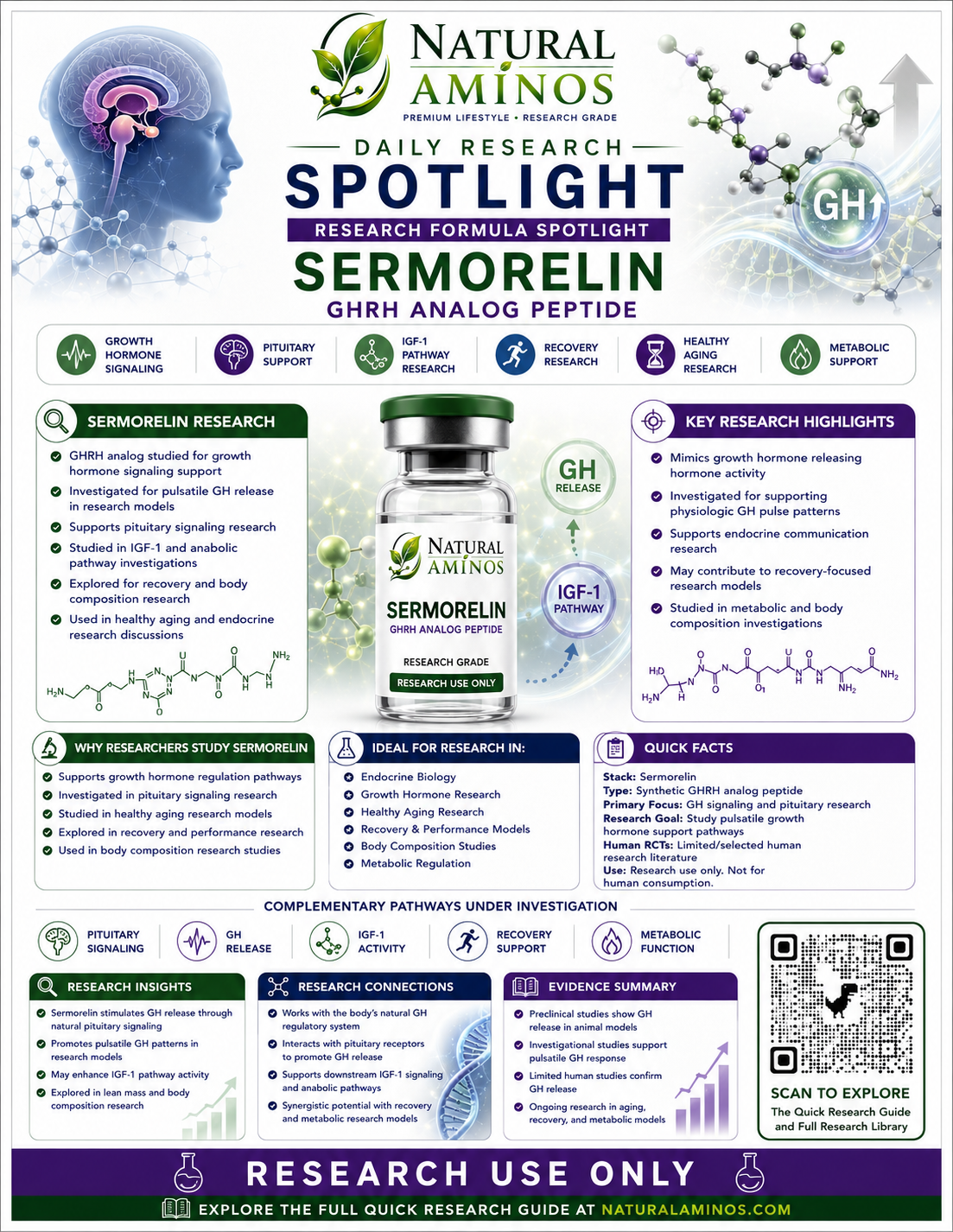
Sermorelin Research Data
For laboratory research use only; not for human or veterinary use or consumption. This page provides research information, not personal-use instructions or medical advice.
NATURAL AMINOS RESEARCH
Formula of the Day
Sermorelin
Growth Hormone Axis & Healthy Aging Spotlight
Benefits
Sermorelin is a synthetic 29-amino-acid peptide representing the shortest fully functional fragment of naturally occurring growth hormone-releasing hormone (GHRH). Rather than supplying growth hormone (GH) directly, it stimulates the pituitary gland's own somatotroph cells to produce and release GH, working within the body's natural pulsatile release pattern and negative feedback system — a mechanistically different approach from direct recombinant HGH injection.
The most reliably reproduced benefit across GHRH-class peptide research is improved sleep: because GH is naturally released in large pulses during slow-wave (deep) sleep, and both that sleep stage and the GH pulse amplitude decline with age, bedtime sermorelin dosing has been associated in clinical studies with increased slow-wave sleep time and improved subjective sleep quality. Other claimed benefits — improved body composition (increased lean mass, reduced fat), increased energy, and elevated IGF-1 levels approaching those of younger adults — appear in the literature but rest on a considerably thinner and older evidence base than the sleep finding, drawn substantially from small older-adult trials and from the broader GHRH drug class rather than sermorelin-specific, adequately powered studies.
Uses
Sermorelin's only FDA-approved uses were pediatric: as a diagnostic agent (the sermorelin stimulation test, used as an alternative to insulin tolerance testing to evaluate whether a child's pituitary gland could adequately secrete GH) and as a treatment for idiopathic growth hormone deficiency and growth failure in children. Outside of that former approval, sermorelin is used off-label by some providers for adults with age-related GH decline, marketed for anti-aging, body composition, sleep, and energy purposes, and has also been studied in combination with other GH-releasing peptides to raise IGF-1 levels, and, in limited exploratory work, in patients with recurrent gliomas.
Published Research
Sermorelin has an unusually long formal regulatory history compared to most peptides in this series: it was FDA-approved under the brand name Geref, first in 1990 for the diagnostic evaluation of growth hormone deficiency in children and later, in 1997, for the treatment of idiopathic GH deficiency and growth failure in children. This approval was based on completed clinical trial data submitted to the FDA, and the diagnostic and therapeutic trials showed sermorelin reliably stimulated pituitary GH release and produced meaningful height-velocity increases in responsive children, with a milder side-effect profile than direct recombinant GH therapy, though smaller effect sizes. The manufacturer, EMD Serono, voluntarily withdrew Geref from the US market in 2008; the FDA's own subsequent determination confirmed this withdrawal was for commercial reasons — the pediatric GHD market was small and dominated by synthetic GH products — not for safety or effectiveness concerns.
Adult evidence is considerably thinner and older. A study cited across multiple secondary sources found older adults treated with sermorelin achieved IGF-1 levels approaching those of younger individuals, with effects persisting up to two weeks post-treatment, and one 16-week trial in older adults reported a modest 1.26 kg increase in lean body mass. A comparative study evaluating sermorelin against growth hormone-releasing peptides in the context of male hypogonadism found sermorelin increased GH by a similar magnitude to comparator peptides, while also producing small acute rises in prolactin, FSH, and LH not seen with all comparators — a mechanistic difference worth noting rather than a proven clinical benefit or harm. Research in children with pulsatile GH secretion, comparing 1 mg sermorelin to native GHRH(1-40), found both significantly increased GH levels, again with sermorelin producing those small additional hormonal effects.
Beyond metabolic and growth outcomes, exploratory research by Y. Chang and colleagues has examined sermorelin's potential role in patients with recurrent gliomas, described in secondary sources as investigating possible anti-tumor properties — this remains an early, narrowly scoped line of inquiry rather than an established use. No large, modern, placebo-controlled randomized trial isolating sermorelin specifically (as opposed to the broader GHRH class) in adults for anti-aging, sleep, or body composition outcomes was identified in this search; most contemporary secondary sources explicitly note that current adult-use claims lean on older pediatric-era data and the broader GHRH drug class rather than sermorelin-specific modern trials.
Why More Research Is Needed
What's solidly established: sermorelin reliably stimulates pituitary GH release, this mechanism was validated well enough for two separate FDA approvals in children, and its side-effect profile over three decades of documented use is generally described as mild. What is markedly less established is the modern, adult, off-label use case it is now most commonly marketed for. The sleep benefit has the most direct supporting data of the anti-aging claims, tied to a well-understood mechanism (amplifying the natural slow-wave sleep GH pulse). The body-composition, energy, and broader "anti-aging" claims rest on a mix of small older-adult trials, decades-old pediatric data, and extrapolation from the wider GHRH peptide class — not a dedicated, adequately powered, modern randomized trial base in adults.
A further open question is monitoring and long-term safety in the specific population now using it: because sermorelin is no longer a branded, FDA-tracked product and is sourced through 503A compounding pharmacies, published sources note a lack of long-term clinical studies in this current use context, distinct from the well-documented pediatric trial record. The hormonal side effects observed in some comparative studies (small rises in prolactin, FSH, and LH) also have not been thoroughly characterized for long-term, off-label, adult dosing regimens, which typically differ from the originally approved pediatric protocols.
Verdict — theory vs. proof: sermorelin is unusual in this series for having genuine historical FDA approval and real completed human trials — but that proof was established for a narrow pediatric indication that has since been commercially discontinued, not for the adult anti-aging and body-composition uses it is now primarily sold for. The mechanistic theory for those adult uses is reasonable and builds on the same validated GHRH-pituitary pathway, but the practical evidence specific to sermorelin in adults is thin, dated, and partly borrowed from the broader GHRH class. Treat the pediatric GHD indication as genuinely evidence-backed history, and the modern adult wellness use as a plausible extension of that mechanism that has not itself been rigorously retested.
Sources
• Federal Register — Determination That GEREF (Sermorelin Acetate) Injection Was Not Withdrawn From Sale for Reasons of Safety or Effectiveness
• Clinical Peptide — Is Sermorelin FDA Approved? Regulatory History and Current Status
• PMC — Beyond the Androgen Receptor: The Role of Growth Hormone Secretagogues in the Modern Management of Body Composition in Hypogonadal Males
• Medical Antiaging (whitepaper) — Sermorelin Medical Evidence, Monis A. and Maple K.
• TrimRX — Sermorelin: What the Research Actually Says, Evidence Review
• Peptides.org — Sermorelin: Reviews, Clinical Trials, and Safety
• Testing.com — Sermorelin Benefits: What the Research Actually Shows
• FormBlends Clinical Research — Sermorelin Benefits: What the Research Actually Shows (sleep/GHRH-class evidence)
Hashtags
#Sermorelin #GHRH #GrowthHormone #PeptideTherapy #HealthyAging #SleepScience #PeptideResearch #ScienceBased #HormoneHealth
This material is for research and educational purposes only and is not medical advice.