Tesamorelin Research Data
For laboratory research use only; not for human or veterinary use or consumption. This page provides research information, not personal-use instructions or medical advice.
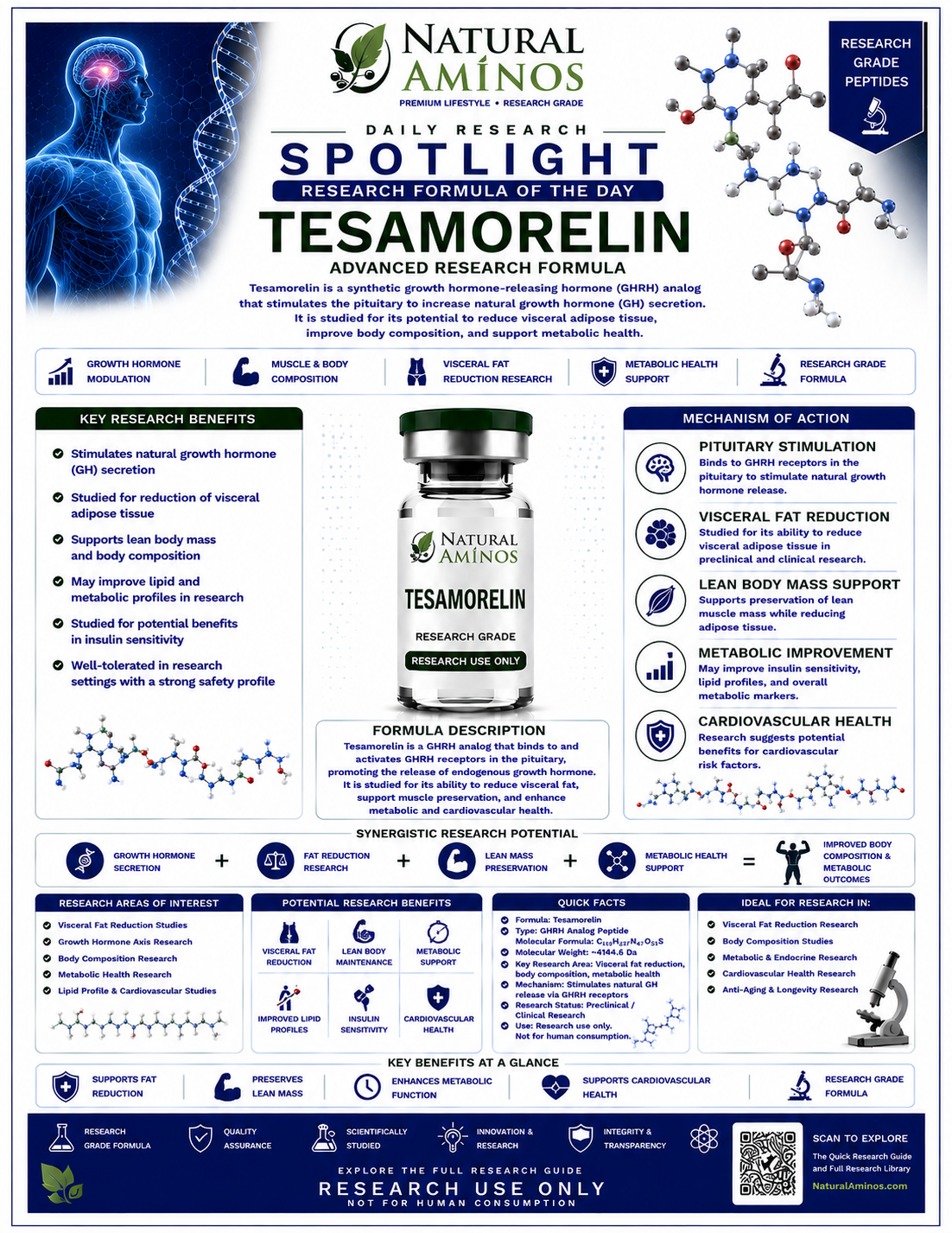
Natural Aminos Research Formula of the Day — Tesamorelin
Benefits
Tesamorelin is a stabilized synthetic analog of growth hormone-releasing hormone (GHRH 1–44), engineered with an N-terminal cap that protects it from DPP-4 enzyme breakdown, giving it a longer active window than natural GHRH. It binds the GHRH receptor on the pituitary gland and stimulates the body's own pulsatile release of growth hormone, which in turn drives IGF-1 production in the liver — rather than supplying growth hormone directly, the way synthetic HGH does.
Its best-documented benefit is a significant, CT-scan-verified reduction in visceral adipose tissue (VAT) — the deep abdominal fat linked to metabolic and cardiovascular risk. A recent meta-analysis of five randomized controlled trials found tesamorelin produced a statistically significant reduction in visceral fat and trunk fat, along with a significant increase in lean body mass, without significant changes in blood glucose control.
Beyond body composition, tesamorelin has shown a second, separately-studied benefit: two placebo-controlled randomized trials in older adults (ages 55–87, including participants with mild cognitive impairment) found 20 weeks of tesamorelin significantly improved executive function in both healthy and cognitively impaired participants, and improved delayed verbal memory specifically in the MCI group.
Uses
Tesamorelin's FDA-approved use, under the brand names EGRIFTA SV and EGRIFTA WR, is reducing excess visceral abdominal fat in adults with HIV-associated lipodystrophy — it is one of the few peptides in this series with a completed FDA approval pathway rather than off-label or compounded-only status. It has also been studied specifically for liver fat in HIV patients with nonalcoholic fatty liver disease, where a 12-month trial found a greater reduction in liver fat with tesamorelin than placebo.
Outside its approved indication, tesamorelin is increasingly used off-label in general (non-HIV) populations for visceral fat and body-composition goals, extending from the same GH/IGF-1 mechanism but outside the population the drug was actually tested in. It is also being formally investigated, in an active Johns Hopkins University-sponsored Phase 2 randomized trial (NCT03150511), as a therapy to speed axonal regeneration, reduce muscle atrophy, and improve functional recovery after peripheral nerve injury — a use still under investigation, not yet established.
Published Research
The strongest evidence is the visceral fat indication that earned FDA approval. Pooled analysis of two multicenter, double-blind, placebo-controlled Phase 3 trials found daily tesamorelin reduced visceral adipose tissue and maintained that reduction for up to 52 weeks, while preserving subcutaneous fat and improving body image and lipid markers, with fat returning to baseline within 26 weeks of stopping treatment. A 2025/2026 meta-analysis of five randomized controlled trials confirmed a significant visceral fat reduction (mean difference −27.71 cm²) and a significant lean body mass increase (+1.42 kg), with adverse events limited mostly to arthralgia, myalgia, paresthesia, and injection-site reactions, and no significant disruption of glucose control.
The cognitive-function evidence is a separate, smaller but real body of randomized trial data. A double-blind, placebo-controlled trial of 137–152 older adults (55–87 years old, including both cognitively healthy participants and those with mild cognitive impairment) found that 20 weeks of nightly tesamorelin significantly improved executive function in both groups, and significantly improved delayed verbal recall specifically in the MCI subgroup — the first study to demonstrate this effect and one built on an earlier positive 6-month pilot study in healthy older adults.
A dedicated randomized controlled Phase 2 trial testing tesamorelin for peripheral nerve injury recovery (axonal regeneration, muscle atrophy, functional outcomes) is currently active and recruiting at Johns Hopkins — meaning this specific application has a real trial underway but no published outcome data yet.
Why More Research Is Needed
What's actually proven: tesamorelin has cleared the highest evidence bar available — FDA approval based on multiple large, randomized, placebo-controlled Phase 3 trials — for reducing visceral fat in HIV-associated lipodystrophy, with effects replicated in independent meta-analysis. Its cognitive benefit in older adults, including memory improvement in mild cognitive impairment, also rests on real randomized, placebo-controlled human trial data, though from a smaller, separate research program run mostly by one research group (University of Washington).
What's still theory or unconfirmed: the popular off-label use of tesamorelin for general body-composition and fat-loss goals in people without HIV or lipodystrophy extends the same GH/IGF-1 mechanism to a different population than the one actually studied — plausible given the mechanism, but not the tested population or outcome. The peripheral nerve injury application is the clearest current example of theory-in-progress: the mechanistic rationale (GH/IGF-1 signaling supporting nerve and muscle repair) is reasonable enough that a real randomized Phase 2 trial is underway, but as of now it remains an open hypothesis with no published result. Broader "recovery and anti-aging" claims built on tesamorelin raising GH and IGF-1 levels are the least tested of all — they follow logically from what GH/IGF-1 does in general physiology, but tesamorelin itself has not been tested for those specific outcomes. The clear line to draw is: visceral fat reduction and the specific cognitive-function findings are proven in trials; everything else riding on the same GH-release mechanism is a reasonable extrapolation still waiting on its own dedicated human evidence.
Sources
Metabolism/PubMed — Effects of Tesamorelin (TH9507) in HIV-Infected Patients with Excess Abdominal Fat: Pooled Analysis of Two Phase 3 Trials
PubMed (2025/2026) — Body Composition, Hepatic Fat, Metabolic, and Safety Outcomes of Tesamorelin in HIV-Associated Lipodystrophy: A Meta-Analysis of Randomized Controlled Trials
Archives of Neurology / Alzheimer's & Dementia (Baker et al., 2011–2012) — Tesamorelin, a GHRH Analogue, Improves Cognitive Function in MCI and Healthy Aging: Randomized Controlled Trial
ClinicalTrials.gov NCT03150511 — Tesamorelin Therapy to Enhance Axonal Regeneration, Minimize Muscle Atrophy, and Improve Functional Outcomes Following Peripheral Nerve Injury (Johns Hopkins University, active Phase 2)
ScienceDirect Topics — Tesamorelin: overview of GHRH analog mechanism, stability, and FDA approval history
PMC — Effect of Tesamorelin in People with HIV With and Without Dorsocervical Fat: Post Hoc Analysis of Phase 3 Trial
Hashtags
#Peptidetherapy #PeptideResearch #PeptideScience #Biohacking #ResearchPeptides #ScienceBased #Tesamorelin #GHRH #BodyComposition #CognitiveHealth #VisceralFat