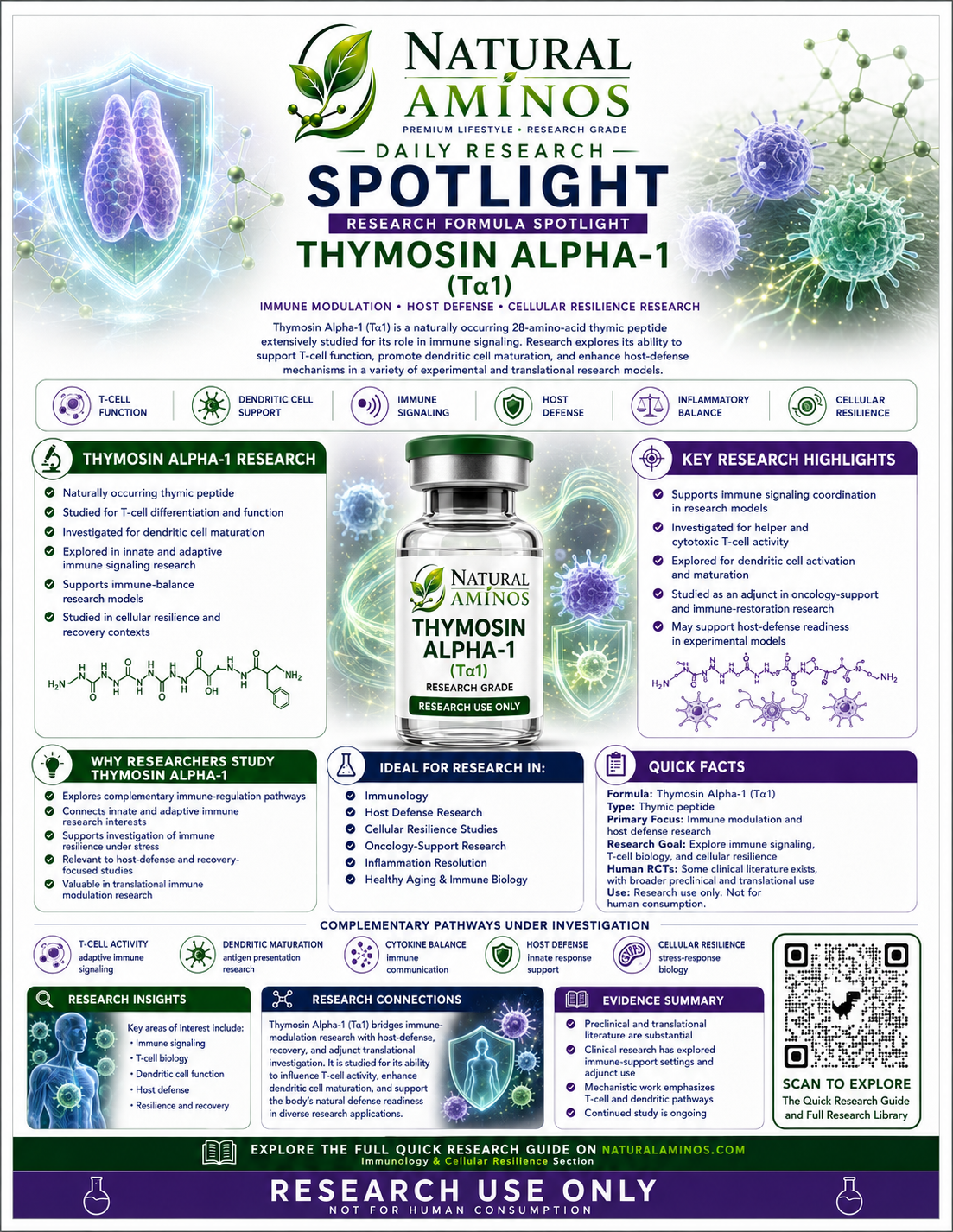
Thymosin Alpha-1 Research Data
For laboratory research use only; not for human or veterinary use or consumption. This page provides research information, not personal-use instructions or medical advice.
NATURAL AMINOS RESEARCH
Formula of the Day
Thymosin Alpha-1
Thymic Immune-Modulating Peptide — Spotlight
Benefits
Thymosin alpha-1 (Tα1) is a 28-amino-acid peptide naturally produced by the thymus gland, synthesized commercially as thymalfasin. It works by activating Toll-like receptor 9 (TLR9) signaling on dendritic cells, which drives Th1-polarized immune responses, promotes T-cell maturation, and coordinates a more organized adaptive immune response rather than simply amplifying inflammation broadly. That distinction matters clinically: Tα1 is described as an immune-balancing agent, capable of both boosting an underactive immune response (as in chronic viral infection) and tempering an overactive, dysregulated one (as in sepsis, where excess inflammation itself is dangerous).
Its most established benefit is improving viral clearance in chronic hepatitis B, where it raises rates of complete virological response compared with no treatment. In critically ill patients with severe sepsis, Tα1 has repeatedly restored a marker of immune competence (monocyte HLA-DR expression) that predicts survival, and pooled trial data show an associated reduction in mortality. It has also been studied as a vaccine adjuvant, improving antibody response in people who did not respond to a first round of hepatitis B vaccination.
Uses
As the branded drug Zadaxin, thymosin alpha-1 is approved in more than 35 countries — including China and Italy — for chronic hepatitis B, and in several of those countries also for hepatitis C and as an adjunct in certain cancers (melanoma, hepatocellular carcinoma, non-small-cell lung cancer) alongside chemotherapy. It is not FDA-approved in the United States; as of a February 2026 reclassification it holds FDA 503A Category 2 status, meaning it can be prescribed and compounded by licensed US pharmacies but has not gone through FDA's own approval review. Beyond its approved indications, Tα1 has been studied clinically for severe sepsis, ARDS, COPD, post-bone-marrow-transplant infections, and — during the pandemic — severe COVID-19.
Published Research
The hepatitis B evidence is long-standing: a pivotal randomized trial in 98 patients found a complete virological response in 40.6% of those on thymosin alpha-1 versus 9.4% of untreated controls, and this result has been replicated across further RCTs combining Tα1 with interferon or antivirals over more than two decades of published trial data. For sepsis, the multicenter ETASS randomized trial (n=361) found 28-day mortality of 26.0% in the Tα1 group versus 35.0% in controls — a result that did not reach the conventional significance threshold on its primary non-stratified analysis (p=0.062) but did on a secondary log-rank analysis (p=0.049), alongside a significant improvement in the immune marker mHLA-DR. A larger meta-analysis of 19 RCTs (530 patients with mortality data) found a statistically significant 41% relative reduction in sepsis mortality with Tα1 (RR 0.59, 95% CI 0.45–0.77); a more recent 2025 meta-analysis using individual patient data from two large multicenter RCTs (967 vs. 960 patients) was conducted specifically because the effect, despite being statistically consistent across trials, remains debated in the critical care field.
For COVID-19, a multicenter cohort study found associations between Tα1 use and improved outcomes in severely ill patients, but this and most other COVID-19 Tα1 studies were observational cohorts rather than randomized trials, and a 2023 systematic review explicitly describes the evidence for Tα1 in SARS-CoV-2 infection specifically as still debatable, in contrast to its more established sepsis and hepatitis B data.
Why More Research Is Needed
What's actually proven: for chronic hepatitis B, thymosin alpha-1 has decades of randomized human trial data behind it and international regulatory approval in 35+ countries — among the strongest evidence bases of any peptide covered in this series. Sepsis has real randomized trial and meta-analytic support for a mortality benefit, though the single largest dedicated trial (ETASS) only reached significance on a secondary analysis, not its primary one, which is a meaningfully weaker result than a clean primary-endpoint win.
Where theory still does real work: the TLR9-driven, Th1-polarizing mechanism gives a coherent explanation for why the same peptide could help both an underactive immune response (chronic viral infection) and an overactive, dysregulated one (sepsis) — immune balancing rather than blanket stimulation. That mechanistic story is plausible and consistent with the clinical data pattern seen so far, but it is still an interpretation of the mechanism, not a separately proven claim on its own.
Where the theory is weaker in practice: COVID-19 use is the clearest example of theory running ahead of proof within this compound's own literature: the same TLR9/Th1 mechanism that helps explain hepatitis B and sepsis data was extended to COVID-19 based on plausible reasoning about immune dysregulation in severe viral illness, but the actual COVID-19 evidence is mostly observational, and reviewers in the field have explicitly called the result debatable rather than established. The lack of FDA approval in the US, despite decades of foreign trial data, also reflects a real regulatory evidence gap, not just a formality.
Verdict — theory vs. proof: thymosin alpha-1 has some of the deepest human trial history in this series for its approved use (hepatitis B) and meaningful, if second-tier, trial support for sepsis. Its extension into COVID-19 and other off-label critical-care uses is a reasonable mechanistic extrapolation from that same immune-balancing theory, but it remains explicitly unsettled in the published literature rather than confirmed.
Sources
• Mutchnick et al. — Pivotal Randomized Trial of Thymosin Alpha 1 in Chronic Hepatitis B, Hepatology, 1998
• Wu et al. — The Efficacy of Thymosin Alpha 1 for Severe Sepsis (ETASS): A Multicenter, Single-Blind, Randomized Controlled Trial, Critical Care, 2013
• Liu et al. — The Efficacy of Thymosin α1 as Immunomodulatory Treatment for Sepsis: A Systematic Review of Randomized Controlled Trials, BMC Infectious Diseases, 2016
• Frontiers in Cellular and Infection Microbiology — Efficacy of Thymosin α1 for Sepsis: A Systematic Review and Meta-Analysis of RCTs (individual patient data, 2025)
• Tao et al. — Thymosin α1 and Its Role in Viral Infectious Diseases: The Mechanism and Clinical Application, Molecules, 2023
• ClinicalTrials.gov — Thymalfasin (Thymosin Alpha 1) to Treat COVID-19 Infection (NCT04487444)
• Efficacy of Thymosin Alpha 1 in the Treatment of COVID-19: A Multicenter Cohort Study, Frontiers in Immunology, 2021
Hashtags
#Peptidetherapy #PeptideResearch #PeptideScience #Biohacking #ResearchPeptides #ScienceBased #ThymosinAlpha1 #ImmuneHealth #HepatitisB #Sepsis #TLR9
This material is for research and educational purposes only and is not medical advice. Thymosin alpha-1 is not FDA-approved in the United States.