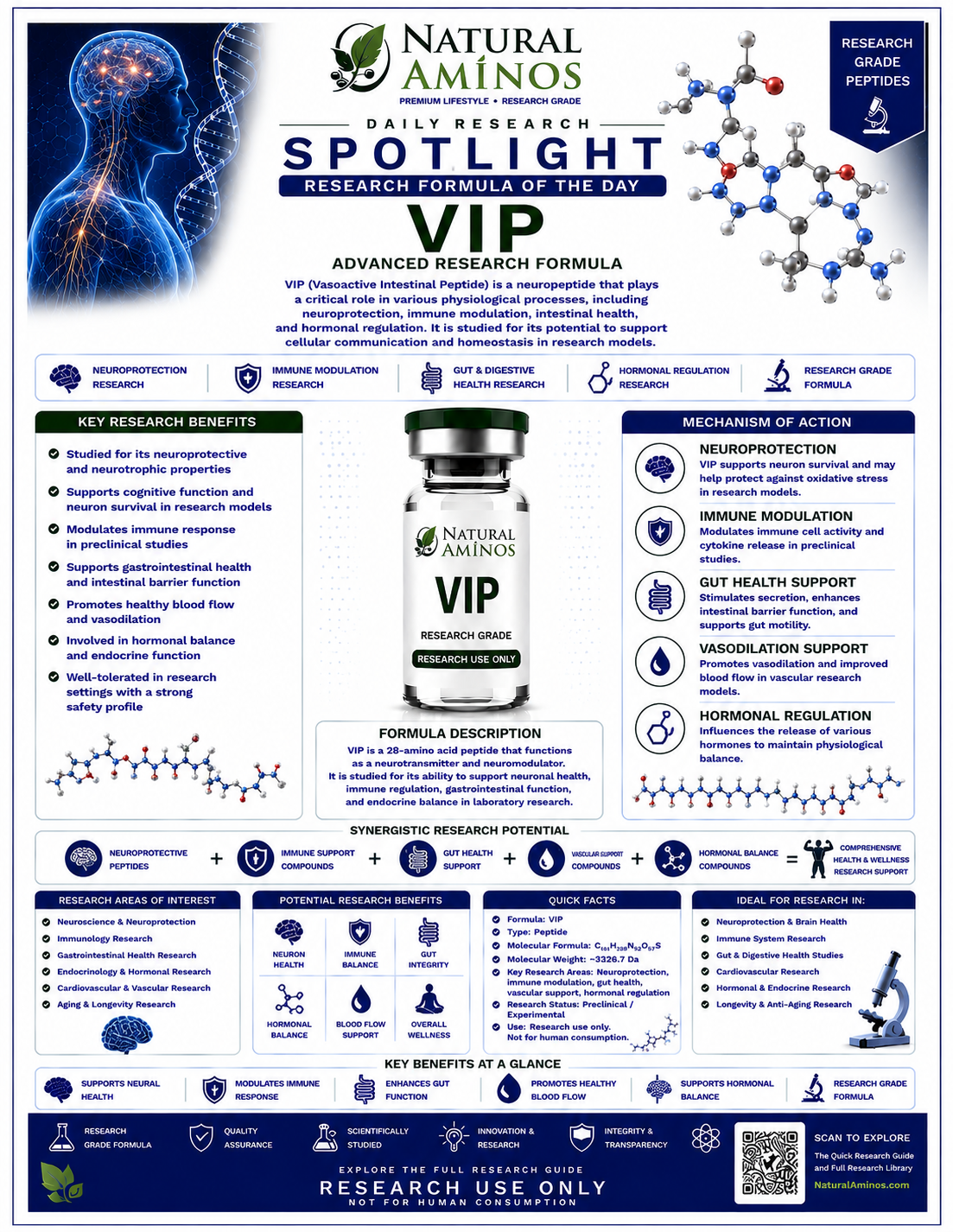
VIP Research Data
For laboratory research use only; not for human or veterinary use or consumption. This page provides research information, not personal-use instructions or medical advice.
Natural Aminos Research Formula of the Day — VIP (Vasoactive Intestinal Peptide)
Benefits
VIP is a 28-amino-acid neuropeptide, first isolated from the upper intestine in 1970, that is naturally produced throughout the nervous, immune, and cardiopulmonary systems. It acts on two G-protein-coupled receptors, VPAC1 and VPAC2, to trigger cAMP signaling, giving it an unusually broad physiological reach: potent vasodilation, bronchodilation, positive effects on heart contraction, gut motility regulation, and immune modulation.
Its anti-inflammatory profile is well characterized in laboratory and animal research: VIP suppresses pro-inflammatory cytokines (TNF-α, IL-6, IL-12), inhibits NF-κB activation, promotes regulatory T-cell differentiation, and shifts macrophages toward an anti-inflammatory (M2) state — mechanisms described in foundational work by Delgado and colleagues and reviewed extensively in the immunology literature. In the nervous system, animal and cell research shows VIP supports neuronal survival and neurite outgrowth. In the gut, VIP contributes to secretory cell differentiation and has been shown in a 2024 mouse study to mitigate radiation-induced intestinal injury.
Uses
VIP's furthest-developed therapeutic use is as a drug candidate (under names like aviptadil) for cardiopulmonary conditions — pulmonary arterial hypertension (PAH), asthma, and COPD — based on its vasodilatory, bronchodilatory, and anti-inflammatory actions in the lung and heart, though clinical use has historically been limited by VIP's very short plasma half-life.
Outside formal drug development, VIP's best-known current use is as the final step of the Shoemaker Protocol for Chronic Inflammatory Response Syndrome (CIRS), a mold/biotoxin-illness framework. In that context, compounded intranasal VIP is prescribed off-label — specifically after mold avoidance, binder therapy, and MARCoNS (nasal bacterial colonization) eradication have already been completed — with the stated goal of correcting inflammatory markers (TGF-β1, C4a, MMP-9, VEGF, MSH) and exercise-related pulmonary artery pressure. VIP is not FDA-approved for CIRS, mold illness, or any related indication; aviptadil has received orphan-drug and investigational designations for selected respiratory indications but VIP itself remains an off-label, compounded therapy in this context.
Published Research
The CIRS evidence centers on one key published study: Shoemaker and colleagues' 2013 open-label trial of 20 carefully selected, treatment-refractory CIRS-water-damaged-building patients, which reported that intranasal VIP reduced symptoms to control-equivalent levels, corrected several inflammatory and hormonal markers, normalized exercise-related pulmonary artery systolic pressure, and improved quality of life in all trial participants. A separate 2017 publication from the same research group reported that intranasal VIP was associated with restored grey matter volume on brain MRI (NeuroQuant) over an 18-month protocol. Later CIRS-focused publications from the same group report transcriptomic changes during VIP treatment.
These CIRS findings come with real design limitations that independent reviewers, including an FDA evidence assessment, have flagged directly: the pivotal 2013 study was small (n=20), open-label, and had no concurrent control group, meaning it cannot establish that VIP itself caused the observed changes, nor predict which patients would respond. Participants were also a narrow, highly selected cohort — patients who had already completed the earlier Shoemaker protocol steps — not a general population of people with suspected mold-related illness.
Separately from the CIRS-specific literature, VIP's broader vasodilatory, bronchodilatory, and anti-inflammatory mechanisms are supported by a substantial independent body of preclinical and cell-based research spanning cardiopulmonary disease models (COPD, PAH, asthma), immunology (autoimmune disease models including rheumatoid arthritis, multiple sclerosis, type 1 diabetes), and gastrointestinal physiology — none of which was conducted in a CIRS population and none of which by itself demonstrates a CIRS-specific clinical benefit.
Why More Research Is Needed
What's actually proven: VIP's core biology — vasodilation, bronchodilation, cytokine suppression, and regulatory T-cell promotion — is well established across decades of published immunology and physiology research, largely from non-CIRS disease and cell models. That mechanistic foundation is genuinely strong and is why VIP-based drug candidates remain of interest for cardiopulmonary disease.
What's still theory or thin evidence: the specific claim that intranasal VIP corrects Chronic Inflammatory Response Syndrome rests almost entirely on one small, open-label, uncontrolled 20-patient study plus follow-up publications from the same research group and protocol framework. That study reported real, favorable changes, but its own design — no control group, a narrow pre-selected patient cohort, self-reported symptom scoring — cannot rule out placebo effect, natural symptom fluctuation, or the effect of the many prior protocol steps patients had already completed before starting VIP. An FDA evidence review reached the same conclusion: the study could not isolate VIP's own treatment effect with confidence. The theoretical case that VIP's known anti-inflammatory and vasodilatory mechanisms could plausibly help an inflammatory, biotoxin-associated illness is reasonable and internally consistent — but a plausible mechanism applied to a specific, contested clinical framework (CIRS itself is not a universally recognized diagnosis in mainstream medicine) is a considerably lower bar than a replicated, controlled clinical trial. Until a randomized, controlled trial of VIP in CIRS patients exists, the honest read is: strong general pharmacology, a single small uncontrolled positive signal specific to CIRS, and no confirmatory trial.
Sources
PMC — Prospect of Vasoactive Intestinal Peptide Therapy for COPD/PAH and Asthma: A Review
PMC — Recent Advances in Vasoactive Intestinal Peptide Physiology and Pathophysiology: Focus on the Gastrointestinal System
PMC (2024) — Vasoactive Intestinal Peptide Promotes Secretory Differentiation and Mitigates Radiation-Induced Intestinal Injury
USPTO/Patent literature — Modified Vasoactive Intestinal Peptides (Delgado et al., Pharmacol. Reviews 2004, cited on VIP immunomodulation)
Health (SciRes, 2013) — Shoemaker, Ryan et al.: Vasoactive Intestinal Polypeptide (VIP) Corrects Chronic Inflammatory Response Syndrome (CIRS) Acquired Following Exposure to Water-Damaged Buildings
European Society of Medicine — CIRS Protocol: Evidence-Based Treatment for Biotoxins (summary of 2017 VIP/grey-matter MRI findings)
Nutrition with Judy (clinical summary, citing FDA evidence review limitations) — VIP Therapy for CIRS
Hashtags
#Peptidetherapy #PeptideResearch #PeptideScience #Biohacking #ResearchPeptides #ScienceBased #VIP #VasoactiveIntestinalPeptide #ImmuneHealth #InflammationResearch #CIRS